


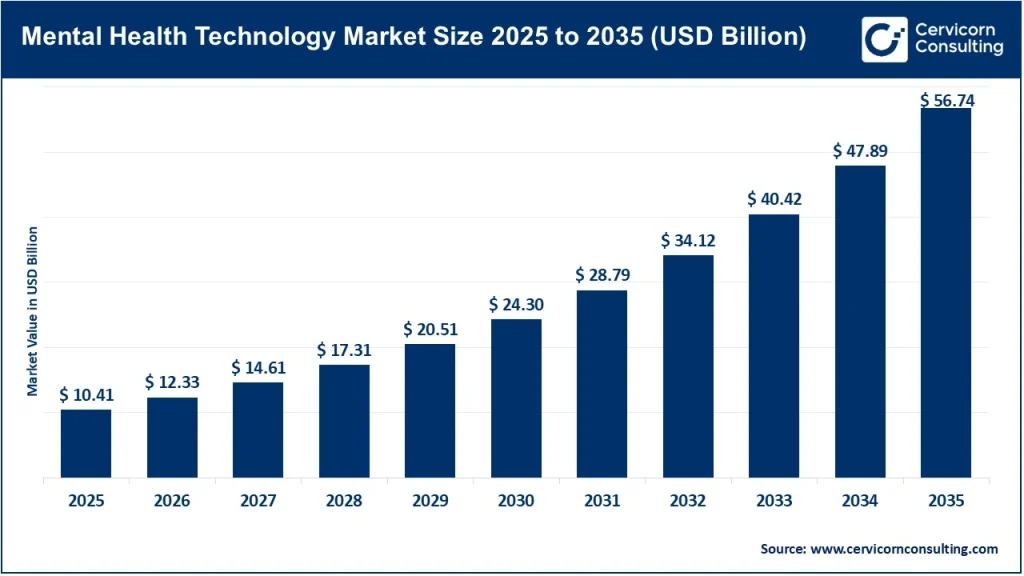
Mental Health Technology Market Size
The global mental health technology market was valued at approximately USD 10.41 billion in 2025 and is projected to reach nearly USD 56.74 billion by 2035, growing at a CAGR of 18.5%.
What is the Mental Health Technology Market?
The mental health technology market refers to the rapidly expanding ecosystem of digital solutions designed to improve mental healthcare delivery, accessibility, diagnosis, treatment, and patient engagement. The market includes telepsychiatry platforms, virtual therapy services, AI-powered mental health assistants, digital therapeutics, mental wellness mobile applications, wearable monitoring devices, remote patient monitoring systems, electronic behavioral health records, predictive analytics platforms, and cloud-based mental healthcare management solutions. These technologies enable individuals to access mental health support from virtually anywhere while helping healthcare providers deliver personalized, data-driven, and scalable behavioral healthcare. Growing internet penetration, smartphone adoption, artificial intelligence, cloud computing, and increasing investments in digital healthcare continue to accelerate innovation across this market.
Mental Health Technology Market Growth Factors
The mental health technology market is experiencing remarkable growth due to the increasing global prevalence of anxiety, depression, stress-related disorders, and other behavioral health conditions, coupled with rising awareness regarding mental wellness and the reduction of social stigma surrounding mental illness. The widespread adoption of telemedicine, rapid advancements in artificial intelligence, machine learning, wearable health devices, cloud computing, and predictive analytics have significantly improved accessibility to mental healthcare services while enabling early diagnosis and personalized treatment.
Government initiatives supporting digital healthcare infrastructure, expanding reimbursement policies for telehealth, increasing employer investments in employee mental wellness programs, growing healthcare expenditure, rising smartphone and internet penetration, expanding insurance coverage for behavioral health services, increased venture capital funding for digital health startups, and growing demand for remote healthcare following the COVID-19 pandemic are collectively driving market expansion.
Furthermore, the shortage of mental health professionals worldwide has accelerated the adoption of technology-enabled solutions capable of improving patient engagement, reducing waiting times, enhancing treatment outcomes, and lowering healthcare costs, making digital mental health one of the fastest-growing segments within the broader healthcare technology industry.
Get a Free Sample: https://www.cervicornconsulting.com/sample/2979
Why is the Mental Health Technology Market Important?
Mental health technology has become an essential component of modern healthcare because millions of individuals worldwide still lack timely access to qualified mental health professionals. Traditional mental healthcare systems often face long waiting lists, geographical limitations, high treatment costs, and workforce shortages. Digital technologies help overcome these barriers by providing convenient, affordable, and personalized care.
Its importance can be understood through several factors:
- Improves accessibility for patients living in rural and underserved regions.
- Enables early intervention through AI-powered symptom screening and digital assessments.
- Supports continuous monitoring using mobile applications and wearable technologies.
- Reduces treatment costs by minimizing unnecessary hospital visits.
- Expands healthcare capacity despite shortages of psychologists and psychiatrists.
- Enhances patient engagement through personalized therapy plans and digital coaching.
- Provides data-driven insights that improve clinical decision-making.
- Supports employers in managing workforce wellbeing and productivity.
- Reduces stigma by allowing private and confidential access to therapy.
- Strengthens preventive healthcare through proactive mental wellness programs.
As governments and healthcare organizations increasingly prioritize mental health, technology is becoming a critical enabler for delivering scalable and sustainable behavioral healthcare services.
Major Companies Operating in the Mental Health Technology Market
| Company | Specialization | Key Focus Areas | Notable Features | 2025 Revenue* | Approx. Market Position | Global Presence |
|---|---|---|---|---|---|---|
| Teladoc Health | Virtual healthcare and behavioral health | Telehealth, BetterHelp, chronic care, integrated virtual care | Large provider network, AI-enabled care navigation, employer and payer partnerships | Approximately US$2.53 Billion | Leading global virtual healthcare provider | North America, Europe, Latin America, Asia-Pacific |
| Headspace Health | Digital mental wellness | Meditation, therapy, coaching, employer wellness | Mindfulness programs, CBT tools, enterprise solutions | Private company (financials not publicly disclosed) | One of the largest digital wellness platforms | More than 190 countries |
| Lyra Health | Enterprise mental healthcare | Employer behavioral healthcare, AI matching, coaching | Evidence-based care, provider matching, workplace mental health | Private company (financials not publicly disclosed) | Leading enterprise mental health platform | North America with expanding international operations |
| Spring Health | Precision mental healthcare | AI-powered behavioral health, employer benefits | Precision care navigation, measurement-based treatment | Private company (financials not publicly disclosed) | Rapidly growing enterprise platform | Global employer network across multiple countries |
| Talkspace | Online therapy and psychiatry | Virtual counseling, psychiatric care, payer partnerships | Licensed therapists, insurance integration, messaging therapy | Approximately US$228.9 Million | Leading public digital therapy platform | Primarily United States with expanding virtual reach |
*Private companies generally do not publicly disclose audited annual revenue. Market share figures are not officially reported because the market remains highly fragmented.
Leading Trends and Their Impact
1. Artificial Intelligence in Mental Healthcare
Artificial intelligence is transforming behavioral healthcare by enabling symptom screening, risk prediction, personalized treatment recommendations, clinical documentation automation, and conversational mental health assistants.
Impact
- Faster patient assessment
- Reduced clinician workload
- Improved diagnostic accuracy
- Personalized therapy recommendations
2. Expansion of Teletherapy Services
Video consultations, chat-based therapy, and remote psychiatric consultations continue to become mainstream healthcare services.
Impact
- Increased accessibility
- Lower healthcare costs
- Better patient convenience
- Higher treatment adherence
3. Growth of Digital Therapeutics
Digital therapeutics (DTx) are clinically validated software solutions used to prevent or treat mental disorders such as depression, anxiety, insomnia, and ADHD.
Impact
- Evidence-based digital treatment
- Better clinical outcomes
- Reduced dependence on medication
- Improved healthcare scalability
4. Wearable Mental Health Monitoring
Wearables increasingly measure stress levels, sleep quality, heart rate variability, and emotional wellbeing.
Impact
- Continuous patient monitoring
- Early identification of mental health deterioration
- Personalized wellness interventions
5. Employer-Sponsored Mental Health Platforms
Organizations are investing heavily in employee mental wellbeing to reduce absenteeism, burnout, and healthcare costs.
Impact
- Higher employee productivity
- Reduced turnover
- Better workplace engagement
- Improved organizational resilience
6. Personalized Behavioral Healthcare
AI algorithms analyze patient history, therapy outcomes, lifestyle data, and biomarkers to customize treatment pathways.
Impact
- Improved treatment success
- Better patient satisfaction
- Faster recovery
- Efficient resource utilization
7. Integration with Electronic Health Records
Mental health platforms increasingly integrate with hospital information systems and electronic health records.
Impact
- Improved care coordination
- Better clinician collaboration
- Comprehensive patient history
- Enhanced healthcare efficiency
Successful Examples of Mental Health Technology Around the World
BetterHelp (United States)
BetterHelp has become one of the world’s largest online therapy platforms by connecting licensed therapists with patients through secure video, messaging, and phone sessions. The platform has significantly expanded access to affordable mental healthcare while reducing geographical barriers.
Headspace (United States)
Headspace transformed meditation into a scalable digital wellness solution by combining mindfulness programs with therapy, coaching, and employer wellness services. Millions of users now rely on its digital platform for stress management and emotional wellbeing.
NHS Talking Therapies Digital Services (United Kingdom)
The United Kingdom has integrated digital cognitive behavioral therapy (CBT) platforms into public healthcare, allowing patients to access evidence-based therapy remotely. These initiatives have reduced waiting times while expanding treatment accessibility.
Woebot Health (United States)
Woebot utilizes conversational artificial intelligence to provide cognitive behavioral therapy-inspired emotional support. The platform offers users immediate guidance while complementing professional mental healthcare.
Wysa (India)
Developed with AI-powered conversational technology, Wysa has gained global recognition for providing confidential emotional support, guided meditation, and self-help exercises. The platform is widely used by healthcare providers, employers, and educational institutions.
SilverCloud Health (Ireland)
SilverCloud delivers clinically validated digital behavioral health programs addressing anxiety, depression, stress, and chronic illness management. Healthcare organizations across multiple countries utilize its evidence-based digital interventions.
Global Regional Analysis
North America
North America represents the largest mental health technology market due to advanced healthcare infrastructure, widespread telemedicine adoption, favorable reimbursement policies, strong venture capital investments, and high awareness regarding behavioral health.
Government Initiatives and Policies
- Expansion of telehealth reimbursement programs.
- Increased federal funding for behavioral health modernization.
- Integration of mental health into primary healthcare.
- Support for digital health innovation through public healthcare agencies.
- Enhanced insurance coverage for virtual mental healthcare.
The United States continues to lead innovation through strong collaboration between technology companies, healthcare providers, insurers, and employers.
Europe
Europe remains one of the fastest-growing markets owing to universal healthcare systems, supportive digital health regulations, aging populations, and increasing investments in preventive healthcare.
Government Initiatives and Policies
- European digital health strategies promoting telemedicine.
- National mental health action plans across major European countries.
- Funding for digital healthcare transformation.
- Expansion of electronic health record interoperability.
- AI governance frameworks supporting responsible healthcare innovation.
Countries including Germany, the United Kingdom, France, and the Netherlands continue expanding reimbursement for digital therapeutics and remote mental healthcare services.
Asia-Pacific
Asia-Pacific is expected to witness the highest growth due to rapid smartphone adoption, expanding healthcare infrastructure, increasing mental health awareness, and significant investments in digital transformation.
Government Initiatives and Policies
- National digital healthcare missions.
- Investments in telemedicine infrastructure.
- Public awareness campaigns addressing mental illness.
- Expansion of AI-enabled healthcare innovation.
- Digital health startup funding programs.
China, India, Japan, Australia, Singapore, and South Korea are investing heavily in digital healthcare ecosystems that include behavioral health technologies.
Latin America
Latin America is gradually adopting mental health technologies due to improving internet connectivity, increasing healthcare digitization, and rising awareness of behavioral health disorders.
Government Initiatives and Policies
- Expansion of telehealth regulations.
- Public healthcare modernization initiatives.
- Digital inclusion programs.
- Increased investments in healthcare infrastructure.
- Mental health awareness campaigns.
Brazil, Mexico, Chile, and Colombia are among the leading regional adopters.
Middle East and Africa
The Middle East and Africa are emerging markets where governments are increasingly investing in healthcare modernization and digital transformation.
Government Initiatives and Policies
- National digital health strategies.
- Smart hospital development programs.
- AI adoption in healthcare.
- Telemedicine regulations.
- Increased mental health awareness initiatives.
Countries including the UAE, Saudi Arabia, South Africa, and Israel are strengthening digital healthcare ecosystems through public-private partnerships and investments in healthcare innovation.
Future Outlook of the Mental Health Technology Market
The future of the mental health technology market is expected to be shaped by artificial intelligence, generative AI, predictive analytics, digital therapeutics, wearable biosensors, precision medicine, and integrated virtual healthcare ecosystems. Future platforms will increasingly combine clinical decision support, conversational AI, remote monitoring, biometric analysis, and personalized therapy recommendations into unified behavioral healthcare solutions. Employer-sponsored mental health benefits, insurance reimbursement for digital therapies, expanding public healthcare investments, and improved interoperability with electronic health records will further accelerate adoption. As healthcare systems continue shifting toward preventive, patient-centric, and value-based care models, mental health technology will play a central role in improving clinical outcomes, expanding access to quality care, reducing healthcare costs, and supporting long-term population mental wellbeing.
To Get Detailed Overview, Contact Us: https://www.cervicornconsulting.com/contact-us
Read Report: Refurbished E-Bike Market Revenue, Trends, and Strategic Insights by 2035