


Table of Contents
ToggleRefurbished E-Bike Market Size
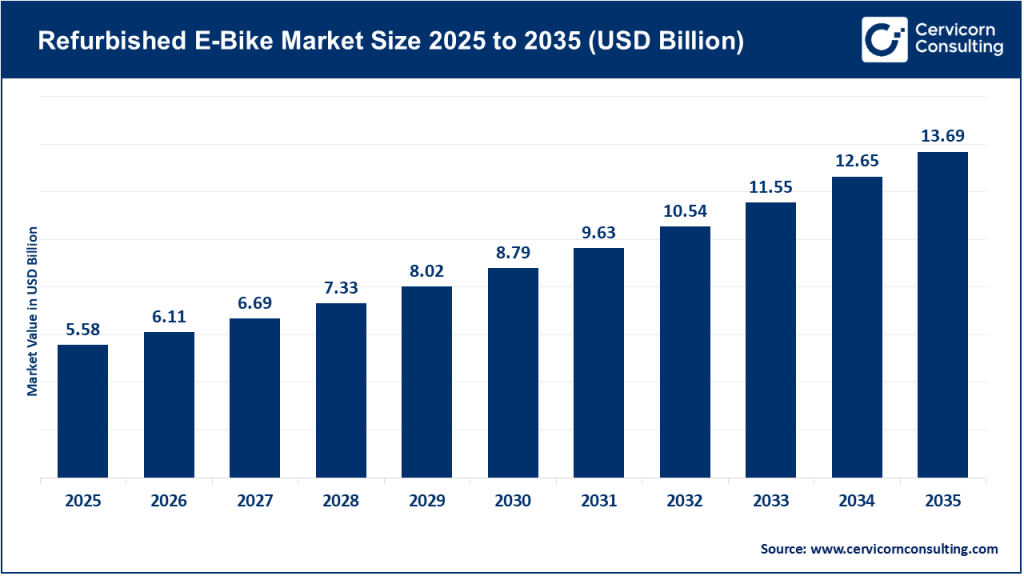
The global refurbished e-bike market was valued at approximately USD 5.58 billion in 2025 and is projected to reach nearly USD 13.69 billion by 2035, growing at a CAGR of 9.39%.
Refurbished E-Bike Market Growth Factors
The refurbished e-bike market is experiencing remarkable growth due to the increasing global demand for affordable and sustainable transportation solutions, rising awareness of circular economy principles, rapid urbanization, expanding cycling infrastructure, and growing consumer acceptance of pre-owned premium products. Escalating prices of new electric bicycles have encouraged cost-conscious consumers to seek certified refurbished alternatives that offer comparable performance at significantly lower prices. Government incentives supporting clean mobility, carbon reduction targets, and investments in cycling infrastructure across Europe, North America, and Asia-Pacific are further stimulating market expansion.
Advances in battery diagnostics, professional refurbishment processes, digital marketplaces, AI-powered bike inspection technologies, and standardized certification programs have significantly improved consumer confidence. Additionally, growing environmental concerns regarding electronic waste and resource conservation, combined with corporate sustainability initiatives and increasing participation from established bicycle manufacturers, are creating a robust ecosystem that supports long-term growth in the refurbished e-bike market.
Get a Free Sample: https://www.cervicornconsulting.com/sample/2637
What is the Refurbished E-Bike Market?
The refurbished e-bike market refers to the commercial ecosystem involved in collecting, inspecting, repairing, upgrading, certifying, and reselling previously owned electric bicycles. Unlike conventional second-hand bicycles sold directly between consumers, refurbished e-bikes undergo comprehensive technical inspections performed by professional mechanics.
The refurbishment process generally includes:
- Battery health testing
- Motor diagnostics
- Electronic system inspection
- Frame integrity verification
- Brake replacement
- Tire replacement
- Software updates
- Component servicing
- Cosmetic restoration
- Performance testing
Certified refurbished e-bikes are typically sold with warranties, return policies, service support, and quality certifications that differentiate them from ordinary used bikes.
The market includes:
- Specialized refurbishment companies
- OEM-certified refurbishment programs
- Online marketplaces
- Bicycle retailers
- Fleet refurbishment providers
- Rental fleet resale programs
- Subscription service providers
As electric bicycles become mainstream transportation options worldwide, refurbishment has become an essential part of extending product life while reducing environmental impact.
Why is the Refurbished E-Bike Market Important?
The refurbished e-bike market delivers value across economic, environmental, and social dimensions.
Promotes Circular Economy
Refurbishment extends the lifecycle of expensive electric bicycles, reducing waste and maximizing resource efficiency.
Improves Affordability
Many premium e-bikes cost several thousand dollars. Refurbished alternatives make electric mobility accessible to a much broader consumer base.
Reduces Carbon Emissions
Manufacturing new bicycles requires raw materials, energy, transportation, and packaging. Extending product life significantly lowers lifecycle emissions.
Minimizes Electronic Waste
E-bike batteries, controllers, motors, and electronic systems contain valuable materials. Refurbishment reduces premature disposal.
Encourages Sustainable Urban Mobility
Affordable refurbished e-bikes encourage commuters to replace short car trips with zero-emission transportation.
Supports Local Employment
Refurbishment centers require:
- Certified mechanics
- Battery specialists
- Software technicians
- Logistics professionals
- Quality inspectors
- Customer support teams
This creates skilled jobs within regional circular economy ecosystems.
Major Companies Operating in the Refurbished E-Bike Market
| Company | Specialization | Key Focus Areas | Notable Features | 2025 Revenue* | Market Share* | Global Presence |
|---|---|---|---|---|---|---|
| Upway | Certified refurbished e-bikes | Industrial refurbishment, online resale | Multi-point inspection, warranty, large inventory | Private (not publicly disclosed) | Leading specialist | Europe & North America |
| The Pro’s Closet | Premium used and refurbished bicycles | Certified pre-owned bikes | Trade-in program, inspections | Private | Strong North American presence | United States |
| Trek (Red Barn Refresh) | OEM-certified refurbished Trek bikes | Circular economy, trade-ins | 151-point inspection, lifetime frame warranty on eligible bikes | Trek privately held | Growing OEM segment | Global Trek dealer network |
| BikeExchange | Online bicycle marketplace | New and used bicycle listings | Global marketplace connecting buyers and sellers | Private | Significant marketplace presence | Multiple international markets |
| Whizz Mobility | E-bike leasing and refurbishment | Fleet lifecycle management | Commercial fleet refurbishment | Private | Emerging player | North America |
Company Profiles
Upway
Upway has become one of the world’s leading dedicated refurbished e-bike platforms. The company acquires pre-owned electric bicycles, subjects them to standardized professional refurbishment, and resells them with warranties. It has expanded industrial refurbishment centers across Europe and North America and offers hundreds of brands through its digital marketplace. By late 2025, Upway reported having refurbished and sold more than 100,000 e-bikes and was expanding its refurbishment network after raising additional growth capital.
The Pro’s Closet
The Pro’s Closet specializes in certified pre-owned premium bicycles, including electric bikes. The company combines detailed inspections, authentication, trade-in programs, and online sales to create confidence among buyers seeking high-quality second-hand bicycles.
Trek (Red Barn Refresh)
Trek launched the Red Barn Refresh program to support circular mobility by collecting, inspecting, and restoring pre-owned Trek bicycles. Each certified bike undergoes a comprehensive 151-point inspection before resale and includes warranty and service benefits designed to provide an ownership experience similar to purchasing a new bicycle.
BikeExchange
BikeExchange operates a global online marketplace connecting bicycle retailers, brands, and consumers. The platform supports sales of both new and refurbished bicycles, improving accessibility and price transparency.
Whizz Mobility
Whizz Mobility focuses on commercial fleet leasing and lifecycle management. Refurbishment enables the company to maximize fleet utilization while reducing operational costs and supporting sustainable urban delivery services.
Leading Trends Shaping the Refurbished E-Bike Market
1. Professional Certification Programs
Consumers increasingly prefer certified refurbishment programs that include:
- Warranty coverage
- Battery diagnostics
- Component replacement
- Quality inspections
- Service records
These programs reduce perceived purchasing risk.
2. Battery Health Diagnostics
Battery performance remains the most critical consideration for refurbished e-bikes.
Advanced battery diagnostics now evaluate:
- Charge cycles
- Capacity retention
- Internal resistance
- Safety performance
- Thermal stability
Improved battery testing enhances buyer confidence.
3. OEM Participation
Manufacturers are increasingly launching official refurbishment initiatives.
Benefits include:
- Brand trust
- Genuine replacement parts
- Factory-trained technicians
- Warranty support
- Customer retention
OEM involvement is helping formalize the market.
4. Circular Economy Business Models
Manufacturers and retailers increasingly integrate:
- Trade-in programs
- Buy-back initiatives
- Leasing
- Subscription services
- Certified resale
These models generate recurring revenue while reducing environmental impact.
5. Digital Marketplaces
Online platforms simplify:
- Product comparison
- Financing
- Warranty management
- Home delivery
- Digital inspections
Technology is expanding market accessibility worldwide.
6. AI and Predictive Diagnostics
Artificial intelligence is beginning to assist refurbishment operations by:
- Predicting battery lifespan
- Detecting component wear
- Optimizing refurbishment costs
- Improving inventory valuation
- Supporting preventive maintenance
7. Sustainable Consumer Preferences
Younger consumers increasingly prioritize:
- Reduced environmental impact
- Circular consumption
- Lower carbon footprints
- Responsible purchasing
This behavioral shift is boosting demand for refurbished products.
Impact of These Trends
These trends are transforming refurbished e-bikes from a niche second-hand option into a professionally managed mobility category. Standardized refurbishment processes improve quality consistency, while digital commerce expands geographic reach. Battery testing and warranties reduce consumer uncertainty, encouraging wider adoption. At the same time, OEM participation enhances credibility and supports circular economy objectives by extending product lifecycles and reducing waste. Collectively, these developments are expected to strengthen customer confidence, improve resale values, and expand the role of refurbished e-bikes in sustainable urban transportation.
Successful Examples of the Refurbished E-Bike Market Around the World
Upway (Europe & North America)
Upway has built one of the largest industrial refurbishment ecosystems dedicated to electric bicycles. The company combines centralized refurbishment facilities, standardized inspections, digital commerce, logistics, and warranty support to make premium e-bikes more affordable while extending product life.
Trek Red Barn Refresh (United States)
Trek’s certified refurbishment initiative demonstrates how established manufacturers can integrate circular economy principles into traditional bicycle retail through trade-ins, factory-standard inspections, and certified resale.
Decathlon Second Life Programs (Europe)
Several European retailers have introduced refurbishment and resale initiatives for bicycles and sporting equipment, supporting reuse while reducing environmental impact.
Swapfiets Fleet Refurbishment (Europe)
Subscription bicycle providers refurbish returned bikes for continued deployment, maximizing asset utilization and reducing lifecycle costs.
Municipal Bike-Sharing Fleet Resale
Several cities periodically refurbish retired public bike-sharing fleets before resale to consumers, schools, and community organizations, extending asset life and supporting affordable mobility.
Global Regional Analysis
North America
North America represents one of the fastest-growing refurbished e-bike markets due to increasing urban cycling, rising fuel prices, expanding e-bike adoption, and consumer demand for affordable mobility solutions.
Key Drivers
- Growth of online marketplaces
- Expanding cycling infrastructure
- Sustainability awareness
- Premium e-bike adoption
- Corporate commuting programs
Government Initiatives and Policies
- Federal investments supporting bicycle infrastructure through transportation funding.
- State and municipal e-bike rebate programs in jurisdictions such as California, Colorado, Minnesota, and others that encourage electric bicycle adoption, with some programs recognizing certified refurbished purchases where eligible.
- Urban mobility plans promoting active transportation and emissions reduction.
Europe
Europe remains the largest and most mature refurbished e-bike market.
Countries including Germany, the Netherlands, France, Belgium, and Denmark have well-developed cycling cultures.
Growth Factors
- Strong environmental policies
- Circular economy regulations
- High e-bike ownership
- Mature bicycle infrastructure
- Consumer acceptance of refurbished goods
Government Policies
- European Union Circular Economy Action Plan encouraging reuse, repair, and recycling.
- National incentives supporting e-bike purchases and sustainable mobility.
- Extended producer responsibility regulations promoting product lifecycle management.
- Investments in cycling infrastructure through national and local mobility programs.
Asia-Pacific
Asia-Pacific is expected to witness substantial growth.
China remains the world’s largest e-bike manufacturing hub, while Japan, South Korea, Australia, and India are expanding electric mobility initiatives.
Key Drivers
- Rapid urbanization
- Growing middle class
- Affordable mobility demand
- Expanding online commerce
- Government electrification policies
Government Initiatives
- China continues to support electric mobility through industrial policies, urban transportation planning, and manufacturing incentives.
- India promotes electric mobility under schemes such as FAME and complements these efforts with state-level EV policies, while investments in cycling and shared mobility are gradually increasing.
- Japan supports low-carbon transportation and innovation in advanced mobility technologies.
Latin America
Countries including Brazil, Mexico, Chile, and Colombia are gradually adopting e-bikes as urban mobility alternatives.
Government investments in cycling infrastructure, congestion reduction strategies, and environmental sustainability are creating opportunities for refurbished bicycle providers.
Middle East & Africa
Although still an emerging market, interest in sustainable transportation is increasing.
Smart city developments in the Gulf region and investments in urban mobility are encouraging gradual adoption of electric bicycles. In parts of Africa, refurbished e-bikes offer an affordable transportation solution for commuters and small businesses, where lower acquisition costs can improve accessibility.
Government Initiatives and Policies Shaping the Market
Governments worldwide are increasingly recognizing electric bicycles as an important component of sustainable transportation strategies. Public policies supporting cycling infrastructure, emissions reduction, and circular economy practices are indirectly strengthening the refurbished e-bike market.
Key policy measures include:
- Expansion of protected bicycle lanes and cycling networks.
- Financial incentives, rebates, and tax benefits for e-bike purchases in selected jurisdictions.
- Circular economy legislation encouraging product reuse, repair, refurbishment, and recycling.
- Right-to-repair initiatives that improve access to spare parts and repair information.
- Extended producer responsibility frameworks that encourage manufacturers to manage products throughout their lifecycle.
- Urban clean mobility strategies aimed at reducing congestion, air pollution, and greenhouse gas emissions.
- Public procurement programs incorporating sustainable mobility and fleet refurbishment.
- Battery safety standards and certification requirements that enhance confidence in refurbished electric bicycles.
These initiatives are expected to improve consumer trust, encourage investment in professional refurbishment facilities, and support the long-term growth of the global refurbished e-bike market.
To Get Detailed Overview, Contact Us: https://www.cervicornconsulting.com/contact-us
Read Report: House Call Market Revenue, Trends, and Strategic Insights by 2035