


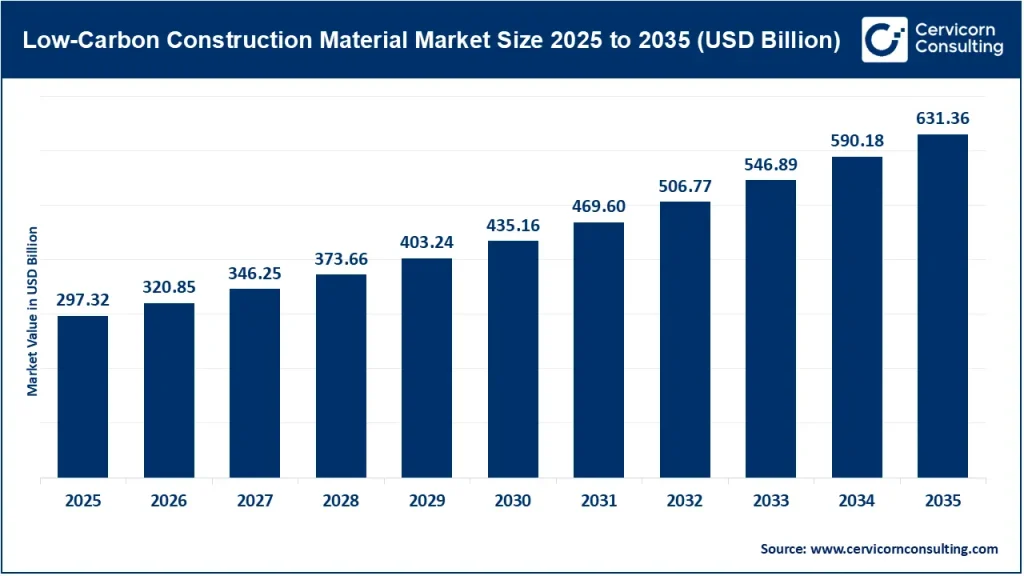
Low-Carbon Construction Material Market Size
The global low-carbon construction material market was valued at approximately USD 297.32 billion in 2025 and is projected to reach USD 631.36 billion by 2035, expanding at a CAGR of 7.82% during the forecast period.
Low-Carbon Construction Material Market Growth Factors
The low-carbon construction material market is expanding as governments, infrastructure developers, architects, contractors, and building owners increasingly focus on reducing embodied carbon across the construction lifecycle. A major growth factor is the rising contribution of buildings and construction to global emissions, with the sector responsible for approximately 37% of global CO₂ emissions and nearly half of global material extraction, according to the latest Global Status Report for Buildings and Construction.
Demand is also being strengthened by stricter building codes, lifecycle carbon assessment, green public procurement, corporate net-zero commitments, carbon pricing mechanisms, and the growing availability of lower-emission steel, cement, concrete, timber, recycled aggregates, and other alternative materials. The EU’s Carbon Border Adjustment Mechanism (CBAM), which entered its definitive regime in January 2026 and covers iron, steel and cement among other products, is increasing the importance of embedded-carbon performance in international trade.
At the same time, advances in electric-arc-furnace steelmaking, renewable electricity, hydrogen-based direct reduced iron, carbon capture, supplementary cementitious materials, recycled construction inputs, mass timber, and carbon-sequestering materials are creating new pathways for lowering emissions. Public procurement is another important catalyst because governments can create early demand for lower-carbon products while helping manufacturers achieve economies of scale. Together, these factors are shifting construction-material purchasing from a traditional emphasis on cost, strength, and availability toward a broader model that considers carbon intensity, recyclability, lifecycle performance, traceability, and environmental product declarations.
What Is the Low-Carbon Construction Material Market?
The low-carbon construction material market refers to the production, distribution, and adoption of building materials that generate substantially lower greenhouse-gas emissions than conventional alternatives over their lifecycle.
The market covers materials used in residential buildings, commercial properties, industrial facilities, transportation infrastructure, energy projects, and civil engineering applications. Major categories include:
- Low-carbon and green steel
- Low-carbon cement and concrete
- Recycled and low-carbon aggregates
- Supplementary cementitious materials
- Recycled metals
- Mass timber and engineered wood
- Low-carbon bricks and masonry
- Recycled construction materials
- Low-carbon insulation
- Bio-based construction materials
- Carbon-sequestering building products
- Low-emission glass and other building-envelope materials
Steel and cement are particularly important because they are fundamental to modern construction while requiring energy-intensive production processes. Consequently, decarbonizing these materials can have an outsized effect on the overall carbon footprint of buildings and infrastructure.
Low-carbon materials can reduce emissions through multiple approaches, including renewable electricity, increased recycled content, energy efficiency, alternative fuels, material substitution, electrification, hydrogen, carbon capture, optimized production, and circular-economy practices.
Get a Free Sample: https://www.cervicornconsulting.com/sample/2732
Why Is the Low-Carbon Construction Material Market Important?
Construction has historically been dominated by materials selected primarily according to price, structural performance, durability, and availability. However, the growing emphasis on whole-life carbon is changing procurement decisions.
Low-carbon construction materials are important for several reasons.
Reducing Embodied Carbon
Operational energy efficiency alone cannot deliver deep building-sector decarbonization. Materials themselves generate emissions during extraction, processing, manufacturing, transportation, installation, replacement, and disposal.
Lifecycle carbon assessments therefore increasingly consider both operational and embodied emissions. The European Commission’s revised building framework specifically promotes lifecycle global warming potential calculations to encourage the use of cleaner steel, cement, wood, and other lower-carbon materials.
Supporting Net-Zero Construction
Developers and corporations are increasingly setting emissions targets for their buildings and supply chains. Low-carbon materials allow companies to address Scope 3 emissions associated with purchased construction products.
Meeting Government Regulations
Governments are introducing building standards, carbon disclosure requirements, green procurement programs, and industrial decarbonization policies. These measures are creating a stronger commercial incentive for manufacturers to develop verified low-carbon products.
Improving Circularity
Many low-carbon materials incorporate recycled content. Electric-arc-furnace steelmaking, for example, can use significant quantities of scrap steel, reducing dependence on primary raw materials and supporting circular material flows.
Creating New Industrial Opportunities
The transition is encouraging investment in hydrogen-based steelmaking, renewable-energy-powered electric furnaces, low-clinker cement, carbon capture, recycled aggregates, engineered timber, and innovative material technologies.
Major Companies in the Low-Carbon Construction Material Market
The market is highly fragmented across steel, cement, concrete, timber, insulation, glass, aggregates, and other material categories. The companies below are particularly relevant because of their scale in steel and construction-related products and their investments in lower-carbon production.
| Company | Specialization | Key Focus Areas | Notable Features | 2025 Revenue | Market Share* | Global Presence |
|---|---|---|---|---|---|---|
| ArcelorMittal | Steel and mining | Green steel, EAF, renewable energy, hydrogen-based steel | XCarb® low-carbon steel portfolio | $61.35B | Not separately disclosed | Europe, Americas, Asia and Africa |
| Nucor Corporation | Steel and steel products | EAF steel, recycling, lower-emission production | Large-scale scrap-based steelmaking | $32.49B | Not separately disclosed | Primarily North America |
| Steel Dynamics | Steel, fabrication and metals | EAF steel, recycled inputs, renewable energy | Highly EAF-oriented production model | $18.18B | Not separately disclosed | United States and Mexico |
| Commercial Metals Company (CMC) | Rebar, steel products and construction solutions | Recycling, EAF steel, circular construction | Strong construction-products portfolio | $7.8B | Not separately disclosed | North America and Europe |
| Nippon Steel Corporation | Integrated steel and engineering | Hydrogen, advanced steel, emissions reduction | Large Asian steel producer with global operations | ¥10.06T | Not separately disclosed | Japan and international markets |
*A separate 2025 global market-share figure for the low-carbon construction material market is not consistently disclosed by these diversified companies; therefore, company-wide revenue should not be interpreted as low-carbon-material revenue.
ArcelorMittal
ArcelorMittal is one of the world’s largest steel producers and has positioned decarbonization as a major part of its long-term strategy.
Its XCarb® platform brings together reduced-, low-, and zero-carbon steel products and related innovation activities. The company offers recycled and renewably produced steel manufactured using electric-arc-furnace technology and renewable electricity.
ArcelorMittal reported approximately $61.35 billion in 2025 revenue, according to its 2025 reporting.
Its global presence gives it an important role in supplying lower-carbon steel for construction, automotive, infrastructure, and industrial applications.
Nucor Corporation
Nucor Corporation is a major U.S. steel producer with a production model heavily based on electric-arc furnaces and recycled steel.
Nucor generated approximately $32.49 billion in net sales in 2025, up 6% from 2024.
Its EAF-oriented model provides a structural advantage in producing steel with lower emissions than traditional coal-intensive blast-furnace routes, although actual emissions vary according to electricity sources, raw materials, plant configuration, and product.
Nucor’s activities are particularly relevant to construction because its portfolio includes structural steel, sheet, bar, plate, joists, deck, rebar, and other products.
Steel Dynamics
Steel Dynamics is another major EAF-based steel producer. Its operations span steel production, steel fabrication, metals recycling, and aluminum.
The company reported $18.2 billion in 2025 net sales, with record steel shipments of 13.7 million tons.
Its focus on recycled steel inputs and electric-arc-furnace production makes it an important participant in the lower-carbon construction-material supply chain.
Commercial Metals Company
Commercial Metals Company, commonly known as CMC, supplies rebar, merchant bar, wire rod, structural products, construction solutions, and related materials.
CMC generated approximately $7.8 billion in fiscal 2025 net sales.
The company has a strong connection to sustainable construction because recycled steel and rebar products are extensively used in buildings, bridges, highways, foundations, and other infrastructure.
Nippon Steel Corporation
Nippon Steel Corporation is one of the world’s major steel producers and has a broad international footprint.
For fiscal 2025, Nippon Steel reported consolidated revenue of ¥10.0632 trillion, with steelmaking and steel fabrication representing ¥9.2217 trillion of revenue.
The company’s decarbonization strategy includes technologies designed to reduce emissions from primary steelmaking, including hydrogen-related technologies, advanced processes, and greater use of low-carbon energy.
Leading Trends and Their Impact
1. Growth of Green Steel
Green and near-zero-emission steel is becoming one of the most important segments of the low-carbon construction-material market.
Steel producers are pursuing several pathways, including EAF technology, increased scrap utilization, renewable electricity, direct reduced iron, hydrogen, and carbon capture.
ArcelorMittal’s XCarb® portfolio illustrates how steelmakers are moving from broad sustainability commitments toward identifiable lower-carbon products that can be purchased for construction projects.
Impact: Construction companies can increasingly specify steel according to emissions performance rather than simply purchasing conventional grades.
2. Lifecycle Carbon Assessment
The industry is moving beyond operational energy efficiency toward measuring emissions across the entire building lifecycle.
The EU’s revised Energy Performance of Buildings Directive is a major example. From 2028, lifecycle global warming potential must be calculated and disclosed for new buildings above 1,000 square meters, with the requirement expanding to all new buildings from 2030.
Impact: Developers will have stronger incentives to select materials with lower embodied carbon.
3. Low-Carbon Concrete
Concrete manufacturers are reducing emissions through lower-clinker formulations, supplementary cementitious materials, alternative fuels, recycled aggregates, optimized mix designs, and carbon capture.
Impact: Concrete specifications are increasingly incorporating embodied-carbon limits and environmental product declarations.
4. Circular Construction
Recycling is becoming a central component of low-carbon construction. Steel can be repeatedly recycled, while demolition materials can be recovered and processed into new aggregates and products.
Impact: Construction and demolition waste is increasingly viewed as a material resource rather than simply a disposal problem.
5. Mass Timber and Engineered Wood
Mass timber products such as cross-laminated timber and glue-laminated timber are gaining attention as alternatives for certain structural applications.
Wood can store biogenic carbon during the service life of a building, although lifecycle performance depends on responsible forestry, product manufacturing, transportation, building longevity, and end-of-life treatment.
Impact: Hybrid steel-timber and concrete-timber structures are creating new opportunities for reducing embodied emissions.
6. Environmental Product Declarations
Environmental Product Declarations, or EPDs, are becoming increasingly important for comparing material carbon footprints.
Impact: Manufacturers are under greater pressure to measure, verify, and transparently report product-level environmental performance.
7. Green Public Procurement
Government procurement can create significant demand for low-carbon steel, cement, concrete, and other products. The UK’s policy work, for example, has focused on embodied-emissions reporting, product classifications, and green procurement for steel, cement, and concrete.
Impact: Public infrastructure projects can become early markets for low-carbon products and help manufacturers scale production.
Successful Examples of Low-Carbon Construction Materials Around the World
European Low-Carbon Steel Projects
Europe has become a major testing ground for lower-carbon steel. ArcelorMittal’s XCarb® products demonstrate the commercial movement toward reduced-emission steel for construction applications. The company’s XCarb® recycled and renewably produced steel uses EAF production powered by renewable electricity, with the company reporting carbon footprints that can reach approximately 300 kg of CO₂ per tonne of finished steel under specific conditions involving 100% scrap.
The development of the Low Emission Steel Standard (LESS) is another important example. ArcelorMittal reported in 2025 that its entities in Belgium, France, Luxembourg and Spain joined LESS, with participating steel producers representing almost 45% of European steel production.
This illustrates the market’s movement toward standardized definitions and credible labeling of low-emission steel.
Mass Timber in the United States
Mass-timber construction is another successful pathway. One Bridgeland Green in Houston, Texas, is an example of a large office building using predominantly prefabricated mass-timber structural components. The project was reported to avoid roughly 2,750 metric tons of CO₂ emissions and store approximately 1,300 metric tons of CO₂.
The project demonstrates how engineered timber can move beyond small residential structures into commercial construction.
Electric-Arc-Furnace Steel in North America
The United States provides an important example of large-scale EAF steel production. Nucor and Steel Dynamics operate extensive EAF-based production networks, using significant amounts of recycled steel.
Steel Dynamics shipped a record 13.7 million tons of steel in 2025 while generating $18.2 billion in annual sales.
These operations demonstrate that recycled-material steelmaking can operate at very large commercial scales while serving construction and infrastructure markets.
Low-Carbon Procurement in the United Kingdom
The UK is developing policies that place greater emphasis on embodied emissions and product-level carbon information. Its low-carbon industrial products framework initially focuses on steel, cement, and concrete and aims to help buyers compare products according to embodied emissions.
This approach is significant because it connects government policy with actual purchasing decisions.
Global Regional Analysis Including Government Initiatives and Policies
North America
North America is a major market for low-carbon construction materials because of large infrastructure investments, manufacturing expansion, building activity, and the extensive presence of EAF steelmakers.
The United States has a substantial advantage in recycled steel production because EAF technology is widely established. Nucor and Steel Dynamics are prominent examples of companies operating large EAF-based production systems.
Government procurement policies are also important. Federal infrastructure spending has increased attention on embodied carbon and lower-carbon construction products.
The region is also seeing increasing investment in low-carbon concrete, recycled aggregates, mass timber, and advanced building products.
Canada is similarly promoting clean industrial development and lower-carbon construction through carbon pricing, clean technology investment, building standards, and procurement mechanisms.
Market impact: North America is likely to remain a major center for recycled steel, low-carbon infrastructure materials, and technology-driven construction products.
Europe
Europe is among the most policy-driven markets for low-carbon construction materials.
The EU’s CBAM definitive regime began on January 1, 2026, covering cement, iron and steel, aluminum, fertilizers, electricity, and hydrogen. Importers are required to account for embedded emissions and comply with the relevant carbon-pricing mechanism.
The revised Energy Performance of Buildings Directive is also transforming demand. Lifecycle global warming potential will be disclosed for large new buildings from 2028 and all new buildings from 2030.
These policies are significant because they move embodied carbon from a voluntary sustainability consideration toward a measurable component of building regulation.
European steelmakers are also developing green steel technologies, hydrogen-based production, EAF capacity, recycled products, and low-emission labeling systems.
Market impact: Europe is expected to remain a leading innovation and regulatory market for low-carbon construction materials.
Asia-Pacific
Asia-Pacific represents a critical long-term market because of rapid urbanization, infrastructure development, industrialization, and the enormous scale of steel and cement production.
Japan is pursuing steel-sector decarbonization through advanced steelmaking technologies and hydrogen-related initiatives. Nippon Steel’s global scale gives the company an important role in commercializing lower-carbon steel solutions. Its fiscal 2025 consolidated revenue reached ¥10.0632 trillion.
China remains the world’s largest construction and steel market, making improvements in energy efficiency, renewable power, recycling, and industrial decarbonization particularly significant for global emissions.
India is another major growth market. Rapid urbanization and infrastructure development are increasing demand for cement, steel, concrete, and other construction materials, while the country’s green steel and industrial decarbonization initiatives are encouraging cleaner production.
The region’s challenge is balancing massive construction demand with the need to reduce emissions from energy-intensive materials.
Market impact: Asia-Pacific offers enormous volume potential, but the pace of market transformation will depend heavily on renewable electricity availability, industrial policy, technology costs, carbon accounting, and infrastructure investment.
Latin America
Latin America has growing opportunities in low-carbon construction because of renewable electricity resources, expanding cities, infrastructure requirements, and access to biomass and other lower-carbon energy sources.
Brazil is particularly important because of its large steel and construction industries and relatively strong renewable-energy base.
Green steel projects can benefit from renewable electricity and hydrogen production potential, while sustainable timber and bio-based materials provide additional opportunities.
Market impact: The region could become a competitive supplier of lower-carbon industrial materials if renewable energy, hydrogen infrastructure, financing, and international certification systems develop at scale.
Middle East & Africa
The Middle East is emerging as an important location for green hydrogen, renewable energy, and low-carbon industrial projects.
Countries with abundant solar resources can potentially use renewable electricity to produce hydrogen and support lower-carbon steel and other industrial materials.
Africa also has significant long-term potential due to urbanization, infrastructure requirements, renewable-energy resources, and mineral availability. However, financing, technology access, electricity reliability, and industrial infrastructure remain important barriers.
Market impact: Green hydrogen and renewable-energy availability could enable selected Middle Eastern and African markets to become competitive producers of low-carbon industrial materials.
Government Initiatives and Policies Shaping the Market
Government policies are increasingly determining how quickly low-carbon construction materials move from premium niche products to mainstream construction inputs.
European Union
The EU is combining several policy mechanisms, including CBAM, the EU ETS, the revised EPBD, lifecycle carbon assessment, and industrial decarbonization programs.
CBAM is especially influential because it puts an explicit carbon-related financial obligation on covered imports.
United Kingdom
The UK is developing an embodied-emissions reporting framework and product classifications for low-carbon industrial products, initially focusing on steel, cement, and concrete.
The UK has also updated guidance for procuring steel in government contracts, reinforcing the role of public procurement in shaping the steel market.
United States
U.S. federal infrastructure and clean-industry programs have increased attention on low-embodied-carbon materials, particularly for publicly funded construction. This is encouraging manufacturers to provide better carbon information and develop cleaner production pathways.
Japan
Japan’s industrial decarbonization strategy places significant emphasis on technologies that can reduce emissions from difficult-to-abate sectors such as steelmaking. Large producers such as Nippon Steel are investing in technologies designed to reduce the carbon intensity of steel production.
India
India’s rapid infrastructure expansion is creating a large addressable market for low-carbon cement, steel, concrete, recycled materials, and energy-efficient construction products. Government-led green steel and industrial decarbonization efforts are expected to increasingly influence material specifications and procurement.
Market Outlook
The low-carbon construction material market is moving from an emerging sustainability segment toward a broader transformation of the global construction supply chain. The biggest change is the shift from simply asking whether a material is durable and cost-effective to asking how much carbon was emitted to produce it, how much recycled content it contains, how long it can remain in use, and what happens to it at the end of its lifecycle.
Steel and cement are likely to remain central to this transformation. Steelmakers are expanding EAF production, recycled inputs, renewable electricity, hydrogen-based technologies, and product-level carbon certification, while cement and concrete manufacturers are pursuing lower-clinker formulations, alternative fuels, supplementary cementitious materials, carbon capture, and recycled aggregates.
The next phase of market development will depend on five interconnected factors: cost competitiveness, standardized carbon measurement, government procurement, availability of clean energy, and customer willingness to pay for verified lower-carbon products.
As regulations such as the EU’s CBAM and lifecycle building-carbon requirements become more influential, carbon intensity is increasingly becoming a commercial attribute of construction materials rather than only an environmental metric. This shift is expected to encourage manufacturers, contractors, developers, and infrastructure owners to integrate embodied-carbon performance directly into material selection and project planning.
To Get Detailed Overview, Contact Us: https://www.cervicornconsulting.com/contact-us
Read Report: Carbon Capture, Utilization, and Storage Market Revenue, Trends, and Strategic Insights by 2035