


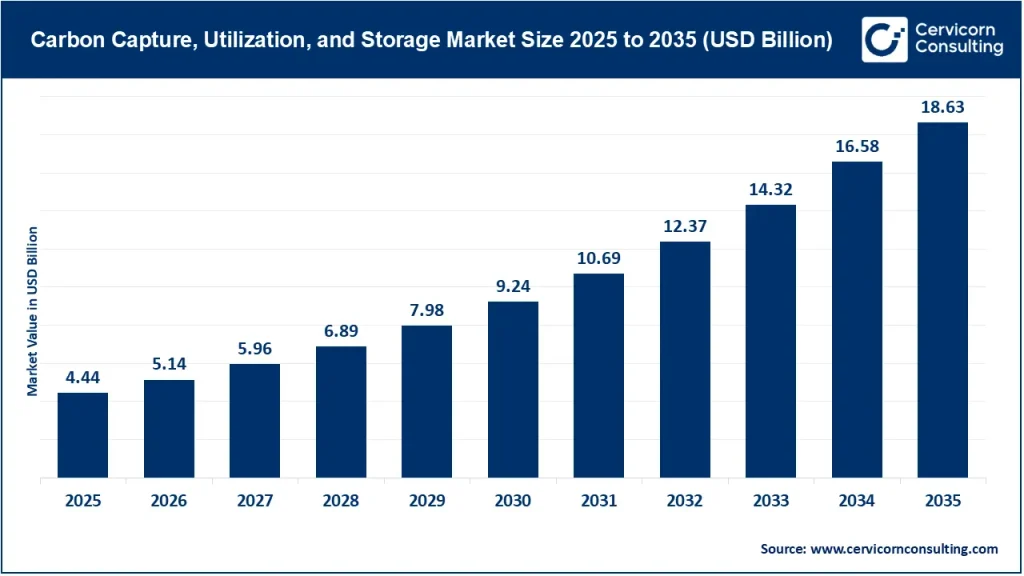
Carbon Capture, Utilization, and Storage Market Size
The global carbon capture, utilization, and storage market was valued at approximately USD 4.44 billion in 2025 and is projected to reach USD 18.63 billion by 2035, expanding at a CAGR of 15.42% during the forecast period.
Carbon Capture, Utilization, and Storage Market Growth Factors
The carbon capture, utilization, and storage market is growing rapidly due to increasingly ambitious global climate commitments, expanding carbon taxation policies, government incentives for carbon reduction projects, rising investments in clean hydrogen production, growing adoption of enhanced oil recovery using captured CO₂, technological improvements in direct air capture and post-combustion capture systems, increasing demand from cement and steel industries for decarbonization, expansion of carbon transportation pipelines, development of underground geological storage facilities, supportive funding from international organizations, stronger ESG commitments among multinational corporations, and growing collaboration between energy companies and technology providers to commercialize large-scale carbon management projects.
What is the Carbon Capture, Utilization, and Storage Market?
Carbon Capture, Utilization, and Storage (CCUS) refers to technologies that capture carbon dioxide (CO₂) emissions from industrial facilities, power plants, and other emission-intensive operations before they enter the atmosphere. Once captured, the CO₂ is either utilized in industrial processes or permanently stored deep underground in geological formations.
The market encompasses a complete value chain including:
- Carbon capture technologies
- CO₂ compression systems
- Transportation pipelines
- Shipping infrastructure
- Carbon utilization technologies
- Geological storage solutions
- Monitoring and verification systems
- Engineering and construction services
- Digital monitoring platforms
- Carbon management software
CCUS has become one of the most important decarbonization technologies because many heavy industries cannot eliminate emissions solely through renewable energy adoption.
Get a Free Sample: https://www.cervicornconsulting.com/sample/2713
Why is Carbon Capture, Utilization, and Storage Important?
Carbon capture plays a critical role in limiting global temperature rise while supporting economic growth.
Its importance includes:
- Reducing industrial greenhouse gas emissions
- Supporting global net-zero targets
- Decarbonizing difficult industrial sectors
- Producing low-carbon hydrogen
- Enabling sustainable fuel production
- Creating carbon-based chemicals and materials
- Supporting enhanced oil recovery with lower emissions
- Protecting existing industrial investments
- Maintaining energy security during energy transition
- Supporting circular carbon economies
According to various international climate studies, achieving net-zero emissions by 2050 is significantly more difficult without large-scale deployment of CCUS technologies.
Major Companies Driving the Carbon Capture, Utilization, and Storage Market
| Company | Specialization | Key Focus Areas | Notable Features | 2025 Revenue (Approx.) | Estimated CCUS Market Share | Global Presence |
|---|---|---|---|---|---|---|
| Equinor | Integrated energy and CCS development | Offshore carbon storage, CO₂ transport, industrial decarbonization | Pioneer of Northern Lights CCS project | USD 115+ Billion | 10–12% | Europe, North America, Asia-Pacific |
| ExxonMobil | Large-scale CCS infrastructure | Carbon hubs, industrial CCS, hydrogen | Operating one of the world’s largest CO₂ pipeline networks | USD 340+ Billion | 15–18% | Global |
| BP | Energy transition and CCS | Hydrogen, carbon storage, industrial clusters | Developing UK carbon capture hubs | USD 190+ Billion | 8–10% | Europe, Americas, Middle East, Asia |
| Global CCS Institute | Industry association | Research, policy, project development | Leading global CCUS knowledge organization | Membership organization | N/A | 100+ countries |
| Aker Solutions | Engineering and EPC solutions | Carbon capture plants, offshore engineering | Strong expertise in industrial carbon capture systems | USD 5+ Billion | 5–7% | Europe, North America, Middle East, Asia |
Company Overview
Equinor
Equinor is one of the world’s leading carbon storage developers and has decades of experience in offshore geological storage. The company operates several flagship CCS initiatives including the Northern Lights project in Norway, which is expected to become one of Europe’s largest carbon storage facilities.
Core strengths include:
- Offshore CO₂ storage
- Industrial partnerships
- Cross-border carbon transportation
- Carbon storage infrastructure
ExxonMobil
ExxonMobil has invested billions of dollars into carbon capture technology and operates one of the world’s largest carbon transportation networks. The company is developing multiple industrial carbon hubs serving refineries, chemical plants, and manufacturing facilities.
Key capabilities include:
- Carbon pipeline infrastructure
- Industrial capture systems
- Low-carbon hydrogen
- Large-scale sequestration
BP
BP has integrated carbon capture into its broader energy transition strategy by investing heavily in industrial clusters across Europe and North America. The company combines hydrogen production with carbon capture to reduce emissions from energy-intensive industries.
Focus areas include:
- Blue hydrogen
- Industrial CCS hubs
- Carbon transportation
- Offshore storage
Global CCS Institute
The Global CCS Institute is the leading international organization promoting carbon capture deployment worldwide. It provides research, policy recommendations, project databases, technical expertise, and industry collaboration.
Its major contributions include:
- Global project tracking
- Policy development
- Technical research
- Industry collaboration
Aker Solutions
Aker Solutions develops engineering, procurement, and construction services for large carbon capture facilities. The company supplies modular capture technologies and supports offshore storage developments worldwide.
Major strengths include:
- Capture engineering
- Modular carbon capture plants
- Offshore platform integration
- Carbon transportation systems
Leading Trends Transforming the Carbon Capture, Utilization, and Storage Market
Expansion of Carbon Capture Hubs
Instead of individual facilities operating independently, governments are encouraging industrial clusters where multiple companies share common capture, transportation, and storage infrastructure. This significantly lowers project costs while improving operational efficiency.
Market Impact
- Lower infrastructure costs
- Faster commercialization
- Increased industrial participation
Direct Air Capture (DAC)
Direct Air Capture removes CO₂ directly from ambient air rather than industrial exhaust streams. Although still expensive, rapid innovation is improving commercial viability.
Market Impact
- Negative emissions
- Carbon removal credits
- Support for net-zero strategies
Integration with Hydrogen Production
Blue hydrogen production relies heavily on carbon capture technology to remove emissions generated during natural gas reforming.
Market Impact
- Expanding hydrogen economy
- Industrial fuel transition
- Cleaner chemical manufacturing
Artificial Intelligence in Carbon Management
AI is increasingly used to optimize capture efficiency, monitor storage sites, predict equipment failures, and reduce operating costs.
Market Impact
- Higher capture rates
- Improved safety
- Reduced maintenance costs
Carbon Utilization Technologies
Captured CO₂ is increasingly converted into valuable commercial products.
Applications include:
- Sustainable aviation fuel
- Building materials
- Synthetic fuels
- Plastics
- Chemicals
- Carbon-based fertilizers
Market Impact
- Additional revenue streams
- Circular carbon economy
- Reduced storage dependency
Successful Examples of Carbon Capture, Utilization, and Storage Around the World
Northern Lights (Norway)
The Northern Lights project is among the world’s largest commercial carbon storage initiatives. Developed by Equinor and partners, it transports captured CO₂ from industrial facilities across Europe to offshore storage reservoirs beneath the North Sea.
Key achievements:
- Cross-border carbon transport
- Offshore geological storage
- European industrial collaboration
Quest CCS Project (Canada)
The Quest facility captures CO₂ emissions generated during hydrogen production and stores them underground.
Achievements include:
- Millions of tonnes of CO₂ stored
- High capture efficiency
- Proven commercial operation
Petra Nova (United States)
Petra Nova became one of the largest post-combustion carbon capture projects attached to a coal-fired power station.
Highlights include:
- Commercial-scale capture
- Enhanced oil recovery utilization
- Technology validation
Sleipner CCS Project (Norway)
Operating since the 1990s, Sleipner remains one of the longest-running offshore carbon storage projects.
Key benefits:
- Long-term monitoring
- Proven storage safety
- Extensive geological research
Gorgon Carbon Storage Project (Australia)
The Gorgon project is among the world’s largest underground carbon storage operations linked to natural gas production.
Major features:
- Massive storage capacity
- LNG emission reduction
- Advanced monitoring systems
Global Regional Analysis
North America
North America currently dominates the carbon capture market due to substantial investments by oil & gas companies, favorable tax incentives, established pipeline infrastructure, and increasing industrial decarbonization initiatives.
Government Initiatives
- U.S. Inflation Reduction Act expanding carbon capture incentives
- Enhanced 45Q tax credits
- DOE funding for carbon capture demonstration projects
- Canadian carbon pricing framework
- Federal investment tax credits for CCUS
Market Characteristics
- Largest operating CCS capacity
- Extensive pipeline networks
- High private investment
- Strong research ecosystem
Europe
Europe is rapidly expanding carbon capture deployment through aggressive climate legislation and coordinated regional infrastructure development.
Government Initiatives
- European Green Deal
- Net Zero Industry Act
- Innovation Fund
- Carbon Border Adjustment Mechanism (CBAM)
- EU Emissions Trading System (EU ETS)
Market Characteristics
- Offshore storage leadership
- Cross-border carbon transport
- Strong regulatory framework
- Large industrial clusters
Countries leading include:
- Norway
- United Kingdom
- Netherlands
- Denmark
- Germany
Asia-Pacific
Asia-Pacific is expected to register the fastest growth as industrial economies invest heavily in emission reduction technologies.
Government Initiatives
China
- National carbon market
- Large CCS demonstration projects
- Green manufacturing policies
Japan
- Green Transformation (GX) strategy
- Government support for CCS commercialization
- International CCS partnerships
South Korea
- Carbon neutrality roadmap
- Hydrogen economy investments
- Industrial carbon reduction initiatives
Australia
- Carbon Capture and Storage Development Fund
- Offshore storage projects
- LNG decarbonization strategy
Market Characteristics
- Rapid industrialization
- Growing hydrogen projects
- Expanding government funding
- Increasing private partnerships
Middle East & Africa
Oil-producing nations are increasingly integrating CCUS into their long-term energy transition strategies.
Government Initiatives
Saudi Arabia
- Vision 2030 sustainability initiatives
- Industrial carbon capture programs
United Arab Emirates
- Net Zero 2050 strategy
- ADNOC carbon capture expansion
- Hydrogen development
Market Characteristics
- Low-cost storage potential
- Oil & gas integration
- Growing hydrogen economy
Latin America
Latin America is gradually adopting carbon capture technologies, particularly in bioenergy, cement manufacturing, and oil production.
Government Initiatives
Brazil
- National climate commitments
- Bioenergy integration
- Low-carbon fuel programs
Chile
- National hydrogen strategy
- Renewable energy investments
Market Characteristics
- Emerging market
- Bioenergy opportunities
- Increasing international investment
Government Initiatives and Policies Shaping the Market
Government support remains the single most significant catalyst for CCUS deployment worldwide.
Key policy measures include:
- Carbon pricing mechanisms
- Carbon taxes
- Tax credits for CCS investments
- Emissions trading systems
- Net-zero commitments
- Industrial decarbonization grants
- Public-private partnerships
- Low-carbon hydrogen incentives
- Research and development funding
- International climate financing
Many governments are also simplifying permitting procedures for carbon transportation pipelines and geological storage facilities, accelerating commercial project deployment. Additionally, international collaborations among governments, energy companies, technology providers, and financial institutions are fostering knowledge sharing and reducing project risks, enabling faster commercialization of large-scale CCUS infrastructure. As carbon accounting standards become more robust and voluntary carbon markets mature, CCUS is expected to play an increasingly central role in global climate mitigation strategies, supporting sustainable industrial growth while helping nations meet ambitious emissions reduction targets.
To Get Detailed Overview, Contact Us: https://www.cervicornconsulting.com/contact-us
Read Report: On-Demand Healthcare Market Revenue, Trends, and Strategic Insights by 2035