


Last Mile Delivery Market: 6 Strategic Decisions for Building Faster, More Cost-Efficient Delivery Networks
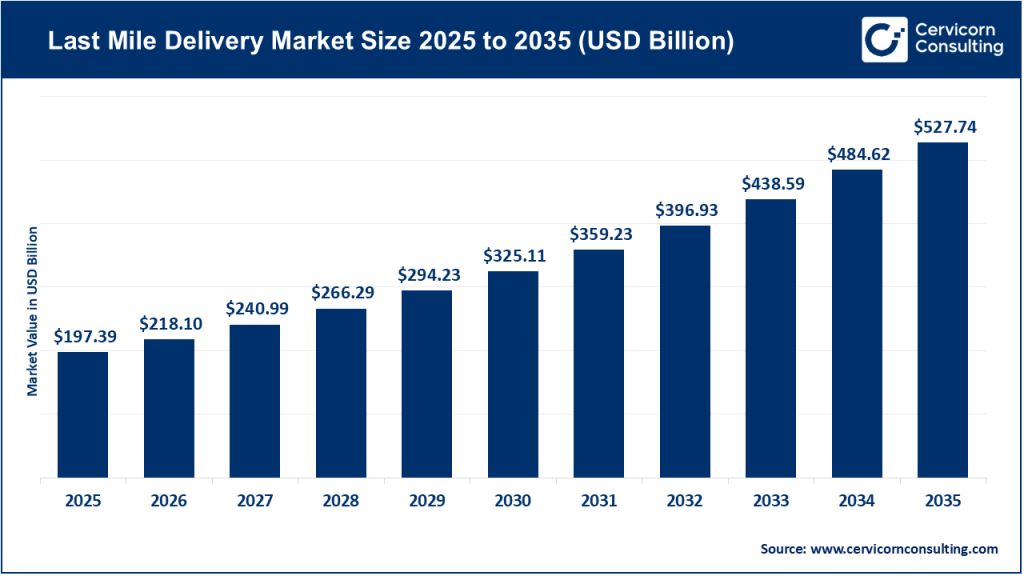
The global last mile delivery market was valued at USD 197.39 billion in 2025 and is projected to reach approximately USD 527.74 billion by 2035, growing at a CAGR of 10.33% from 2026 to 2035.
The expansion of e-commerce, quick commerce, changing customer expectations, and investments in logistics automation are reshaping last-mile delivery operations. However, market growth does not automatically translate into higher profitability for logistics providers and retailers. Companies must balance delivery speed, fleet utilization, infrastructure investments, operating costs, and customer experience.
The growing demand for same-day and instant delivery is also changing how businesses approach distribution networks. Retailers are moving closer to customers through localized fulfillment centers, while logistics providers are investing in AI-based route optimization, electric vehicles, real-time tracking, and alternative delivery models.
For decision-makers, the central question is no longer simply how to deliver faster. It is how to build a delivery network that can scale without allowing transportation costs, failed deliveries, and infrastructure requirements to erode margins.
The following six strategic decisions highlight where companies should focus their investments and operational priorities.
1. Should Companies Prioritize Delivery Speed or Cost Efficiency?
The growing popularity of same-day and instant delivery is creating pressure on logistics providers and retailers to shorten delivery windows. However, faster delivery requires additional investments in local inventory, fulfillment infrastructure, delivery personnel, and fleet availability.
The standard delivery segment accounted for approximately 56.2% of global market revenue in 2025, demonstrating the continued importance of cost-effective delivery models. Meanwhile, instant delivery is gaining traction, particularly in urban markets where customers prioritize convenience.
Companies should evaluate delivery speed according to product category, customer expectations, geographic density, and order economics rather than adopting a uniform delivery promise.
Strategic considerations:
-
Maintain standard delivery for non-urgent shipments and products with lower delivery urgency.
-
Introduce same-day delivery selectively in locations with sufficient order density.
-
Evaluate instant delivery for high-frequency categories such as groceries, food, and essential consumer products.
-
Measure the profitability of each delivery model using cost per order, average delivery distance, and delivery success rates.
-
Develop differentiated delivery pricing to recover the additional costs associated with faster fulfillment.
Business implication: Companies that align delivery speed with customer willingness to pay can improve service differentiation without unnecessarily increasing fulfillment expenses.
Get a Free Sample: https://www.cervicornconsulting.com/sample/2625
2. Where Should Companies Invest in Micro-Fulfillment Centers and Hyperlocal Infrastructure?
The expansion of quick commerce is changing the traditional distribution model. Instead of fulfilling every order through large centralized warehouses, businesses are increasingly considering dark stores, micro-fulfillment centers, and localized distribution hubs.
This approach can reduce delivery distances and improve order turnaround times. However, establishing additional facilities also increases rental expenses, inventory holding costs, labor requirements, and operational complexity.
The Asia-Pacific last mile delivery market was valued at approximately USD 47.20 billion in 2025 and is projected to reach USD 126.18 billion by 2035, making it an important region for infrastructure expansion.
For companies evaluating new locations, the investment decision should be based on actual delivery demand rather than population growth or online shopping penetration alone.
Strategic considerations:
-
Identify high-order-density locations where centralized fulfillment creates excessive delivery distances.
-
Compare the economics of dark stores, micro-fulfillment centers, and existing distribution facilities.
-
Evaluate inventory turnover and product availability before expanding localized storage.
-
Assess opportunities in Tier 2 and Tier 3 cities where digital commerce and delivery demand are expanding.
-
Determine whether partnerships with third-party logistics providers can reduce the capital required for network expansion.
Business implication: A carefully designed hyperlocal network can improve delivery efficiency, but infrastructure expansion should be supported by location-level demand forecasts and utilization analysis.
3. How Can AI and Route Optimization Improve Delivery Economics?
Last-mile delivery involves multiple variables, including traffic congestion, delivery density, vehicle availability, customer availability, and changing delivery schedules. Traditional route planning may struggle to manage these variables efficiently across large delivery networks.
AI-powered route optimization can help companies improve dispatch decisions, estimate delivery times, allocate vehicles, and dynamically adjust routes when operational conditions change.
The increasing use of real-time tracking and predictive analytics is also creating opportunities to reduce failed deliveries and improve customer communication.
However, companies should distinguish between investing in new technology and achieving measurable operational improvements.
Strategic considerations:
-
Implement dynamic route optimization to account for traffic, delivery priority, and vehicle capacity.
-
Use historical delivery data to identify locations with recurring delays and failed delivery attempts.
-
Integrate order management, warehouse management, and transportation management systems.
-
Apply predictive analytics to forecast peak delivery demand and optimize workforce allocation.
-
Evaluate technology investments through measurable indicators such as cost per delivery, on-time delivery rate, fuel consumption, and vehicle utilization.
Business implication: AI investments should be prioritized where they address specific operational inefficiencies rather than being treated as standalone digital transformation projects.
4. Should Companies Accelerate Electric Vehicle Adoption Across Delivery Fleets?
Fleet electrification is becoming an important consideration for last-mile delivery companies as they look to manage fuel expenses, emissions, and changing environmental requirements.
Electric two-wheelers, three-wheelers, vans, and cargo bikes offer different advantages depending on delivery distance, payload requirements, route conditions, and charging infrastructure.
The economics of fleet electrification, however, vary significantly across operating environments. While electric vehicles can reduce fuel and maintenance expenses, companies must also consider acquisition costs, charging infrastructure, battery performance, vehicle downtime, and replacement cycles.
Strategic considerations:
-
Prioritize electric two-wheelers and three-wheelers for short-distance, high-frequency urban deliveries.
-
Evaluate electric vans for predictable routes with sufficient daily utilization.
-
Assess charging infrastructure availability before committing to large-scale fleet electrification.
-
Compare total cost of ownership rather than evaluating vehicles solely on purchase price.
-
Consider leasing, fleet partnerships, and financing models to reduce upfront capital requirements.
Major logistics companies are already establishing long-term electrification targets. Amazon aims to deploy 100,000 electric delivery vans by 2030, while FedEx has targeted full electrification of its package pickup and delivery vehicle fleet by 2040.
Business implication: Fleet electrification should follow a phased investment strategy based on route suitability, utilization, infrastructure readiness, and long-term operating economics.
5. How Can Companies Reduce Failed Deliveries and Improve Customer Experience?
Failed deliveries remain a significant operational challenge because every unsuccessful attempt can generate additional transportation costs, rescheduling requirements, customer support activity, and reverse logistics expenses.
As e-commerce volumes increase, companies must improve delivery visibility and customer communication to prevent avoidable delivery failures.
Real-time tracking, digital addressing systems, delivery notifications, and flexible delivery scheduling can help businesses improve the reliability of their distribution networks.
Strategic considerations:
-
Introduce real-time shipment tracking and proactive delivery notifications.
-
Use address verification and digital location tools to reduce incorrect delivery attempts.
-
Provide flexible delivery windows and customer-selected delivery preferences.
-
Analyze failed delivery patterns by location, product category, delivery partner, and time of day.
-
Evaluate parcel lockers, pickup points, and alternative delivery locations in congested urban areas.
-
Integrate reverse logistics processes to manage returns and unsuccessful deliveries more efficiently.
Business implication: Improving first-attempt delivery success can reduce unnecessary operating expenses while strengthening customer retention and service reliability.
6. Which Regional and Industry Opportunities Should Companies Target?
Last-mile delivery demand is expanding across different regions and end-user industries, but the infrastructure requirements and operating economics vary considerably.
North America accounted for approximately 35.84% of global market revenue in 2025, supported by established e-commerce infrastructure, strong consumer demand, and investments in logistics automation.
Asia-Pacific is emerging as an important growth opportunity, driven by expanding digital commerce, urbanization, quick commerce, and investments in localized delivery networks.
Companies should also consider opportunities beyond conventional e-commerce and retail distribution.
Healthcare and pharmaceuticals represent an important application area because medicines, medical equipment, and temperature-sensitive products require specialized delivery capabilities.
Strategic considerations:
-
Evaluate North America for opportunities involving established logistics infrastructure, automation, and technology-enabled delivery services.
-
Assess Asia-Pacific for investments in hyperlocal delivery, quick commerce, and expanding e-commerce networks.
-
Explore healthcare logistics opportunities involving temperature-controlled transportation and specialized handling.
-
Evaluate food and grocery delivery requirements, particularly in densely populated urban locations.
-
Consider partnerships with retailers, pharmaceutical distributors, and e-commerce platforms to secure recurring delivery volumes.
-
Assess local regulations, infrastructure availability, and competitive intensity before entering new markets.
Business implication: Companies that align regional expansion with specific industry requirements can identify more sustainable growth opportunities than those pursuing geographic expansion alone.
Competitive Landscape: Companies Shaping the Last Mile Delivery Market
The last mile delivery market includes established logistics providers, e-commerce companies, and emerging autonomous delivery technology developers. Competition is increasingly influenced by network coverage, delivery reliability, automation capabilities, fleet economics, and technology integration.
Key companies operating in this market include:
-
Amazon Logistics: Focuses on expanding delivery infrastructure, same-day fulfillment capabilities, automation, and electric vehicle adoption to strengthen its distribution network.
-
United Parcel Service (UPS): Competes through its extensive parcel delivery infrastructure, integrated logistics capabilities, and technology-enabled fleet and route management.
-
FedEx: Focuses on improving network efficiency, shipment visibility, and sustainable transportation across its pickup and delivery operations.
-
Deutsche Post AG: Through DHL, invests in international delivery infrastructure, sustainable transportation, and technology-driven logistics operations.
-
XPO Logistics: Provides transportation and logistics services with an emphasis on network optimization and operational efficiency.
-
Kerry Logistics Network: Offers integrated logistics and supply chain solutions across international markets.
-
YTO Express Group: Operates within China’s express delivery industry, supported by expanding parcel volumes and logistics infrastructure.
-
Drone Delivery Canada: Focuses on commercial drone delivery solutions for specialized logistics and transportation applications.
-
A2Z Drone Delivery: Develops drone-based delivery technologies for applications requiring alternative transportation capabilities.
-
Flirtey: Associated with autonomous drone delivery solutions and the development of alternative last-mile transportation models.
Competition is likely to intensify as traditional logistics providers improve operational efficiency while technology companies develop alternative delivery solutions. Companies will increasingly need to differentiate through cost efficiency, network flexibility, delivery reliability, and specialized services.
Conclusion: Building a Profitable and Scalable Last-Mile Delivery Network
The last mile delivery market is entering a period of significant transformation, supported by e-commerce expansion, quick commerce, AI-enabled logistics, fleet electrification, and changing customer expectations.
However, the next phase of competition will depend on how effectively companies translate these developments into sustainable operating models.
For logistics providers, the priority should be improving fleet utilization, route efficiency, and delivery success rates. Retailers need to determine where localized fulfillment infrastructure can support faster delivery without creating excessive inventory and operating expenses. Technology providers have opportunities to address specific industry requirements through route optimization, automation, tracking, and predictive analytics.
Ultimately, companies that make informed decisions about delivery models, infrastructure investments, technology adoption, and regional expansion will be better positioned to build resilient and profitable last-mile delivery operations.
Key Market Intelligence Areas for Business Decision-Makers
Understanding the market requires more than tracking overall growth. Companies evaluating investments or expansion strategies should examine:
-
Market sizing and forecasts: Identify growth opportunities across regions, service types, delivery models, and end-user industries.
-
Competitive benchmarking: Evaluate leading logistics providers, their operational capabilities, service portfolios, and expansion strategies.
-
Technology assessment: Understand the commercial potential of AI-based routing, autonomous delivery, drones, and fleet electrification.
-
Regional opportunity analysis: Compare infrastructure readiness, e-commerce penetration, delivery demand, and competitive intensity.
-
Customer and industry analysis: Assess delivery expectations and specialized requirements across retail, grocery, healthcare, and logistics.
-
Investment and expansion assessment: Evaluate the commercial viability of micro-fulfillment centers, fleet upgrades, and alternative delivery models.
These insights can help logistics operators, retailers, e-commerce companies, fleet technology providers, and investors identify where market growth is creating actionable business opportunities.
To Get Detailed Overview, Contact Us: https://www.cervicornconsulting.com/contact-us