


Composite AI Market: Strategic Decisions for Enterprises Moving Beyond Standalone AI Models
The global composite AI market is entering a high-growth phase as enterprises move beyond standalone machine learning and generative AI applications toward integrated systems capable of handling complex business decisions. For technology providers, enterprise software companies, system integrators, and AI adopters, the opportunity is not simply about deploying more AI models. It is about determining how multiple AI techniques can work together to improve operational accuracy, automate workflows, and deliver measurable business outcomes.
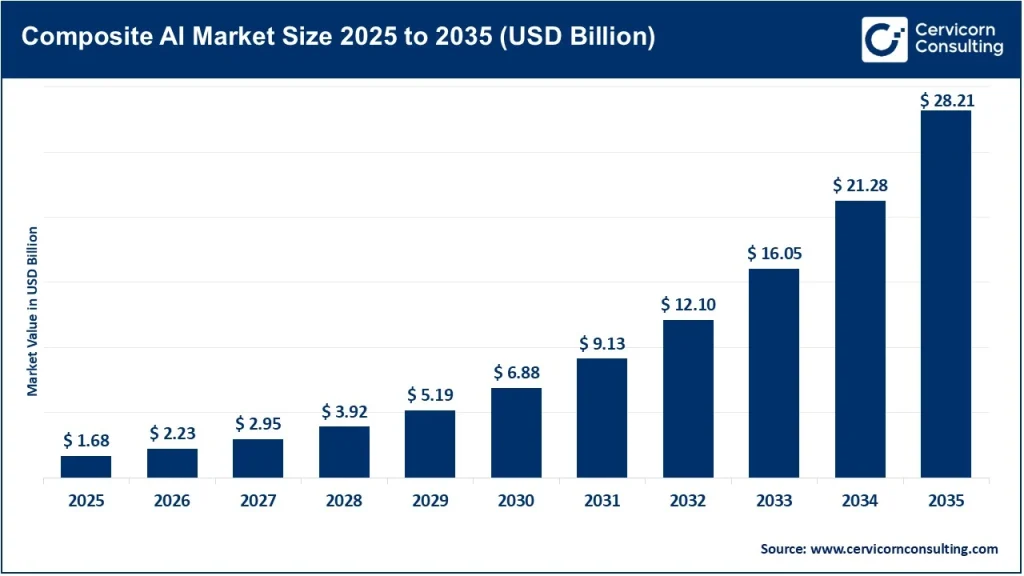
The global Composite AI market was valued at USD 1.68 billion in 2025 and is projected to exceed USD 28.21 billion by 2035, expanding at a CAGR of 32.6% from 2026 to 2035. This growth reflects increasing demand for enterprise AI systems that combine machine learning, natural language processing (NLP), knowledge graphs, rule-based systems, optimization, and other analytical techniques within unified workflows.
For businesses, this creates important decisions around technology architecture, application selection, data infrastructure, AI governance, and commercial positioning. Companies that align their Composite AI investments with specific operational requirements will be better positioned to move from experimental deployments toward scalable enterprise applications.
Understanding the Composite AI Opportunity
Composite AI refers to an approach that combines multiple artificial intelligence techniques within a single system or workflow to address problems that may be difficult for an individual AI model to solve effectively.
Unlike standalone AI applications, Composite AI integrates different capabilities such as prediction, reasoning, pattern recognition, contextual understanding, and automation. For example, a financial institution can combine machine learning for fraud detection, NLP for transaction-related communication analysis, knowledge graphs for identifying relationships between entities, and rule-based systems for compliance checks.
Similarly, manufacturers can integrate predictive maintenance models, sensor data processing, computer vision, and optimization algorithms to improve equipment performance and production planning.
The commercial opportunity extends across BFSI, healthcare, manufacturing, retail, IT and telecom, transportation, and logistics. However, adoption will depend on how effectively vendors and enterprise users address integration complexity, data quality, infrastructure costs, and governance requirements.
Get a Free Sample: https://www.cervicornconsulting.com/sample/2972
1. Should Companies Invest in Composite AI Software or Build Their Own Infrastructure?
One of the first strategic decisions for enterprises is determining whether to adopt existing Composite AI software platforms, develop proprietary systems, or combine both approaches.
Software accounted for 46.8% of the global Composite AI market in 2025, making it the leading offering segment. Its position reflects the importance of platforms that support model orchestration, workflow automation, decision intelligence, and integration of multiple AI techniques.
For enterprise buyers, software platforms can reduce the time required to integrate different AI models and deploy applications across departments. They can also provide centralized monitoring, workflow management, and model management capabilities.
However, proprietary development may be more appropriate for organizations operating in specialized environments where existing platforms cannot adequately address domain-specific requirements, data restrictions, or integration needs.
Key business considerations:
-
Platform selection: Evaluate whether available software supports multiple AI models, knowledge graphs, NLP, predictive analytics, and rule-based decision engines.
-
Integration flexibility: Assess compatibility with existing enterprise resource planning (ERP), customer relationship management (CRM), cloud, and data management systems.
-
Customization requirements: Determine whether standard platform capabilities can support industry-specific workflows or whether proprietary development is necessary.
-
Total cost of ownership: Compare licensing, infrastructure, implementation, maintenance, and model management expenses.
-
Vendor dependency: Evaluate data portability, interoperability, customization flexibility, and the risks associated with dependence on a single technology provider.
The hardware segment also deserves attention. It is expected to register the fastest growth among offerings as Composite AI deployments require more computing resources for model training, real-time inference, multimodal processing, and enterprise-scale analytics.
For technology vendors, this creates opportunities to position AI software alongside optimized computing infrastructure and integration services.
2. Which Composite AI Applications Offer the Strongest Commercial Opportunities?
Selecting the right application is critical because not every business process requires a multi-technique AI architecture. Enterprises should prioritize workflows where combining different AI capabilities produces a meaningful improvement over standalone automation or analytics.
Product design and development represented 22.8% of the Composite AI market in 2025, making it the largest application segment. Customer service accounted for 21.3%, while predictive maintenance represented 16.4%.
These segments demonstrate the growing commercial relevance of Composite AI across both innovation-driven and operational business functions.
Product design and development
Manufacturers, automotive companies, electronics developers, and industrial equipment producers can combine machine learning, simulation, optimization, and data processing to accelerate product development.
Potential applications include:
-
Optimizing product specifications and design parameters.
-
Identifying design defects during development.
-
Reducing prototype testing requirements.
-
Evaluating alternative materials and configurations.
-
Improving product customization based on customer requirements.
Companies developing industrial AI platforms should prioritize integration with engineering software, simulation environments, and product lifecycle management systems.
Customer service
Customer service is expected to be the fastest-growing application segment. Enterprises are increasingly looking beyond conventional chatbots toward systems capable of understanding customer intent, retrieving contextual information, predicting customer requirements, and executing relevant actions.
Composite AI can combine NLP, recommendation engines, machine learning, and business rules to improve customer interactions.
Technology vendors should evaluate opportunities in omnichannel customer support, automated complaint resolution, intelligent recommendations, and customer retention analytics.
Predictive maintenance
Manufacturing, energy, transportation, and industrial equipment companies can combine sensor data, anomaly detection, predictive analytics, and optimization to identify equipment failures and improve maintenance planning.
The commercial opportunity is particularly relevant for vendors offering industrial analytics, connected equipment platforms, and asset performance management solutions.
Security and surveillance
Composite AI can combine computer vision, behavioral pattern recognition, anomaly detection, and contextual analytics to strengthen security monitoring. Enterprises should evaluate accuracy, false-positive rates, response time, and privacy requirements before deploying these applications at scale.
The decision for technology providers is to prioritize applications where multiple AI techniques deliver measurable improvements in accuracy, efficiency, or operational performance rather than competing solely on model capabilities.
3. How Should Companies Prioritize Data Processing and Machine Learning Capabilities?
Data readiness is one of the most important requirements for successful Composite AI deployment. Integrating multiple AI techniques does not automatically improve performance if the underlying information is fragmented, inconsistent, outdated, or difficult to access.
Data processing held 24.1% of the Composite AI market by technique in 2025, making it the largest technique segment. Data mining and machine learning accounted for 22.4%, while text analysis and NLP represented 16.9%.
These figures highlight the importance of data preparation and analytical capabilities in the Composite AI ecosystem.
For enterprise technology buyers, investment decisions should focus on the following areas:
-
Data integration: Combine structured and unstructured information from enterprise applications, databases, sensors, documents, and external sources.
-
Data quality management: Establish processes to identify missing information, inconsistent records, duplicate entries, and inaccurate datasets.
-
Knowledge representation: Evaluate knowledge graphs and semantic technologies that help AI systems understand relationships between business entities and operational information.
-
Machine learning capabilities: Prioritize models that can identify patterns, generate predictions, and improve performance as new data becomes available.
-
Real-time data processing: Determine whether applications require immediate responses or can operate using periodic data updates.
-
Data accessibility: Establish secure access mechanisms that allow different AI models to use relevant information without creating unnecessary data duplication.
For AI software vendors, the opportunity extends beyond model development. Companies that provide data integration, model orchestration, data governance, and enterprise interoperability can capture additional value as organizations scale Composite AI deployments.
An important consideration is whether the enterprise has sufficient data maturity to support a multi-model environment. Organizations with fragmented infrastructure may need to strengthen their data architecture before investing in complex Composite AI applications.
4. What AI Governance and Explainability Capabilities Should Enterprises Demand?
As Composite AI systems become involved in financial decisions, healthcare operations, security monitoring, and other sensitive business activities, governance becomes a critical purchasing consideration.
Unlike standalone models, Composite AI systems may involve several models and decision mechanisms operating together. This increases the need to understand how information moves through the workflow, which models influence an outcome, and how decisions can be reviewed.
For BFSI organizations, these capabilities are particularly important in fraud detection, credit assessment, risk management, and regulatory monitoring.
The BFSI sector held 17.9% of the Composite AI market in 2025, representing the largest vertical share. Its adoption is supported by demand for real-time analytics, transaction monitoring, compliance automation, and more effective risk assessment.
Healthcare and life sciences, meanwhile, represent an important emerging opportunity because of the increasing use of AI across clinical information, imaging, patient monitoring, and treatment planning.
Enterprise buyers should assess the following governance requirements:
-
Decision explainability: Can the system provide understandable explanations for its recommendations and outputs?
-
Model monitoring: Can individual models be monitored for accuracy, performance degradation, and unexpected behavior?
-
Data privacy: Does the platform support appropriate access controls, encryption, and data protection requirements?
-
Bias assessment: Are there mechanisms to identify and evaluate potentially biased outputs?
-
Auditability: Can organizations maintain records of model versions, data inputs, system outputs, and important decision events?
-
Human oversight: Can employees review, override, or escalate AI-generated decisions when necessary?
For vendors, governance should be treated as a core product capability rather than an additional feature introduced after deployment.
Organizations that operate in regulated markets should also assess the regulatory requirements applicable to their specific jurisdictions and use cases before selecting an AI architecture.
5. Should Enterprises Target Industry-Specific Composite AI Solutions?
A broad enterprise AI platform may offer flexibility, but industry-specific solutions can provide stronger commercial differentiation by addressing specialized workflows and operational requirements.
The Composite AI market spans multiple verticals, including BFSI, retail and e-commerce, healthcare and life sciences, IT and telecom, manufacturing, government and defense, energy and utilities, and transportation and logistics.
Each vertical presents different adoption requirements.
BFSI: Fraud detection and risk intelligence
Financial institutions can integrate transaction analytics, behavioral pattern recognition, NLP, and rule-based systems to identify suspicious activity and strengthen compliance monitoring.
Vendors should focus on real-time processing, explainable decisions, integration with existing banking systems, and reliable fraud detection performance.
Healthcare and life sciences: Clinical and operational intelligence
Healthcare and life sciences are projected to be the fastest-growing vertical in the Composite AI market.
Potential applications include:
-
Combining clinical records with medical imaging analysis.
-
Supporting patient risk identification and monitoring.
-
Improving clinical documentation and information retrieval.
-
Supporting treatment planning through predictive analytics.
-
Optimizing hospital resource allocation and operational workflows.
For technology providers, the opportunity lies in developing solutions that can integrate heterogeneous healthcare data while addressing privacy, security, and clinical oversight requirements.
Manufacturing: Quality control and predictive maintenance
Manufacturers can integrate computer vision, machine learning, sensor analytics, and optimization to improve production quality and operational efficiency.
The most relevant investment areas include automated defect detection, equipment monitoring, production scheduling, and process optimization.
Retail and e-commerce: Personalization and customer intelligence
Retailers can combine customer behavior analytics, recommendation engines, NLP, and demand forecasting to improve customer engagement and inventory decisions.
Technology vendors should evaluate opportunities in personalized commerce, customer segmentation, automated service, and demand planning.
IT and telecom: Network optimization and service automation
Telecom operators can use Composite AI to combine network performance data, anomaly detection, predictive analytics, and automated troubleshooting.
This creates opportunities for vendors offering intelligent network management, service assurance, and operational automation solutions.
The strategic implication is that vendors should avoid treating Composite AI as a single uniform market. Industry-specific workflows, purchasing requirements, integration environments, and regulatory conditions will influence product development and go-to-market strategies.
6. Which Geographic Markets Should Companies Prioritize for Expansion?
Geographic expansion requires more than identifying regions with the highest current market share. Companies must also consider enterprise AI maturity, infrastructure availability, customer demand, regulatory environments, and the competitive landscape.
North America accounted for 37.4% of the global Composite AI market in 2025, maintaining its leadership position. Europe followed with 26.4%, while Asia-Pacific represented 22.7%.
However, Asia-Pacific is identified as the fastest-growing regional market, creating opportunities for technology companies seeking to expand beyond established enterprise AI markets.
North America
The North American Composite AI market was valued at USD 0.63 billion in 2025 and is projected to reach USD 10.55 billion by 2035.
The region benefits from mature enterprise AI adoption, established cloud infrastructure, strong technology ecosystems, and growing demand for intelligent automation.
For vendors, priorities should include enterprise platform partnerships, BFSI applications, healthcare intelligence, industrial AI, and advanced customer service automation.
Europe
The European market reached USD 0.44 billion in 2025 and is expected to reach USD 7.45 billion by 2035.
Demand is supported by enterprise digitalization, industrial automation, and increasing attention to trustworthy AI, data protection, and regulatory compliance.
Companies entering this market should prioritize transparent AI architectures, data governance, industrial applications, and solutions aligned with European enterprise requirements.
Asia-Pacific
The Asia-Pacific Composite AI market was valued at USD 0.38 billion in 2025 and is projected to exceed USD 6.40 billion by 2035.
China and India represent important opportunities within the region.
-
China: Large-scale industrial digitalization, AI investment, smart manufacturing, and financial technology adoption are creating demand for integrated AI applications.
-
India: Growing enterprise AI adoption, digital transformation across BFSI and healthcare, and increasing use of AI in enterprise services create opportunities for platform providers and implementation partners.
However, affordability, implementation costs, infrastructure readiness, and availability of skilled AI professionals will influence the pace of adoption.
LAMEA
The LAMEA Composite AI market was valued at USD 0.23 billion in 2025 and is anticipated to reach USD 3.81 billion by 2035.
Government-led digital transformation, enterprise modernization, and investments in financial services, telecom, energy, and public sector technology are creating opportunities.
For companies entering these markets, partnerships with regional technology providers and industry-focused implementation capabilities may be important for commercial expansion.
Geographic strategy: Technology providers should balance the established enterprise demand in North America and Europe with the longer-term expansion opportunities across Asia-Pacific and LAMEA. Market entry decisions should also account for local infrastructure, procurement practices, regulatory requirements, and partner availability.
7. How Can Companies Build a Competitive Advantage in the Composite AI Market?
As the Composite AI ecosystem expands, competition will involve more than developing advanced models. Companies will need to demonstrate their ability to integrate different AI technologies into reliable, scalable, and commercially useful enterprise systems.
The competitive landscape includes established enterprise technology companies, cloud providers, analytics specialists, and AI-focused software developers.
Important companies operating in the market include:
-
IBM
-
SAS Institute
-
Microsoft
-
Google
-
Amazon Web Services (AWS)
-
Salesforce
-
BlackSwan Technologies
-
Oracle
-
OpenText
-
SAP
-
Hewlett Packard Enterprise (HPE)
-
Pega
Their competitive positioning differs across enterprise software, cloud infrastructure, analytics, data management, workflow automation, and AI platform capabilities.
For businesses evaluating competitors or planning market entry, the following areas deserve attention:
Platform capabilities: Assess the breadth of AI techniques supported, including machine learning, NLP, knowledge graphs, computer vision, and rule-based reasoning.
Enterprise integration: Evaluate compatibility with existing enterprise applications, cloud platforms, databases, and operational systems.
Industry specialization: Identify whether competitors offer solutions designed for BFSI, healthcare, manufacturing, retail, or telecom requirements.
Governance and explainability: Compare model monitoring, auditability, privacy controls, and mechanisms for human oversight.
Commercial positioning: Examine pricing models, licensing structures, implementation requirements, and the ability to demonstrate measurable customer value.
Strategic partnerships: Monitor relationships between AI platform developers, cloud providers, system integrators, hardware manufacturers, and industry-specific software companies.
Recent developments also demonstrate how the competitive landscape is evolving:
-
In February 2026, Google Cloud introduced Gemini 3.1 Pro in preview on Vertex AI, while expanding enterprise agent-building and multimodal AI capabilities.
-
In June 2025, Salesforce launched Agentforce 3, introducing the Agentforce Command Center to strengthen observability, governance, and control of enterprise AI agents.
-
In May 2025, IBM expanded its watsonx portfolio with the watsonx AI Model Gateway and previewed Granite 4.0 Tiny, supporting multi-model orchestration and enterprise AI deployment.
-
In May 2025, Microsoft announced additional Azure AI Foundry capabilities and broader AI agent support at Build 2025.
These developments indicate that the market is moving toward integrated AI environments where model orchestration, governance, automation, and enterprise connectivity are increasingly important competitive factors.
Key Risks Companies Must Address Before Scaling Composite AI
Despite its growth potential, Composite AI adoption involves several challenges that can affect implementation timelines, investment returns, and long-term commercial success.
1. High implementation and integration costs
Combining multiple AI models, data pipelines, orchestration tools, and governance systems can increase deployment complexity. Enterprises should assess implementation costs before committing to large-scale infrastructure investments.
2. Shortage of specialized talent
Composite AI requires expertise across machine learning, NLP, data engineering, MLOps, system integration, and AI governance. Organizations may need to invest in workforce development or collaborate with external technology partners.
3. Data privacy and security concerns
Composite AI applications often process sensitive business, financial, customer, and healthcare information. Weak data controls can create compliance risks and reduce enterprise confidence.
4. Difficulty demonstrating measurable ROI
Successful pilot projects do not always translate into profitable enterprise deployments. Companies should establish clear performance indicators, including operational cost reduction, decision accuracy, processing time, productivity improvements, and revenue contribution.
5. Infrastructure and scalability constraints
As Composite AI applications expand across departments, enterprises may face increasing computing, storage, networking, and model monitoring requirements. Infrastructure planning should account for both initial deployment and long-term operating expenses.
Strategic Priorities for Companies Operating in the Composite AI Market
The expansion of Composite AI creates opportunities across software development, hardware infrastructure, consulting, enterprise automation, and industry-specific applications. However, market growth alone does not guarantee commercial success.
Companies should align their investments with the following priorities:
| Strategic priority | Recommended business action |
|---|---|
| Product development | Build interoperable platforms supporting multiple AI techniques and enterprise workflows. |
| Industry specialization | Prioritize applications with clear operational value in BFSI, healthcare, manufacturing, and telecom. |
| Data infrastructure | Strengthen data integration, processing, quality management, and knowledge representation. |
| AI governance | Incorporate explainability, model monitoring, privacy, and auditability into platform design. |
| Geographic expansion | Evaluate Asia-Pacific growth opportunities while maintaining positions in established markets. |
| Partnerships | Develop relationships with cloud providers, system integrators, hardware companies, and enterprise software vendors. |
| Commercial strategy | Focus on measurable customer outcomes, deployment flexibility, and long-term platform economics. |
Conclusion: Moving from AI Experimentation to Integrated Enterprise Intelligence
The Composite AI market is transitioning toward a more integrated approach to enterprise artificial intelligence. As organizations adopt increasingly complex AI applications, the ability to combine prediction, reasoning, data processing, and automation within unified workflows will become an important competitive differentiator.
With the global market projected to grow from USD 1.68 billion in 2025 to USD 28.21 billion by 2035, technology providers and enterprise buyers have an expanding opportunity to participate in this transformation.
For software developers, the priority will be building interoperable platforms that simplify multi-model deployment. For enterprise users, investment decisions should focus on applications where integrated AI can improve business performance, reduce operational complexity, and strengthen decision-making. For investors and market entrants, understanding competitive positioning, regional adoption, industry-specific demand, and infrastructure requirements will be essential.
Ultimately, the companies best positioned to benefit from Composite AI will be those that move beyond isolated AI capabilities and develop solutions that address complete business processes with measurable commercial value.
To Get Detailed Overview, Contact Us: https://www.cervicornconsulting.com/contact-us