


Lab-on-a-Chip Market: Where Will the Next Wave of Diagnostic Adoption Come From?
Lab-on-a-chip technology is moving beyond the laboratory as healthcare providers, diagnostics companies and life-science researchers look for faster testing, lower sample volumes and more decentralized workflows.
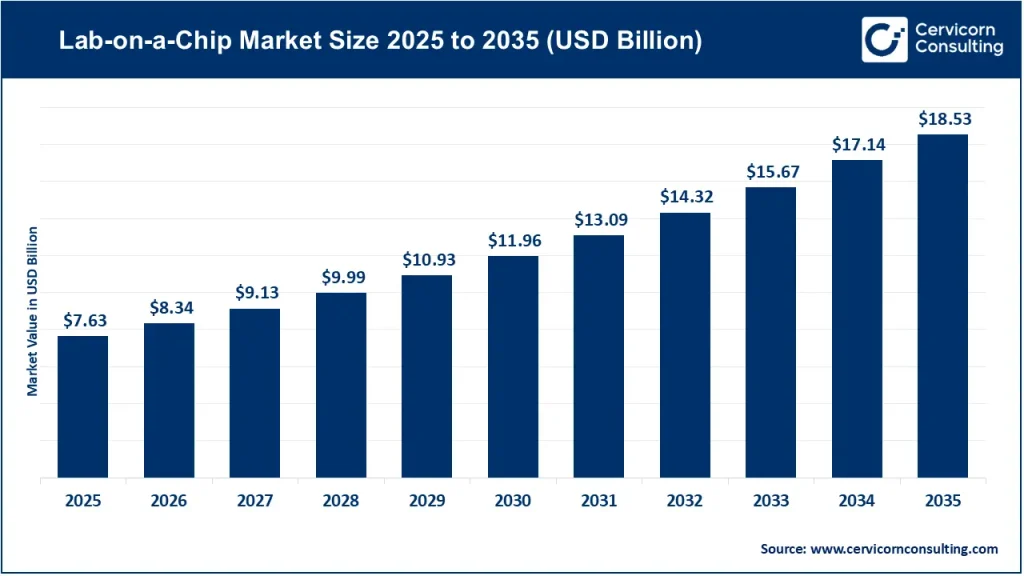
The global lab-on-a-chip market was valued at USD 6.97 billion in 2024 and is projected to reach around USD 17.14 billion by 2034, expanding at a 9.42% CAGR from 2025 to 2034. The opportunity is increasingly tied to how effectively companies can translate microfluidic innovation into reliable, scalable and clinically useful diagnostic platforms.
The more important question for technology suppliers and healthcare decision-makers is therefore not simply how large the market will become. It is which applications, technologies and deployment models will capture the next stage of growth.
Why lab-on-a-chip is becoming strategically important
Traditional laboratory diagnostics often depend on centralized facilities, specialized equipment and multiple processing steps. Lab-on-a-chip platforms can integrate functions such as sample preparation, fluid handling, amplification, separation and detection within compact systems.
That changes the economics and operating model of testing.
Smaller sample volumes can reduce reagent consumption, while integrated workflows can shorten turnaround times. Portable systems can also bring testing closer to patients, particularly where centralized laboratory infrastructure is limited.
This is particularly relevant to point-of-care diagnostics, infectious-disease testing, cancer biomarker analysis, genomics and personalized medicine.
The broader microfluidics market illustrates the direction of travel: lab-on-a-chip accounted for 38.7% of the microfluidics market in 2025, while organs-on-a-chip was identified as one of the fastest-growing areas.
The real growth opportunity is moving toward decentralized testing
Clinical diagnostics remains the largest application segment in Cervicorn’s analysis, accounting for 39.2% of the 2024 lab-on-a-chip market. Hospitals and clinics represented an even larger 44.5% share by end user.
This combination is strategically important.
Healthcare systems increasingly need diagnostic platforms that can deliver useful results without sending every sample through a centralized laboratory. Point-of-care systems can support faster clinical decisions in emergency care, infectious diseases, chronic disease monitoring and resource-constrained environments.
The trend is also visible in current technology development. In 2026, India’s Technology Development Board supported commercialization of an indigenous point-of-care renal diagnostic platform designed for primary healthcare, highlighting the push toward accessible diagnostic technologies outside major laboratory networks.
For lab-on-a-chip companies, this creates a larger opportunity than simply selling laboratory instruments. The competitive question becomes whether a platform can fit into real-world clinical workflows, decentralized settings and existing healthcare infrastructure.
Microfluidics remains the technology foundation
Microfluidics held the largest technology share in Cervicorn’s 2024 analysis at 41.7%, followed by electrophoresis-based technologies at 30.4% and array-based technologies at 18.1%.
Microfluidics is attractive because it allows multiple analytical processes to be performed using very small quantities of fluid.
But the next phase of competition is likely to depend on more than channel design.
Companies need to consider:
- Sample preparation and handling
- Multiplexing capability
- Detection sensitivity
- Cartridge reliability
- Sensor integration
- Automation
- Data interpretation
- Manufacturing consistency
- Compatibility with clinical workflows
Recent research on digital microfluidics reinforces this transition. Although digital microfluidics can automate and miniaturize biomedical assays, scaling from prototypes to industrial production still involves challenges involving materials, standardization, reliability and integration with detection systems.
For investors and technology suppliers, this makes the lab-to-fab transition an increasingly important indicator of commercial potential.
AI is changing what a lab-on-a-chip platform can deliver
Miniaturization is only one part of the value proposition.
As chip-based diagnostics generate increasingly complex datasets, software and AI can become an important layer between the physical test and the clinical decision.
Cervicorn’s market analysis identifies software and services as an emerging component of the ecosystem, supporting automated analysis, interoperability and digital-health integration.
This direction is consistent with broader developments in diagnostics. Roche’s 2026 agreement to acquire PathAI, for example, reflects the growing strategic importance of AI-powered diagnostic analysis, biomarker discovery and personalized healthcare.
For lab-on-a-chip developers, the opportunity therefore extends beyond creating a smaller diagnostic instrument.
The stronger proposition could be a connected diagnostic workflow combining sample processing, detection, interpretation and clinical data.
Manufacturing may determine which technologies scale
One of the biggest commercial gaps in lab-on-a-chip is the transition from a technically successful prototype to a repeatable product.
A chip may perform exceptionally well in a controlled research environment but face very different requirements when produced at commercial volumes.
Manufacturers have to maintain:
- Consistent microfluidic performance
- Reproducible cartridge quality
- Stable reagents
- Reliable biosensors
- High-volume manufacturing yields
- Shelf-life requirements
- Quality-control standards
- Regulatory compliance
This is already becoming visible across the microfluidics ecosystem. In 2026, microfluidic manufacturing partnerships have increasingly focused on taking cartridge technologies from R&D toward automated production and higher-volume manufacturing.
The commercial advantage may therefore shift toward companies capable of combining microfluidic engineering with manufacturing discipline and regulatory execution.
Point-of-care molecular diagnostics is creating a larger competitive field
Lab-on-a-chip platforms are not competing only against other microfluidic technologies.
They increasingly compete with molecular diagnostics, conventional laboratory analyzers, portable PCR systems, CRISPR-based diagnostics and other rapid-testing platforms.
That makes time-to-result, accuracy and total cost per test critical.
The investment environment illustrates this broader convergence. In July 2026, Sapphiros received a $12.4 million BARDA award to advance portable, connected molecular diagnostic platforms for point-of-care, field-use and emergency-response applications.
The implication for lab-on-a-chip companies is straightforward: technical miniaturization alone will not guarantee adoption. Platforms need a compelling combination of speed, accuracy, usability, economics and scalability.
North America leads, but Asia-Pacific deserves closer attention
North America accounted for 43% of the global lab-on-a-chip market in 2024, making it the leading regional market. Europe followed with 26%, while Asia-Pacific represented 22%.
North America’s advantage is supported by established healthcare infrastructure, R&D activity and early adoption of point-of-care diagnostics.
However, Asia-Pacific presents a different growth opportunity.
Cervicorn projects the Asia-Pacific lab-on-a-chip market to increase from USD 1.53 billion in 2024 to approximately USD 3.77 billion by 2034.
India is particularly relevant. The country’s lab-on-a-chip market is projected to grow from USD 178 million in 2026 to USD 420.4 million by 2033, representing a 13.06% CAGR.
The opportunity is connected to expanding diagnostics infrastructure, decentralized healthcare requirements and demand for affordable testing.
For companies entering Asia-Pacific, therefore, the relevant question is not simply market size. It is which healthcare settings can support commercially viable deployment of compact diagnostic technologies.
Where should companies focus next?
The strongest opportunities are likely to emerge where lab-on-a-chip technology directly addresses a measurable workflow requirement.
1. Rapid infectious-disease diagnostics
Outbreak preparedness and decentralized testing can benefit from compact diagnostic platforms that reduce dependence on centralized laboratories.
2. Cancer and biomarker testing
Multiplexed chips can support biomarker detection while AI-enabled analysis can increase the value of the resulting data.
3. Personalized medicine
Smaller sample requirements and highly targeted assays make LOC platforms relevant to patient-specific diagnostics and treatment selection.
4. Drug discovery
Pharmaceutical companies can use microfluidic systems for screening, cellular analysis and other workflows where reducing reagent consumption and experimental time has direct economic value.
5. Environmental and food testing
The opportunity extends beyond healthcare into water-quality monitoring, food contamination and agricultural testing, where portable analysis can reduce delays associated with centralized laboratories.
6. Emerging-market diagnostics
Affordable, portable systems could become particularly important where healthcare providers need diagnostic capabilities closer to patients but cannot justify extensive centralized laboratory infrastructure.
What should investors and technology companies watch?
The next stage of the lab-on-a-chip market will likely be shaped by a combination of technology performance and commercialization capability.
Five indicators deserve particular attention:
Clinical validation: Can the technology demonstrate reliable performance in real-world settings?
Manufacturing scalability: Can the chip and cartridge be produced consistently at commercially viable volumes?
Recurring revenue: Does the platform generate consumables, reagents, software or service revenue after the initial instrument sale?
Workflow integration: Can the technology connect with existing laboratory information systems and clinical processes?
Application specificity: Does the platform solve a clearly defined diagnostic or research requirement better than conventional alternatives?
These factors can be more important than headline market growth when evaluating individual opportunities.
The competitive landscape is becoming broader
Major companies participating in the lab-on-a-chip ecosystem include Thermo Fisher Scientific, Illumina, Danaher, Merck KGaA, Abbott Laboratories, QIAGEN, Agilent Technologies, Standard BioTools, Revvity and Bio-Rad Laboratories. Cervicorn’s analysis identifies these companies among the key participants in the market.
However, competition is increasingly extending beyond traditional diagnostic and laboratory-equipment companies toward microfluidic specialists, digital-health companies, AI developers, semiconductor-related technologies and contract manufacturers.
That makes competitive intelligence particularly important for companies evaluating partnerships, acquisitions, product launches and regional expansion.
What the next phase of the lab-on-a-chip market could look like
The market is moving from the question of “Can laboratory functions be miniaturized?” toward a more commercially important question:
“Can those functions be converted into reliable, affordable and scalable diagnostic workflows?”
Cervicorn estimates the global lab-on-a-chip market will reach USD 17.14 billion by 2034, with North America maintaining its leadership while Asia-Pacific expands at a faster pace.
At the same time, developments in point-of-care diagnostics, AI-enabled analysis, digital microfluidics, molecular testing and decentralized healthcare are broadening the addressable opportunity.
For companies operating in this space, the most valuable market intelligence will increasingly come from understanding which applications are achieving clinical adoption, which technologies are reaching scalable manufacturing, where investment is moving, and which business models can generate recurring revenue from diagnostic platforms.
To Get Detailed Overview, Contact Us: https://www.cervicornconsulting.com/contact-us
Read Report: Carbon steel market: How infrastructure, EVs and low-carbon production are reshaping demand