


Carbon steel market: How infrastructure, EVs and low-carbon production are reshaping demand
Carbon steel remains one of the most widely used materials across construction, automotive manufacturing, energy infrastructure, machinery and transportation. Yet the market is changing in ways that go beyond overall steel consumption.
Manufacturers and buyers are increasingly dealing with three interconnected questions: where demand is coming from, how steel specifications are changing, and how producers can manage cost and emissions without compromising performance.
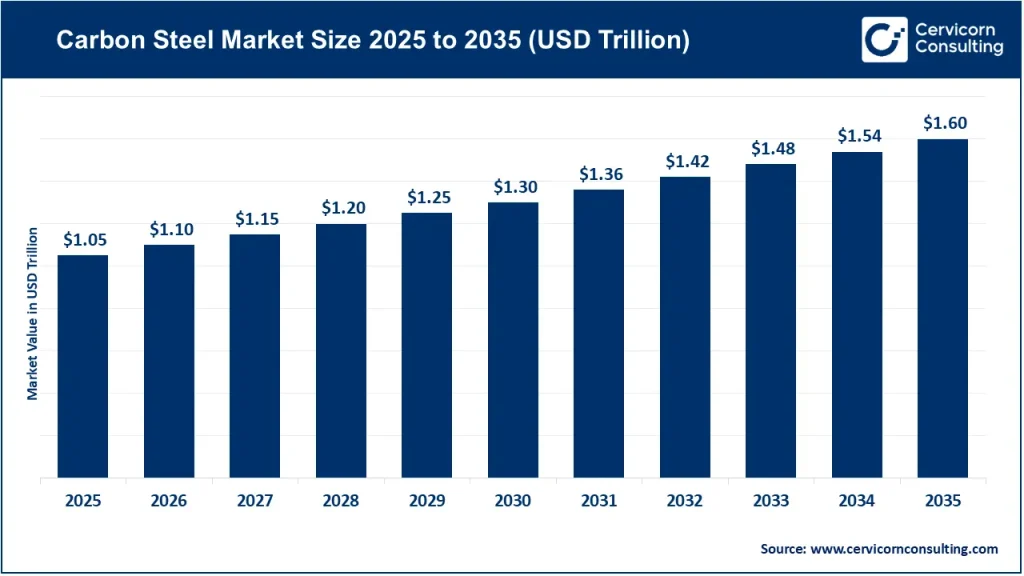
The global carbon steel market was valued at approximately USD 1.05 trillion in 2025 and is projected to reach around USD 1.60 trillion by 2035, expanding at a 4.79% CAGR from 2026 to 2035.
This growth is being supported by infrastructure development, automotive production, energy projects and industrial expansion. At the same time, producers face raw-material price volatility, stricter environmental requirements and competition from alternative materials.
Why carbon steel demand is changing
The fundamental advantage of carbon steel is its combination of strength, availability, weldability and relatively competitive cost. These characteristics continue to make it suitable for applications ranging from structural beams and pipelines to vehicle components and industrial machinery.
However, demand is becoming more application-specific.
Infrastructure projects require large volumes of structural steel, plates, bars and pipes, while automotive manufacturers increasingly need grades that provide strength without adding unnecessary weight. Energy infrastructure creates another distinct demand profile, with pipelines, storage systems and industrial equipment requiring specific mechanical and corrosion-performance characteristics.
Cervicorn’s market analysis identifies automotive and transportation as the largest application segment, accounting for 37.5%, while low-carbon or mild steel represents 78.2% of the grade segment. Hot-rolled carbon steel accounts for 35.8% of the product-type segment, reflecting its broad use in construction, pipelines and heavy machinery.
For companies operating across these sectors, the key issue is therefore not simply whether carbon steel demand is increasing. It is which grades, forms and processing technologies are gaining demand within each application.
For detailed market sizing, segmentation and regional analysis, readers can request the Carbon Steel Market sample report from Cervicorn Consulting.
Infrastructure is keeping large-volume demand intact
Urbanization and infrastructure investment remain major drivers of carbon steel consumption.
Bridges, rail networks, highways, commercial buildings, industrial facilities, water infrastructure and energy projects require substantial quantities of structural steel and fabricated components. This is particularly important in developing economies where industrialization and urban expansion are occurring simultaneously.
Asia-Pacific remains central to this demand. Cervicorn estimates that the regional carbon steel market was worth approximately USD 0.59 trillion in 2024 and could reach around USD 0.90 trillion by 2034.
Recent investment activity also illustrates the continuing importance of steel-intensive infrastructure. In India, NMDC commissioned an integrated Rs 5,427 crore project in Chhattisgarh incorporating iron ore processing, a 135-kilometer slurry pipeline and a 2 million-tonne-per-year pellet plant. Such projects strengthen the upstream steel value chain while supporting downstream production capacity.
For steel producers, this creates an opportunity but also a planning challenge: infrastructure demand can be substantial, but project timing, government spending cycles and regional construction activity can create significant variations in order volumes.
Automotive demand is shifting toward higher-performance steel
The automotive sector is another important source of carbon steel demand, but vehicle manufacturing is changing the type of steel required.
Automakers are under pressure to reduce vehicle weight while maintaining crash performance, durability and structural integrity. At the same time, electric vehicles introduce additional requirements around battery protection, chassis design and structural components.
This is encouraging greater use of higher-strength steel grades in areas where conventional materials may not provide the desired strength-to-weight balance.
The shift also creates competition between carbon steel, advanced high-strength steels, aluminum and engineered composites. Manufacturers therefore have to evaluate not only the purchase price of a material but also its forming characteristics, joining requirements, recyclability, durability and impact on overall vehicle architecture.
For carbon steel producers, developing grades that meet increasingly demanding automotive specifications can be more important than simply increasing production volumes.
Energy infrastructure is creating another demand channel
The energy transition does not eliminate the need for steel. Instead, it changes where steel is being consumed.
Oil and gas pipelines, hydrogen infrastructure, power-generation equipment, transmission systems, storage facilities and renewable-energy projects all require steel components.
Recent orders illustrate this connection. In September 2026, Welspun Corp’s U.S. subsidiary announced a $412.5 million pipe supply order for oil, gas and water pipeline applications, with execution scheduled for fiscal years 2028 and 2029. The company said its global order book reached $4.7 billion, with demand linked to LNG, oil and gas, power and hydrogen infrastructure.
For carbon steel manufacturers, this means energy infrastructure should be viewed as a collection of different demand pools rather than a single end-use category. Pipeline requirements, renewable-energy structures and industrial equipment can have different specifications, certification requirements and purchasing cycles.
The industry is under pressure to reduce emissions
One of the biggest structural changes facing carbon steel producers is the transition toward lower-emission production.
Traditional steelmaking is energy- and carbon-intensive, making decarbonization increasingly important for producers selling into markets with stricter environmental requirements.
Electric Arc Furnaces (EAFs), increased scrap utilization, energy-efficiency improvements, process optimization and digital monitoring are among the approaches being used to reduce the environmental footprint of steel production.
Cervicorn’s analysis identifies sustainability and green steel production as a major market trend, particularly through greater adoption of recycled steel and EAF-based production.
The commercial implications are significant. Steelmakers increasingly need to consider not only production costs but also the carbon intensity associated with different production routes.
Europe provides an important example. Steel producers there are operating under increasing pressure from environmental regulations while also facing high energy costs and competition from imported steel. Recent industry reporting has highlighted the combined impact of energy prices, trade measures and excess global capacity on European steel producers.
This creates a difficult balance: producers need to invest in cleaner technologies while maintaining competitive costs in a market where steel prices can be highly sensitive to global supply and demand.
Raw-material volatility remains a major operational problem
Carbon steel production depends heavily on iron ore, coking coal, scrap and energy. Price movements in these inputs can quickly affect margins.
The issue is particularly relevant for integrated producers relying on iron ore and coking coal. India’s steel sector, for example, remains heavily dependent on imported coking coal. Recent efforts by Steel Authority of India to evaluate Mongolian coking coal illustrate how producers are exploring alternative sources as steel demand grows and supply-chain resilience becomes more important.
For manufacturers, diversification of raw-material sources can therefore become part of broader supply-chain planning.
Procurement teams increasingly need visibility into:
- Iron ore and coking coal prices
- Scrap availability and quality
- Energy costs
- Regional steel production capacity
- Import and export flows
- Freight and logistics costs
- Trade restrictions and tariffs
- Demand from major consuming industries
These variables can influence the economics of carbon steel even when underlying end-use demand remains relatively stable.
Global overcapacity is creating another layer of uncertainty
Demand growth does not automatically translate into higher producer profitability.
The global steel industry continues to face concerns about excess capacity. The OECD has estimated that global steel overcapacity could reach approximately 745 million metric tons in 2026, compared with 601 million tons in 2025. At the OECD Global Forum on Steel Excess Capacity, participating economies discussed measures related to subsidies, tariffs and trade transparency.
For carbon steel producers, this creates a more complicated competitive environment.
Additional production capacity can support supply security, but excessive capacity can place downward pressure on prices and make it harder for higher-cost producers to maintain margins.
This makes capacity planning particularly important. Companies considering new mills, rolling lines or downstream facilities need to assess not only expected demand growth but also regional capacity additions and import competition.
Digitalization is becoming part of steel production strategy
Another important shift is the use of automation, AI and digital monitoring throughout steel production.
Modern steel plants can use automated process controls, predictive maintenance, quality monitoring and data analytics to improve consistency and reduce downtime.
For carbon steel producers, digitalization can address several operational challenges simultaneously. Predictive maintenance can reduce unexpected equipment failures, while automated quality inspection can help identify defects earlier. Process data can also be used to optimize energy consumption and production parameters.
However, technology adoption can be difficult for smaller producers because modernization requires capital expenditure, skilled personnel and integration with existing production systems.
The challenge is therefore not simply adopting AI or automation. It is identifying where digital investments can produce measurable improvements in yield, energy consumption, quality or equipment utilization.
What this means for carbon steel companies
The carbon steel market is becoming increasingly segmented by application, geography and production technology.
A producer supplying construction customers may prioritize hot-rolled products and large-volume contracts. An automotive-focused supplier may need to invest in high-strength grades and advanced processing capabilities. An energy-sector supplier may need specialized certification and long-term project relationships.
At the same time, decarbonization is changing the competitive landscape.
Companies evaluating the market should therefore examine several factors together:
Demand: Which end-use industries are expanding, and what steel products do they require?
Capacity: Where are new steelmaking and rolling capacities being added?
Technology: Which production and quality-control technologies are improving cost competitiveness?
Raw materials: How exposed are producers to iron ore, coking coal, scrap and energy-price movements?
Sustainability: How quickly are customers and regulators increasing requirements for lower-emission steel?
Trade: How could tariffs, import restrictions and regional supply imbalances affect pricing and market access?
Regionalization: Are customers moving toward shorter and more resilient steel supply chains?
These questions can provide a more useful view of the market than looking at total steel consumption alone.
Where the market is heading
Carbon steel is unlikely to lose its central role in global industrial development simply because alternative materials and lower-carbon production technologies are emerging.
Instead, the market is evolving around performance, efficiency, regional supply security and environmental requirements.
Asia-Pacific is expected to remain a major demand center because of its industrial and infrastructure base. North America is seeing investment across manufacturing, energy and infrastructure, while Europe faces the dual challenge of maintaining steel competitiveness and accelerating decarbonization. Cervicorn estimates that North America’s carbon steel market could grow from approximately USD 0.21 trillion in 2024 to USD 0.33 trillion by 2034, while Europe’s market could increase from about USD 0.17 trillion to USD 0.25 trillion over the same period.
For companies operating in this market, the most important question is increasingly specific: where will the next increment of carbon steel demand come from, what specifications will it require, and which producers will be positioned to supply it competitively?
Understanding these shifts requires analysis across product type, grade, form, application, regional demand, competitive positioning, production technology and emerging investment patterns.
To Get Detailed Overview, Contact Us: https://www.cervicornconsulting.com/contact-us
Read Report: How Sovereign AI Is Solving the Growing Problem of Data, Infrastructure, and AI Control