


Iron and Steel Market: 6 Decisions That Can Help Businesses Improve Growth and Profitability
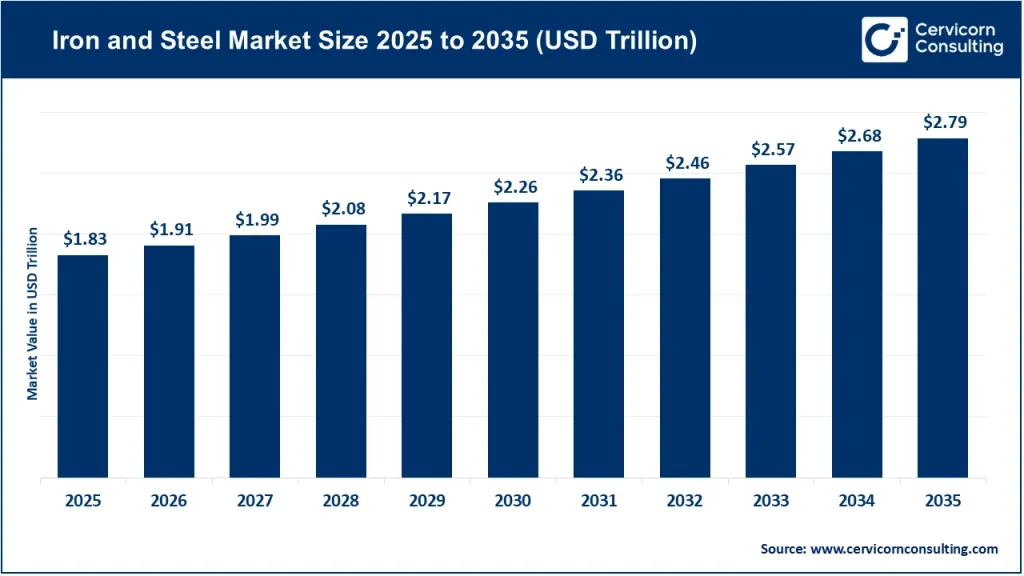
The global iron and steel market was valued at approximately USD 1.83 trillion in 2025 and is projected to exceed USD 2.79 trillion by 2035, growing at a CAGR of 4.31% from 2026 to 2035. However, market expansion alone may not guarantee profitability. Infrastructure investment, manufacturing expansion and urbanization continue to create opportunities, particularly in India and Southeast Asia. At the same time, excess global capacity, volatile raw-material prices, trade restrictions and rising decarbonization requirements are changing how steel companies evaluate their next investments.
Global steel demand is projected to grow modestly over the coming years, while the OECD warns that excess steelmaking capacity could reach 745 million tonnes by 2028. This imbalance makes capacity utilization, production costs and market selection increasingly important for steel producers.
For businesses across the iron and steel value chain, the challenge is to identify where demand is commercially attractive, which investments can generate sustainable returns and how to remain competitive as market conditions change.
Here are six decisions worth evaluating.
1. Where Should Capacity Expansion Be Prioritized?
Expanding production capacity can help companies capture rising demand, but new capacity does not automatically translate into higher profits. The location, timing and intended customer base of an investment can be just as important as its scale.
India presents a significant opportunity. Domestic steel consumption exceeded 164 million tonnes in FY 2025–26, supported by infrastructure development and demand from automotive and other industrial sectors. At the same time, capacity additions are increasing the importance of balancing production growth with actual consumption.
Before approving an expansion, businesses should assess:
- Regional demand visibility: Which infrastructure, construction, automotive and manufacturing projects are likely to generate sustained steel demand?
- Capacity utilization: Can the proposed facility operate at commercially viable utilization levels under conservative demand assumptions?
- Location economics: How will proximity to iron ore, coal, scrap, ports, customers and transport networks affect delivered costs?
- Expansion flexibility: Can capacity be added in phases to reduce exposure to uncertain demand?
Business implication: Expansion decisions should be based on achievable sales volumes and expected margins rather than national demand forecasts alone.
Get a Free Sample: https://www.cervicornconsulting.com/sample/2801
2. How Can Companies Reduce Exposure to Raw-Material Price Volatility?
Iron ore, coking coal, scrap, alloys and electricity have a direct influence on steel production costs. Sudden price movements can weaken margins, particularly when producers cannot immediately pass higher costs on to customers.
The appropriate sourcing strategy depends on the production route, geographic location, supplier concentration and availability of alternative inputs.
Companies should evaluate whether to secure long-term supply contracts, diversify suppliers, invest in captive mining, increase scrap utilization or build inventory buffers for strategically important materials.
Key decisions include:
- Supplier diversification: Would additional suppliers reduce exposure to geopolitical disruptions, transport delays or concentrated sourcing?
- Contract structure: Should procurement rely on fixed-price contracts, index-linked agreements or a combination of both?
- Inventory management: What stock levels balance supply continuity against working-capital costs and the risk of holding expensive inventory?
- Input substitution: Can alternative grades, higher-quality scrap or process improvements reduce costs without compromising product specifications?
Business implication: The objective is not simply to buy raw materials at the lowest price. It is to maintain a predictable cost base while protecting production continuity and product quality.
3. Which Steel Products Offer Better Margin Opportunities?
Steel producers often face a strategic choice between maximizing volumes in commodity products and expanding into higher-value segments. The right balance depends on customer requirements, technical capabilities, competitive intensity and the cost of qualifying new products.
Demand from infrastructure and construction supports opportunities in long products, while automotive, renewable energy, machinery, electrical equipment and specialized manufacturing create requirements for different grades and specifications.
Companies evaluating a product-mix shift should consider:
- Customer concentration: Is demand supported by a diversified customer base or a small number of large buyers?
- Technical differentiation: Can the company produce grades that require specialized processing, consistent quality or demanding certification?
- Margin sustainability: Will the expected premium cover additional processing, quality assurance, R&D and customer-qualification costs?
- Downstream integration: Could processing, coating, fabrication or customized steel solutions improve customer retention and profitability?
Moving into a specialized segment can create stronger customer relationships, but it may also require additional capital, technical expertise and longer qualification cycles.
Business implication: Product diversification should prioritize segments where the company can establish a defensible cost, quality or service advantage rather than simply chase reported market growth.
4. How Should Companies Respond to Trade Barriers and Changing Regional Demand?
Steel is particularly exposed to changes in tariffs, import restrictions, trade remedies and regional industrial policies. A market that offers attractive demand growth may not provide the same commercial opportunity once duties, compliance expenses and freight costs are included.
India’s steel industry illustrates this complexity. Domestic demand has remained resilient, while exporters face challenges from protectionist measures and evolving carbon-related trade requirements. At the same time, global excess capacity can intensify price competition in export markets.
Before entering a new market or increasing export exposure, businesses should assess:
- Landed-cost competitiveness: How do tariffs, freight, insurance, duties and local distribution expenses affect the final selling price?
- Trade-policy exposure: Which markets have changing safeguard measures, import quotas or product-specific restrictions?
- Customer diversification: Would serving additional countries or industries reduce dependence on one demand center?
- Regulatory readiness: Can the company meet local product standards, traceability requirements and applicable emissions-disclosure rules?
Business implication: Export strategy should account for the total cost of market access and the durability of customer demand, not just the size of the addressable market.
5. Which Decarbonization Investments Are Commercially Viable?
Steel producers face growing pressure to reduce emissions while maintaining cost competitiveness. Potential pathways include greater scrap utilization, energy efficiency, electric arc furnace (EAF) production, renewable electricity, hydrogen-based direct reduced iron (DRI) and carbon capture technologies.
However, these options differ significantly in capital requirements, infrastructure needs, technological maturity and operating costs. A transition strategy that works in one region may not be economically viable in another.
Research published by IEEFA in April 2026 highlighted a gap between the decarbonization commitments of major Indian steel companies and their progress in aligning operational plans and capital allocation with those commitments.
Companies should evaluate four factors before committing to a decarbonization pathway:
-
Emissions reduction potential: Which production processes contribute most to the company’s emissions, and where can reductions be achieved most effectively?
-
Energy availability: Can the facility secure reliable, competitively priced renewable electricity, green hydrogen or other required inputs?
-
Investment returns: What are the expected capital costs, operating savings, financing requirements and payback periods under different scenarios?
-
Customer and regulatory requirements: Are buyers willing to reward lower-emission steel, and which current or anticipated regulations apply to the company’s target markets?
Business implication: Decarbonization investments should be evaluated against measurable emissions reductions, operating economics and customer demand. Phased implementation can help companies manage uncertainty while building capabilities for future requirements.
6. Where Can Digital Technologies Improve Operational Performance?
As steelmakers expand capacity and manage increasingly complex production systems, digital technologies can improve visibility across manufacturing, maintenance, procurement and quality control.
Artificial intelligence, predictive maintenance, advanced process control and production analytics can help companies identify inefficiencies that are difficult to detect through conventional reporting alone.
The Ministry of Steel’s digital roadmap, unveiled in February 2026, reflects India’s focus on using AI, automation and data-driven decision-making across the steel value chain.
Before investing in new systems, businesses should identify where digitalization can deliver measurable operational value:
-
Predictive maintenance: Can equipment monitoring reduce unplanned downtime and maintenance expenses?
-
Process optimization: Can analytics improve yield, energy consumption, throughput or product consistency?
-
Quality management: Can automated inspection identify defects earlier and reduce rework or material losses?
-
Supply-chain visibility: Can integrated data improve inventory planning, delivery reliability and procurement decisions?
Technology investments should be evaluated against clearly defined operational baselines. Implementation costs, data quality, system integration, workforce readiness and cybersecurity also need consideration.
Business implication: The strongest digital investments address specific operational constraints and demonstrate improvements in cost, quality, reliability or production efficiency.
To Get Detailed Overview, Contact Us: https://www.cervicornconsulting.com/contact-us
Read Report: Combined Heat and Power: 5 Decisions That Determine Whether an Investment Delivers Strong Returns