


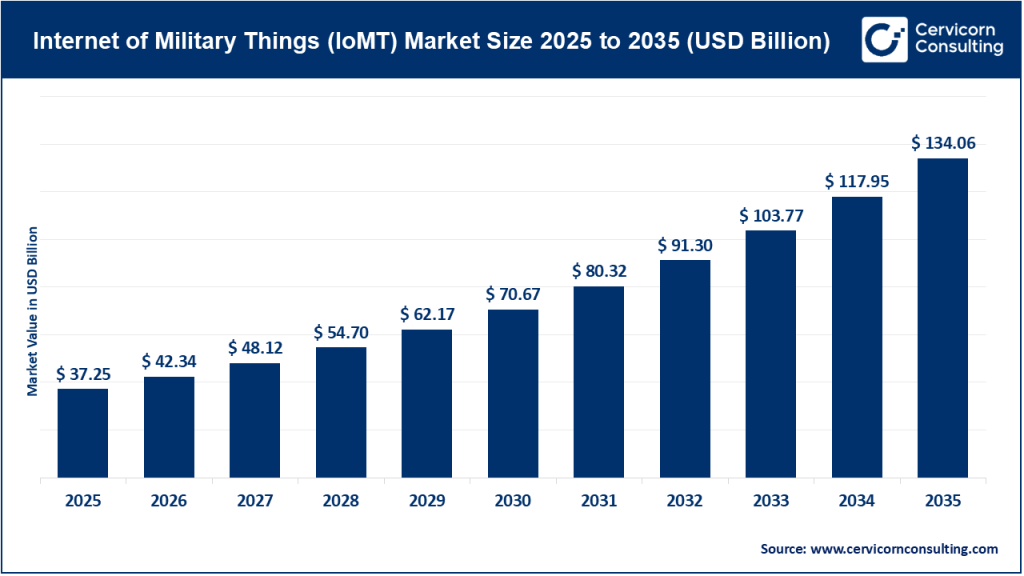
Internet of Military Things Market Size
The global Internet of military things market is experiencing rapid expansion, with estimates indicating growth from approximately USD 37.25 billion in 2025 to over USD 134.06 billion by 2035 with a CAGR of 13.66%, reflecting strong adoption of connected battlefield technologies and modernization initiatives worldwide.
What is the Internet of Military Things Market?
The Internet of Military Things refers to a highly interconnected ecosystem of smart military devices, sensors, vehicles, weapons systems, and communication platforms that use advanced networking technologies to collect, transmit, and analyze real-time data across defense environments. It is an extension of the broader Internet of Things (IoT), specifically tailored for military applications, enabling seamless communication between soldiers, command centers, unmanned systems, and battlefield equipment.
IoMT integrates technologies such as artificial intelligence (AI), machine learning, cloud computing, edge computing, and advanced communication networks (including 5G and satellite systems) to enhance situational awareness, operational coordination, and mission efficiency. These systems operate across land, air, naval, and space domains, supporting defense forces in intelligence gathering, surveillance, reconnaissance (ISR), logistics, and combat operations.
Why is the Internet of Military Things Important?
The importance of IoMT lies in its ability to transform traditional military operations into data-driven, network-centric warfare systems. Modern warfare increasingly relies on speed, precision, and real-time intelligence—areas where IoMT plays a critical role.
Firstly, IoMT enhances situational awareness, allowing commanders to access real-time battlefield data from multiple sources, including drones, sensors, and wearable devices. This leads to faster and more informed decision-making. Secondly, it improves operational efficiency and coordination, enabling seamless communication between different military units and reducing response time during critical missions.
Additionally, IoMT significantly contributes to force protection and soldier safety. Wearable sensors can monitor soldier health, fatigue levels, and environmental conditions, while autonomous systems reduce the need for human involvement in high-risk missions. It also supports predictive maintenance of military equipment, minimizing downtime and ensuring mission readiness.
Furthermore, IoMT plays a key role in cyber warfare and defense, as modern military operations depend heavily on secure data transmission and network resilience. Advanced encryption, blockchain-based communication, and quantum-resistant protocols are increasingly being integrated into IoMT systems to safeguard sensitive defense data.
Internet of Military Things Market Growth Factors
The growth of the Internet of Military Things (IoMT) market is driven by a combination of rising global defense budgets, increasing geopolitical tensions, and the growing need for advanced situational awareness and real-time intelligence in modern warfare; military organizations worldwide are investing heavily in modernization programs that integrate AI, machine learning, and edge computing into connected battlefield ecosystems, while the rapid adoption of next-generation communication technologies such as 5G, satellite networks, and secure mesh networks is enhancing data transmission and interoperability across defense platforms.
Additionally, the increasing deployment of unmanned systems, smart sensors, and wearable devices, coupled with the demand for predictive maintenance and efficient logistics, is accelerating IoMT adoption, as these technologies enable improved operational efficiency, mission effectiveness, and decision-making capabilities across land, air, and naval forces.
Get a Free Sample: https://www.cervicornconsulting.com/sample/2914
Key Companies in the IoMT Market
Below is a structured overview of major players in the IoMT ecosystem:
| Company | Specialization | Key Focus Areas | Notable Features | 2024 Revenue (Approx.) | Market Share | Global Presence |
|---|---|---|---|---|---|---|
| Lockheed Martin Corporation | Aerospace & defense systems | Autonomous systems, AI-enabled warfare, ISR | Advanced fighter jets, missile systems, IoMT integration | ~$67B | Significant | North America, Europe, Asia |
| Raytheon Technologies (RTX) | Defense electronics & cybersecurity | Missile defense, radar systems, connected sensors | Strong AI & cybersecurity capabilities | ~$69B | Strong | Global (US, Europe, Middle East, Asia) |
| Northrop Grumman Corporation | Advanced defense technology | Autonomous drones, space systems, C4ISR | Leader in unmanned systems & surveillance | ~$39B | High | US, Europe, Asia-Pacific |
| BAE Systems plc | Defense & security solutions | Electronic warfare, naval systems, IoT integration | Strong presence in cybersecurity & combat systems | ~$26B | Prominent | Europe, US, Middle East |
| Thales Group | Aerospace, defense & digital security | Secure communications, IoT platforms, AI systems | Expertise in secure IoMT networks | ~$20B | Growing | Europe, Asia, Middle East |
Note: Revenue figures are approximate industry estimates based on recent financial disclosures.
These companies are heavily investing in IoMT technologies, including connected sensors, battlefield networks, AI-driven analytics, and secure communication systems, positioning themselves as leaders in the evolving defense landscape.
Leading Trends and Their Impact
1. Integration of Artificial Intelligence and Machine Learning
AI and ML are transforming IoMT by enabling predictive analytics, autonomous decision-making, and real-time threat detection. These technologies allow military systems to process vast amounts of data quickly, improving mission outcomes and reducing human intervention.
2. Rise of Autonomous Systems
Unmanned aerial vehicles (UAVs), ground robots, and autonomous naval systems are becoming integral to IoMT ecosystems. These systems enhance surveillance, reconnaissance, and combat capabilities while minimizing risks to personnel.
3. Edge Computing and Real-Time Processing
Edge computing enables data processing closer to the source, reducing latency and ensuring faster decision-making in critical situations. This is particularly important in battlefield environments where real-time intelligence is crucial.
4. Advanced Cybersecurity Solutions
With increasing connectivity comes higher vulnerability to cyber threats. IoMT systems are adopting advanced cybersecurity measures, including encryption, blockchain, and zero-trust architectures, to protect sensitive data and ensure secure communications.
5. 5G and Next-Generation Communication Networks
The deployment of 5G and satellite-based communication systems is enhancing connectivity, enabling faster data transfer and improved interoperability between military platforms.
6. Wearable Military Devices
Wearable IoMT devices are gaining traction for monitoring soldier health, location, and performance, improving both safety and operational efficiency.
Successful Examples of IoMT Around the World
United States – Joint All-Domain Command and Control (JADC2)
The U.S. Department of Defense is implementing JADC2, a large-scale IoMT initiative that connects sensors and shooters across all military branches. This system enables real-time data sharing and coordinated operations across land, air, sea, space, and cyber domains.
United Kingdom – Network-Enabled Capability (NEC)
The UK Ministry of Defence has developed NEC, which integrates IoMT technologies to improve communication and coordination between military units, enhancing mission effectiveness.
Israel – Integrated Battlefield Systems
Israel has deployed advanced IoMT systems that combine drones, sensors, and AI analytics to provide real-time intelligence and rapid response capabilities.
China – Intelligentized Warfare Strategy
China is heavily investing in IoMT as part of its “intelligentized warfare” strategy, focusing on AI-driven systems, autonomous weapons, and integrated battlefield networks.
India – Defense Digital Transformation Initiatives
India is adopting IoMT through initiatives such as network-centric warfare systems, indigenous drone development, and AI-based surveillance platforms, aimed at strengthening national security and operational readiness.
Global Regional Analysis Including Government Initiatives and Policies
North America
North America dominates the IoMT market, accounting for a significant share in 2024. The United States leads the region due to its substantial defense budget and strong focus on technological innovation.
Government initiatives such as JADC2, investments in AI and autonomous systems, and collaborations with private defense contractors are driving market growth. The U.S. Department of Defense is actively promoting digital transformation and network-centric warfare, ensuring continuous adoption of IoMT technologies.
Canada is also investing in IoMT for border security and joint defense operations, further strengthening regional growth.
Europe
Europe represents the second-largest IoMT market, driven by increasing defense spending and regional security concerns. Countries such as the United Kingdom, Germany, and France are investing heavily in digital defense systems.
The European Defence Fund (EDF) and NATO collaborations are key initiatives supporting IoMT adoption. Additionally, programs focused on digital sovereignty and secure communication networks are accelerating the deployment of IoMT technologies across the region.
Asia-Pacific
Asia-Pacific is the fastest-growing region in the IoMT market, fueled by rising geopolitical tensions and increasing defense budgets. Countries like China, India, Japan, and South Korea are investing in advanced military technologies and indigenous defense systems.
Government policies promoting self-reliance, such as India’s “Make in India” initiative and China’s military modernization programs, are driving IoMT adoption. The region is witnessing rapid integration of AI, drones, and smart surveillance systems, making it a key growth hub.
Middle East & Africa
The Middle East & Africa region is experiencing steady growth in IoMT adoption, primarily driven by investments in border security, counter-terrorism, and critical infrastructure protection. Countries such as Saudi Arabia, UAE, and Israel are investing in advanced surveillance and defense technologies.
Government initiatives focusing on national security and modernization are supporting the deployment of IoMT systems, particularly in high-risk areas.
Latin America
Latin America is an emerging market for IoMT, with countries investing in defense modernization and security infrastructure. While the market is relatively smaller compared to other regions, increasing focus on border control and internal security is driving adoption.
To Get Detailed Overview, Contact Us: https://www.cervicornconsulting.com/contact-us
Read Report: Physical AI Market Revenue, Trends, and Strategic Insights by 2035