


Physical AI Market Size
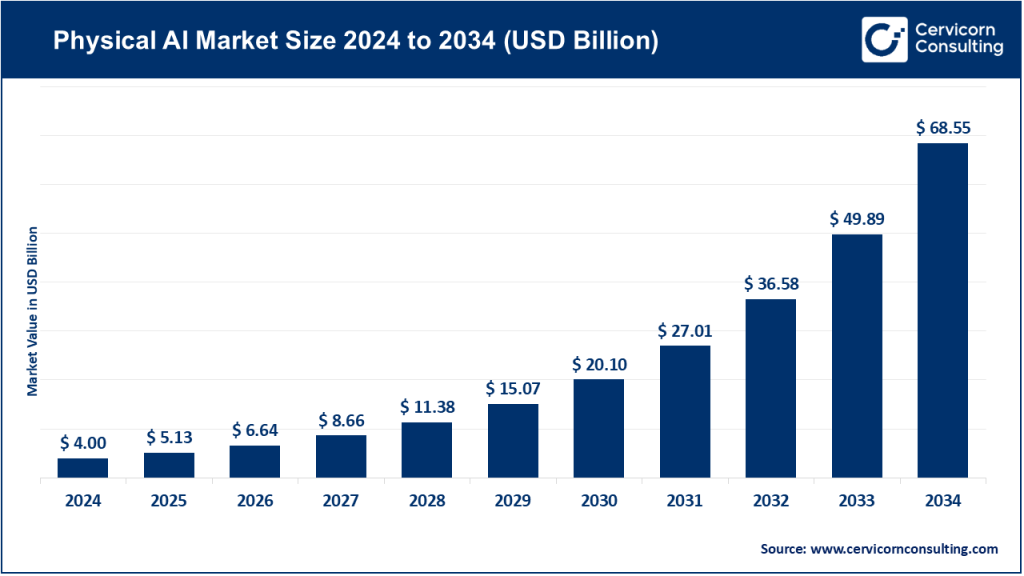
The global physical AI market size was worth USD 5.13 billion in 2025 and is anticipated to expand to around USD 68.54 billion by 2034, registering a compound annual growth rate (CAGR) of 33.49% from 2026 to 2035.
What is the Physical AI Market?
The physical AI market refers to the global industry focused on integrating artificial intelligence with machines that can perceive, analyze, and interact with the physical world. Unlike traditional software-based AI systems, physical AI involves embodied systems such as robots, autonomous vehicles, drones, smart manufacturing machines, and AI-powered medical devices that perform tasks in real-world environments. These systems rely on a combination of advanced technologies including robotics, sensors, computer vision, machine learning, reinforcement learning, and edge computing to sense surroundings and make autonomous decisions.
Physical AI systems typically combine perception, cognition, and actuation, enabling machines to analyze environmental data, interpret complex scenarios, and take physical action such as moving objects, navigating spaces, or performing surgery. Industries including manufacturing, healthcare, logistics, agriculture, construction, defense, and retail are increasingly adopting these systems to enhance productivity, safety, and operational efficiency.
Physical AI Market Growth Factors
The growth of the physical AI market is primarily driven by the increasing demand for intelligent automation across multiple industries, rapid advancements in robotics and sensor technologies, and the rising adoption of autonomous systems in sectors such as manufacturing, healthcare, logistics, and defense. As organizations strive to improve productivity, reduce operational costs, and address global labor shortages, businesses are increasingly deploying AI-powered robots and autonomous machines capable of performing repetitive, dangerous, or highly precise tasks. Advances in computer vision, reinforcement learning, and edge AI have significantly improved the ability of machines to understand complex environments and operate independently. Additionally, the declining cost of sensors, GPUs, and robotic hardware has made physical AI solutions more accessible for enterprises of all sizes.
Governments and private investors are also allocating significant funding toward robotics innovation, smart manufacturing initiatives, and AI infrastructure development. The expansion of e-commerce logistics, autonomous mobility systems, and AI-assisted healthcare technologies further contributes to market expansion. As a result, the physical AI industry is witnessing rapid commercialization and is expected to continue expanding at a CAGR exceeding 30% over the next decade, transforming how machines interact with the real world.
Get a Free Sample: https://www.cervicornconsulting.com/sample/2741
Why the Physical AI Market is Important
Physical AI represents a transformative shift in the evolution of artificial intelligence because it enables digital intelligence to interact with the real world. While earlier AI systems primarily focused on data analysis and digital services, physical AI extends these capabilities into real-world operations, enabling machines to physically manipulate objects, navigate environments, and collaborate with humans.
One of the major reasons this market is important is its potential to solve global labor shortages in industries such as manufacturing, logistics, agriculture, and healthcare. Autonomous robots and AI-powered machines can perform repetitive or hazardous tasks that humans may find difficult or unsafe.
Another important aspect is the improvement in operational efficiency and productivity. Physical AI systems can work continuously with high precision, reducing errors and increasing manufacturing output. In healthcare, AI-assisted surgical robots help doctors perform complex procedures with improved accuracy and minimal invasiveness.
Additionally, physical AI plays a crucial role in next-generation technologies, including smart factories, autonomous vehicles, intelligent warehouses, and service robots. These technologies are fundamental to the development of Industry 4.0 and smart cities. As physical AI continues to evolve, it is expected to reshape global supply chains, improve safety standards, and enable new business models across multiple sectors.
Major Companies in the Physical AI Market
SoftBank Robotics Group
- Specialization: Service robots and humanoid robotics
- Key Focus Areas: Human–robot interaction, service robotics, and AI-enabled humanoid assistants
- Notable Features: Known for developing robots such as Pepper and NAO that interact with humans in retail, hospitality, and healthcare environments
- 2024 Revenue: SoftBank Group reported approximately USD 46 billion in overall revenue
- Market Share: Estimated 3–5% of the global service robotics segment
- Global Presence: Japan, North America, Europe, and Asia
SoftBank Robotics Group is one of the pioneers in social robotics and AI-powered service robots. The company focuses on building humanoid robots capable of interacting naturally with humans using voice recognition, emotion detection, and AI-driven learning. Its robots are widely deployed in retail stores, airports, hospitals, and customer service environments.
ABB
- Specialization: Industrial robotics and automation solutions
- Key Focus Areas: Smart factories, industrial robotics, collaborative robots, and AI-powered automation
- Notable Features: Advanced robotics platforms used in manufacturing, logistics, and automotive production
- 2024 Revenue: Approximately USD 32 billion
- Market Share: Around 10–12% of the global industrial robotics market
- Global Presence: Operations in more than 100 countries
ABB is one of the world’s leading providers of industrial automation and robotics solutions. The company develops AI-powered robots capable of performing complex industrial tasks such as welding, assembly, and material handling. ABB’s robots are widely used in automotive manufacturing and electronics production.
Toyota Motor Corporation
- Specialization: Autonomous mobility and robotics technology
- Key Focus Areas: Autonomous vehicles, mobility robotics, and AI-driven manufacturing systems
- Notable Features: Development of human-support robots and AI-based mobility systems
- 2024 Revenue: Over USD 300 billion
- Market Share: Significant presence in mobility robotics and automotive automation
- Global Presence: More than 170 countries
Toyota has been investing heavily in robotics and artificial intelligence through initiatives such as the Toyota Research Institute. The company develops service robots for elderly care, autonomous driving technologies, and AI-powered factory automation systems.
FANUC
- Specialization: Factory automation and industrial robots
- Key Focus Areas: CNC systems, robotic automation, and AI-based manufacturing
- Notable Features: High-precision robotic arms used in manufacturing and electronics production
- 2024 Revenue: Approximately USD 6–7 billion
- Market Share: Around 15–20% of the global industrial robot market
- Global Presence: Over 100 countries
FANUC is a global leader in industrial robotics and factory automation technologies. Its AI-powered robots are widely used in automotive assembly lines, semiconductor manufacturing, and logistics automation.
Siemens
- Specialization: Industrial AI, automation, and digital manufacturing
- Key Focus Areas: Smart manufacturing, digital twins, and AI-driven industrial systems
- Notable Features: Integration of AI with industrial automation platforms
- 2024 Revenue: Around USD 80 billion
- Market Share: Significant presence in industrial automation and smart manufacturing
- Global Presence: Operations in more than 190 countries
Siemens plays a major role in the physical AI ecosystem by combining industrial software with automation hardware. The company’s AI-powered platforms enable factories to optimize production processes, predictive maintenance, and supply chain management.
Leading Trends in the Physical AI Market and Their Impact
Rise of Autonomous Robots
Autonomous robots are becoming increasingly capable of operating in complex environments such as warehouses, factories, and hospitals. Advances in AI algorithms allow robots to adapt to changing conditions and learn from experience. This trend is accelerating automation across industries.
Integration of AI with Edge Computing
Edge computing enables physical AI systems to process data locally rather than relying on cloud infrastructure. This reduces latency and allows robots to make real-time decisions in critical situations such as surgical procedures or autonomous driving.
Growth of Collaborative Robots (Cobots)
Collaborative robots are designed to work safely alongside human workers. Cobots are gaining popularity in manufacturing environments because they increase productivity while maintaining workplace safety.
AI-Powered Smart Manufacturing
Smart factories are integrating robotics, IoT sensors, and AI analytics to optimize production processes. Physical AI enables predictive maintenance, automated quality inspection, and efficient resource management.
Expansion of Humanoid Robotics
Humanoid robots are emerging as a major trend in physical AI. These robots are designed to perform tasks traditionally carried out by humans, such as warehouse operations, customer service, and caregiving.
Successful Examples of Physical AI Market Applications Around the World
Amazon Robotics
Amazon operates hundreds of thousands of robots in its fulfillment centers to automate warehouse operations. These robots transport goods, sort packages, and assist workers in order fulfillment, significantly improving efficiency and reducing operational costs.
Boston Dynamics Robots
Robots developed by Boston Dynamics, such as Spot and Atlas, demonstrate advanced physical AI capabilities including dynamic movement, object handling, and autonomous navigation. These robots are used in industrial inspections, construction monitoring, and security operations.
Autonomous Vehicles
Self-driving vehicles represent one of the most advanced applications of physical AI. These vehicles use sensors, cameras, and machine learning algorithms to understand road conditions and navigate traffic without human intervention.
AI-Powered Surgical Robots
Surgical robotics systems powered by artificial intelligence are transforming healthcare by enabling surgeons to perform minimally invasive procedures with greater precision, improved visualization, and faster patient recovery times.
Global Regional Analysis and Government Initiatives
North America
North America is one of the largest markets for physical AI technologies due to strong technological infrastructure, significant investments in artificial intelligence research, and the presence of leading robotics companies. The United States plays a dominant role in innovation, supported by government programs promoting AI development, robotics research funding, and partnerships between universities and technology companies. Major technology firms and startups in the region are heavily investing in autonomous robots, industrial automation systems, and AI-powered logistics solutions.
Europe
Europe is actively supporting robotics and automation through collaborative research programs and industrial partnerships. Countries such as Germany, France, and the United Kingdom are investing heavily in smart manufacturing and Industry 4.0 initiatives. Government policies and funding programs encourage the development of AI-driven automation technologies while ensuring ethical standards and regulatory frameworks for responsible AI deployment.
Asia-Pacific
The Asia-Pacific region is expected to experience the fastest growth in the physical AI market due to rapid industrialization and widespread adoption of robotics in manufacturing. Countries such as China, Japan, and South Korea are global leaders in robotics production and deployment. Government initiatives supporting robotics innovation, advanced manufacturing technologies, and AI research are accelerating the adoption of physical AI across industries including electronics manufacturing, automotive production, and logistics.
China has become one of the largest markets for industrial robots, supported by national strategies aimed at strengthening domestic robotics manufacturing capabilities and promoting automation across industries. Japan continues to lead in robotics innovation, while South Korea has one of the highest robot densities in manufacturing worldwide.
Latin America
Latin America is gradually adopting physical AI technologies in sectors such as mining, agriculture, and logistics. Countries including Brazil and Mexico are investing in automation technologies to improve manufacturing competitiveness and enhance productivity in industrial sectors.
Middle East and Africa
The Middle East and Africa region is emerging as a growing market for robotics and artificial intelligence technologies. Governments in countries such as the United Arab Emirates and Saudi Arabia are investing in smart city initiatives, AI-driven infrastructure, and automation systems. These investments are expected to drive demand for physical AI solutions in transportation, public services, and urban development projects.
To Get Detailed Overview, Contact Us: https://www.cervicornconsulting.com/contact-us
Read Report: Aluminum Alloys Market Revenue, Trends, and Strategic Insights by 2035