


Internet of Medical Things (IoMT) Market Size
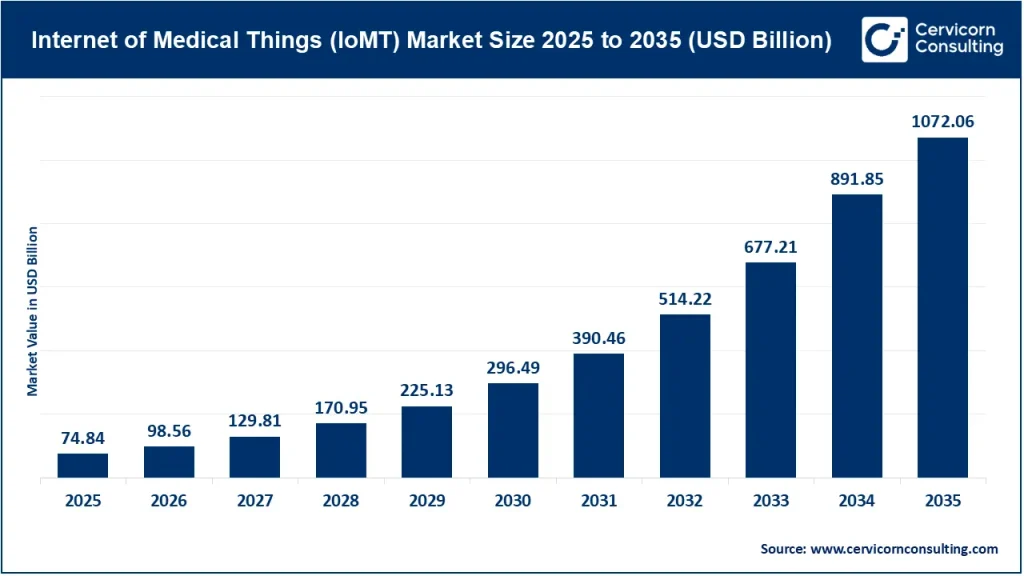
The global internet of medical things (IoMT) market was valued at approximately USD 74.84 billion in 2025 and is projected to reach USD 1072.06 billion by 2035, expanding at a CAGR of 30.5% during the forecast period.
Internet of Medical Things (IoMT) Market Growth Factors
The global Internet of Medical Things (IoMT) market is witnessing remarkable growth due to the rapid adoption of connected medical devices, increasing prevalence of chronic diseases, rising demand for remote patient monitoring, expanding telehealth services, and continuous advancements in artificial intelligence (AI), cloud computing, and 5G connectivity. Healthcare providers are increasingly investing in digital transformation initiatives to improve patient outcomes, reduce operational costs, and enable real-time clinical decision-making. Government initiatives promoting electronic health records (EHR), digital healthcare infrastructure, cybersecurity standards, and smart hospitals are further accelerating market expansion.
Additionally, the growing aging population, increased smartphone penetration, wearable health devices, and favorable reimbursement policies for remote healthcare services continue to drive the widespread implementation of IoMT solutions across hospitals, clinics, diagnostic laboratories, home healthcare settings, and ambulatory care centers.
Get a Free Sample: https://www.cervicornconsulting.com/sample/2704
What is the Internet of Medical Things (IoMT) Market?
The Internet of Medical Things (IoMT) market refers to the ecosystem of interconnected medical devices, healthcare software, wearable technologies, cloud platforms, sensors, and communication networks that collect, transmit, analyze, and share patient health data in real time.
IoMT combines Internet of Things (IoT) technologies with healthcare systems to create connected environments where medical devices communicate seamlessly with healthcare providers and patients. These devices include wearable fitness trackers, glucose monitors, ECG patches, smart inhalers, connected insulin pumps, implantable cardiac devices, hospital equipment, imaging systems, infusion pumps, and remote monitoring solutions.
IoMT enables continuous patient monitoring, predictive analytics, personalized treatment, and proactive disease management while improving operational efficiency across healthcare organizations.
The market includes:
- Remote patient monitoring devices
- Connected imaging systems
- Smart hospital equipment
- Wearable medical devices
- Implantable connected devices
- Cloud-based healthcare platforms
- AI-powered healthcare analytics
- Medical cybersecurity solutions
- Telemedicine infrastructure
- Connected diagnostic equipment
Why is the Internet of Medical Things (IoMT) Market Important?
The healthcare industry is undergoing one of its largest digital transformations, and IoMT is at the center of this evolution.
Its importance includes:
Improved Patient Outcomes
Continuous monitoring allows physicians to detect health complications before they become critical, leading to earlier interventions and improved survival rates.
Better Chronic Disease Management
Patients suffering from diabetes, cardiovascular diseases, COPD, hypertension, and neurological disorders benefit significantly from connected medical devices that continuously monitor vital parameters.
Reduced Hospital Readmissions
Real-time patient monitoring enables healthcare providers to identify warning signs early, reducing emergency admissions and hospital readmissions.
Increased Healthcare Accessibility
IoMT makes quality healthcare available in rural and underserved areas through remote consultations and connected diagnostic systems.
Lower Healthcare Costs
Remote monitoring minimizes unnecessary hospital visits, shortens inpatient stays, and optimizes resource allocation, significantly reducing healthcare expenditures.
Enhanced Clinical Decision Making
AI-powered IoMT platforms provide healthcare professionals with actionable insights derived from continuous patient data, improving diagnosis and treatment accuracy.
Major Companies Operating in the Internet of Medical Things (IoMT) Market
| Company | Specialization | Key Focus Areas | Notable Features | 2025 Revenue (Approx.) | Estimated Market Share | Global Presence |
|---|---|---|---|---|---|---|
| Medtronic | Connected medical devices | Diabetes management, cardiac care, neuromodulation | Connected insulin pumps, implantable monitoring systems | USD 33–34 Billion | High | More than 150 countries |
| GE Healthcare | Connected imaging and digital healthcare | Imaging, AI diagnostics, hospital monitoring | Edison digital platform, AI-enabled diagnostics | USD 20–21 Billion | High | 160+ countries |
| Philips Healthcare | Patient monitoring and connected care | Telehealth, imaging, ICU monitoring | Remote patient monitoring ecosystem | USD 19–20 Billion | High | 100+ countries |
| Siemens Healthineers | Digital diagnostics and smart hospitals | Imaging, laboratory diagnostics, AI solutions | Integrated digital hospital ecosystem | USD 25–27 Billion | Significant | 180+ countries |
| Abbott Laboratories | Wearable healthcare technologies | Diabetes care, cardiovascular monitoring | FreeStyle Libre continuous glucose monitoring | USD 42–43 Billion | High | More than 160 countries |
Note: Revenue figures are approximate company-wide revenues for 2025 and market share estimates represent their relative position within the connected healthcare and IoMT ecosystem.
Leading Trends Shaping the Internet of Medical Things (IoMT) Market and Their Impact
AI-Powered Predictive Healthcare
Artificial intelligence has become one of the strongest growth drivers for IoMT.
Machine learning algorithms analyze massive amounts of patient data collected from connected devices to predict disease progression, identify abnormalities, and recommend preventive interventions.
Impact
- Faster diagnosis
- Reduced clinical errors
- Personalized treatment plans
- Predictive patient care
Remote Patient Monitoring Becoming Standard Care
Healthcare providers increasingly deploy wearable sensors and connected monitoring devices that continuously track patient health outside hospitals.
This trend gained momentum after the COVID-19 pandemic and continues to expand rapidly.
Impact
- Reduced hospitalization
- Improved patient engagement
- Better chronic disease management
- Lower healthcare costs
Smart Hospitals
Hospitals are becoming digitally connected through IoMT-enabled infrastructure.
Connected beds, smart infusion pumps, wireless monitoring systems, automated medication management, and AI-assisted imaging create integrated healthcare environments.
Impact
- Higher operational efficiency
- Reduced equipment downtime
- Better patient safety
- Improved hospital workflow
Wearable Medical Devices
Consumer health wearables are evolving into clinically validated medical devices capable of monitoring ECG, blood pressure, oxygen saturation, glucose levels, and sleep disorders.
Impact
- Preventive healthcare
- Continuous wellness monitoring
- Increased patient participation
- Early disease detection
Integration with Electronic Health Records (EHR)
IoMT devices increasingly integrate with hospital information systems and electronic medical records.
Healthcare providers gain instant access to patient histories, imaging reports, laboratory results, and real-time monitoring data.
Impact
- Improved clinical coordination
- Reduced medical errors
- Faster treatment decisions
- Better healthcare efficiency
Cloud-Based Healthcare Platforms
Cloud computing enables secure storage and instant sharing of patient information among physicians, laboratories, hospitals, and insurance providers.
Impact
- Scalable healthcare infrastructure
- Lower IT costs
- Better collaboration
- Faster data accessibility
Cybersecurity Becoming a Priority
As connected healthcare devices continue increasing, protecting patient information has become a major industry priority.
Manufacturers invest heavily in:
- Device authentication
- Secure firmware
- End-to-end encryption
- Zero-trust security architecture
Impact
- Higher patient trust
- Regulatory compliance
- Reduced cyber risks
- Improved healthcare resilience
Digital Therapeutics Integration
IoMT devices are increasingly integrated with digital therapeutics that combine connected monitoring with behavioral interventions and medication adherence.
Impact
- Better disease management
- Improved patient outcomes
- Higher treatment adherence
- Personalized healthcare delivery
Successful Examples of Internet of Medical Things (IoMT) Around the World
Abbott FreeStyle Libre
Abbott’s FreeStyle Libre has revolutionized diabetes management through continuous glucose monitoring.
Patients receive real-time glucose readings without frequent finger-prick tests, while physicians remotely monitor patient data for timely interventions.
Medtronic Connected Insulin Pumps
Medtronic offers smart insulin delivery systems connected to continuous glucose monitoring devices.
These systems automatically adjust insulin delivery based on blood glucose levels, significantly improving diabetes management.
Philips eICU Program
Philips developed one of the world’s largest connected intensive care ecosystems.
Critical care specialists remotely monitor ICU patients across multiple hospitals, enabling faster clinical responses and improved patient outcomes.
GE Healthcare Edison Platform
GE Healthcare’s Edison platform integrates imaging, AI, analytics, and cloud technologies to enhance diagnostic accuracy and workflow efficiency.
Healthcare professionals can analyze medical imaging alongside patient monitoring data using a unified digital platform.
Siemens Healthineers Digital Hospital Solutions
Siemens Healthineers enables hospitals to connect imaging systems, laboratory diagnostics, patient monitoring, and AI-powered clinical decision support into a unified ecosystem.
This integrated approach improves efficiency and supports data-driven care.
Remote Cardiac Monitoring Programs
Connected cardiac implants and wearable ECG monitors allow physicians to continuously monitor patients with heart conditions.
These systems can automatically alert healthcare providers when abnormal heart rhythms are detected.
Global Regional Analysis of the Internet of Medical Things (IoMT) Market
North America
North America remains the largest IoMT market due to advanced healthcare infrastructure, high digital health investments, widespread adoption of connected devices, and supportive reimbursement systems.
Key Growth Drivers
- Strong healthcare spending
- High wearable device adoption
- AI-enabled hospitals
- Mature cloud infrastructure
- Advanced digital health ecosystem
Government Initiatives and Policies
- Expansion of telehealth reimbursement policies
- National cybersecurity guidance for healthcare systems
- Continued promotion of interoperable electronic health records
- Funding for digital health innovation and connected care
- Programs encouraging remote patient monitoring for chronic disease management
The United States continues to lead global IoMT innovation through partnerships among hospitals, technology companies, insurers, and research institutions.
Europe
Europe represents a highly mature IoMT market supported by universal healthcare systems, medical technology innovation, and strong data protection regulations.
Key Growth Drivers
- Aging population
- Digital healthcare modernization
- Connected diagnostics
- Smart hospitals
- AI adoption
Government Initiatives and Policies
- European Health Data Space initiatives promoting secure health data exchange
- National digital health strategies across member states
- Investments in AI-enabled healthcare
- Funding for connected hospital infrastructure
- Strong cybersecurity and privacy regulations governing medical data
Germany, the United Kingdom, France, Italy, and the Nordic countries continue investing heavily in digital healthcare transformation.
Asia-Pacific
Asia-Pacific is expected to record the fastest market growth due to expanding healthcare infrastructure, rapid digitalization, increasing smartphone adoption, and growing investments in connected healthcare.
Key Growth Drivers
- Large patient population
- Rising chronic diseases
- Government healthcare digitization
- Growing middle class
- Expansion of telemedicine
Government Initiatives and Policies
China
- National digital healthcare development strategies
- Smart hospital initiatives
- AI-driven healthcare innovation
- Investments in connected medical infrastructure
Japan
- Healthcare digital transformation programs
- Aging population support initiatives
- Connected elderly care solutions
- Expansion of robotic and AI healthcare technologies
India
- National Digital Health Mission (NDHM)
- Ayushman Bharat Digital Mission
- Expansion of digital health IDs
- Promotion of telemedicine platforms
- Increasing investments in healthcare interoperability
South Korea
- Smart hospital development
- AI healthcare adoption
- 5G-enabled medical services
- Digital health innovation funding
Latin America
Latin America is gradually embracing IoMT as governments invest in expanding healthcare accessibility and digital transformation.
Key Growth Drivers
- Growing healthcare investments
- Telemedicine adoption
- Smartphone penetration
- Increasing chronic diseases
- Public-private healthcare partnerships
Government Initiatives and Policies
Countries including Brazil, Mexico, Chile, and Colombia are implementing digital health modernization programs that encourage connected healthcare services, electronic records, and remote patient monitoring.
Middle East & Africa
The Middle East is rapidly adopting IoMT technologies as countries diversify their economies and modernize healthcare systems.
Key Growth Drivers
- Smart hospitals
- Government healthcare investment
- AI integration
- Growing private healthcare sector
- Expansion of digital infrastructure
Government Initiatives and Policies
United Arab Emirates
- National Artificial Intelligence Strategy
- Smart healthcare transformation
- Digital hospital investments
- Expansion of telehealth services
Saudi Arabia
- Vision 2030 healthcare transformation
- Digital healthcare infrastructure
- Connected hospital initiatives
- AI-driven medical innovation
Several African countries are also deploying IoMT solutions to improve healthcare access in remote regions through mobile health platforms and connected diagnostic systems.
Future Opportunities in the Internet of Medical Things (IoMT) Market
The future of IoMT extends far beyond remote monitoring. Emerging opportunities include AI-assisted surgical systems, digital twins for personalized medicine, blockchain-secured medical data exchange, edge computing for real-time diagnostics, 5G-enabled connected ambulances, smart implants, robotic rehabilitation, and home-based virtual hospitals. As healthcare systems increasingly shift toward value-based care, IoMT will play a pivotal role in enabling preventive healthcare, reducing treatment costs, improving operational efficiency, and delivering more personalized patient experiences. The convergence of IoMT with AI, cloud computing, advanced analytics, and next-generation connectivity is expected to create a highly interconnected healthcare ecosystem capable of transforming global medical care over the coming decade.
To Get Detailed Overview, Contact Us: https://www.cervicornconsulting.com/contact-us
Read Report: Structural Steel Market Revenue, Trends, and Strategic Insights by 2035