


Table of Contents
ToggleStructural Steel Market Size
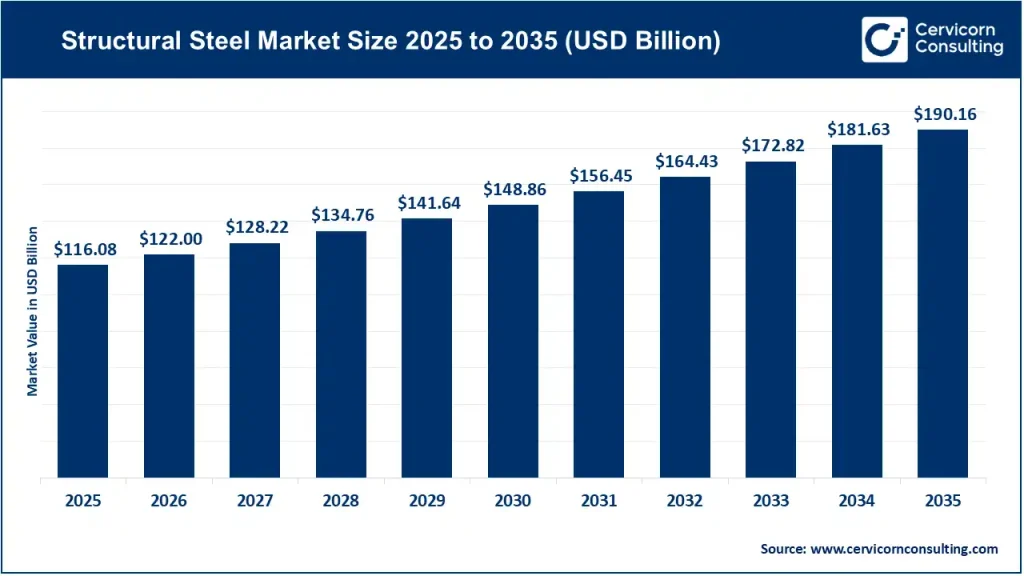
The global structural steel market was valued at approximately USD 116.08 billion in 2025 and is projected to reach USD 190.16 billion by 2035, expanding at a CAGR of 5.06% during the forecast period.
Structural Steel Market Growth Factors
The structural steel market is experiencing strong and sustained growth due to rapid urbanization, increasing infrastructure development, expanding commercial and industrial construction activities, and rising investments in transportation networks across both developed and emerging economies. Governments worldwide are investing heavily in smart cities, highways, airports, railways, bridges, renewable energy projects, and industrial facilities, significantly boosting demand for structural steel. The growing adoption of prefabricated and modular construction methods, combined with advancements in high-strength steel grades and sustainable steel production technologies, is further accelerating market expansion.
Additionally, increasing focus on green buildings, recyclable construction materials, seismic-resistant structures, and lightweight engineering solutions is encouraging architects and contractors to prefer structural steel over traditional construction materials. Technological innovations such as Building Information Modeling (BIM), automation in fabrication, robotic welding, AI-driven project planning, and digital manufacturing are also improving efficiency, reducing project timelines, and driving long-term growth across the global structural steel market.
Get a Free Sample: https://www.cervicornconsulting.com/sample/2699
What is the Structural Steel Market?
The structural steel market refers to the global industry involved in manufacturing, processing, distributing, and supplying steel products specifically engineered for load-bearing construction applications. Structural steel includes beams, columns, channels, angles, plates, tubes, and other fabricated steel components that provide the strength and framework required for buildings, bridges, stadiums, industrial plants, warehouses, offshore platforms, airports, and transportation infrastructure.
Structural steel is produced according to international engineering standards to ensure consistent strength, durability, flexibility, and safety. Unlike conventional steel products, structural steel is designed to withstand heavy loads while maintaining structural integrity over decades of use.
The market encompasses raw steel manufacturers, fabricators, engineering companies, construction firms, infrastructure developers, and distributors that collectively support global construction and industrial development.
Why is the Structural Steel Market Important?
Structural steel serves as the backbone of modern infrastructure and economic development. Nearly every major construction project—from skyscrapers to railway stations—depends on structural steel because of its exceptional mechanical properties and engineering versatility.
Its importance includes:
- Enables construction of high-rise buildings
- Supports transportation infrastructure including bridges and railways
- Essential for airports, ports, and logistics hubs
- Critical for industrial manufacturing facilities
- Preferred material for renewable energy installations
- Highly recyclable, supporting sustainability goals
- Faster construction through prefabrication
- Lower maintenance compared to many alternative materials
- Excellent earthquake resistance
- Long service life with high strength-to-weight ratio
As governments continue investing in infrastructure modernization, structural steel remains indispensable to global development.
Major Applications of Structural Steel
Structural steel is widely used in:
- Commercial Buildings
- Residential High-Rise Construction
- Industrial Plants
- Warehouses
- Manufacturing Facilities
- Airports
- Metro Rail Systems
- Railway Stations
- Bridges
- Highway Projects
- Offshore Oil Platforms
- Renewable Energy Infrastructure
- Wind Turbine Towers
- Stadiums
- Hospitals
- Educational Institutions
- Smart Cities
- Data Centers
Structural Steel Market Value Chain
The market ecosystem consists of:
- Iron ore suppliers
- Steel manufacturers
- Rolling mills
- Fabricators
- Engineering consultants
- Construction contractors
- Infrastructure developers
- Logistics companies
- Government agencies
- Real estate developers
- Industrial end users
Each participant contributes toward delivering engineered steel solutions for modern infrastructure.
Top Companies in the Structural Steel Market
| Company | Specialization | Key Focus Areas | Notable Features | 2025 Revenue (Approx.) | Market Share (Approx.) | Global Presence |
|---|---|---|---|---|---|---|
| Tata Steel | Integrated steel manufacturing | Infrastructure steel, construction steel, green steel | Strong sustainability initiatives, advanced manufacturing | US$28–30 Billion | 3–4% | Asia, Europe, Middle East |
| ArcelorMittal | Global steel production | Structural steel, automotive steel, mining | World’s largest integrated steel producer by output | US$63–66 Billion | 8–10% | Over 60 countries |
| Evraz PLC | Steel and mining | Heavy structural sections, rails, construction steel | Strong expertise in infrastructure-grade steel | US$12–14 Billion | 2–3% | Europe, North America, Asia |
| Baogang Group | Steel manufacturing | Heavy steel, structural sections, industrial steel | Major Chinese steel producer with integrated operations | US$18–22 Billion | 3–4% | Asia, Middle East, Africa |
| Gerdau S.A. | Long steel products | Construction steel, reinforcing steel, fabricated products | Leading supplier across the Americas | US$13–15 Billion | 2–3% | Americas, Europe |
Leading Trends Transforming the Structural Steel Market
1. Green Steel Production
Steel manufacturers are increasingly investing in electric arc furnaces (EAFs), hydrogen-based steelmaking, and carbon capture technologies to reduce greenhouse gas emissions. Green steel is becoming a preferred choice for sustainable infrastructure projects.
Impact
- Lower carbon emissions
- Compliance with environmental regulations
- Higher adoption in LEED-certified buildings
2. Modular Construction
Prefabricated structural steel components enable faster project completion with reduced labor requirements.
Impact
- Shorter construction timelines
- Improved quality control
- Reduced onsite waste
3. Building Information Modeling (BIM)
Digital modeling allows engineers to optimize structural steel designs before fabrication begins.
Impact
- Improved project accuracy
- Lower construction costs
- Better collaboration across stakeholders
4. High-Strength Structural Steel
Advanced metallurgical innovations have resulted in stronger yet lighter structural steel grades.
Impact
- Reduced material consumption
- Increased building height capability
- Enhanced seismic performance
5. Automation in Fabrication
Robotic welding, CNC cutting, laser processing, and AI-assisted fabrication are improving production efficiency.
Impact
- Higher precision
- Reduced manufacturing errors
- Lower production costs
6. Smart Infrastructure Projects
Governments are incorporating sensors and digital monitoring systems into bridges and buildings.
Impact
- Predictive maintenance
- Increased infrastructure safety
- Longer asset lifespan
7. Circular Economy
Steel remains one of the world’s most recycled construction materials.
Impact
- Reduced raw material demand
- Lower environmental footprint
- Increased resource efficiency
Successful Examples of the Structural Steel Market Around the World
Burj Khalifa – United Arab Emirates
The world’s tallest building extensively utilizes structural steel within its spire and supporting systems. High-strength steel enabled the structure to achieve exceptional height while maintaining stability under extreme wind conditions.
Beijing Daxing International Airport – China
One of the world’s largest airport terminals features massive structural steel frameworks supporting its innovative roof design. Advanced fabrication techniques enabled rapid construction while maintaining architectural precision.
Sydney Harbour Bridge – Australia
A landmark example of structural steel engineering, this iconic bridge demonstrates the long-term durability and reliability of steel in large-scale infrastructure.
One World Trade Center – United States
The skyscraper incorporates high-strength structural steel designed to withstand significant wind loads and meet stringent safety standards, showcasing modern engineering practices.
High-Speed Rail Networks – Japan
Japan’s railway stations, bridges, and supporting infrastructure rely heavily on precision-engineered structural steel capable of withstanding seismic activity and supporting high-speed transportation systems.
Crossrail (Elizabeth Line) – United Kingdom
One of Europe’s largest infrastructure projects employed structural steel extensively in underground stations, tunnels, and transport facilities, illustrating steel’s role in complex urban transit developments.
Global Regional Analysis
North America
North America remains one of the largest structural steel markets due to extensive infrastructure modernization, commercial construction, industrial expansion, and renewable energy investments.
Market Drivers
- Aging bridge replacement programs
- Industrial reshoring
- Data center construction
- Renewable energy installations
- Commercial real estate development
Government Initiatives
- U.S. Infrastructure Investment and Jobs Act (IIJA): Allocates substantial funding for bridges, highways, transit systems, airports, ports, and water infrastructure, significantly increasing demand for structural steel.
- Buy America Requirements: Encourage the use of domestically produced steel in federally funded infrastructure projects.
- Canada’s Investing in Canada Plan: Supports public transit, green infrastructure, and transportation projects requiring structural steel.
- Incentives for clean steel manufacturing and decarbonization technologies are also accelerating investment in low-emission production.
Regional Outlook
The U.S. continues to dominate regional demand, supported by large-scale public infrastructure projects, industrial facilities, and commercial construction.
Europe
Europe represents a technologically advanced structural steel market driven by sustainable construction, energy-efficient buildings, and industrial modernization.
Market Drivers
- Green building initiatives
- Offshore wind farms
- Smart cities
- Industrial automation
- Infrastructure renovation
Government Policies
- European Green Deal: Encourages low-carbon construction materials and sustainable steel production.
- Fit for 55 Package: Supports emissions reduction across energy-intensive industries, including steel manufacturing.
- Carbon Border Adjustment Mechanism (CBAM): Promotes cleaner steel production and competitiveness.
- National funding programs across Germany, France, Italy, and the Nordic countries support infrastructure modernization and climate-resilient construction.
Regional Outlook
Germany leads regional demand owing to its strong industrial base, engineering expertise, and investment in advanced manufacturing and renewable energy infrastructure.
Asia-Pacific
Asia-Pacific dominates the global structural steel market, driven by rapid urbanization, industrialization, and extensive infrastructure development.
Market Drivers
- Smart city projects
- Urban housing development
- Manufacturing expansion
- Transportation infrastructure
- Renewable energy investments
Government Initiatives
- China’s 14th Five-Year Plan: Prioritizes infrastructure, advanced manufacturing, and green development, sustaining high demand for structural steel.
- India’s National Infrastructure Pipeline (NIP): Supports investments across roads, railways, airports, logistics, and urban infrastructure.
- PM Gati Shakti National Master Plan (India): Integrates multimodal infrastructure development, creating long-term opportunities for structural steel.
- Japan’s National Resilience Program: Focuses on earthquake-resistant infrastructure and modernization.
- South Korea’s Green New Deal: Promotes eco-friendly buildings and sustainable industrial growth.
Regional Outlook
China remains the world’s largest producer and consumer of structural steel, while India is among the fastest-growing markets due to rapid urbanization and government-led infrastructure investments.
Latin America
Latin America is witnessing increasing structural steel demand as governments prioritize transportation infrastructure, mining projects, industrial facilities, and commercial real estate.
Market Drivers
- Mining investments
- Urban infrastructure
- Industrial expansion
- Logistics hubs
- Renewable energy projects
Government Policies
- Brazil’s logistics and transportation investment programs encourage new highways, rail corridors, and ports.
- Mexico’s National Infrastructure initiatives support industrial corridors and manufacturing expansion.
- Public-private partnerships are increasingly financing major construction projects throughout the region.
Regional Outlook
Brazil and Mexico account for the largest share of regional structural steel consumption due to their strong industrial sectors and ongoing infrastructure investments.
Middle East & Africa
The Middle East & Africa market is expanding rapidly through mega infrastructure projects, urban development, and diversification away from oil-dependent economies.
Market Drivers
- Smart cities
- Tourism infrastructure
- Airports
- Commercial real estate
- Industrial zones
- Renewable energy
Government Initiatives
- Saudi Vision 2030: Drives investment in megaprojects such as NEOM, transportation networks, entertainment hubs, and industrial cities, boosting structural steel demand.
- UAE Net Zero 2050 Strategy: Encourages sustainable construction and low-carbon building materials.
- Egypt Vision 2030: Supports new administrative cities, transportation infrastructure, and industrial expansion.
- African governments, supported by multilateral development institutions, continue investing in roads, railways, energy infrastructure, and urban development.
Regional Outlook
Saudi Arabia and the UAE are leading regional growth through large-scale construction projects, while South Africa remains an important steel production and consumption hub.
Emerging Opportunities in the Structural Steel Market
Several high-growth opportunities are expected to shape the market over the coming years:
- Expansion of green hydrogen-based steel production.
- Rising adoption of electric arc furnace (EAF) technology to reduce emissions.
- Increased demand for structural steel in offshore wind farms and solar energy projects.
- Growth of modular and prefabricated construction in residential and commercial sectors.
- Digital fabrication, AI-driven design optimization, and robotic welding improving productivity.
- Modernization of aging infrastructure in developed economies.
- Rapid urbanization and industrialization in emerging markets across Asia, Africa, and Latin America.
- Greater use of recyclable and low-carbon materials in line with global sustainability goals.
- Increasing investments in data centers, logistics hubs, and advanced manufacturing facilities requiring high-performance structural steel.
- Government-backed infrastructure stimulus programs expected to sustain long-term demand for durable and resilient steel construction solutions.
To Get Detailed Overview, Contact Us: https://www.cervicornconsulting.com/contact-us
Read Report: Epoxy Resin Market Revenue, Trends, and Strategic Insights by 2035