


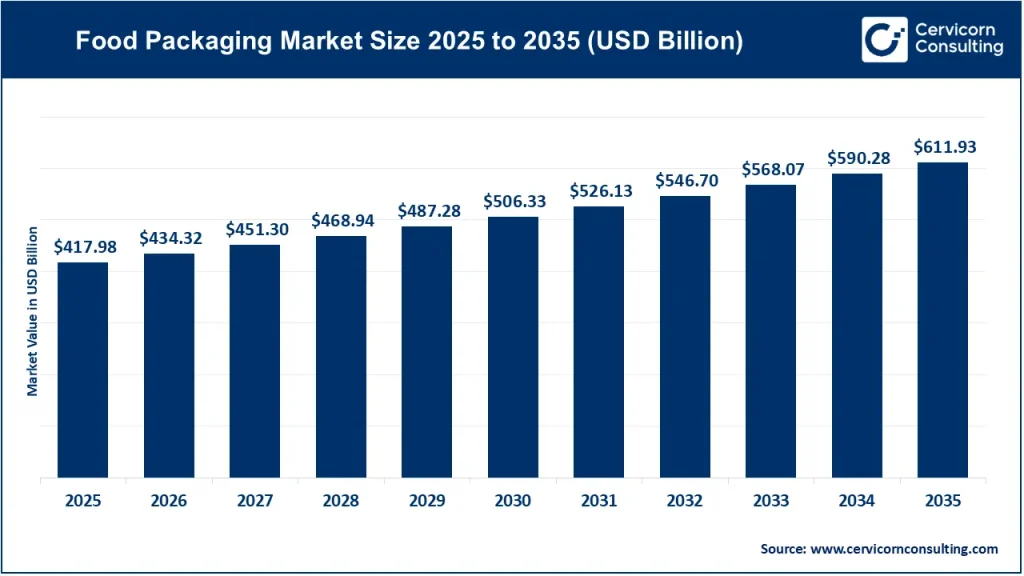
Food Packaging Market Size
The global food packaging market size was valued at USD 417.98 billion in 2025 and is projected to reach USD 611.93 billion by 2035, representing a 3.89% CAGR.
Food packaging market growth factors
The market is being driven by the expansion of packaged and convenience foods, rising online food delivery, growth in ready-to-eat meals, urbanization, changing consumer lifestyles, food-safety requirements, and increasing demand for packaging that extends shelf life. Sustainability is becoming another major growth catalyst as food manufacturers and retailers move toward recyclable, reusable, compostable, paper-based, and lower-material packaging formats. Asia Pacific accounted for approximately 39% of the global market in 2025, while flexible packaging represented about 49% and plastic accounted for approximately 42% of the market. Bags and pouches represented the largest product-format segment at about 24%, reflecting demand for lightweight, resealable, convenient, and high-barrier packaging.
At the same time, modified atmosphere packaging (MAP), intelligent packaging, active packaging, recyclable mono-material films, and advanced barrier coatings are expanding the role of packaging from simple containment toward food preservation, traceability, convenience, and waste reduction.
Get a Free Sample: https://www.cervicornconsulting.com/sample/2764
What is the food packaging market?
The food packaging market encompasses the materials, products, technologies, equipment, and solutions used to contain, protect, preserve, transport, display, and distribute food products. It covers packaging materials such as plastic, paper and paperboard, glass, metal, and biodegradable or compostable materials, along with formats including flexible, rigid, and semi-rigid packaging.
Food packaging includes everyday products such as bags, pouches, cartons, boxes, cans, bottles, jars, trays, clamshells, cups, tubs, films, wraps, sachets, and stick packs. It also incorporates specialized technologies such as modified atmosphere packaging, vacuum packaging, active packaging, intelligent packaging, aseptic packaging, and retort packaging.
The market has increasingly moved beyond basic product containment. Packaging is now expected to preserve freshness, provide tamper evidence, communicate product information, withstand increasingly complex distribution networks, support e-commerce logistics, and satisfy sustainability requirements.
Why is food packaging important?
Food safety and protection
Packaging provides a physical barrier between food and external contaminants, helping protect products against moisture, oxygen, microorganisms, light, physical damage, and temperature fluctuations. This is particularly important for meat, seafood, dairy products, processed foods, bakery products, and fresh produce.
Food-contact materials are also subject to regulatory requirements. In India, for example, the Food Safety and Standards Authority of India (FSSAI) maintains dedicated Food Safety and Standards (Packaging) Regulations covering food-contact packaging materials and related requirements.
Shelf-life extension
Packaging technologies such as MAP, vacuum packaging, aseptic packaging, retort packaging, and high-barrier films can help extend product shelf life. Longer shelf life can improve distribution efficiency and reduce spoilage across supply chains.
MAP represented approximately 18% of the global food packaging market in 2025, according to Acumen Research and Consulting.
Convenience
Consumers increasingly demand packaging that is easy to open, carry, store, reseal, microwave, portion, and dispose of. Stand-up pouches, resealable bags, single-serving packs, ready-meal trays, and lightweight containers are examples of packaging formats responding to these requirements.
Sustainability
Packaging companies are investing in recyclable paperboard, mono-material films, fiber-based packaging, recycled content, compostable materials, lightweight structures, and packaging designs that use less material. These changes are being reinforced by regulations and sustainability commitments from food manufacturers and retailers.
Leading companies in the food packaging market
International Paper Company
Specialization: Fiber-based packaging, corrugated packaging, containerboard, and sustainable packaging solutions.
Key focus areas: International Paper has increasingly focused its portfolio on sustainable packaging, particularly corrugated packaging and fiber-based solutions. Its 2025 operations incorporated the acquisition of DS Smith, strengthening its presence across North America and Europe. International Paper completed the DS Smith acquisition on January 31, 2025.
Notable features: The company emphasizes renewable and recyclable fiber-based packaging and serves customers across multiple industries. Its post-acquisition portfolio provides greater geographic reach and packaging capabilities.
2025 revenue: International Paper reported USD 23.63 billion in net sales in 2025. DS Smith contributed approximately USD 7.8 billion of those sales following the acquisition.
Market share: A standalone global food-packaging market share was not separately disclosed in the company’s 2025 financial reporting.
Global presence: International Paper has a substantial North American and European footprint, with the DS Smith combination significantly expanding its packaging presence in Europe. The company is also pursuing a strategic separation into North American and EMEA businesses.
Mondi
Specialization: Flexible packaging, paper bags, kraft paper, corrugated packaging, consumer packaging, and specialty paper solutions.
Key focus areas: Mondi focuses heavily on recyclable and sustainable packaging, paper-based alternatives, flexible packaging, barrier technologies, and circular-economy solutions.
Notable features: Mondi has strong positions in kraft paper, paper bags, corrugated packaging, specialty kraft paper, and pet-food packaging. The company reported that 88% of its revenue in 2025 came from products that were reusable, recyclable, or compostable, compared with 74% in its 2020 baseline year.
2025 revenue: Mondi reported €7.663 billion in group revenue in 2025, compared with €7.416 billion in 2024.
Market share: A specific percentage of the global food packaging market was not separately disclosed. Mondi reported leading positions in several packaging categories, including global leadership in sack kraft paper and paper bags and leading positions in European consumer packaging.
Global presence: Mondi operates an extensive production and customer network across Europe, emerging markets, and other international markets, giving it significant geographic reach in both paper and flexible packaging.
Smurfit Kappa Group / Smurfit Westrock
Specialization: Corrugated packaging, paper-based packaging, consumer packaging, displays, and paper products.
Key focus areas: The business focuses on corrugated packaging, sustainable fiber-based packaging, retail-ready packaging, e-commerce packaging, consumer packaging, and packaging optimization.
Notable features: The company became Smurfit Westrock following the combination of Smurfit Kappa and WestRock. Its expanded platform provides packaging operations across North America, Europe, Latin America, and Asia-Pacific.
2025 revenue: Smurfit Westrock reported USD 31.179 billion in net sales in 2025, compared with USD 21.109 billion in 2024. The company operates in 40 countries worldwide.
Market share: The company does not separately disclose a global food-packaging market share percentage.
Global presence: Its 2025 net sales included approximately USD 18.6 billion from North America, USD 10.9 billion from Europe, the Middle East and Africa and Asia-Pacific, and USD 2.1 billion from Latin America.
Graphic Packaging International, LLC
Specialization: Paperboard packaging and consumer packaging solutions.
Key focus areas: Graphic Packaging concentrates on paperboard cartons, food and beverage packaging, sustainable consumer packaging, paperboard innovation, and plastic-to-paperboard conversion opportunities.
Notable features: The company has increasingly emphasized replacing plastic packaging with paperboard alternatives. Graphic Packaging reported that approximately 96% of its packaging products sold in 2025 were designed to be recyclable, while innovation projects generated approximately USD 210 million in revenue during 2025.
2025 revenue: Graphic Packaging Holding Company reported USD 8.617 billion in net sales in 2025, compared with USD 8.807 billion in 2024. Packaging volumes were broadly flat, while innovation sales growth reached USD 213 million in the company’s reported operating analysis.
Market share: A standalone percentage of the global food packaging market was not disclosed.
Global presence: The company operates primarily across North America and international markets, with its products serving food, beverage, foodservice, household, and other consumer categories.
DS Smith
Specialization: Corrugated packaging, paper-based packaging, retail packaging, e-commerce packaging, and sustainable packaging solutions.
Key focus areas: DS Smith has historically focused on circular packaging, corrugated solutions, packaging design, recycling, retail-ready formats, and reducing unnecessary packaging material.
Notable features: DS Smith is now part of International Paper following the completion of the acquisition on January 31, 2025. The transaction combined two major fiber-based packaging businesses and expanded International Paper’s European and North American capabilities.
2025 revenue: DS Smith no longer reports as an independent public company following the acquisition. International Paper reported that DS Smith contributed approximately USD 7.8 billion in net sales to its consolidated 2025 results after the acquisition.
Market share: No current standalone DS Smith market-share figure is applicable because the business is now integrated into International Paper.
Global presence: Before the combination, DS Smith had a major European and North American packaging footprint. Its capabilities now contribute to International Paper’s broader global sustainable-packaging platform.
Leading trends and their impact on the food packaging market
1. Shift toward recyclable and paper-based packaging
One of the strongest structural trends is the transition from difficult-to-recycle packaging toward recyclable paperboard, fiber-based packaging, mono-material plastics, and other circular solutions.
Graphic Packaging’s 2025 sustainability results illustrate this shift, with 880 million plastic packages reportedly replaced with paperboard innovations during 2025.
Impact: Packaging producers are investing in new coating technologies, barrier papers, recyclable films, fiber-based trays, and packaging designs that can fit existing recycling systems.
2. Growth of flexible packaging
Flexible packaging accounted for approximately 49% of the food packaging market in 2025.
Pouches, films and flexible laminates provide high packaging efficiency while reducing material weight and transportation requirements.
Impact: Manufacturers are increasingly developing mono-material flexible structures and recyclable high-barrier packaging to combine lightweight performance with sustainability objectives.
3. Smart and intelligent packaging
Smart packaging incorporates technologies such as sensors, QR codes, indicators, digital authentication, freshness monitoring, and traceability systems.
Impact: These technologies can improve supply-chain visibility, consumer engagement, product authentication, and information sharing while creating opportunities for food brands to connect physical packaging with digital platforms.
4. Shelf-life extension technologies
MAP, vacuum packaging, active packaging, aseptic packaging, and high-barrier structures are gaining importance as food producers attempt to maintain freshness throughout increasingly long supply chains.
Impact: Advanced packaging can help food manufacturers distribute products over longer distances and support retail and e-commerce models while potentially reducing food losses.
5. Convenience and ready-to-eat food packaging
Ready-to-eat meals, snacks, frozen foods, meal kits, takeaway food, and food-delivery services are generating demand for portion-controlled, resealable, lightweight, microwaveable, and transport-resistant packaging.
Impact: Packaging design is increasingly being developed around consumer experience rather than only protection and containment.
6. E-commerce-driven packaging innovation
Online grocery and food delivery require packaging capable of handling additional transportation, vibration, stacking, temperature changes, and last-mile distribution.
Impact: Producers are developing stronger yet lightweight boxes, protective inserts, tamper-evident packaging, leak-resistant containers, and optimized shipping formats.
Successful examples of food packaging market innovation around the world
Europe: recyclable and circular packaging
Europe has become an important testing ground for recyclable and circular packaging. Mondi, for example, reported that 88% of its 2025 revenue came from reusable, recyclable, or compostable products. Its corrugated packaging portfolio was reported as 100% recyclable or verified compostable, while circular alternatives were available or being developed for 98% of its flexible packaging portfolio.
This illustrates the broader transition toward packaging designed around end-of-life considerations rather than solely around production and distribution.
North America: paperboard replacement of plastic
Graphic Packaging has expanded paperboard innovation designed to replace plastic packaging. The company reported approximately 1.9 billion plastic packages replaced with paperboard innovations over two years, including 880 million in 2025.
This demonstrates how food packaging suppliers are responding to brand-owner demand for material reduction and improved recyclability.
India: EPR and food-contact compliance
India is developing its packaging ecosystem through a combination of food-contact safety requirements and plastic-waste management measures. The country’s Plastic Waste Management Amendment Rules, 2024 strengthened the extended producer responsibility framework and introduced greater digital reporting and monitoring requirements.
At the same time, FSSAI’s Food Safety and Standards (Packaging) Regulations provide requirements for food-contact packaging materials, including specifications concerning materials and food-contact safety.
Asia Pacific: convenience and packaged-food expansion
Asia Pacific accounted for approximately 39% of the global food packaging market in 2025, with the regional market estimated at USD 165.83 billion. The combination of food manufacturing, urbanization, packaged-food consumption, e-commerce, and food delivery is creating strong demand for flexible, rigid, lightweight, and sustainable packaging.
Global regional analysis including government initiatives and policies
Asia Pacific
Asia Pacific represented the largest regional market in 2025, with approximately 39% market share and a market value of USD 165.83 billion. The region is expected to reach USD 316.15 billion by 2035, corresponding to a 6.7% CAGR.
China, India, Japan, South Korea, Southeast Asia, and Australia are contributing to regional demand through their food-processing industries, urban populations, organized retail, packaged-food consumption, and e-commerce networks.
Government policy is also increasingly focused on plastic-waste management, recycling infrastructure, food safety, and producer responsibility. In India, the 2024 Plastic Waste Management amendments strengthened EPR-related obligations and digital reporting, while FSSAI continues to regulate food-contact packaging materials.
Market impact: Companies operating in Asia Pacific are likely to focus increasingly on recyclable packaging, recycled materials, domestic recycling infrastructure, lightweight structures, and packaging formats suited to rapidly growing convenience-food and delivery markets.
Europe
Europe represented approximately 24% of the global food packaging market in 2025, with the regional market valued at about USD 102.05 billion. It is forecast to reach USD 161.75 billion by 2035 at a 4.5% CAGR.
European regulation is strongly influencing packaging design. The EU’s Packaging and Packaging Waste Regulation (PPWR) establishes a harmonized framework covering packaging and packaging waste, including requirements relating to recyclability, reuse, recycled content, and packaging waste reduction. The regulation entered application across the EU on 12 August 2026.
The EU framework also includes restrictions affecting PFAS in food-contact packaging, increasing the need for alternative barrier technologies.
Market impact: European packaging companies are accelerating recyclable mono-material films, fiber-based alternatives, lightweighting, reusable packaging, recycled content, and barrier-coating technologies.
North America
North America remains a major food-packaging market because of its large packaged-food industry, established retail infrastructure, foodservice sector, and demand for convenience foods.
The region is also an important center for packaging innovation. Companies such as International Paper, Graphic Packaging, and Smurfit Westrock are investing in fiber-based packaging, paperboard solutions, corrugated packaging, and recyclable alternatives.
International Paper’s acquisition of DS Smith in 2025 significantly strengthened its North American and European sustainable-packaging platform.
Market impact: Demand is shifting toward lightweight packaging, recyclable paperboard, e-commerce-ready formats, sustainable foodservice packaging, and technologies that improve shelf life.
Latin America
Latin America’s food packaging industry is supported by expanding food processing, agricultural exports, urbanization, modern retail, and packaged-food consumption. Brazil and Mexico are particularly important production and consumption centers.
The region is also experiencing increased attention toward recycling, plastic-waste reduction, and producer responsibility.
Market impact: Packaging suppliers are balancing cost-sensitive markets with increasing requirements for recyclable and resource-efficient formats. Flexible packaging remains particularly important because it combines low material usage with convenience and transport efficiency.
Middle East & Africa
The Middle East and Africa represent emerging opportunities for food packaging because of population growth, expanding food manufacturing, retail modernization, food imports, tourism, foodservice development, and investment in logistics infrastructure.
According to Acumen Research and Consulting, the Middle East & Africa food packaging market is projected to register the fastest regional CAGR of 7.3% during 2026–2035.
Governments and businesses across the region are increasingly investing in recycling, waste-management infrastructure, domestic food production, and sustainability programs.
Market impact: Demand is expected to increase for packaging capable of protecting food under challenging transportation and climatic conditions while supporting longer shelf life and efficient distribution.
Regulatory direction shaping the global market
Across major markets, food packaging regulation is increasingly converging around several themes:
- Recyclability: Packaging needs to become easier to collect, sort, and recycle.
- Extended producer responsibility: Producers and brand owners are increasingly expected to participate financially or operationally in packaging waste management.
- Recycled content: Regulations are encouraging greater use of recycled materials.
- Food-contact safety: Packaging must comply with standards designed to prevent harmful migration into food.
- Packaging reduction: Lightweighting and elimination of unnecessary packaging are becoming more important.
- Reuse: Some jurisdictions are introducing or expanding requirements and targets for reusable packaging.
- Chemical restrictions: Regulations are increasingly addressing substances of concern, including PFAS in certain food-contact packaging applications.
- Digital traceability and reporting: Online reporting and data systems are becoming more important in packaging-waste compliance.
India’s 2024 Plastic Waste Management amendments, for example, strengthened digital reporting and EPR implementation, while the EU’s PPWR establishes a more comprehensive packaging lifecycle framework.
To Get Detailed Overview, Contact Us: https://www.cervicornconsulting.com/contact-us
Read Report: AI in Networks Market Revenue, Trends, and Strategic Insights by 2035