


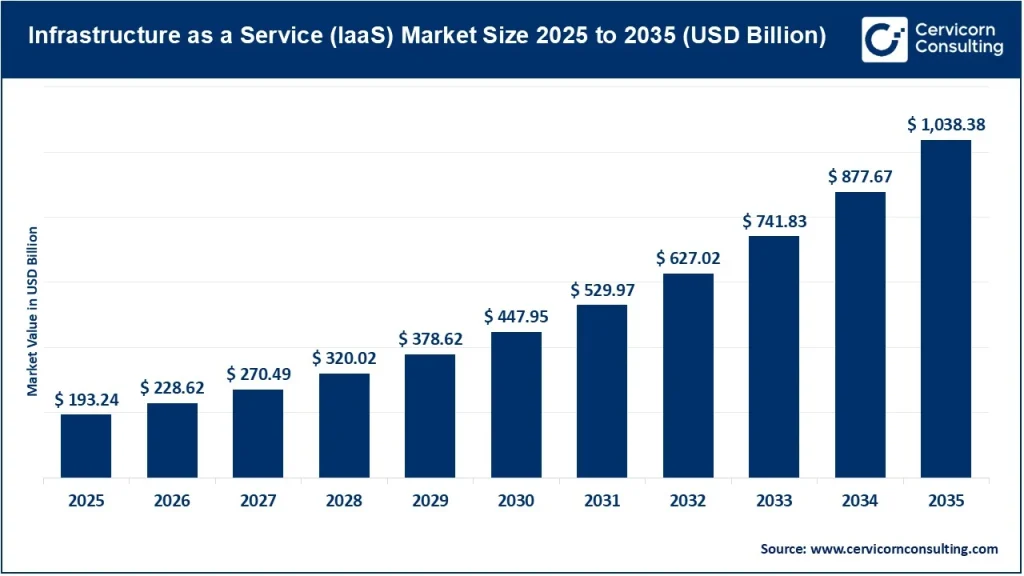
Infrastructure as a Service (IaaS) Market Size
The global infrastructure as a service (IaaS) market has experienced exponential growth due to increasing enterprise digitization, growing data volumes, and the need for agile IT environments. The market was valued at approximately USD 193.24 billion in 2025 and is projected to exceed USD 1,038 billion by 2035, growing at a strong CAGR of around 18.3%.
What is Infrastructure as a Service (IaaS) Market?
Infrastructure as a Service (IaaS) refers to a cloud computing model that provides virtualized computing resources over the internet, enabling businesses to access essential IT infrastructure such as servers, storage, networking, and virtualization without owning or maintaining physical hardware. In the IaaS market, cloud service providers host and manage these infrastructure components in data centers, while customers access them on a pay-as-you-go basis. This model eliminates the need for heavy upfront capital investments and allows organizations to scale resources dynamically based on demand. IaaS forms the foundational layer of cloud computing, supporting higher-level services like Platform as a Service (PaaS) and Software as a Service (SaaS).
Why is the Infrastructure as a Service (IaaS) Market Important?
The IaaS market plays a critical role in modern digital economies by enabling organizations to innovate faster, reduce operational costs, and maintain flexibility in a rapidly evolving technological landscape. It allows companies to deploy applications globally within minutes, ensuring business continuity and improved customer experience. IaaS is particularly important for startups and enterprises alike, as it removes the complexity of managing physical infrastructure and allows them to focus on core business functions. Additionally, it supports emerging technologies such as artificial intelligence (AI), big data analytics, Internet of Things (IoT), and machine learning by providing scalable computing power. Governments and enterprises rely heavily on IaaS for disaster recovery, remote workforce enablement, and secure data storage. With over 85% of enterprises adopting cloud technologies globally, IaaS has become a backbone of digital transformation strategies across industries.
Infrastructure as a Service (IaaS) Market Growth Factors
The growth of the Infrastructure as a Service (IaaS) market is driven by multiple interconnected factors, including rapid digital transformation across industries, increasing adoption of cloud-native applications, and the rising demand for scalable and cost-efficient IT infrastructure solutions. Organizations are shifting from capital expenditure (CapEx) to operational expenditure (OpEx) models, enabling them to pay only for the resources they use, which significantly reduces total cost of ownership. The surge in data generation, fueled by IoT devices, e-commerce platforms, and digital services, is further accelerating the need for high-performance computing and storage solutions. Additionally, the growing popularity of remote work and hybrid work environments has increased reliance on cloud-based infrastructure for seamless collaboration and accessibility. The integration of advanced technologies such as artificial intelligence, machine learning, and edge computing into cloud platforms is also expanding the scope of IaaS adoption. Furthermore, enterprises are increasingly adopting multi-cloud and hybrid cloud strategies to enhance flexibility, avoid vendor lock-in, and improve data security, all of which contribute to sustained market expansion.
Get a Free Sample: https://www.cervicornconsulting.com/sample/2941
Key Companies in the IaaS Market
| Company | Specialization | Key Focus Areas | Notable Features | 2024 Revenue (Approx.) | Market Share | Global Presence |
|---|---|---|---|---|---|---|
| Amazon Web Services (AWS) | Cloud Infrastructure Leader | Compute, Storage, AI, Databases | Broadest service portfolio, high scalability | ~$110B+ annually (cloud segment estimate) | ~30% | 190+ countries |
| Microsoft Azure | Enterprise Cloud Solutions | Hybrid Cloud, AI, DevOps | Strong enterprise integration, hybrid capabilities | ~$75B | ~20% | 60+ regions worldwide |
| Google Cloud Platform | Data & AI-driven Cloud | Data Analytics, AI/ML, Kubernetes | High-performance computing, AI leadership | ~$50B | ~13% | Global network across continents |
| IBM Cloud | Hybrid & Enterprise Cloud | AI, Blockchain, Hybrid Cloud | Strong security, industry-specific solutions | ~$15B (cloud segment estimate) | ~2% | Global enterprise presence |
| Oracle Cloud Infrastructure | Database & Enterprise Apps | Database Cloud, ERP, High-performance computing | High-speed performance, cost efficiency | ~$8–10B | ~3% | Expanding global regions |
Insights:
- AWS leads the market with around 30% share, followed by Azure (20%) and Google Cloud (13%), collectively controlling over 60% of the market.
- The market is highly consolidated, with top players dominating innovation and pricing strategies.
Leading Trends and Their Impact
1. Rise of Multi-Cloud and Hybrid Cloud Strategies
Organizations increasingly adopt multi-cloud environments to avoid vendor lock-in and improve resilience. Hybrid cloud solutions allow businesses to combine on-premise and cloud infrastructure, enhancing flexibility and compliance.
Impact: Improved operational agility and risk management.
2. Integration of Artificial Intelligence and Machine Learning
Cloud providers are embedding AI/ML capabilities directly into their infrastructure services, enabling businesses to leverage advanced analytics without investing in specialized hardware.
Impact: Accelerates innovation and data-driven decision-making.
3. Growth of Edge Computing
Edge computing reduces latency by processing data closer to its source. IaaS providers are expanding edge infrastructure to support real-time applications like autonomous vehicles and smart cities.
Impact: Enhances performance for latency-sensitive applications.
4. Increased Focus on Security and Compliance
With rising cyber threats, cloud providers are investing heavily in security frameworks, encryption, and compliance certifications.
Impact: Builds trust and accelerates adoption in regulated industries.
5. AI-Optimized Infrastructure and GPU-as-a-Service
The demand for AI workloads is driving the development of GPU-based cloud infrastructure, enabling high-performance computing for complex tasks.
Impact: Positions IaaS as a critical enabler of next-generation technologies.
Successful Examples of IaaS Market Around the World
1. Netflix (AWS)
Netflix uses AWS infrastructure to stream content globally, ensuring scalability and high availability. AWS enables Netflix to handle millions of concurrent users seamlessly.
2. Airbnb (AWS)
Airbnb leverages IaaS for data storage, analytics, and scalability, allowing it to manage massive global traffic efficiently.
3. Spotify (Google Cloud)
Spotify uses Google Cloud’s data analytics and machine learning capabilities to deliver personalized music recommendations.
4. Government Digital Services (Azure)
Many governments use Microsoft Azure for digital transformation initiatives, enabling secure and scalable public services.
5. Zoom (Multi-Cloud Strategy)
Zoom utilizes multiple cloud providers to ensure reliability and performance, especially during peak usage periods.
Global Regional Analysis Including Government Initiatives and Policies
North America
North America dominates the IaaS market, accounting for around 42% of global revenue due to strong presence of major cloud providers and advanced IT infrastructure.
Government Initiatives:
- U.S. government’s “Cloud Smart Strategy” promotes cloud adoption across federal agencies.
- Investments in AI and digital infrastructure drive cloud demand.
Europe
Europe is experiencing steady growth due to increasing focus on data privacy and digital sovereignty.
Government Policies:
- General Data Protection Regulation (GDPR) ensures strict data security compliance.
- GAIA-X initiative aims to create a secure European cloud ecosystem.
Asia-Pacific
Asia-Pacific is the fastest-growing region due to rapid industrialization, digital transformation, and increasing cloud adoption in countries like China, India, and Japan.
Government Initiatives:
- India’s “Digital India” program promotes cloud adoption across public sectors.
- China’s investments in cloud infrastructure and AI technologies accelerate growth.
Latin America
The region is witnessing growing adoption of cloud services, particularly among SMEs.
Policies:
- Governments are promoting digital transformation and cloud adoption through incentives and funding programs.
Middle East & Africa
This region is emerging as a significant market due to investments in smart cities and digital infrastructure.
Government Initiatives:
- UAE and Saudi Arabia are investing heavily in cloud infrastructure under Vision 2030 initiatives.
- Expansion of hyperscale data centers supports regional growth.
Market Dynamics and Competitive Landscape
The IaaS market is characterized by intense competition among major cloud providers, with AWS, Microsoft Azure, and Google Cloud leading the market. These companies continuously innovate by introducing new services, reducing pricing, and expanding global data center networks. Smaller players like IBM Cloud and Oracle Cloud focus on niche markets, such as hybrid cloud and enterprise applications, to maintain competitiveness. The market is also witnessing increased mergers, partnerships, and collaborations aimed at enhancing service capabilities and expanding market reach.
Future Outlook
The future of the IaaS market is closely tied to advancements in emerging technologies such as artificial intelligence, quantum computing, and edge computing. As businesses continue to digitize operations, the demand for scalable and flexible infrastructure solutions will remain strong. The market is expected to witness continued growth, driven by innovation, increasing cloud adoption, and evolving business needs.
To Get Detailed Overview, Contact Us: https://www.cervicornconsulting.com/contact-us
Read Report: Industry 5.0 Market Revenue, Trends, and Strategic Insights by 2035