


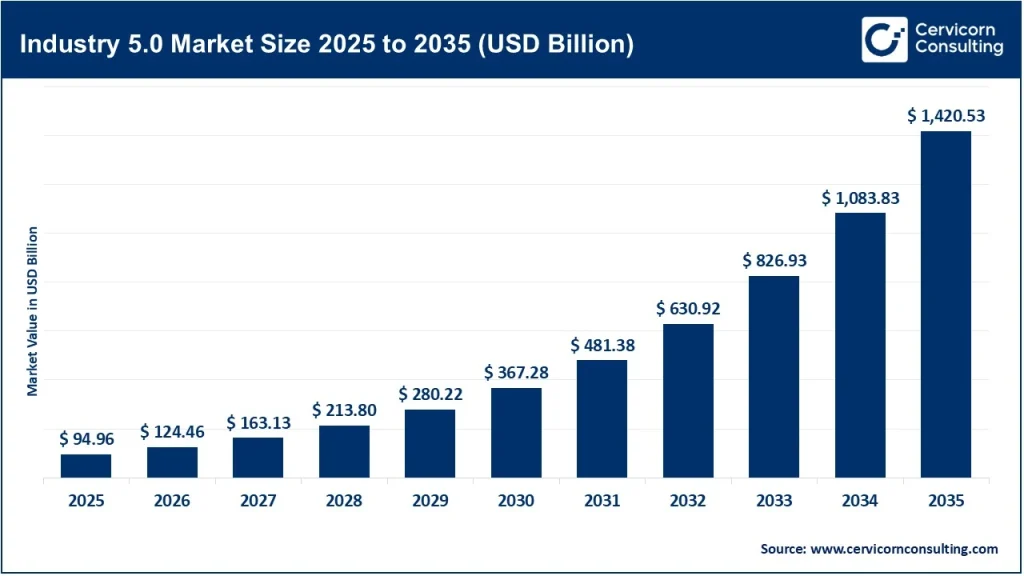
Industry 5.0 Market Size
The global Industry 5.0 market was valued at approximately USD 94.96 billion in 2025 and is projected to reach nearly USD 1,420.53 billion by 2035, growing at a CAGR of about 31.2% during the forecast period.
What is the Industry 5.0 Market?
The Industry 5.0 market refers to the global ecosystem of technologies, solutions, and services that enable human-machine collaboration in industrial environments. It integrates advanced technologies such as artificial intelligence, collaborative robots (cobots), industrial IoT, edge computing, augmented reality (AR/VR), digital twins, and 3D printing to create adaptive and intelligent production systems.
Industry 5.0 is not a replacement of Industry 4.0 but an evolution that places humans back at the center of industrial processes, empowering workers with intelligent tools instead of replacing them. It promotes three core pillars:
- Human-centric production systems
- Sustainability-driven manufacturing
- Resilient and adaptive industrial ecosystems
Why is Industry 5.0 Important?
Industry 5.0 is critical because it addresses key limitations of Industry 4.0, particularly over-automation and lack of personalization. It enables:
- Improved workforce collaboration with AI systems
- Mass customization of products
- Higher productivity with reduced operational errors
- Sustainable and energy-efficient manufacturing
- Enhanced workplace safety through predictive systems
It is also strategically important for governments and enterprises as it aligns with climate goals, digital transformation policies, and advanced manufacturing competitiveness.
Get a Free Sample: https://www.cervicornconsulting.com/sample/2933
Industry 5.0 Market Growth Factors
The Industry 5.0 market is experiencing rapid expansion due to multiple interconnected growth drivers, including the increasing adoption of artificial intelligence for real-time decision-making, rising deployment of collaborative robots (cobots) that enhance human-machine interaction, growing demand for mass customization in manufacturing, and accelerating integration of IoT and edge computing in industrial operations.
Additionally, sustainability regulations and net-zero initiatives are pushing enterprises to adopt energy-efficient production systems, while advancements in digital twin technology, industrial 3D printing, augmented reality (AR/VR), and predictive maintenance solutions are enabling smarter and more resilient factories, further strengthened by government incentives for smart manufacturing, rising labor skill shortages that encourage automation augmentation rather than replacement, and increasing investments by global industrial leaders in R&D and smart infrastructure development.
Global Industry 5.0 Market Overview
The global Industry 5.0 market is witnessing exponential growth. It was valued at approximately USD 66.9 billion in 2024 and is projected to reach USD 84.9 billion in 2025, expanding at a strong CAGR of around 29–34% through 2030 depending on the forecast model. Some projections estimate the market could exceed USD 300 billion by 2029–2030, reflecting aggressive adoption across manufacturing economies.
North America currently leads the market due to advanced automation ecosystems, strong R&D investments, and early adoption of AI-driven industrial systems, followed by Europe and Asia-Pacific, where manufacturing modernization is accelerating rapidly.
Key Market Companies Overview
1. Siemens AG
- Specialization: Digital industries, smart infrastructure, automation systems
- Key Focus Areas: Digital twins, industrial AI, smart factories, electrification
- Notable Features: End-to-end industrial digitalization platforms, strong focus on sustainability and AI-driven automation
- 2024 Revenue: ~€77 billion (company-wide estimate)
- Market Share Position: Global leader in industrial automation and digital industries
- Global Presence: Europe, North America, Asia-Pacific
Siemens is a core driver of Industry 5.0 transformation through its digital industries division and smart infrastructure solutions, enabling human-machine collaboration in large-scale industrial systems.
2. ABB Ltd.
- Specialization: Robotics, electrification, industrial automation
- Key Focus Areas: Collaborative robotics, motion control, AI-based industrial robotics
- Notable Features: Strong robotics portfolio, energy-efficient automation systems
- 2024 Revenue: ~USD 32–35 billion (approx.)
- Market Share Position: Top 3 global robotics and automation leader
- Global Presence: Europe, Americas, Asia
ABB plays a major role in deploying cobots and robotics systems that enhance human productivity in manufacturing environments.
3. Rockwell Automation
- Specialization: Industrial automation and information systems
- Key Focus Areas: Smart manufacturing, IoT integration, industrial analytics
- Notable Features: Strong integration of OT (Operational Technology) and IT systems
- 2024 Revenue: ~USD 9–10 billion
- Market Share Position: Leading U.S. industrial automation provider
- Global Presence: North America, Europe, Asia
Rockwell Automation is a cornerstone of Industry 5.0, enabling connected factories and real-time operational intelligence systems.
4. Schneider Electric
- Specialization: Energy management and industrial automation
- Key Focus Areas: Sustainability, smart grids, IoT-enabled automation
- Notable Features: Strong ESG and energy efficiency integration
- 2024 Revenue: ~€35–38 billion
- Market Share Position: Global leader in energy-efficient automation
- Global Presence: Worldwide
Schneider Electric focuses heavily on sustainable Industry 5.0 ecosystems, combining energy optimization with smart manufacturing.
5. Honeywell International Inc.
- Specialization: Industrial software, aerospace systems, automation technologies
- Key Focus Areas: Process automation, predictive analytics, cybersecurity
- Notable Features: AI-powered industrial software platforms
- 2024 Revenue: ~USD 38–40 billion
- Market Share Position: Strong global industrial automation player
- Global Presence: Americas, Europe, Asia
Honeywell contributes significantly to AI-driven industrial safety, automation, and operational intelligence systems.
Leading Trends and Their Impact
1. Human-AI Collaboration
The shift toward collaborative robotics is improving productivity while preserving human decision-making roles.
2. Digital Twin Expansion
Factories are increasingly using virtual replicas for simulation, predictive maintenance, and optimization.
3. Sustainable Manufacturing
Companies are integrating carbon tracking and energy-efficient production systems.
4. Industrial IoT & Edge Computing
Real-time data processing is enabling faster decision-making in smart factories.
5. AI-Driven Predictive Maintenance
Reduces downtime and increases operational efficiency across industries.
Impact:
These trends collectively enhance productivity, flexibility, and sustainability, transforming industrial ecosystems into intelligent, adaptive environments.
Successful Global Examples of Industry 5.0 Implementation
- Siemens Smart Factories (Germany): Fully digitalized production lines using digital twins and AI-based automation
- ABB Robotics Centers (Switzerland): Collaborative robots working alongside humans in precision manufacturing
- Schneider Electric Smart Grids (France/India): AI-driven energy optimization systems
- Honeywell Connected Plant Solutions (USA): Predictive analytics for oil, gas, and chemical industries
- Japan Smart Manufacturing Ecosystems: Advanced cobot integration in automotive manufacturing (Toyota production systems evolution)
These examples highlight real-world adoption of human-machine collaborative manufacturing ecosystems.
Global Regional Analysis and Government Initiatives
North America
North America dominates the Industry 5.0 market due to strong AI innovation, robotics development, and industrial automation adoption. The U.S. government supports smart manufacturing through initiatives like advanced manufacturing partnerships and AI R&D funding programs.
Europe
Europe is a pioneer in Industry 5.0 conceptual development. The European Union strongly promotes human-centric and sustainable industrial transformation, supporting large-scale funding through Horizon Europe programs and green manufacturing policies.
Asia-Pacific
Asia-Pacific is the fastest-growing region due to massive manufacturing bases in China, Japan, South Korea, and India. Governments are investing heavily in smart factory infrastructure, AI manufacturing systems, and robotics deployment.
Government Policies Influencing the Market
- EU Green Deal supporting sustainable manufacturing
- U.S. CHIPS and Science Act boosting industrial automation
- China’s “Made in China 2025” strategy
- India’s “Make in India” and smart manufacturing initiatives
- Japan’s Society 5.0 initiative integrating digital and physical systems
These initiatives are accelerating Industry 5.0 adoption globally by combining policy support with industrial innovation ecosystems.
Final Perspective
Industry 5.0 is rapidly redefining the future of industrial systems by combining human creativity with advanced machine intelligence. With strong growth momentum, increasing government support, and rapid technological convergence, the Industry 5.0 market is evolving into a foundational pillar of global industrial transformation, shaping the next era of smart, sustainable, and human-centered production systems.
To Get Detailed Overview, Contact Us: https://www.cervicornconsulting.com/contact-us
Read Report: Fluorochemicals Market Revenue, Trends, and Strategic Insights by 2035