


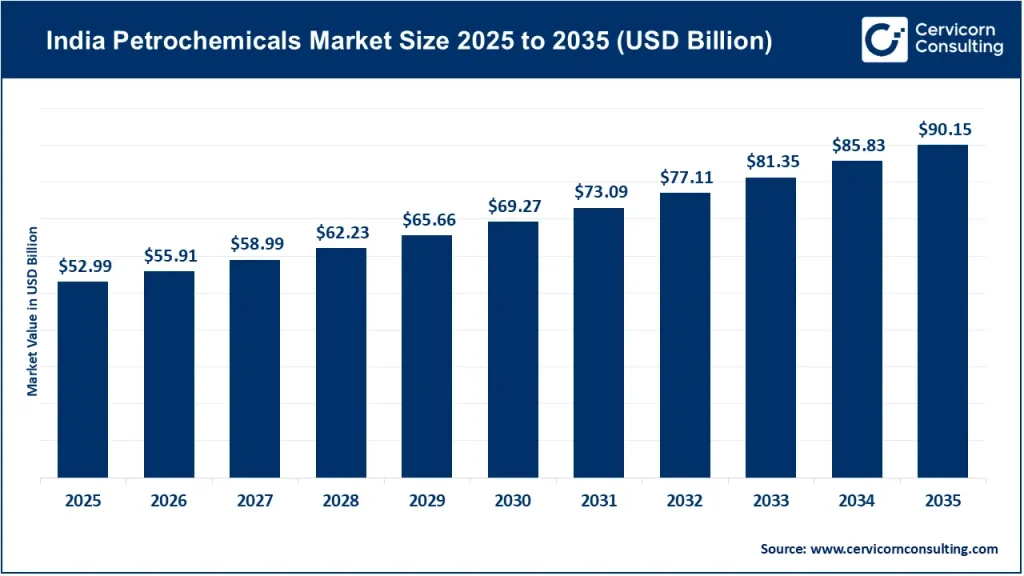
India Petrochemicals Market Size
The India petrochemicals market was valued at approximately USD 52.99 billion in 2025 and is projected to reach around USD 90.15 billion by 2035, expanding at a CAGR of approximately 5.46% during the forecast period.
India Petrochemicals Market Growth Factors
Growth is being supported by rapid urbanisation, rising disposable incomes, infrastructure development, increasing packaged-food and e-commerce consumption, automotive production, expansion of domestic manufacturing and the government’s focus on import substitution. India’s relatively low per-capita polymer consumption also creates considerable headroom for future demand; GAIL notes that India’s polymer consumption is around 15 kg per capita compared with approximately 83 kg in China and about 42 kg globally. At the same time, refinery and petrochemical capacity additions by major companies, investments in integrated complexes, growing exports and the development of plastic and chemical clusters are strengthening domestic supply. Sustainability is becoming another important growth factor as producers increasingly invest in recycled polymers, circular-economy solutions, energy efficiency and lower-carbon production technologies.
What Is the India Petrochemicals Market?
The India petrochemicals market comprises the production, processing, distribution and consumption of chemicals derived primarily from crude oil and natural gas. Petrochemicals form the building blocks for products such as ethylene, propylene, benzene, toluene, xylene, polyethylene, polypropylene, PVC, synthetic rubber, polyester, PET, solvents and numerous chemical intermediates.
The value chain generally begins with petroleum refining and natural-gas processing, followed by cracking or conversion into basic petrochemical building blocks. These materials are then transformed into polymers, synthetic fibres, elastomers and specialty intermediates before reaching downstream industries.
According to NITI Aayog, petrochemicals and organic chemicals represented approximately 24% of India’s domestic chemical industry in fiscal 2025, with a market size of about USD 50 billion. This closely corresponds with independent estimates of the India petrochemicals market and highlights the sector’s substantial contribution to India’s manufacturing ecosystem.
Get a Free Sample: https://www.cervicornconsulting.com/sample/2726
Why Is the India Petrochemicals Market Important?
Petrochemicals are important because they provide essential materials to almost every major industrial and consumer sector. Packaging is one of the largest demand generators, with polyethylene and polypropylene used extensively in films, containers, flexible packaging and consumer products. Automotive manufacturers use polymers, synthetic rubber and engineering plastics for components, interiors, tyres, electrical systems and lightweight structures.
The sector is equally important to construction because PVC, insulation materials, pipes, coatings and polymer-based products support housing and infrastructure development. In textiles, petrochemical-derived polyester fibres and intermediates are fundamental to clothing and industrial fabrics. Petrochemicals also support agriculture through films, irrigation pipes, chemical inputs and packaging.
For India, a strong petrochemical industry can reduce dependence on imported polymers and chemical intermediates, create manufacturing jobs and increase the domestic value captured from crude oil and natural gas. The opportunity is particularly significant because India’s chemical industry remains smaller as a proportion of the global market than its economic and population scale would suggest. NITI Aayog estimates India’s chemicals industry at USD 200–220 billion in fiscal 2025 and identifies petrochemicals and organic chemicals as one of its major segments.
Major Companies in the India Petrochemicals Market
| Company | Specialization | Key Focus Areas | Notable Features | 2025 Revenue* | Market Share / Competitive Position |
|---|---|---|---|---|---|
| Reliance Industries Limited | Polymers, polyesters, elastomers, aromatics and intermediates | Integrated refining-to-chemicals, polymers, polyester, specialty chemicals | India’s largest petrochemical producer; global-scale integrated operations | ₹6,26,921 crore O2C revenue | Largest Indian petrochemical producer; exact total-market percentage not separately disclosed |
| Indian Oil Corporation Limited | Polymers, petrochemical intermediates and specialty products | Capacity expansion, polymer grades, downstream integration | India’s second-largest petrochemical player; 4.3 MMTPA current capacity | ₹27,982 crore petrochemicals revenue | Second-largest petrochemical player by company-reported positioning |
| Haldia Petrochemicals Limited | Olefins, polymers and downstream petrochemicals | Polymer production, specialty chemicals and capacity expansion | Major eastern India petrochemical complex | ₹14,290 crore consolidated revenue from operations | Major regional producer; precise national market-share percentage not publicly disclosed |
| Bharat Petroleum Corporation Limited | Refining-linked petrochemicals and polypropylene | Kochi petrochemicals, Bina ethylene cracker, downstream polymers | Expanding from refining into an integrated petrochemical model | ₹5,00,517 crore consolidated revenue from operations | Emerging integrated petrochemical player; major capacity expansion underway |
| GAIL (India) Limited | Gas-based polymers and petrochemical products | Polymer production, PDH-PP, PP expansion and PTA | Major gas-based petrochemical producer | ₹1,42,291 crore consolidated revenue from operations | Major polymer supplier; sold 1.141 MMT of polymers in FY2024-25 |
Reliance Industries Limited
Reliance is the dominant force in India’s petrochemical industry and operates one of the world’s largest integrated refining and petrochemical ecosystems. Its Oil-to-Chemicals business covers transportation fuels, polymers and elastomers, intermediates and polyesters. In FY2024-25, O2C revenue increased 11% to ₹6,26,921 crore, while production included approximately 3.0 MMT of polypropylene, 2.2 MMT of polyethylene and 0.8 MMT of PVC. Reliance describes itself as India’s largest petrochemical producer and one of the world’s leading polymer producers, with polymer capacity exceeding 5.8 MMT annually and exports to more than 60 countries.
Its competitive advantage comes from integration: crude refining, feedstock flexibility, cracking, polymerisation, polyester production and global product placement are connected within a large-scale ecosystem. This allows Reliance to optimise feedstocks and shift production toward products with stronger economics.
Indian Oil Corporation Limited
IndianOil is India’s largest refiner and describes itself as the second-largest petrochemical player in India. Its petrochemical portfolio includes polypropylene, polyethylene, polyester-related products and other chemical intermediates.
The company’s petrochemical business generated ₹27,982 crore in revenue during FY2024-25, while petrochemical sales reached a record 3.24 MMT, including exports. IndianOil currently has around 4.3 MMTPA of petrochemical production capacity and aims to expand this to more than 13 MMTPA by 2030. New polymer grades, OEM approvals and projects at Paradip, Panipat and Haldia demonstrate the company’s strategy of moving toward higher-value petrochemical products.
Haldia Petrochemicals Limited
Haldia Petrochemicals is an important integrated petrochemical producer based in West Bengal and plays a particularly significant role in eastern India’s polymer and chemical supply chain. Its operations include petrochemical feedstocks, olefins, polymers and downstream products.
For FY2024-25, HPL’s consolidated revenue from operations was approximately ₹14,290 crore. The company is also diversifying beyond its established polymer base. Its planned investments in phenol and acetone production illustrate the growing emphasis on higher-value chemical products. The development of additional facilities at Haldia can strengthen India’s domestic supply of chemical intermediates while supporting import substitution.
Bharat Petroleum Corporation Limited
BPCL is transitioning from a conventional refining and marketing company toward a more integrated energy and petrochemicals business. Its Kochi refinery already supports petrochemical production, while the company is developing major new projects.
BPCL reported ₹5,00,517 crore of consolidated revenue from operations in FY2024-25. Its major petrochemical expansion includes an approximately ₹50,000-crore ethylene cracker and downstream petrochemical project at Bina, alongside a polypropylene project at Kochi. The Bina project is designed to add approximately 2.2 MMTPA of bulk petrochemical capacity, while the Kochi polypropylene project is planned at around 400 KTPA. These projects could significantly strengthen BPCL’s position in India’s petrochemical landscape.
GAIL (India) Limited
GAIL is India’s major natural-gas transmission and marketing company and an important gas-based petrochemical producer. Its petrochemical operations include polymer production through its Pata complex and associated businesses.
GAIL reported ₹1,42,291 crore in consolidated revenue from operations in FY2024-25. During the year, it sold 1.141 MMT of polymers, including 845 KTA from GAIL and 296 KTA from Brahmaputra Cracker and Polymer Limited. The company is also developing a 500 KTA propane dehydrogenation-polypropylene plant at Usar and a 60 KTA polypropylene expansion at Pata.
Leading Trends and Their Impact
1. Expansion of Domestic Petrochemical Capacity
One of the most important trends is the rapid expansion of domestic capacity. Indian companies are investing in crackers, polymer units and integrated refinery-petrochemical complexes to capture more value from hydrocarbons. IndianOil’s plan to increase capacity from 4.3 MMTPA to more than 13 MMTPA by 2030 is an example of this shift.
Impact: Higher domestic capacity can reduce import dependence, improve feedstock security and create opportunities for downstream manufacturers.
2. Rising Polymer Consumption
Packaging, e-commerce, construction, automotive and consumer goods are increasing demand for polyethylene, polypropylene and other polymers. GAIL estimates future Indian polymer demand growth at around 8% annually, with PE and PP having recorded strong historical growth.
Impact: Polymer producers are likely to prioritise capacity additions, product differentiation and new grades designed for automotive, packaging and infrastructure applications.
3. Shift Toward Specialty and High-Value Chemicals
Commodity petrochemicals remain important, but companies are increasingly looking at specialty polymers, performance materials and higher-margin intermediates.
Impact: This trend can improve profitability and reduce exposure to cyclical commodity-polymer prices while strengthening India’s participation in global value chains.
4. Circular Economy and Recycled Polymers
Environmental regulation and customer demand are encouraging producers to invest in recycling and circularity. IndianOil’s recycled-polymer brand CYCLOPLAST, for example, achieved its highest annual sales during FY2024-25.
Impact: Recycling infrastructure, chemical recycling, recycled-content polymers and waste-management technologies are expected to become increasingly important competitive factors.
5. Greater Refinery-Petrochemical Integration
Indian refiners are increasing petrochemical intensity so that more refinery feedstocks can be converted into value-added chemical products instead of fuels alone.
Impact: Integrated facilities can improve resource efficiency and provide greater flexibility during periods of weak transportation-fuel margins.
6. Feedstock Security and Import Substitution
India still depends on imports for several petrochemical and chemical products. NITI Aayog highlights petrochemical trade deficits and identifies domestic capacity expansion as an important opportunity for reducing import dependence.
Impact: Companies are likely to pursue backward integration, long-term feedstock contracts and strategic capacity additions in products with high import dependence.
Successful Examples of Petrochemical Markets Around the World
Saudi Arabia – Jubail Industrial City
Saudi Arabia’s Jubail model demonstrates how integrated petrochemical clusters can combine feedstock availability, infrastructure, logistics and large-scale chemical production. Companies such as SABIC have built globally competitive businesses around integrated complexes.
Lesson for India: Integrated industrial clusters can reduce infrastructure costs and improve the competitiveness of downstream manufacturers.
Singapore – Jurong Island
Jurong Island is a major global petrochemical hub connecting refineries, crackers, chemical plants, storage terminals and logistics infrastructure.
Lesson for India: Shared utilities, efficient ports, integrated pipelines and co-location can help Indian petrochemical clusters compete internationally.
South Korea – Ulsan
Ulsan has developed a powerful industrial ecosystem around refining, petrochemicals, automotive manufacturing and shipbuilding.
Lesson for India: Linking petrochemicals with downstream manufacturing can generate greater value addition and export opportunities.
United States – Gulf Coast
The U.S. Gulf Coast benefits from extensive refining and petrochemical infrastructure, abundant feedstocks, pipelines, ports and large downstream manufacturing markets.
Lesson for India: Feedstock availability and logistics infrastructure are critical for maintaining international cost competitiveness.
India – Jamnagar Integrated Complex
Reliance’s Jamnagar ecosystem represents India’s strongest example of large-scale refinery-petrochemical integration. The complex combines refining, petrochemical manufacturing, feedstock flexibility and global exports. Its scale demonstrates how integration can support both domestic supply and international market participation. Reliance’s polymer and petrochemical products are exported to more than 60 countries.
Government Initiatives and Policies Shaping the Market
Petroleum, Chemicals and Petrochemicals Investment Regions
The PCPIR policy is one of the most important policy frameworks for India’s petrochemical industry. The programme uses a cluster-based approach to bring production facilities, logistics, utilities, environmental infrastructure and other services together. The original PCPIR policy was formulated in 2007, with subsequent policy frameworks supporting longer-term development.
Four major PCPIR locations have been identified: Dahej in Gujarat, Paradeep in Odisha, Visakhapatnam in Andhra Pradesh, and the Tamil Nadu region. NITI Aayog identifies PCPIRs as a major mechanism for supporting integrated chemical manufacturing and investment.
Plastic Parks Scheme
The government’s Plastic Parks Scheme supports cluster development for plastic processing and downstream industries. The government can provide grant funding of up to 50% of project cost, subject to a ceiling of ₹40 crore per project. Ten Plastic Parks had been approved across multiple states by 2026.
The objective is to consolidate downstream plastic-processing capacity, provide common infrastructure, increase investment and production, and improve exports while supporting environmentally sustainable practices.
New Scheme of Petrochemicals
The Department of Chemicals and Petrochemicals implements the New Scheme of Petrochemicals, which covers initiatives such as Plastic Parks, Centres of Excellence, research and innovation programmes and other industry-development measures.
These programmes help strengthen India’s technical capabilities, promote innovation and support downstream applications.
National Policy on Petrochemicals
The National Policy on Petrochemicals, introduced in 2007, established a framework focused on developing value-added petrochemical products at globally competitive prices while encouraging environmentally responsible technologies and innovation.
The policy also placed emphasis on research and development, technology innovation and human-resource development, areas that remain essential as India’s petrochemical industry moves toward specialty and sustainable products.
Research and Innovation Support
The government has introduced the Petrochemicals Research and Innovation Commendation Scheme, which recognises innovations in petrochemicals and downstream plastic processing. The initiative is designed to encourage researchers, academics and industry participants to develop new products, processes and technologies.
Make in India and Atmanirbhar Bharat
The broader Make in India and Atmanirbhar Bharat strategies are supporting domestic manufacturing, supply-chain resilience and import substitution. The Department of Chemicals and Petrochemicals specifically identifies PCPIRs and Plastic Parks as mechanisms supporting indigenous chemical and petrochemical manufacturing.
Emerging Chemical Parks
The government’s 2026 Budget proposals also place greater emphasis on Chemical Parks, building on the experience of PCPIRs and Plastic Parks. The proposed model is intended to provide shared infrastructure, utilities, logistics and regulatory facilitation for chemical manufacturers, potentially improving project economics and accelerating industrial development.
Future Outlook
The India petrochemicals market is entering a phase in which capacity expansion, downstream integration, import substitution, specialty chemicals, recycling and global value-chain participation are likely to shape competitive strategies. India’s domestic petrochemical consumption still has substantial room to grow because per-capita consumption remains below that of several major Asian and developed markets. At the same time, new refinery-petrochemical complexes and capacity expansions by Reliance, IndianOil, BPCL, GAIL and other industry participants are expected to strengthen the domestic supply base.
The most significant opportunity will be moving beyond commodity production toward higher-value polymers, specialty materials, advanced recycling, sustainable chemicals and application-specific products. Companies that combine scale with technology, feedstock flexibility, efficient logistics and circular-economy capabilities are likely to be better positioned as India seeks to become a globally competitive petrochemical manufacturing hub.
To Get Detailed Overview, Contact Us: https://www.cervicornconsulting.com/contact-us
Read Report: Carbon Black Market Revenue, Trends, and Strategic Insights by 2035