


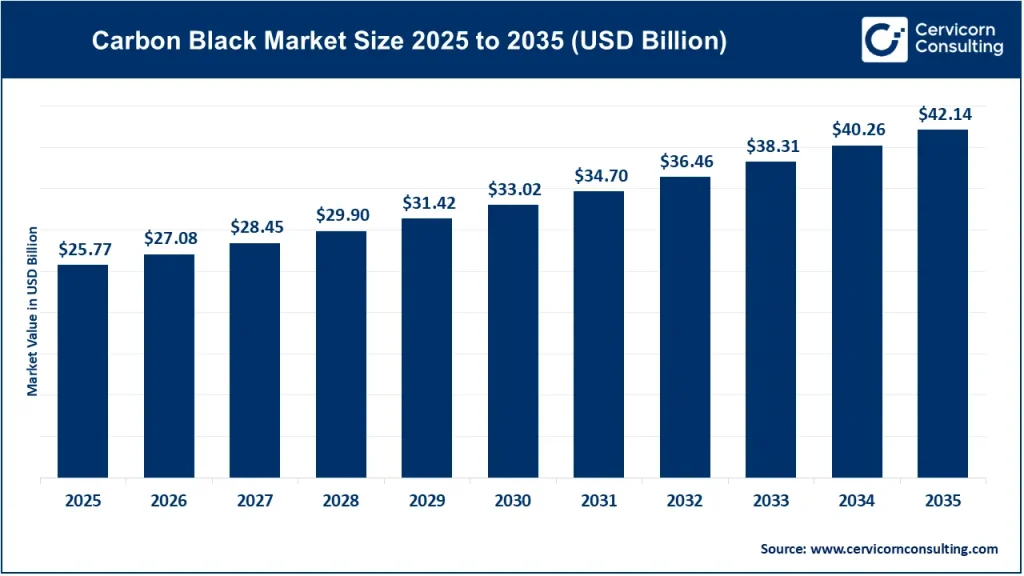
Carbon Black Market Size
The global carbon black market was valued at approximately USD 25.77 billion in 2025 and is projected to reach around USD 42.14 billion by 2035, expanding at a CAGR of approximately 5.04% during the forecast period.
Carbon Black Market Growth Factors
The carbon black market is being driven primarily by rising global tire production, increasing vehicle ownership, growth in replacement tire demand, expanding automotive manufacturing, infrastructure development, and increasing consumption of plastics and rubber products. The continued expansion of electric vehicles is creating additional demand for specialized carbon black used in conductive components and battery-related applications, while conventional automotive tires remain the largest demand center for reinforcing grades. Growth in construction, cables, pipes, industrial rubber products, paints, coatings, printing inks, and packaging is also supporting consumption.
At the same time, manufacturers are increasingly developing specialty, conductive, low-PAH, sustainable, and recovered carbon black grades to respond to environmental requirements and changing customer specifications. Raw-material availability and pricing remain important factors because conventional carbon black production depends heavily on hydrocarbon feedstocks and energy. The transition toward circular manufacturing is creating another growth avenue through recovered carbon black produced from end-of-life tires. Government policies concerning waste-tire management, industrial emissions, carbon reduction, electric mobility, and resource efficiency are further influencing investment decisions and product development.
Get a Free Sample: https://www.cervicornconsulting.com/sample/2725
What Is the Carbon Black Market?
Carbon black is a finely divided form of elemental carbon manufactured through controlled thermal decomposition or incomplete combustion of hydrocarbon feedstocks. The production process creates particles and aggregates with carefully controlled size, structure, surface chemistry, and other characteristics. These properties allow carbon black manufacturers to engineer grades for different industrial applications. Cabot describes carbon black as elemental carbon produced from by-product feedstock streams through highly controlled processes that generate different particle and aggregate characteristics.
The market includes several major product categories, including furnace black, thermal black, acetylene black, channel black, and other specialty grades. Furnace black is particularly important because of its extensive use in tire and rubber reinforcement. Specialty grades are increasingly important for plastics, inks, coatings, conductive applications, batteries, cables, and advanced materials.
The carbon black industry can broadly be divided into rubber carbon black and specialty carbon black. Rubber carbon black is primarily used in tires and other rubber products to increase durability, tensile strength, abrasion resistance, and service life. Specialty carbon black is designed for applications where specific characteristics such as color strength, conductivity, UV protection, dispersion, or rheological performance are required.
Why Is Carbon Black Important?
Carbon black is important because it performs multiple functions that cannot easily be replicated by many alternative materials at comparable cost and performance.
In the tire industry, carbon black is a critical reinforcing filler. It improves tread wear, strength, durability, and resistance to abrasion. This makes it indispensable to passenger vehicles, trucks, buses, motorcycles, and industrial tires.
In plastics, carbon black provides black coloration and protects polymers from UV degradation. It is also used in pipes, films, agricultural products, packaging, and electrical components.
In coatings and printing inks, specialty carbon black provides strong coloration, optical density, gloss control, and other visual properties. Carbon black can also provide electrical conductivity or antistatic performance in plastics, cables, and electronic materials.
Its importance is becoming even greater as battery and energy-storage technologies expand. Specialty carbon black can function as a conductive additive in battery electrodes, while its conductive properties also support high-voltage cables and other electrical applications. Orion specifically identifies battery-industry growth, electric-vehicle penetration, and energy-storage systems as important drivers for specialty carbon black demand.
Leading Companies in the Carbon Black Market
The competitive environment includes large multinational manufacturers with extensive production networks, technology portfolios, specialty grades, and long-term customer relationships. The following companies are among the leading participants.
| Company | Specialization | Key Focus Areas | Notable Features | 2025 Revenue* | Market Share | Global Presence |
|---|---|---|---|---|---|---|
| Cabot Corporation | Reinforcing and specialty carbon materials | Tires, rubber, conductive materials, batteries, plastics | Strong global technology platform and diversified particle-based materials portfolio | USD 3.71B total company revenue; USD 2.34B Reinforcement Materials sales | Approx. 15% in some industry estimates | Americas, Europe, Asia Pacific, Middle East and other markets |
| Orion Engineered Carbons S.A. | Rubber and specialty carbon black | Tires, coatings, polymers, inks, batteries | Two-segment model; extensive specialty portfolio | USD 1.81B | Approx. 12% in some estimates | Americas, Europe, Asia, Middle East and other markets |
| Birla Carbon | Rubber and specialty carbon black | Tires, rubber, plastics, coatings, sustainable carbon materials | One of the largest global carbon black producers; sustainability focus | Private-company carbon-black revenue not separately disclosed | 17%+ | Asia, Europe, Americas and other regions |
| Continental Carbon Company | Carbon black | Tire and rubber products, specialty grades | Long operating history and North American manufacturing base | Not publicly disclosed | Approx. 8% in some estimates | Primarily North America with historical international operations |
| Tokai Carbon Co., Ltd. | Carbon black and advanced carbon materials | Tires, rubber, electronics, fine carbon and industrial applications | Major Japanese carbon-materials producer with diversified carbon portfolio | Carbon Black segment approx. JPY 147B | Approx. 6% in some estimates | Japan, Asia, North America, Europe and other markets |
*Revenue figures refer to company-wide revenue or reported segment revenue where a company does not separately disclose total carbon-black revenue. Market-share figures vary among research providers and should therefore be treated as industry estimates rather than audited company figures. Industry estimates place the top five companies at roughly 46% combined market share in 2025.
Cabot Corporation
Cabot Corporation is one of the leading global manufacturers of reinforcing and specialty carbon materials. Its carbon black operations are organized primarily within its Reinforcement Materials segment. Cabot reported USD 3.713 billion in total net sales and other operating revenues in fiscal 2025, while Reinforcement Materials generated USD 2.341 billion in sales.
The company focuses heavily on reinforcing carbons for tires and rubber products while also developing conductive and specialty materials. Cabot has been investing in capacity, technology, sustainability, and geographic expansion. In 2025, it announced an agreement to acquire Bridgestone’s reinforcing carbons manufacturing facility in Mexico, strengthening its North American production footprint.
Orion Engineered Carbons S.A.
Orion Engineered Carbons S.A. operates across rubber carbon black and specialty carbon black. Its applications include tires, mechanical rubber goods, coatings, plastics, printing inks, cables, polymers, batteries, and conductive materials.
In 2025, Orion generated USD 1.8067 billion in net sales, with total carbon black volume of 948.6 thousand metric tons. Rubber Carbon Black represented 75.4% of total volume, while Specialty Carbon Black accounted for 24.6%. Specialty Carbon Black generated USD 618.5 million in sales, while Rubber Carbon Black generated USD 1.1882 billion.
Orion’s broad geographical footprint includes operations and technical centers in North America, Europe, China, South Korea, Japan, Brazil, and other markets.
Birla Carbon
Birla Carbon is a major global carbon black producer and is estimated by Global Market Insights to have held more than 17% of the global market in 2025, making it one of the industry’s leading companies.
Its portfolio covers rubber carbon black and specialty grades serving tire, mechanical rubber, plastics, coatings, inks, and other applications. Sustainability is becoming an increasingly important focus. Birla Carbon reported that 16 carbon black plants maintained ISCC Plus certification in FY2025, supporting the use of certified sustainable feedstocks and lower-impact material strategies.
The company is also active in recovered carbon black and circular-economy initiatives, positioning itself to benefit from increasing demand for more sustainable tire and rubber materials.
Continental Carbon Company
Continental Carbon Company has a long history in the carbon black industry, dating back to the construction of its first carbon black plant in Texas in 1936. The company subsequently expanded production in Oklahoma and Alabama and developed international activities through partnerships and acquisitions.
Its historical capabilities and established customer relationships provide a strong position in rubber and tire-related markets. Continental Carbon remains particularly relevant to the North American carbon black supply chain.
Because it is not a publicly listed company with the same level of financial disclosure as Cabot or Orion, a reliable standalone 2025 revenue figure is not publicly disclosed.
Tokai Carbon Co., Ltd.
Tokai Carbon Co., Ltd. is a diversified carbon-materials manufacturer headquartered in Japan. Its operations extend beyond carbon black into fine carbon, graphite electrodes, smelting and lining products, and industrial furnaces.
Tokai Carbon’s carbon black division recorded approximately JPY 147 billion in 2025 sales, a 6.1% year-over-year decline. The decline reflected lower volumes caused mainly by production adjustments among tire manufacturers and lower prices. The company expects recovery in 2026.
Leading Trends and Their Impact on the Carbon Black Market
1. Rising Demand for Electric Vehicles
EV adoption is changing the composition of carbon black demand. Although EV tires continue to require conventional reinforcing carbon black, battery technologies create additional demand for conductive carbon materials.
This trend is encouraging manufacturers to expand specialty grades capable of meeting the conductivity, purity, dispersion, and electrochemical requirements of advanced batteries.
2. Growth in Specialty Carbon Black
Commodity rubber carbon black remains the largest application area, but specialty grades are gaining strategic importance. Specialty products command greater value because customers require precise particle characteristics and application-specific performance.
Demand is increasing from coatings, high-performance plastics, printing inks, cables, conductive polymers, and batteries.
3. Sustainability and Recovered Carbon Black
Environmental pressure is encouraging manufacturers to reduce the carbon intensity of production and develop circular alternatives. Recovered carbon black produced from end-of-life tires provides an opportunity to substitute part of conventional carbon black consumption while improving resource efficiency.
India’s regulatory framework already recognizes recovered carbon black as one potential output from recycling waste tires. In 2025, India’s Ministry of Environment, Forest and Climate Change noted that waste tires can be imported by authorized users for recycling and recovery into products including recovered carbon black.
4. Greater Focus on Low-Emission Production
Carbon black production is energy-intensive and can generate hazardous air pollutants. As a result, producers are investing in process optimization, emission controls, energy efficiency, cleaner feedstocks, and sustainability certifications.
These investments may raise short-term production costs but can strengthen competitiveness as customers increasingly demand lower-carbon materials.
5. Tire Industry Transformation
The tire industry remains the single most important demand center. Changes in vehicle production, replacement tire sales, truck transportation, tire imports, EV penetration, and tire design therefore directly influence carbon black consumption.
Orion’s 2025 results illustrate this connection: its rubber carbon black volumes increased 3.7%, but sales declined because of lower oil prices and pricing effects.
6. Feedstock and Energy Price Volatility
Carbon black manufacturers are sensitive to changes in oil-derived feedstock and energy costs. Long-term supply contracts increasingly include mechanisms that adjust selling prices based on feedstock and energy costs.
Orion reported that approximately 65% of its global volume was covered by indexed contracts incorporating feedstock and/or energy adjustments.
Successful Examples of Carbon Black Market Development Around the World
Asia Pacific: Integrated Tire and Chemical Manufacturing
Asia Pacific provides one of the strongest examples of successful carbon black market development. Rapid automotive production, tire manufacturing, industrialization, infrastructure investment, and plastics consumption have created a large local customer base.
India, China, Japan, South Korea, and Southeast Asian countries are particularly important. Producers benefit from proximity to tire manufacturers and other rubber-product companies, while specialty grades are gaining traction in electronics, cables, plastics, and battery applications.
India: Circular Carbon Black Development
India is increasingly becoming an important market for both conventional and recovered carbon black. The combination of a large tire industry, expanding automotive production, and government attention toward waste management creates an attractive environment for circular carbon materials.
Birla Carbon’s investment in recovered carbon black and its involvement in India’s circular carbon ecosystem illustrate how global manufacturers are responding to this opportunity. Government consideration of waste-tire recycling and recovered carbon black further supports the development of this segment.
North America: Technology and Specialty Materials
North America demonstrates the importance of technology-intensive carbon black production. Companies such as Cabot have combined traditional reinforcing carbon black with specialty conductive and performance materials.
Cabot’s acquisition agreement for Bridgestone’s Mexico carbon black facility is an example of strategic consolidation designed to strengthen manufacturing capabilities and customer supply.
Europe: Sustainability and High-Performance Grades
Europe is increasingly defined by environmental compliance, circularity, and high-performance materials. Carbon black producers serving European tire, automotive, coatings, plastics, and industrial customers must increasingly account for carbon costs and environmental requirements.
This is encouraging manufacturers to develop lower-emission production processes, sustainable feedstocks, and specialty grades capable of supporting lightweighting, electrification, and energy-efficient products.
Global Regional Analysis Including Government Initiatives and Policies
North America
North America represents a mature but technologically advanced carbon black market. The region benefits from a large automotive sector, substantial tire replacement demand, plastics consumption, and advanced specialty-material applications.
The United States maintains specific environmental standards for carbon black production. The EPA’s National Emission Standards for Hazardous Air Pollutants cover carbon black production facilities using furnace black, thermal black, or acetylene decomposition processes. Benzene is identified as the primary hazardous air pollutant controlled at carbon black facilities.
The regulatory environment encourages producers to invest in emissions-control technologies, process improvements, monitoring systems, and safer manufacturing practices.
Mexico is also becoming strategically important because of its proximity to the U.S. automotive and tire industries. Cabot’s planned acquisition of Bridgestone’s Tamaulipas carbon black facility demonstrates the strategic importance of the region.
Europe
Europe is a high-value market for specialty and sustainable carbon black. Demand comes from tires, automotive components, coatings, plastics, printing, cables, and industrial applications.
European environmental policy increasingly places emphasis on industrial emissions, energy efficiency, carbon accounting, circular economy principles, and sustainable materials. Carbon black manufacturers are therefore focusing on cleaner production, renewable or alternative energy, optimized feedstocks, and lower-carbon products.
The region is also important for specialty carbon black because manufacturers of premium automotive products, conductive materials, coatings, and advanced polymers require high-performance grades.
Asia Pacific
Asia Pacific is the largest regional carbon black market, supported by strong tire manufacturing, automotive production, construction, plastics, and industrial development.
China represents a particularly important production and consumption center. Its environmental policies are increasingly shifting toward controlling total carbon emissions and carbon intensity rather than relying solely on energy-consumption controls. China’s environmental policy framework has been developing a transition toward a carbon-emissions dual-control system, alongside greater emphasis on clean energy, energy efficiency, industrial transformation, and carbon governance.
For carbon black manufacturers, these measures can increase compliance requirements while also encouraging modernization and cleaner production technologies.
Japan remains strategically important through companies such as Tokai Carbon, while South Korea’s industrial and electronics ecosystem supports demand for specialty and conductive carbon materials.
India
India is one of the most attractive growth markets because of its expanding automotive industry, tire production, infrastructure investment, plastics consumption, and industrial manufacturing.
The Indian carbon black market was valued at approximately INR 100.96 billion in 2025 and is projected to reach about INR 201.77 billion by 2034, representing a 7.32% CAGR from 2026 to 2034, according to IMARC.
Government initiatives supporting automotive manufacturing, electric mobility, infrastructure development, waste management, and circular economy practices can indirectly increase demand for carbon black.
The government’s approach to waste tires is particularly relevant. Under India’s Hazardous and Other Wastes Management framework, authorized users can undertake recycling and recovery activities involving waste tires, including production of recovered carbon black.
This creates an emerging pathway for India to become not only a major consumer and producer of conventional carbon black but also a significant market for circular carbon materials.
Latin America
Latin America represents an emerging opportunity driven by automotive production, tire replacement, construction, infrastructure, plastics, and industrial rubber demand. Brazil is particularly important because of its large automotive and manufacturing base.
The region also provides opportunities for multinational producers to expand localized manufacturing and distribution, reducing logistics costs and strengthening relationships with tire and rubber manufacturers.
Middle East & Africa
The Middle East & Africa market is supported by infrastructure development, construction, automotive demand, industrial rubber products, cables, plastics, and growing manufacturing activity.
The Middle East’s petrochemical infrastructure provides access to hydrocarbon feedstocks, while infrastructure investment can support demand for pipes, cables, coatings, plastics, and rubber products. Africa offers longer-term growth potential as vehicle ownership, road infrastructure, industrial production, and tire consumption increase.
Strategic Outlook for Carbon Black Producers
The competitive priorities of carbon black manufacturers are changing from simply expanding production capacity toward technology differentiation, sustainability, geographic localization, and specialty-grade development.
Large producers are increasingly balancing three objectives: protecting their core tire and rubber business, expanding specialty applications, and reducing the environmental footprint of production.
The market’s future growth will therefore depend not only on the number of tires and vehicles produced but also on how rapidly carbon black expands into batteries, conductive plastics, cables, coatings, high-performance polymers, and circular-material applications.
The industry’s evolution is already visible in company strategies. Cabot is strengthening reinforcing carbon capacity while maintaining a diversified materials portfolio; Orion is balancing rubber and specialty carbon black; Birla Carbon is investing in sustainability and circular solutions; Tokai Carbon is integrating carbon black with broader advanced-carbon businesses; and Continental Carbon continues to serve established rubber and tire markets.
With the global market projected to expand substantially through 2035, suppliers that can combine reliable high-volume production with specialty technology, sustainable feedstocks, emissions control, and localized customer support are positioned to capture the strongest opportunities across the evolving carbon black value chain.
To Get Detailed Overview, Contact Us: https://www.cervicornconsulting.com/contact-us
Read Report: South Korea AI Infrastructure Market Revenue, Trends, and Strategic Insights by 2035