


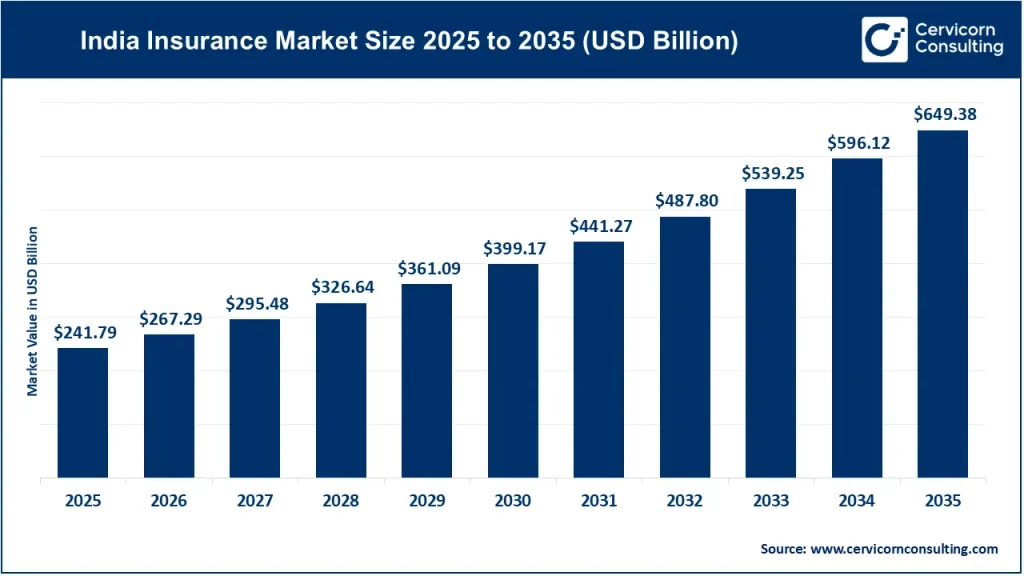
India Insurance Market Size
The India insurance market was valued at approximately USD 241.79 billion in 2025 and is projected to reach USD 649.38 billion by 2035, expanding at a CAGR of 10.55% during the forecast period.
India Insurance Market Growth Factors
The India insurance market is expanding as rising disposable incomes, increasing financial awareness, higher healthcare costs, growing middle-class households, rapid urbanization, expanding digital financial services, greater penetration of banking and fintech channels, and increasing awareness of life and health risks encourage individuals and businesses to purchase insurance. The country’s large underinsured population creates substantial room for future expansion, while regulatory reforms are encouraging product innovation, competition, foreign investment, and technology adoption.
Insurance penetration remained at 3.7% of GDP in FY2024-25, comprising 2.7% for life insurance and 1.0% for non-life insurance, demonstrating that a significant protection gap remains. At the same time, India became the world’s 10th-largest insurance market by premium volume, with the sector collecting ₹11.93 lakh crore in premiums and issuing 41.84 crore policies during FY2024-25. Rising demand for term insurance, retirement products, health insurance, motor insurance, crop protection, property coverage, and digitally distributed policies is therefore creating a broad-based growth opportunity across the market.
What Is the India Insurance Market?
The India insurance market comprises companies, intermediaries, technology providers, reinsurers, government-backed schemes, and regulatory institutions involved in providing financial protection against life, health, property, motor, agricultural, liability, and other risks. The market is broadly divided into life insurance and non-life insurance.
Life insurance includes term insurance, endowment policies, whole-life products, unit-linked insurance plans, annuities, pension products, group insurance, and savings-oriented policies. Non-life insurance includes health, motor, property, travel, marine, crop, commercial, liability, and other specialized forms of insurance.
The Insurance Regulatory and Development Authority of India (IRDAI) regulates the sector and plays a central role in promoting policyholder protection, market development, product innovation, solvency, and orderly competition.
India’s life insurance industry recorded total premium income of approximately ₹8.86 lakh crore in FY2024-25, compared with ₹8.30 lakh crore in FY2023-24. The general insurance industry, including standalone health insurers, underwrote approximately ₹3.08 lakh crore in direct premium during FY2024-25.
The scale of the sector illustrates why insurance is becoming an increasingly important component of India’s financial system. In FY2024-25, the broader insurance sector paid claims of ₹8.36 lakh crore and held assets under management of approximately ₹74.44 lakh crore.
Get a Free Sample: https://www.cervicornconsulting.com/sample/2728
Why Is the India Insurance Market Important?
Insurance is important because it provides financial resilience when households, companies, farmers, and governments face unexpected losses. A life insurance policy can protect dependents after the death of an earning member, while health insurance can prevent medical expenses from substantially reducing household savings.
For businesses, insurance supports investment and continuity by protecting factories, warehouses, vehicles, employees, inventories, and other assets. Agricultural insurance can reduce the financial consequences of crop failure, while motor insurance provides protection against vehicle-related losses and liabilities.
The importance of insurance is particularly high in India because the country’s economic expansion is accompanied by changing risk profiles. Growing healthcare expenditure, natural disasters, climate-related risks, road accidents, cyber threats, business disruptions, and longer life expectancy are increasing demand for specialized protection.
Insurance also contributes to long-term capital formation. Life insurers collect premiums over long periods and invest funds in financial markets and other permitted assets, making the sector an important institutional investor.
However, India’s relatively low penetration indicates substantial untapped demand. Insurance penetration declined from 3.8% in FY2023-24 to 3.7% in FY2024-25, while insurance density increased from USD 95 to USD 97. This combination of a huge population, expanding economy, and comparatively low coverage creates significant long-term market potential.
Leading Insurance Companies in India
The Indian life insurance market remains highly competitive, with Life Insurance Corporation of India maintaining a dominant position while private insurers continue expanding through bancassurance, agency networks, digital distribution, partnerships, and innovative products.
Note: For consistency, the “2025 Revenue” figures below refer to FY2024-25 total premium income/gross written premium, rather than accounting revenue. Market share is calculated using each insurer’s FY2024-25 total premium against the ₹8.86 lakh crore life insurance industry premium reported by IRDAI. This provides a comparable measure across the selected life insurers.
| Company | Specialization | Key Focus Areas | Notable Features | 2025 Revenue* | Market Share** |
|---|---|---|---|---|---|
| Life Insurance Corporation of India (LIC) | Life, savings, protection, pension and group insurance | Mass-market coverage, rural inclusion, pensions, protection | Largest life insurer, extensive physical network, government-backed legacy | ₹4,88,849 crore | 55.19% |
| HDFC Life Insurance Company Ltd. | Protection, savings, investment, retirement and group insurance | Customer-centric products, digital distribution, Tier-2/3 expansion | Strong private-sector franchise and diversified distribution | ₹71,045 crore | 8.02% |
| ICICI Prudential Life Insurance Company Ltd. | Protection, savings, ULIPs, retirement and group insurance | Wealth creation, protection, digital engagement and retirement | Strong bancassurance and investment-linked product portfolio | ₹48,951 crore | 5.53% |
| SBI Life Insurance Company Ltd. | Protection, savings, pension and group insurance | Financial inclusion, protection, agency and bancassurance | Large SBI ecosystem and extensive distribution network | ₹84,985 crore | 9.59% |
| Bajaj Allianz Life Insurance Company Ltd. | Protection, savings, ULIPs, annuity and retirement | Digital insurance, wealth management, protection and retirement | Strong private-sector brand and diversified product portfolio | ₹27,160 crore | 3.07% |
*FY2024-25 premium income/gross written premium.
**Calculated from FY2024-25 industry total premium of ₹8,85,771.73 crore.
Life Insurance Corporation of India
LIC remains the most influential company in India’s life insurance industry. Its FY2024-25 total premium income was approximately ₹4.88 lakh crore, while its total income excluding shareholder-account fund transfers was approximately ₹8.81 lakh crore. The company reported total assets of about ₹56.23 lakh crore and a life fund of approximately ₹47.85 lakh crore as of March 31, 2025.
LIC’s major focus areas include protection, savings, pensions, annuities, group insurance and financial inclusion. Its extensive branch and agency infrastructure gives it a particularly strong presence outside major metropolitan areas. LIC also plays an important role in government-backed insurance programs such as PMJJBY.
HDFC Life Insurance Company Ltd.
HDFC Life is one of India’s leading private life insurers, offering protection, savings, investment, retirement and group insurance products. Its FY2024-25 gross written premium reached ₹71,045 crore, compared with ₹63,076 crore in FY2023-24. The company reported individual new business premium growth of 15%, while its overall industry market share based on individual weighted received premium expanded to 11.1%.
HDFC Life focuses heavily on product innovation, digital engagement, bancassurance, agency distribution and expansion into Tier-2 and Tier-3 markets. Its portfolio includes retail and group products covering savings, protection, investment and retirement requirements.
ICICI Prudential Life Insurance Company Ltd.
ICICI Prudential Life operates across protection, savings, investment, unit-linked insurance, retirement and group insurance. Its FY2024-25 total premium stood at approximately ₹48,951 crore, increasing from ₹43,236 crore in FY2023-24.
The company has focused on balancing protection products with market-linked and savings offerings. Its technology-driven customer engagement, digital servicing capabilities and banking relationships help it address India’s growing demand for convenient insurance purchasing and policy management.
SBI Life Insurance Company Ltd.
SBI Life is one of India’s largest private life insurers and benefits from its association with the State Bank of India ecosystem. Its FY2024-25 gross written premium reached approximately ₹84,985 crore, up from ₹81,431 crore in FY2023-24. The company reported a private-market share of 20.8% for new business premium and 25.3% for individual new business premium.
Its focus areas include protection, savings, retirement, annuities, group insurance and financial inclusion. SBI Life’s extensive distribution infrastructure, including more than 59,000 certified insurance facilitators reported in FY2024-25, supports its ability to reach customers across different geographies.
Bajaj Allianz Life Insurance Company Ltd.
Bajaj Allianz Life provides protection, savings, investment, unit-linked, annuity and retirement solutions. Its total premium income increased from ₹23,043 crore in FY2023-24 to ₹27,160 crore in FY2024-25.
The company focuses on combining traditional insurance distribution with digital channels and technology-led customer engagement. Its presence across protection, savings and retirement products enables it to address the changing financial priorities of India’s expanding middle-income population.
Leading Trends and Their Impact on the India Insurance Market
1. Digitalization of Insurance Distribution
Digitalization is changing how customers discover, compare, purchase and manage insurance policies. Mobile applications, online aggregators, e-KYC, digital payments, electronic policy documents and automated claims processing are reducing dependence on traditional paperwork.
The impact is particularly important for younger customers who increasingly expect insurance to function like other digital financial services. Insurers can use technology to reduce acquisition costs, accelerate underwriting and provide personalized recommendations.
The emergence of Bima Sugam could further accelerate this transition by creating a common digital insurance marketplace. IRDAI notified the Bima Sugam regulations in 2024, establishing a regulatory framework for an electronic insurance marketplace.
2. Artificial Intelligence and Data Analytics
AI and advanced analytics are increasingly being applied to underwriting, fraud detection, customer segmentation, claims management and risk assessment.
Insurers can use large datasets to identify unusual claims patterns, improve pricing and automate routine processes. AI-powered chatbots and virtual assistants can also improve customer service.
However, responsible use of customer data will become increasingly important. Insurers must balance personalization with privacy, cybersecurity and regulatory requirements.
3. Rising Health Insurance Demand
Health insurance is becoming a major growth engine within India’s non-life insurance industry. Health insurance accounted for 41.42% of general insurance premium in FY2024-25, while the health segment recorded 9.19% growth.
Increasing healthcare costs, lifestyle-related illnesses, medical inflation and greater awareness following the COVID-19 pandemic are supporting demand. The market is also moving beyond hospitalization-only coverage toward preventive care, wellness programs, chronic disease management and outpatient services.
4. Growth of Protection Products
Indian consumers are increasingly recognizing the importance of adequate life cover rather than viewing insurance solely as a savings product. Average annual premium per in-force life insurance policy increased by 42.6% between FY2021 and FY2025, indicating that policyholders are increasingly choosing higher levels of protection.
This creates opportunities for pure-term insurance, income-replacement products, critical illness coverage and customized protection plans.
5. Expansion into Tier-2, Tier-3 and Rural Markets
Large metropolitan markets are relatively mature, making smaller cities, towns and rural areas important sources of future growth. Insurers are expanding through local agents, bancassurance, microinsurance, digital onboarding and partnerships with fintech companies.
Distribution remains one of the biggest challenges to achieving broader coverage. Initiatives such as Bima Vahak are designed to strengthen insurance distribution at the grassroots level.
6. Retirement and Annuity Products
India’s demographic structure is changing, creating demand for retirement income and long-term savings products. Rising life expectancy means individuals increasingly need financial resources that can support them after retirement.
Insurers are therefore developing annuities, pension products, guaranteed-income products and retirement-focused investment solutions. This segment could become increasingly important as India’s formal workforce expands.
7. Embedded and Partnership-Based Insurance
Insurance is increasingly being incorporated into banking, e-commerce, mobility, travel, healthcare and financial technology platforms. Embedded insurance allows customers to obtain protection at the point where a risk or purchase occurs.
For example, motor insurance can be offered during vehicle purchases, travel insurance during ticket booking, and device insurance during electronics purchases. This model can reduce customer acquisition friction and improve insurance penetration.
8. Greater Product Personalization
Traditional standardized products are gradually giving way to more personalized insurance solutions. Customer age, income, occupation, lifestyle, health profile and financial goals can increasingly influence product recommendations and pricing.
Personalization can improve relevance and customer retention, although insurers must ensure that pricing and underwriting remain transparent and compliant.
Successful Insurance Examples Around the World and Lessons for India
Singapore: Universal Basic Health Protection
Singapore provides a useful example of combining government-supported insurance with private-sector participation. MediShield Life provides basic health insurance coverage to all Singapore citizens and permanent residents, regardless of age or health conditions. Premiums can be paid through MediSave, Singapore’s healthcare savings mechanism.
The model demonstrates how universal basic coverage can be combined with optional private insurance. India could draw lessons from this structure when developing affordable baseline protection while allowing private insurers to provide additional coverage.
United Kingdom: Compulsory Motor Insurance
The UK requires motorists to have at least third-party motor insurance before driving on public roads.
This illustrates how compulsory insurance requirements can create broad risk pools and ensure that victims of road accidents have a mechanism for compensation. India’s mandatory motor third-party insurance framework similarly demonstrates the role of regulation in creating mass-market insurance demand.
Japan: Strong Life Insurance Culture
Japan is another important international example. OECD data shows that Japan has a comparatively large life insurance component within its insurance sector.
Japan’s experience highlights the importance of long-term savings, retirement planning and life protection in an aging society. India can adapt these lessons as its own population structure gradually changes and retirement planning becomes more important.
United States: Large Non-Life and Employer-Sponsored Ecosystem
The United States demonstrates the scale that can be achieved when insurance becomes deeply integrated into healthcare, employment, property ownership, automobiles and business risk management. OECD data shows the United States has a high overall insurance penetration relative to India.
For India, the lesson is not necessarily to replicate the U.S. model but to expand insurance across multiple economic activities. Greater integration of insurance with employment, healthcare, mortgages, transportation and small-business finance could help close India’s protection gap.
Government Initiatives and Policies Shaping the Market
Insurance for All by 2047
IRDAI’s Insurance for All by 2047 vision is one of the most important long-term initiatives shaping the Indian insurance sector. The objective is to ensure that every citizen has appropriate life, health and property insurance coverage and that enterprises have suitable risk protection.
The initiative places greater emphasis on affordability, accessibility, product innovation, digital distribution and policyholder protection.
100% Foreign Direct Investment
The Sabka Bima Sabki Raksha (Amendment of Insurance Laws) Act, 2025 raised the foreign direct investment limit in Indian insurance companies from 74% to 100%. The reform is intended to attract additional capital, encourage technology transfer, increase competition and strengthen insurance penetration.
The reform could increase investment in digital infrastructure, distribution, product development and specialized insurance segments.
Bima Sugam
Bima Sugam is being developed as a digital insurance marketplace intended to simplify insurance discovery, purchase, servicing and claims. Its regulatory framework was established through the IRDAI Bima Sugam regulations in 2024.
If implemented at scale, the platform could reduce fragmentation and make insurance easier to access, especially for digitally active consumers.
Bima Vahak
Bima Vahak is designed to strengthen insurance distribution at the grassroots level, particularly in rural and underserved communities. The initiative can help insurers reach customers who may have limited access to conventional branches or professional insurance intermediaries. IRDAI issued dedicated Bima Vahak guidelines in 2023.
Pradhan Mantri Jeevan Jyoti Bima Yojana
PMJJBY provides affordable term life insurance to eligible bank and post-office account holders aged 18–50. The scheme currently provides ₹2 lakh of life cover for an annual premium of ₹436. As of February 2026, cumulative enrolment had reached 26.88 crore, according to the Government of India.
The scheme demonstrates how insurance can be distributed through existing banking infrastructure and automatic premium payments.
Pradhan Mantri Suraksha Bima Yojana
PMSBY provides low-cost personal accident insurance to eligible individuals aged 18–70. It provides ₹2 lakh for accidental death or total permanent disability and ₹1 lakh for specified partial permanent disabilities, at an annual premium of ₹20. Cumulative enrolment exceeded 50 crore by February 2025.
PMSBY has helped demonstrate the potential of ultra-low-cost insurance products in expanding financial protection among mass-market customers.
Policyholder Protection and Regulatory Reforms
IRDAI has increasingly moved toward a more principle-based regulatory framework while strengthening policyholder protection. Reforms relating to product approvals, customer service, claims, disclosures, digital processes and grievance handling are intended to make insurance more transparent and customer-focused.
The 2025 insurance law reforms also established a Policyholders’ Education and Protection Fund, aimed at strengthening insurance awareness and consumer education.
These initiatives collectively indicate that India’s insurance market is moving beyond simple expansion of premium volumes toward broader financial inclusion, digital accessibility, stronger consumer protection and deeper risk coverage. With insurance penetration still considerably below that of many developed markets, the combination of demographic change, rising incomes, technology, regulatory reforms and government-backed inclusion programs provides a substantial foundation for continued development of the India insurance market.
To Get Detailed Overview, Contact Us: https://www.cervicornconsulting.com/contact-us
Read Report: Battery Cell Component Market Revenue, Trends, and Strategic Insights by 2035