


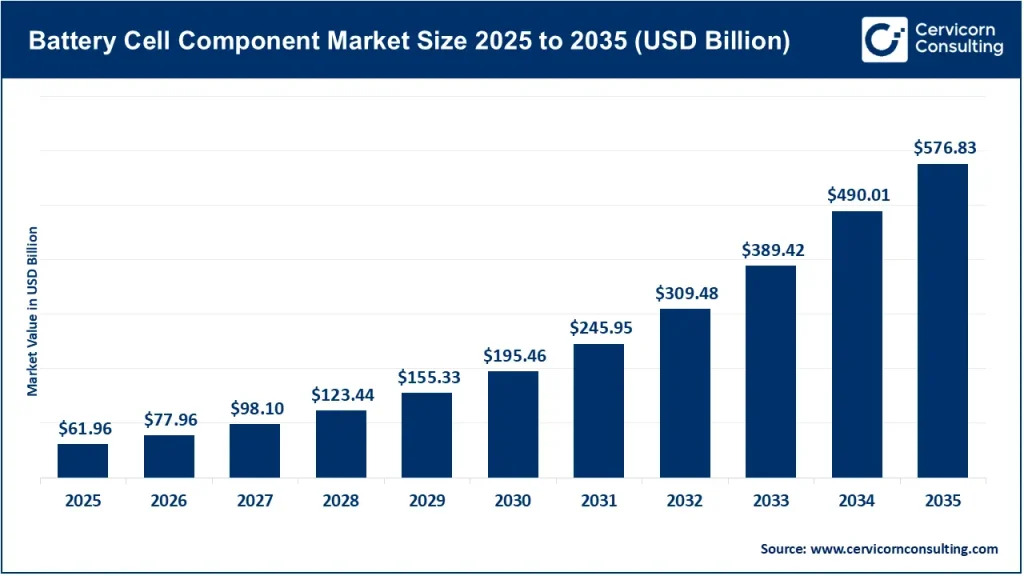
Battery Cell Component Market Size
The global battery cell component market was valued at approximately USD 61.96 billion in 2025 and is projected to reach USD 576.83 billion by 2035, expanding at a CAGR of 25% during the forecast period.
Battery Cell Component Market Growth Factors
The battery cell component market is expanding rapidly as electric vehicles (EVs), energy storage systems (ESS), consumer electronics, industrial equipment, and renewable-energy applications increase their dependence on advanced rechargeable batteries. The expansion of EV production is the strongest demand catalyst, while declining battery costs, improvements in lithium-ion chemistry, increasing adoption of lithium iron phosphate (LFP), high-nickel chemistries, silicon-based anodes, sodium-ion batteries, and next-generation solid-state technologies are encouraging manufacturers to invest in higher-performance cell components.
Government incentives are also reshaping the supply chain by encouraging domestic production of cathode and anode materials, separators, electrolytes, cells, and modules. China accounted for about 80% of global battery-cell production in 2024 and maintained a dominant position in battery components, supplying almost 85% of cathode active materials and more than 90% of anode active materials, highlighting both the scale of the opportunity and the strategic importance of supply-chain diversification. In parallel, the global EV battery market reached 1,187 GWh of deployment in 2025, up 31.7% year over year, creating significant downstream demand for cell components.
What Is the Battery Cell Component Market?
The battery cell component market encompasses the materials, parts, and technologies required to manufacture functional battery cells. A rechargeable lithium-ion cell generally contains a cathode, anode, electrolyte, separator, current collectors, housing or casing, and associated conductive and structural materials. The European Union’s Batteries Regulation defines a battery cell as the basic functional unit containing electrodes, electrolyte, container, terminals and, where applicable, separators and active materials.
The market therefore extends beyond finished battery cells. It includes electrode active materials such as cathode and anode materials, separator films, electrolyte systems, current collectors, conductive additives, binders, cell casings, terminals and other components used during cell manufacturing. Depending on battery chemistry and cell architecture, the composition and specifications of these components can differ substantially.
Battery cell components are critical across cylindrical, prismatic, and pouch cells. Their quality directly affects energy density, charging speed, cycle life, safety, thermal stability, manufacturing yield, and ultimately the cost of the battery pack.
Get a Free Sample: https://www.cervicornconsulting.com/sample/2724
Why Is the Battery Cell Component Market Important?
The market is strategically important because battery performance depends heavily on component quality and integration. A higher-energy-density cathode can increase vehicle driving range, while improved anode materials can support faster charging and longer cycle life. Advanced separators can reduce internal short-circuit risks, and optimized electrolytes can improve thermal and electrochemical stability.
The component supply chain is also central to industrial competitiveness. Battery production is highly concentrated geographically: China accounted for more than 80% of global battery-cell production in 2025, while China, Korea, and Japan continue to dominate many upstream component categories. This concentration has encouraged the United States, European Union, India, Japan and other economies to develop domestic battery manufacturing ecosystems.
The market is additionally important for the energy transition. Batteries enable EVs to replace internal-combustion vehicles, allow renewable electricity to be stored for later use, and support grid balancing and distributed energy systems. Consequently, advances in battery components can influence the affordability and scalability of clean-energy technologies.
Leading Companies in the Battery Cell Component Market
| Company | Specialization | Key Focus Areas | Notable Features | 2025 Revenue | 2025 Market Share* | Global Presence |
|---|---|---|---|---|---|---|
| CATL (Contemporary Amperex Technology Co. Limited) | Lithium-ion batteries, LFP, NMC, sodium-ion and energy-storage batteries | Cell-to-pack, advanced chemistries, manufacturing scale, recycling, global OEM supply | Very large production footprint, strong R&D, CTP technology, broad OEM relationships | RMB 423.7 billion | 39.2% EV battery market | China, Europe, Asia-Pacific and North America |
| LG Energy Solution | EV batteries, ESS batteries, cylindrical, pouch and prismatic technologies | LFP, NCMA/NMC, 46-series cylindrical cells, ESS, advanced manufacturing | Strong automotive partnerships and extensive overseas production | KRW 23.7 trillion | 9.2% EV battery market | South Korea, United States, Europe, China and other markets |
| Panasonic Energy Co., Ltd. | Cylindrical lithium-ion cells and energy-storage batteries | High-energy-density cylindrical cells, 4680, North American production | Long-standing automotive battery expertise and strong Tesla relationship | ¥873.2 billion FY2025 | 3.7% EV battery market | Japan, United States and other international markets |
| Samsung SDI Co., Ltd. | EV batteries, ESS batteries and advanced battery technologies | NCA, LFP, 46-series, solid-state technology, ESS | Premium battery positioning and next-generation technology development | KRW 13.27 trillion | 2.4% EV battery market | South Korea, United States, Europe, China and Asia |
| BYD Company Limited | LFP batteries, Blade Battery and vertically integrated EV battery systems | Blade Battery, LFP, cell-to-pack integration, EV manufacturing | Highly integrated supply chain linking batteries and EVs | RMB 803.97 billion | 16.4% EV battery market | China, Europe, Asia-Pacific, Latin America and other global markets |
CATL
CATL remains the leading force in the global battery industry. Its 2025 revenue reached RMB 423.7 billion, while lithium-ion battery sales increased 39% to 661 GWh. The company maintained a 39.2% global power-battery market share in 2025.
CATL’s competitive advantage comes from scale, chemistry diversification, manufacturing efficiency and continuous investment in battery architecture. Its focus includes LFP, high-nickel systems, sodium-ion technology, cell-to-pack architecture and recycling. The company reported global production capacity of 772 GWh in 2025, with another 321 GWh under construction at year-end.
LG Energy Solution
LG Energy Solution generated KRW 23.7 trillion in 2025 revenue and KRW 1.3 trillion in operating profit. The company is expanding its portfolio beyond conventional EV batteries into ESS, LFP, high-voltage mid-nickel, LMR prismatic and 46-series cylindrical cells.
LG Energy Solution is particularly important in North America because of its extensive manufacturing partnerships with automakers and its investment in local production. It also reported plans to increase ESS production capacity beyond 60 GWh, with more than 80% located in North America.
Panasonic Energy
Panasonic Energy specializes heavily in cylindrical lithium-ion batteries. Its fiscal 2025 net sales were ¥873.2 billion, with the in-vehicle business accounting for ¥481.2 billion. The company has been preparing for mass production of 4680 cells at its Wakayama facility and expanding North American manufacturing.
Its strategy emphasizes high energy density, manufacturing quality and localization of supply chains. Panasonic Energy’s Kansas factory is another important component of its North American expansion strategy.
Samsung SDI
Samsung SDI recorded KRW 13.27 trillion in total revenue in 2025, including KRW 12.38 trillion from its Energy Solution division.
The company is focusing on NCA and LFP batteries for ESS, 46-series cylindrical cells, next-generation solid-state batteries and premium EV applications. Samsung SDI also reported progress in all-solid-state battery validation with BMW and continued development of next-generation battery materials.
BYD
BYD combines battery manufacturing with vehicle production, giving it a highly vertically integrated business model. The company reported RMB 803.97 billion in 2025 revenue, up 3.46% year over year.
Its Blade Battery, based on LFP chemistry, is a major differentiator. BYD’s integration of cathode materials, cells, battery packs and vehicles allows the company to control costs, optimize battery-pack design and accelerate product development. In 2025, BYD held 16.4% of the global EV battery market, second only to CATL.
Leading Trends and Their Impact
1. Rapid Adoption of LFP Chemistry
LFP batteries are gaining importance because of their lower reliance on nickel and cobalt, strong thermal stability and comparatively attractive cost structure. The expansion of affordable EVs and stationary storage is encouraging manufacturers to develop LFP cathodes, optimized separators, electrolytes and conductive systems.
Impact: Component suppliers must adapt production lines and material portfolios toward LFP while maintaining competitive energy density and charging performance.
2. Growth of High-Energy-Density Batteries
Premium EVs require batteries capable of delivering longer range without excessive weight. This is encouraging the development of high-nickel cathodes, silicon-enhanced anodes and advanced electrolytes.
Impact: Component suppliers are increasing R&D spending and improving material purity, particle engineering, coating technologies and electrode manufacturing.
3. Expansion of 46-Series Cylindrical Cells
Large-format cylindrical cells such as 46-series designs are attracting increasing attention from battery manufacturers. LG Energy Solution is expanding its 46-series portfolio, while Samsung SDI is also strengthening its 46-series capabilities.
Impact: Larger cells can reduce the number of cells required per battery pack, potentially simplifying manufacturing and lowering pack-level component requirements.
4. Cell-to-Pack and Cell-to-Chassis Integration
Traditional battery systems use multiple cells assembled into modules and then packs. Cell-to-pack and cell-to-chassis approaches remove some intermediate structures, increasing space utilization and reducing component complexity.
Impact: Suppliers of modules and structural components face pressure to innovate, while manufacturers of cells, thermal systems, adhesives and structural materials gain opportunities.
5. Localization of Battery Supply Chains
Governments increasingly want domestic battery manufacturing capabilities to reduce dependence on imported materials and components. The IEA notes that government-led efforts are driving geographical diversification of battery supply chains.
Impact: New gigafactories are generating demand for localized cathode, anode, separator, electrolyte and equipment suppliers.
6. Battery Recycling and Circularity
Battery recycling is becoming a strategic part of the component ecosystem. CATL, for example, recycled 210,000 tonnes of spent batteries in 2025 and regenerated 24,000 tonnes of lithium salts.
Impact: Recycled lithium, nickel, cobalt and other materials can reduce dependence on primary mining while creating secondary sources of battery-grade materials.
7. Sodium-Ion and Solid-State Technologies
Sodium-ion batteries are emerging as an alternative for cost-sensitive applications, while solid-state batteries are being developed for higher energy density and improved safety.
Impact: These technologies could create new demand for specialized electrolytes, solid electrolytes, separators, electrodes and manufacturing equipment.
Successful Examples of the Battery Cell Component Market Around the World
China: CATL’s Integrated Battery Ecosystem
China demonstrates how scale, vertical integration and supplier clustering can create a powerful battery ecosystem. CATL combines cell manufacturing, material sourcing, technology development, recycling and global production expansion. China’s overall dominance is particularly strong upstream, with the country supplying nearly 85% of cathode active materials and more than 90% of anode active materials.
United States: North American Manufacturing Expansion
The United States has attracted substantial battery manufacturing investment through incentives for domestic production. Korean manufacturers, including LG Energy Solution and Samsung SDI, have expanded their American manufacturing footprints. The IEA reported that U.S. battery manufacturing capacity grew almost 50% in 2024, with Korean companies responsible for nearly 70% of that growth.
The United States is increasingly moving from dependence on imported battery products toward a localized ecosystem covering cells, materials and component manufacturing.
Japan: Panasonic’s High-Performance Cylindrical Strategy
Japan remains a major center for advanced battery engineering. Panasonic Energy’s investment in large-format cylindrical cells, including 4680 technology, demonstrates how established battery manufacturers are adapting cell formats for next-generation EVs. Its North American expansion also shows how Japanese technology providers are combining domestic expertise with localized manufacturing.
South Korea: Advanced Battery Technology and Global OEM Partnerships
South Korean companies have established strong positions in high-performance battery manufacturing. LG Energy Solution, Samsung SDI and other Korean producers have expanded production across North America and Europe while developing high-nickel, LFP, cylindrical and next-generation battery technologies.
This approach demonstrates the importance of combining materials expertise, cell engineering, intellectual property and long-term automotive partnerships.
India: Domestic Advanced Chemistry Cell Manufacturing
India is building its domestic battery industry through the National Programme on Advanced Chemistry Cell Battery Storage, a PLI program with an outlay of ₹18,100 crore designed to establish 50 GWh of domestic ACC manufacturing capacity. The program is intended to reduce dependence on imported advanced chemistry cells and encourage domestic and international manufacturers to establish production in India.
The policy is significant for the component market because domestic cell production can create a larger local customer base for cathode materials, anodes, separators, electrolytes, current collectors and battery manufacturing equipment.
Global Regional Analysis
Asia-Pacific
Asia-Pacific is the dominant region in the battery cell component market. China is the industry’s largest manufacturing center, while Japan and South Korea remain important technology and production hubs. China alone accounted for more than 80% of global battery-cell production in 2025.
China’s strengths include large-scale lithium-ion production, integrated raw-material processing, extensive component manufacturing and established EV demand. CATL and BYD provide major examples of vertically integrated production models.
South Korea specializes in advanced lithium-ion technologies, high-nickel cathodes and global automotive partnerships. Japan retains significant expertise in cylindrical cells, battery quality and advanced materials.
India is emerging as another important manufacturing location. Its ACC PLI program seeks to establish 50 GWh of domestic advanced chemistry cell manufacturing capacity and reduce import dependence.
North America
North America is becoming a major battery manufacturing region because of EV localization strategies, clean-energy investment and government incentives.
The U.S. Inflation Reduction Act’s Section 45X Advanced Manufacturing Production Credit supports qualifying battery components manufactured domestically. Eligible categories include electrode active materials, battery cells and battery modules. The statutory credit includes $35 per kWh for qualifying battery cells and $10 per kWh for battery modules using cells, subject to applicable requirements.
The policy is encouraging manufacturers to establish domestic production of cells and upstream materials. It has also contributed to increased investment from Korean and Japanese battery companies.
Canada is similarly positioned as part of the North American battery supply chain, particularly through investments associated with EV and battery manufacturing.
Europe
Europe is pursuing battery supply-chain localization to strengthen its EV industry and reduce dependence on imported cells and materials. The EU Batteries Regulation establishes requirements covering sustainability, safety, labeling, performance, collection, recycling and battery information.
The regulation is particularly important for component suppliers because sustainability and traceability requirements increasingly affect material sourcing and cell manufacturing. The European regulatory environment is also supporting greater attention to recycled content, battery lifecycle management and responsible supply chains.
European manufacturers are therefore increasingly interested in locally produced cathode and anode materials, recycling infrastructure, battery manufacturing and battery-management technologies.
Latin America
Latin America has a growing strategic role because of its mineral resources and expanding EV and energy-storage opportunities. Countries such as Chile and Argentina are important in the lithium supply chain, while Brazil provides opportunities for EV production, energy storage and battery-related manufacturing.
The region’s future role will depend on its ability to move beyond raw-material extraction toward refining, battery-grade chemical production, component manufacturing and recycling.
Middle East & Africa
The Middle East and Africa represent an emerging market for battery cell components, driven particularly by renewable-energy deployment, grid storage, telecommunications infrastructure and electric mobility.
Energy-storage demand is especially relevant in regions where solar and wind resources are abundant but grid infrastructure requires additional flexibility. Local battery assembly and recycling could gradually create demand for regional component supply chains.
Government-backed renewable-energy programs and investments in clean transportation are likely to support market development, although the region currently has a smaller battery manufacturing base than Asia, North America and Europe.
Government Initiatives and Policies Shaping the Market
United States – Inflation Reduction Act
The U.S. 45X production credit is one of the most important policies affecting battery-component manufacturing. It provides incentives for qualifying domestic battery cells, modules, electrode active materials and critical minerals. The rules also include restrictions concerning prohibited foreign entities and establish a phase-out schedule for many eligible components after 2029.
This framework is encouraging manufacturers to localize production and diversify supply chains.
European Union – Batteries Regulation
The EU Batteries Regulation creates a comprehensive framework covering battery sustainability, safety, performance, labeling, collection, recycling and due diligence. It applies to EV, industrial, light-transport and portable batteries.
For component suppliers, the regulation increases the importance of traceable raw materials, sustainable production, recycling and lifecycle management.
India – ACC PLI Scheme
India’s ACC PLI scheme has a total outlay of ₹18,100 crore and aims to establish 50 GWh of domestic advanced chemistry cell manufacturing capacity. The government describes the program as a mechanism for reducing dependence on imported ACC batteries while encouraging domestic and international investment.
The policy can stimulate an ecosystem of local material and component suppliers as domestic cell production scales.
China – Domestic Manufacturing and Supply-Chain Integration
China’s battery ecosystem has developed through large-scale industrial investment, EV incentives, manufacturing infrastructure and strong integration between raw materials, components, cells, batteries and EVs. The result is an ecosystem with significant cost and scale advantages.
China’s dominance in cathode and anode production demonstrates the impact of industrial clustering and supply-chain integration.
Market Outlook
The battery cell component market is moving toward greater scale, localization, technological diversification and supply-chain integration. Global EV battery demand increased strongly in 2025, while battery manufacturing remains concentrated among Chinese, Korean and Japanese companies.
The next stage of development is likely to be shaped by the interaction of EV adoption, energy-storage growth, LFP expansion, large-format cylindrical cells, advanced anodes, next-generation electrolytes, recycling, solid-state batteries and government-backed localization programs. Component manufacturers that can combine cost efficiency with high performance, traceability and regional manufacturing capabilities are likely to be best positioned as automakers and energy-storage developers increasingly seek secure, diversified and technologically advanced battery supply chains.
To Get Detailed Overview, Contact Us: https://www.cervicornconsulting.com/contact-us
Read Report: 3D Printing in Cosmetic Market Revenue, Trends, and Strategic Insights by 2035