


Table of Contents
ToggleHydrogen Infrastructure Market Size
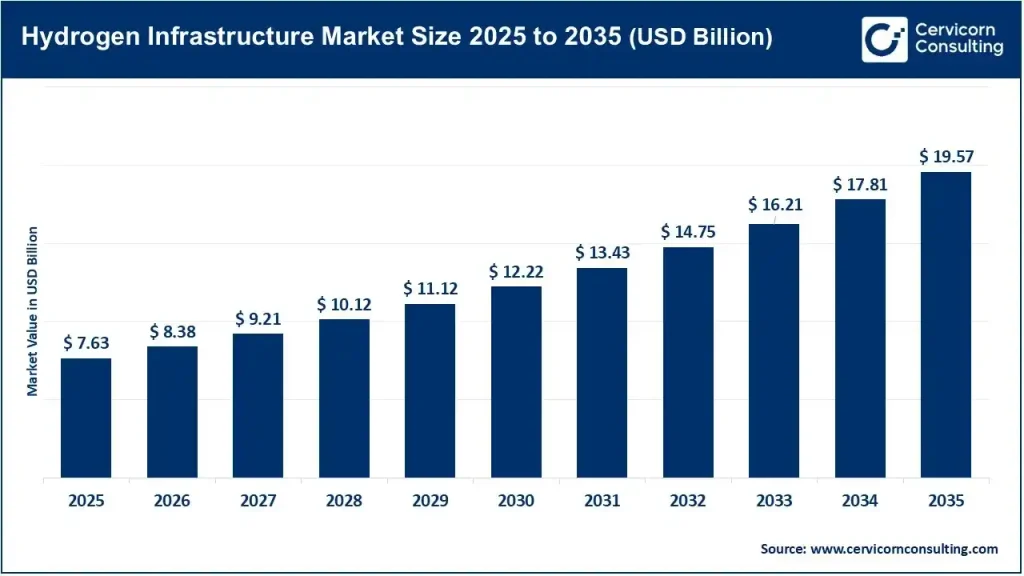
The global hydrogen infrastructure market size was valued at USD 7.63 billion in 2025 and is projected to reach USD 19.57 billion by 2035, representing a 9.9% CAGR.
Hydrogen Infrastructure Market Growth Factors
Growth is being supported by rising hydrogen demand in refining, ammonia, steel, mobility, energy storage, and other hard-to-abate applications; expansion of hydrogen production projects; development of pipelines, storage terminals and refueling stations; government funding and production incentives; increasing adoption of fuel-cell vehicles; and efforts to establish regional hydrogen hubs. The infrastructure opportunity is particularly important because hydrogen production alone does not create a functioning hydrogen economy: large-scale deployment also requires compression, transportation, storage, dispensing, safety systems and reliable connections between producers and end users.
The International Energy Agency (IEA) reported that global hydrogen demand surpassed 100 million tonnes in 2025, while low-emissions hydrogen production increased by 20% to almost 1 million tonnes, although infrastructure availability, project economics, regulation and demand certainty remain important constraints.
Get a Free Sample: https://www.cervicornconsulting.com/sample/3036
What Is the Hydrogen Infrastructure Market?
The hydrogen infrastructure market comprises the equipment, facilities, technologies and networks used to move hydrogen from production to final consumption. It covers infrastructure associated with hydrogen compression, transportation, storage, distribution, refueling and, in some market definitions, production-related systems.
Key components include:
- Hydrogen production infrastructure: electrolyzers, reformers, purification equipment and associated balance-of-plant systems.
- Compression systems: compressors used to increase hydrogen pressure for transportation, storage and dispensing.
- Transportation infrastructure: pipelines, tube trailers, liquid-hydrogen tankers and other hydrogen carriers.
- Storage infrastructure: high-pressure tanks, cryogenic storage, underground storage and stationary storage systems.
- Hydrogen refueling stations: compressors, storage cascades, dispensers, cooling systems and safety equipment.
- Ports and terminals: infrastructure for hydrogen, ammonia and other hydrogen-derived fuels.
- Digital and safety systems: monitoring, leak detection, pressure management, control systems and cybersecurity technologies.
The infrastructure model is evolving from individual facilities toward integrated hydrogen hubs, where production, storage, transportation and consumption are geographically connected. The IEA reported that approximately 37,000 km of hydrogen pipelines had been announced to 2035, although less than 6% had reached final investment decision at the time of its 2025 assessment.
Why Is Hydrogen Infrastructure Important?
Hydrogen infrastructure is important because it determines whether hydrogen can be delivered reliably and economically to industrial and transportation customers. Hydrogen has a relatively low volumetric energy density, meaning that transportation and storage require specialized systems involving compression, liquefaction, pipelines, high-pressure vessels or chemical carriers.
Infrastructure also enables geographic separation between hydrogen production and consumption. Renewable hydrogen, for example, may be produced where solar or wind resources are abundant and then transported to industrial clusters, ports or mobility hubs.
For heavy-duty transportation, infrastructure availability is especially important. Fuel-cell trucks, buses and other hydrogen vehicles require dependable refueling networks. Similarly, industrial users need predictable hydrogen supply before making long-term investments in hydrogen-compatible equipment.
The IEA’s 2025 infrastructure analysis highlights the scale of the challenge: while around 37,000 km of hydrogen pipelines had been announced through 2035, only a small fraction had reached FID. The report also identified approximately 11 TWh of potential underground hydrogen storage capacity from announced projects, with only around 5% having reached FID or construction.
Key Companies in the Hydrogen Infrastructure Market
thyssenkrupp nucera
Specialization: Industrial-scale electrolysis technology and hydrogen production systems.
Key Focus Areas: Alkaline water electrolysis, green hydrogen production, large-scale electrolyzer projects and integrated industrial hydrogen solutions.
Notable Features: thyssenkrupp nucera specializes in industrial-scale electrolysis and has positioned its alkaline water electrolysis technology for large hydrogen projects. thyssenkrupp describes nucera as one of the world’s leading providers of electrolysis technologies for industrial-scale hydrogen production.
2025 Revenue: In its preliminary 2024/25 figures, the company’s Green Hydrogen segment generated approximately EUR 459 million in sales, while total thyssenkrupp nucera sales were slightly below its previously forecast EUR 850–920 million range.
Market Share: A company-specific global hydrogen infrastructure market share is not consistently disclosed in public financial reporting.
Global Presence: Germany-based operations with projects and industrial partnerships spanning Europe, the Middle East, Asia and other international markets.
Nel ASA
Specialization: Electrolyzers and hydrogen fueling technology.
Key Focus Areas: PEM electrolyzers, alkaline electrolyzers, hydrogen fueling stations and large-scale green hydrogen projects.
Notable Features: Nel provides both PEM and alkaline electrolysis technologies, allowing it to serve different project requirements. Its portfolio also includes hydrogen fueling solutions.
2025 Revenue: Nel reported quarterly revenue from contracts with customers of NOK 330 million in Q4 2025, with total revenue and income of NOK 361 million. Its 2025 annual report was published in February 2026.
Market Share: A precise company-level share of the overall hydrogen infrastructure market is not publicly disclosed.
Global Presence: Headquartered in Norway, Nel operates across international hydrogen markets, including Europe and North America.
Hexagon Purus
Specialization: Hydrogen storage cylinders and infrastructure systems.
Key Focus Areas: Type 4 composite cylinders, hydrogen distribution units, mobile refueling stations, stationary storage and hydrogen mobility.
Notable Features: Hexagon Purus uses Type 4 cylinder technology for hydrogen storage and provides systems for mobility and infrastructure applications. In 2025, its Hydrogen Mobility and Infrastructure segment generated NOK 1.028 billion, while hydrogen infrastructure solutions specifically generated NOK 329 million.
2025 Revenue: NOK 329 million from hydrogen infrastructure solutions, including distribution units, mobile refueling stations and stationary storage applications.
Market Share: A standalone global market share for hydrogen infrastructure was not disclosed.
Global Presence: Strong operations across Europe and North America, with applications extending to buses, heavy-duty vehicles, rail, industrial gas and aerospace.
Worthington Enterprises
Specialization: Engineered products and pressure-cylinder technologies, with hydrogen-related capabilities associated with its broader sustainable-energy activities.
Key Focus Areas: Pressure vessels, gas storage, engineered products and energy-related applications.
Notable Features: Worthington has a long-established manufacturing base in pressure-containing products. Its fiscal 2025 results reflect the company’s corporate structure following the deconsolidation of its former Sustainable Energy Solutions segment.
2025 Revenue: Worthington Enterprises reported USD 1.154 billion in fiscal 2025 net sales.
Market Share: A hydrogen-infrastructure-specific market share is not separately reported.
Global Presence: Primarily North American operations with international exposure through products and businesses.
Chart Industries
Specialization: Cryogenic equipment, storage and transportation systems for gases including hydrogen.
Key Focus Areas: Cryogenic tanks, hydrogen liquefaction, storage, transportation, heat-transfer equipment and gas infrastructure.
Notable Features: Chart Industries serves multiple parts of the hydrogen value chain, particularly where cryogenic handling, storage and transportation are required.
2025 Revenue: Chart Industries reported USD 4.264 billion in 2025 sales across its consolidated segments.
Market Share: The company does not separately disclose its percentage share of the global hydrogen infrastructure market.
Global Presence: International manufacturing, engineering and service operations serving customers across North America, Europe, Asia and other markets.
FirstElement Fuel
Specialization: Hydrogen fueling infrastructure.
Key Focus Areas: Hydrogen refueling stations, retail hydrogen distribution and fuel-cell vehicle infrastructure.
Notable Features: FirstElement Fuel operates the True Zero hydrogen fueling network and focuses exclusively on hydrogen mobility. The company describes True Zero as the world’s most extensive network of hydrogen fueling stations.
2025 Revenue: FirstElement Fuel is privately held and does not publicly disclose a comparable 2025 revenue figure.
Market Share: A precise global market share is not publicly disclosed.
Global Presence: Its principal operating footprint is in California, where its True Zero network supports hydrogen fuel-cell transportation.
Leading Trends and Their Impact
Expansion of Hydrogen Hubs
Hydrogen infrastructure is increasingly being developed around integrated hubs instead of isolated production plants. Hubs connect hydrogen producers, storage facilities, transportation systems and end users.
The U.S. Regional Clean Hydrogen Hubs program is an important example. The U.S. Department of Energy’s program includes up to USD 8 billion in federal support for regional hydrogen hubs designed to connect producers, consumers and infrastructure.
Impact: Hub development can reduce transportation distances, improve infrastructure utilization and create clusters of industrial hydrogen demand.
Growth of Hydrogen Pipelines
Pipeline development is emerging as a major infrastructure theme, particularly in Europe and China. The IEA estimates approximately 37,000 km of hydrogen pipelines have been announced through 2035.
Impact: Pipelines can support continuous, large-volume hydrogen delivery, particularly for industrial clusters. However, financing, regulation, safety requirements and demand certainty remain significant considerations.
Expansion of Hydrogen Storage
Large-scale storage is becoming increasingly important as hydrogen production and consumption become more geographically and temporally separated. Underground storage, high-pressure tanks and cryogenic systems are being evaluated for different applications.
Impact: Storage can improve supply reliability, balance production and demand, and support hydrogen-powered electricity generation and industrial operations.
Development of Heavy-Duty Hydrogen Mobility
Hydrogen refueling infrastructure is increasingly targeting trucks, buses, fleets and other heavy-duty applications where fast refueling and long operating ranges can be valuable.
Impact: Infrastructure developers are increasingly focusing on fleet-based stations and high-throughput refueling rather than relying solely on passenger vehicles.
Integration of Hydrogen Derivatives
Hydrogen infrastructure is also expanding beyond gaseous hydrogen. Ammonia, methanol and other hydrogen-derived fuels can facilitate long-distance transportation and international trade.
The IEA reports that nearly 45% of announced low-emissions hydrogen production is intended for export, although many export projects have not yet reached investment stage.
Impact: Ports, terminals, liquefaction facilities and ammonia-handling infrastructure are becoming increasingly important components of the hydrogen value chain.
Increasing Standardization and Certification
Hydrogen infrastructure requires consistent technical standards covering pressure, storage, transportation, safety, purity and certification. The IEA reports progress toward international certification frameworks, while India and the EU have advanced hydrogen certification mechanisms.
Impact: Standardization can facilitate cross-border hydrogen trade, improve investor confidence and reduce technical barriers.
Successful Examples of Hydrogen Infrastructure Around the World
California’s True Zero Network
FirstElement Fuel’s True Zero network represents an established example of hydrogen mobility infrastructure. The company has developed a retail hydrogen fueling network serving fuel-cell vehicles in California.
The model demonstrates how production, distribution, compression, storage and dispensing can be integrated into a consumer-facing hydrogen ecosystem.
U.S. Regional Clean Hydrogen Hubs
The U.S. H2Hubs program represents a large-scale approach to infrastructure development. The program is designed around regional networks linking hydrogen producers and consumers with connective infrastructure.
The approach is significant because it addresses one of hydrogen’s fundamental challenges: infrastructure needs to develop alongside demand.
European Hydrogen Infrastructure
Europe is developing dedicated regulatory and network structures for hydrogen transportation. The European Commission reports that the revised EU gas and hydrogen framework creates rules for hydrogen markets and infrastructure and allows certain existing natural-gas infrastructure to be repurposed for hydrogen.
This creates opportunities for pipelines, cross-border networks, storage facilities and industrial hydrogen corridors.
India’s Emerging Green Hydrogen Hubs
India’s National Green Hydrogen Mission explicitly supports green hydrogen hubs and infrastructure. The mission identifies pipelines, tankers, intermediate storage and last-mile distribution networks as important components of hydrogen supply chains.
The Indian government is also developing green hydrogen hub projects, while its SIGHT program has awarded production capacity to multiple developers. The National Green Hydrogen Mission portal lists awarded projects totaling 412,000 tonnes per year of production capacity in one SIGHT allocation.
Global Regional Analysis Including Government Initiatives and Policies
North America
North America has become a major hydrogen infrastructure investment region, supported by federal funding, tax incentives and industrial demand.
In the United States, the Bipartisan Infrastructure Law provides USD 8 billion for regional clean hydrogen hubs, while the Inflation Reduction Act established incentives for hydrogen production, including a production tax credit of up to USD 3 per kilogram depending on the emissions intensity of production.
The infrastructure focus covers hydrogen production, processing, delivery, storage and end-use applications. California is also an important hydrogen mobility market, supported by fuel-cell vehicle deployment and hydrogen fueling infrastructure.
Canada is developing hydrogen and clean-fuel initiatives that complement broader efforts to build low-carbon energy infrastructure and export opportunities.
Europe
Europe’s hydrogen strategy is strongly connected to industrial decarbonization, renewable energy deployment and energy security. The EU has developed market and infrastructure rules covering hydrogen transportation and certification.
The European Commission states that the revised hydrogen and decarbonized-gas framework is designed to establish EU-wide rules for hydrogen markets and infrastructure and enable repurposing of some existing natural-gas infrastructure for hydrogen.
The region is also developing cross-border hydrogen networks and infrastructure planning mechanisms. Germany is particularly significant, with the IEA reporting that work began in 2025 on repurposing a 400-km section of natural-gas pipeline for hydrogen.
Asia-Pacific
Asia-Pacific is becoming a major hydrogen infrastructure development region because of industrial hydrogen consumption, fuel-cell mobility initiatives, manufacturing capabilities and government support.
Japan has focused heavily on establishing a hydrogen supply chain. Japan’s Hydrogen Society Promotion Act, enacted in May 2024, provides support mechanisms for low-carbon hydrogen deployment, including business-plan approval, price-gap support, hub development and regulatory measures.
China has been developing hydrogen production, transportation and refueling infrastructure as part of its broader clean-energy and industrial strategy. Hydrogen infrastructure development is particularly relevant to heavy-duty transportation and industrial applications.
South Korea has continued developing hydrogen mobility and industrial infrastructure, with fuel-cell vehicles and hydrogen stations forming part of its broader hydrogen-economy strategy.
India
India has established the National Green Hydrogen Mission with an outlay of ₹19,744 crore and a target of developing 5 million metric tonnes per year of green hydrogen production capacity.
The mission supports green hydrogen hubs, transportation, storage, pipelines, distribution systems and export infrastructure. It also includes policy measures designed to facilitate renewable-energy supply for hydrogen production, including provisions relating to interstate transmission charges, renewable-energy banking and open-access connectivity.
India is also seeking to create domestic demand through consumption requirements for designated sectors and to develop green hydrogen and green ammonia exports.
Middle East and Africa
The Middle East is emerging as an important region for large-scale hydrogen and hydrogen-derivative projects because of abundant renewable-energy resources, established energy infrastructure, industrial clusters and access to export markets.
Countries such as Saudi Arabia, the United Arab Emirates and Oman are developing projects focused on green hydrogen and ammonia. Export-oriented infrastructure—including ports, ammonia terminals, renewable-energy generation, electrolysis and storage—is particularly relevant.
Africa also has significant potential, especially in countries with strong solar and wind resources. However, financing, infrastructure connectivity, offtake agreements and access to export infrastructure remain important considerations. The IEA notes that more than half of announced export-oriented low-emissions hydrogen projects are located in emerging and developing economies, where access to affordable capital and export infrastructure can be challenging.
Latin America
Latin America has attracted hydrogen investment because of its renewable-energy resources and potential to produce green hydrogen and ammonia for domestic and export markets. Chile, Brazil and other countries are developing hydrogen strategies, industrial projects and port-linked opportunities.
Chile has positioned green hydrogen as part of its long-term energy and export strategy, although the IEA notes that Chile and several other jurisdictions have faced challenges in meeting earlier electrolyzer deployment targets.
Infrastructure Investment and Market Outlook
The hydrogen infrastructure market is moving from demonstration-scale projects toward interconnected systems involving production, compression, transportation, storage, refueling and industrial consumption. Nevertheless, the sector remains characterized by a significant gap between announced projects and projects that have achieved final investment decisions.
The IEA’s 2025 review found that the pipeline of announced low-emissions hydrogen production projects had declined from the previous year’s expectations, while projects that had reached FID increased. The agency also emphasized that stronger demand policies, infrastructure development and clearer regulation are necessary to convert project announcements into operating assets.
For infrastructure providers, this environment creates opportunities across hydrogen pipelines, compression equipment, storage vessels, liquefaction, refueling stations, distribution units, electrolyzers, ports and digital monitoring systems. Companies capable of integrating multiple components of the hydrogen value chain are increasingly positioned to participate in large hub-scale projects, while specialized suppliers continue to serve specific infrastructure requirements.
To Get Detailed Overview, Contact Us: https://www.cervicornconsulting.com/contact-us
Read Report: Electronic Warfare Market Revenue, Trends, and Strategic Insights by 2035