


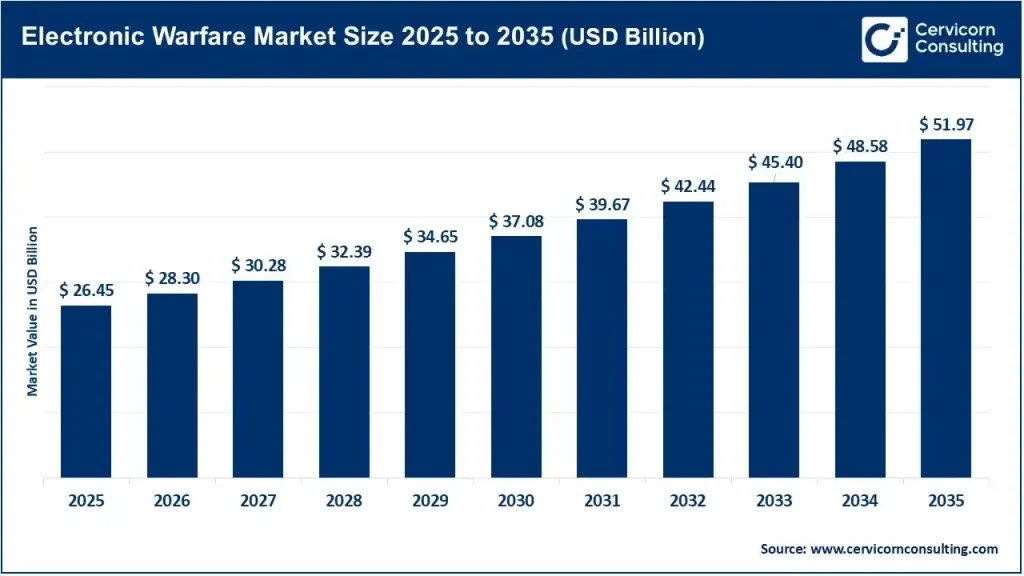
Electronic Warfare Market Size
The global electronic warfare market size was valued at USD 26.45 billion in 2025 and is projected to reach USD 47.91 billion by 2035, representing a 7% CAGR.
Electronic warfare market growth factors
Growth is being supported by rising demand for electronic attack, electronic protection, electronic support, signal intelligence, radar-warning systems, jammers, countermeasure systems, and spectrum-monitoring technologies. The increasing use of drones and autonomous platforms is another major factor because modern militaries require electronic warfare capabilities to detect, disrupt, deceive, or protect against unmanned systems. Experiences from Ukraine have highlighted the importance of adaptable counter-UAS electronic warfare, while NATO has described electromagnetic warfare as applicable across air, land, maritime, space, and cyber operations.
In parallel, the modernization of fighter aircraft, naval platforms, ground forces, missile-defense networks, and command-and-control architectures is creating demand for integrated EW suites. Software-defined architectures, active electronically scanned arrays, artificial intelligence, machine learning, digital signal processing, and cognitive EW are also changing how systems identify and respond to threats. Governments are further supporting demand through defense modernization programs, spectrum-superiority strategies, multinational procurement, and investments in indigenous defense technologies. As electromagnetic environments become more congested and contested, electronic warfare is increasingly being integrated into broader multi-domain operations rather than treated as a standalone capability.
Get a Free Sample: https://www.cervicornconsulting.com/sample/3031
What is the electronic warfare market?
The electronic warfare market comprises technologies, systems, software, platforms, and services designed to use the electromagnetic spectrum to support military operations. At a high level, EW involves three interconnected functions: electronic attack, electronic protection, and electronic support.
Electronic attack includes technologies used to disrupt, deny, deceive, or degrade an adversary’s electromagnetic-dependent systems. Examples include jamming equipment, electronic countermeasures, and certain directed-energy technologies.
Electronic protection focuses on maintaining the effectiveness of friendly systems when operating in a contested electromagnetic environment. Radar-warning systems, frequency agility, electronic counter-countermeasures, signal protection, and electromagnetic signature management are examples.
Electronic support involves detecting, intercepting, identifying, analyzing, and locating electromagnetic emissions. These capabilities can provide information about radar systems, communications networks, navigation signals, and other emitters.
The market spans airborne, naval, ground, space, and unmanned platforms. Modern EW is also increasingly connected with intelligence, surveillance and reconnaissance, cyber operations, communications, radar, satellite systems, and counter-drone technologies. NATO describes electromagnetic warfare as a component of electromagnetic operations that exploits electromagnetic energy to provide situational awareness and offensive and defensive effects.
Why is the electronic warfare market important?
Protecting military communications
Military operations depend heavily on communications. Electronic warfare technologies can help forces maintain communications when adversaries attempt to interfere with radio-frequency systems. Secure and resilient communications are particularly important for distributed forces operating across large geographic areas.
Supporting situational awareness
Electronic support systems can identify electromagnetic emissions and provide information about the surrounding operational environment. This information can contribute to threat identification, surveillance, targeting, and mission planning.
Countering drones and autonomous systems
The rapid proliferation of unmanned aerial systems has increased demand for electronic countermeasures. Systems can target communications or navigation dependencies associated with some drones, while manufacturers are developing more adaptable solutions as unmanned platforms become more sophisticated. U.S. Army analysis of the Ukraine conflict has highlighted the importance of scalable and adaptable counter-UAS capabilities.
Increasing aircraft survivability
Modern combat aircraft increasingly incorporate electronic warfare suites that warn crews about threats and support countermeasures. These capabilities are becoming important components of aircraft modernization programs.
Supporting multi-domain operations
EW is no longer limited to aircraft or battlefield jamming. Military organizations increasingly consider electromagnetic operations alongside cyber, space, intelligence, communications, and conventional military operations. The European Commission describes access to the electromagnetic spectrum as a critical enabler across land, air, sea, space, and cyber domains.
Major companies in the electronic warfare market
The competitive landscape includes large defense contractors with established relationships with military customers, aircraft manufacturers, platform integrators, and national defense agencies. A recent electronic warfare systems market estimate identifies RTX, Lockheed Martin, BAE Systems, Northrop Grumman, and L3Harris among the five largest companies, with the five together estimated to account for 63.7% of the 2025 market. The same source estimates individual shares of approximately 17.2%, 15.1%, 12.4%, 10.3%, and 8.7%, respectively. These should be treated as market-research estimates rather than company-reported figures, because the companies do not separately report total global EW market share.
| Company | Specialization | Key Focus Areas | Notable Features | 2025 Revenue | Estimated EW Market Share* | Global Presence |
|---|---|---|---|---|---|---|
| BAE Systems plc | Defense electronics and EW | Electronic attack, electronic protection, sensors, communications | Electronic Systems business includes EW, avionics, sensors, precision guidance and communications | £30.66B sales | ~12.4% | UK, U.S., Europe, Saudi Arabia, Australia and other markets |
| RTX Corporation | Aerospace and defense technologies | Airborne EW, jamming, radar, sensors, mission systems | Raytheon provides advanced EW and airborne electronic-attack capabilities | $88.60B sales | ~17.2% | North America, Europe, Asia-Pacific and international defense markets |
| L3Harris Technologies, Inc. | Defense communications and spectrum technologies | Spectrum dominance, EW, ISR, communications | Strong focus on connecting space, air, land, sea and cyber domains | $21.9B revenue | ~8.7% | U.S. and international defense markets |
| Northrop Grumman Corporation | Aerospace and defense systems | EW, radar, mission systems, aircraft survivability | EW integrated with sensors, aircraft and multi-domain systems | $42.0B sales | ~10.3% | U.S. and international allied markets |
| Lockheed Martin Corporation | Aerospace, defense and systems integration | EW, aircraft survivability, sensors, C5ISR | EW integrated with major aircraft, missile and mission-system programs | $75.05B net sales | ~15.1% | U.S. and allied international markets |
BAE Systems plc
BAE Systems maintains a significant position in electronic systems and defense electronics. Its Electronic Systems business covers electronic warfare, navigation, electro-optical sensors, avionics, precision guidance, communications, space electronics, and tactical systems. In 2025, Electronic Systems generated £7.528 billion in sales, while BAE Systems reported £30.662 billion in group sales. The company operates in more than 40 countries and identifies the U.S., UK, Europe, Saudi Arabia, and Australia among its major markets.
RTX Corporation
RTX combines aerospace and defense businesses, with Raytheon representing an important source of defense electronics and EW capabilities. The company develops technologies covering electronic attack, radar, sensors, communications, and mission systems. RTX reported $88.603 billion in 2025 sales and ended 2025 with a company backlog of $268 billion, including $107 billion in defense. Its Next Generation Jammer activities also provide exposure to airborne electronic attack.
L3Harris Technologies, Inc.
L3Harris focuses strongly on communications, spectrum dominance, space and mission systems. Its 2025 annual report recorded $21.9 billion in annual revenue, with $7.6 billion generated by Communications & Spectrum Dominance and $10.7 billion from Space & Mission Systems. The company describes its technology portfolio as connecting space, air, land, sea, and cyber domains.
Northrop Grumman Corporation
Northrop Grumman provides EW through its broader portfolio of mission systems, sensors, aircraft, radar, and defense technologies. The company reported $42.0 billion in 2025 sales and a record $95.7 billion backlog. Its Mission Systems business includes technologies relevant to sensing, electronic warfare, communications, and integrated mission operations.
Lockheed Martin Corporation
Lockheed Martin is a major defense systems integrator with EW capabilities integrated into aircraft, missile-defense, naval, space, and command-and-control programs. Its 2025 annual report reported $75.048 billion in net sales. Its position in major aircraft and defense programs gives it opportunities to incorporate EW capabilities directly into larger platform architectures.
Leading trends and their impact
1. Cognitive and AI-enabled electronic warfare
Artificial intelligence and machine learning are increasingly being incorporated into EW architectures to accelerate signal identification, classification, threat assessment, and response. Cognitive EW aims to make systems more adaptable when operating against changing electromagnetic threats.
Impact: This trend is shifting competition from hardware performance alone toward software, algorithms, processing power, data, and rapid software updates.
2. Growth of counter-drone electronic warfare
The proliferation of inexpensive drones has created demand for systems capable of detecting, tracking, and countering unmanned platforms. Experiences from Ukraine have demonstrated how quickly drone and EW technologies can evolve in response to one another.
Impact: Demand is expanding beyond traditional large military platforms toward portable, vehicle-mounted, and networked counter-UAS systems.
3. Software-defined EW architectures
Modern EW systems increasingly rely on software-defined radios, digital signal processing, electronically scanned arrays, and modular architectures. The U.S. Navy’s Next Generation Jammer, for example, uses digital software and electronically scanned array technologies and is designed to receive hardware and software updates as threats evolve.
Impact: Software-defined architectures can shorten upgrade cycles and help defense forces adapt without completely replacing hardware.
4. Integration of EW with cyber and space operations
Military organizations increasingly view the electromagnetic spectrum as a shared operating environment connecting communications, radar, navigation, satellites, and other systems.
Impact: EW suppliers are increasingly competing to provide integrated capabilities rather than isolated jamming or detection equipment.
5. Greater emphasis on electromagnetic spectrum superiority
NATO maintains an Electromagnetic Warfare Policy and EMS Strategy, while its Electromagnetic Warfare Advisory Committee coordinates policy, doctrine, training, and interoperability among Allies.
Impact: Standardization and interoperability requirements are creating opportunities for suppliers capable of integrating systems across multinational defense networks.
6. Modernization of legacy platforms
Many countries are upgrading existing fighter aircraft, ships, armored vehicles, radar networks, and command systems rather than replacing complete platforms.
Impact: EW suppliers can benefit from retrofit programs, electronic upgrades, software modernization, and new self-protection suites.
Successful examples of electronic warfare around the world
United States: Next Generation Jammer
The U.S. Navy’s Next Generation Jammer Mid-Band (NGJ-MB) is an important example of the modernization of airborne electronic attack. The Navy declared initial operational capability for NGJ-MB in December 2024, announced in January 2025. The system is designed to improve the ability of EA-18G Growler aircraft to operate in contested electromagnetic environments.
Ukraine and Russia: battlefield EW adaptation
The Russia-Ukraine war has demonstrated how EW and unmanned systems continuously adapt to each other. U.S. Army analysis has highlighted the widespread use of electronic warfare against drone communications and navigation, while military research has documented the development of lightweight counter-UAS EW systems.
This environment has accelerated interest in portable jammers, drone detection, spectrum monitoring, frequency agility, and alternative navigation and communications technologies.
NATO: multinational electromagnetic warfare coordination
NATO provides another example through its institutional approach to EW. The Alliance’s NEWAC coordinates EW-related policy and cooperation, while the Joint Electronic Warfare Core Staff provides expertise, training, and support. NATO has also emphasized lessons learned from Ukraine and the Middle East in recent EW discussions.
Israel: F-16I self-protection modernization
In January 2025, Israel’s Ministry of Defense announced an approximately $80 million program for an advanced self-protection suite for F-16I aircraft. The package includes an EW system, infrared missile-warning and launch-detection capabilities, and chaff-and-flare systems.
Global regional analysis
North America
North America represents one of the largest markets for electronic warfare because of extensive defense modernization programs, advanced aerospace industries, and significant investment in spectrum operations. One 2026 market estimate values the North American EW systems market at approximately USD 7.3 billion in 2025, with the United States accounting for about USD 5.95 billion.
The United States has established electromagnetic spectrum superiority as a defense priority. The Department of Defense’s Electromagnetic Spectrum Strategy emphasizes developing superior EMS capabilities and integrating spectrum-dependent activities into military operations.
Programs involving airborne electronic attack, counter-UAS, radar modernization, aircraft survivability, and multi-domain operations are expected to remain important demand areas.
Europe
Europe is strengthening EW capabilities as military organizations respond to increasingly contested electromagnetic environments and seek greater interoperability. The European Commission identifies EW as a strategic enabler across all military domains.
The European Defence Fund (EDF) supports collaborative European defense research and capability development. The EDF’s 2025 work program provides a framework for funding defense-related research and development activities, while European defense initiatives increasingly emphasize technologies involving drones, counter-drone systems, cyber defense, space, and electromagnetic operations.
The UK is also strengthening its approach. The 2025 Strategic Defence Review treats the cyber and electromagnetic domain as a core component of modern warfare and calls for a more coherent approach to electromagnetic warfare capability development and spectrum coordination.
Asia Pacific
Asia Pacific is expected to be one of the faster-growing regions for EW systems. A recent market estimate identifies Asia Pacific as the fastest-growing regional market, reflecting defense modernization, expansion of air and naval capabilities, counter-drone requirements, and growing interest in spectrum dominance.
Countries across the region are investing in fighter aircraft, naval platforms, unmanned systems, radar networks, communications infrastructure, and indigenous defense electronics. These developments create opportunities for domestic defense companies as well as international suppliers.
Middle East
The Middle East remains an important market because governments are investing in aircraft survivability, missile defense, surveillance, counter-UAS capabilities, secure communications, and advanced defense electronics. Israel provides a notable example of continued investment in integrated aircraft self-protection and EW systems.
The region’s emphasis on integrated air defense and protection of critical military assets is supporting demand for EW alongside radar, sensors, electronic intelligence, and countermeasure technologies.
Latin America
Latin American demand is comparatively smaller but is developing through modernization of aircraft, naval systems, border-surveillance infrastructure, communications, and security capabilities. Opportunities are likely to focus more on cost-effective modernization, spectrum monitoring, secure communications, and counter-UAS applications rather than very high-end strategic EW systems.
Government initiatives and policies shaping the market
Government policies are playing a major role in determining the pace and structure of electronic warfare adoption. In the United States, electromagnetic spectrum strategies emphasize spectrum superiority, integration, and modernization. NATO’s Electromagnetic Warfare Policy and EMS Strategy provide a framework for allied interoperability, training, doctrine, and capability development.
In Europe, the European Defence Fund is supporting collaborative defense technology development, while the European Commission explicitly identifies EW as an important capability for maintaining access to the electromagnetic spectrum across military domains.
The United Kingdom’s 2025 Strategic Defence Review places electromagnetic warfare within the broader CyberEM domain and calls for coordinated development of EW capabilities and standards aligned with NATO.
Meanwhile, Israel’s defense procurement initiatives demonstrate how governments are combining domestic defense-industry capabilities with modernization programs for aircraft protection and EW.
Overall, government priorities are moving the electronic warfare market toward networked, software-defined, AI-enabled, multi-domain, and interoperable systems. Procurement is increasingly focused not only on individual jammers or sensors but also on architectures that allow military forces to sense the electromagnetic environment, protect friendly systems, disrupt adversary capabilities, and rapidly adapt to changing threats.
To Get Detailed Overview, Contact Us: https://www.cervicornconsulting.com/contact-us
Read Report: U.S. Hospital Services Market Revenue, Trends, and Strategic Insights by 2035