


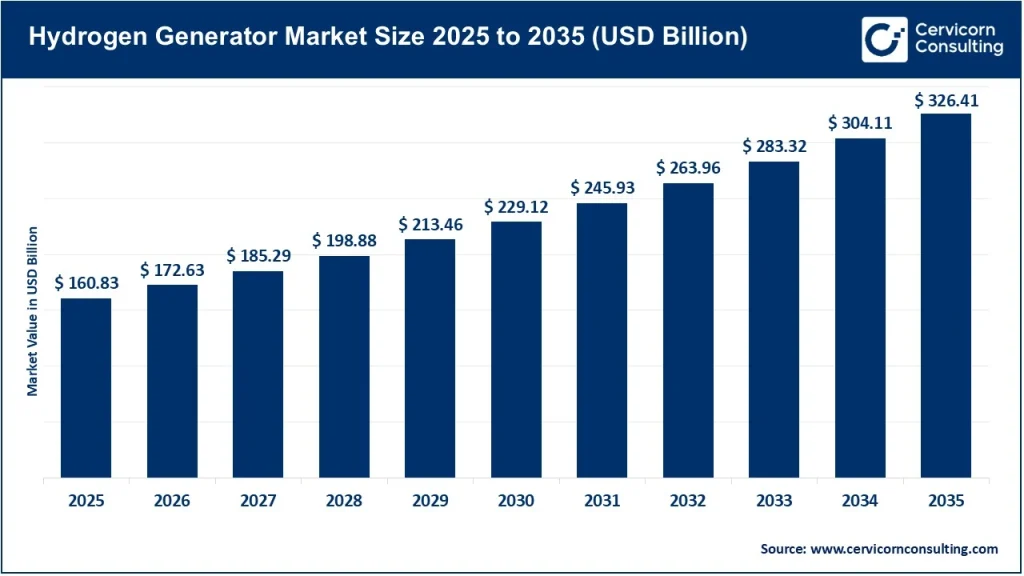
Hydrogen Generator Market Size
The global hydrogen generator market is expected to grow from approximately USD 160.83 billion in 2025 to about USD 326.41 billion by 2035, registering a CAGR of around 7.4% during the forecast period.
What is the Hydrogen Generator Market?
The hydrogen generator market refers to the global ecosystem of technologies, equipment, systems, and services used to produce hydrogen gas either on-site or in centralized facilities for industrial, commercial, and energy applications. These systems convert primary energy sources—such as natural gas, water, or renewable electricity—into hydrogen through processes like electrolysis or reforming.
Hydrogen generators are widely used in refineries, chemical manufacturing, metal processing, semiconductor production, fuel cell applications, and emerging clean mobility solutions. The market includes both large-scale industrial hydrogen plants and compact, modular, or portable hydrogen generation systems used for decentralized applications.
Why the Hydrogen Generator Market is Important?
The hydrogen generator market is important because it directly supports global efforts to reduce carbon emissions and transition toward sustainable energy systems. Hydrogen is considered a clean fuel because its combustion produces only water, making it essential for hard-to-decarbonize industries. Hydrogen generators allow industries to produce hydrogen on-demand, reducing reliance on fossil-fuel-based hydrogen supply chains and minimizing transportation emissions.
Additionally, hydrogen plays a strategic role in energy storage, grid balancing, and renewable energy integration. As solar and wind energy become more widespread, hydrogen acts as a storage medium that stabilizes intermittent power generation, making hydrogen generators a foundational technology in future energy ecosystems.
Hydrogen Generator Market Growth Factors
The hydrogen generator market is experiencing strong growth due to accelerating global decarbonization targets, rising investments in green hydrogen infrastructure, increasing demand for clean fuel alternatives in industrial and transportation sectors, and rapid technological advancements in electrolyzer efficiency and modular hydrogen systems; supportive government policies such as subsidies, carbon reduction mandates, and hydrogen-specific national strategies across Europe, Asia-Pacific, and North America are further boosting adoption, while expanding applications in refining, ammonia production, fuel cells, and energy storage systems are creating sustained long-term demand, alongside declining renewable energy costs and growing private-sector participation in hydrogen-based energy ecosystems, all of which collectively position hydrogen generators as a key enabler of the global clean energy transition.
Get a Free Sample: https://www.cervicornconsulting.com/sample/2939
Key Companies in the Hydrogen Generator Market
1. Linde plc
- Specialization: Industrial gases, large-scale hydrogen production, on-site hydrogen systems
- Key Focus Areas: Green hydrogen, SMR and electrolysis integration, industrial hydrogen supply
- Notable Features: Global hydrogen infrastructure network, advanced engineering capabilities
- 2024 Revenue: Approx. USD 33+ billion (total company revenue)
- Market Share: ~13–18% in hydrogen-related segments
- Global Presence: Strong footprint across North America, Europe, and Asia-Pacific
Linde is a global leader in hydrogen generation and infrastructure, actively involved in both blue and green hydrogen projects and large-scale industrial gas supply systems.
2. Air Liquide
- Specialization: Industrial gases, hydrogen production, fuel cell infrastructure
- Key Focus Areas: Renewable hydrogen, hydrogen refueling stations, low-carbon hydrogen ecosystems
- Notable Features: Extensive global hydrogen supply chain and R&D leadership
- 2024 Revenue: Approx. USD 30–32 billion
- Market Share: ~18% (market leader segment share)
- Global Presence: Europe, Asia, Americas, Middle East
Air Liquide is one of the strongest players driving hydrogen mobility and industrial hydrogen adoption worldwide.
3. Air Products and Chemicals, Inc.
- Specialization: Large-scale hydrogen production, liquefaction, storage
- Key Focus Areas: Green hydrogen mega-projects, clean energy transition infrastructure
- Notable Features: Expertise in hydrogen export and supply chain optimization
- 2024 Revenue: Approx. USD 12–13 billion
- Market Share: Top 3 global hydrogen supplier
- Global Presence: North America, Middle East, Asia-Pacific
Air Products is heavily investing in multi-billion-dollar green hydrogen plants globally, making it a key energy transition leader.
4. Cummins Inc.
- Specialization: Hydrogen generation systems, electrolyzers, fuel cells
- Key Focus Areas: PEM electrolyzers, hydrogen mobility, clean power solutions
- Notable Features: Strong integration of engines and hydrogen technologies
- 2024 Revenue: Approx. USD 34–35 billion
- Market Share: Growing share in electrolyzer segment
- Global Presence: North America, Europe, Asia
Cummins is rapidly expanding into hydrogen production technologies through its electrolyzer division and clean energy portfolio.
5. Plug Power Inc.
- Specialization: Hydrogen fuel cell systems and green hydrogen production
- Key Focus Areas: Green hydrogen plants, fuel cell ecosystems, electrolyzer deployment
- Notable Features: Integrated hydrogen ecosystem model (production-to-use)
- 2024 Revenue: Approx. USD 800 million – 1 billion range
- Market Share: Leading pure-play hydrogen technology company
- Global Presence: North America and expanding into Europe
Plug Power focuses on building a complete hydrogen economy ecosystem from production to end-use applications such as logistics and mobility.
Leading Trends in the Hydrogen Generator Market and Their Impact
One of the most significant trends is the rapid shift toward green hydrogen production using renewable energy-powered electrolysis, which is reducing carbon intensity and improving environmental compliance across industries. Another key trend is the rise of modular and distributed hydrogen generation systems, enabling decentralized production closer to end-users and lowering transportation costs. Additionally, digitalization and AI-driven optimization of hydrogen plants are improving efficiency, predictive maintenance, and system reliability. The growing integration of hydrogen with fuel cell electric vehicles (FCEVs) and industrial decarbonization strategies is also expanding application areas. These trends collectively are accelerating cost reductions, increasing scalability, and positioning hydrogen as a mainstream energy vector rather than a niche industrial gas.
Successful Global Examples of Hydrogen Generator Market Applications
Several large-scale hydrogen initiatives demonstrate the market’s maturity and real-world adoption. In Europe, Germany’s hydrogen valleys integrate renewable energy with electrolyzer-based hydrogen production for industrial clusters. In Japan, hydrogen fuel initiatives under the “hydrogen society” vision support transport and power generation projects. In Australia, green hydrogen export projects supply hydrogen derivatives to Asian markets. In the United States, large-scale hydrogen plants by Air Products and Plug Power supply logistics companies and industrial users. Similarly, Middle Eastern countries like Saudi Arabia are investing in giga-scale hydrogen production hubs as part of energy diversification strategies.
Global Regional Analysis: Government Initiatives and Policy Support
Asia-Pacific
Asia-Pacific dominates the hydrogen generator market due to strong industrial demand and government-backed hydrogen strategies. China leads global hydrogen production, while Japan’s hydrogen roadmap targets large-scale hydrogen adoption across transport and industry. South Korea is investing heavily in hydrogen mobility ecosystems, while India is promoting the National Green Hydrogen Mission to scale domestic production.
Europe
Europe is the fastest-growing regional market, driven by strict climate regulations under the European Green Deal, which mandates significant emissions reduction targets. Countries like Germany, France, and the Netherlands are investing heavily in electrolyzer deployment, hydrogen pipelines, and industrial decarbonization projects. The European Commission is also funding large-scale hydrogen infrastructure expansion programs to accelerate adoption.
North America
The United States and Canada are witnessing strong growth due to federal incentives such as hydrogen tax credits, clean energy funding programs, and Department of Energy initiatives like Hydrogen Shot. Private sector investments from companies like Plug Power, Air Products, and Cummins are accelerating commercial deployment of hydrogen technologies.
Middle East & Africa
The region is emerging as a key hydrogen export hub due to abundant solar energy resources. Countries such as Saudi Arabia and the UAE are investing in giga-scale hydrogen production facilities aimed at global hydrogen supply chains.
Latin America
Brazil and Chile are focusing on renewable hydrogen production using wind and solar energy, targeting export markets and industrial decarbonization applications.
To Get Detailed Overview, Contact Us: https://www.cervicornconsulting.com/contact-us
Read Report: Robotics in Cell Therapy Manufacturing Market Revenue, Trends, and Strategic Insights by 2035