


Table of Contents
ToggleHeat Pump Market Size
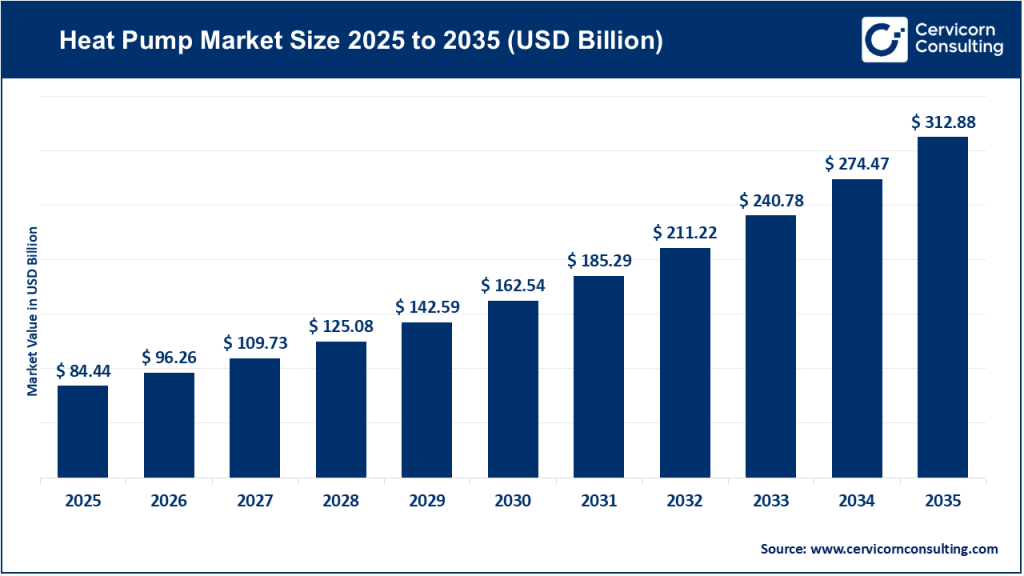
In 2025, the global heat pump market was valued at approximately USD 84.44 billion and is projected to reach nearly USD 312.88 billion by 2035, expanding at a compound annual growth rate (CAGR) of about 14%.
What is the Heat Pump Market?
The heat pump market refers to the global industry involved in the manufacturing, installation, distribution, and maintenance of heat pump systems used for heating, cooling, and water heating applications. Heat pumps operate by transferring heat from one place to another using electricity rather than generating heat directly, making them significantly more energy-efficient than traditional fossil fuel-based systems such as gas boilers or furnaces. These systems extract heat from sources like air, water, or the ground and deliver it indoors for heating or outdoors for cooling depending on the season.
The global heat pump market has experienced rapid expansion due to growing demand for energy-efficient HVAC systems across residential, commercial, and industrial sectors.
Heat pumps have become a critical technology in the transition toward low-carbon energy systems. Governments worldwide are encouraging their adoption as part of broader climate strategies aimed at reducing greenhouse gas emissions and improving energy efficiency in buildings.
Heat Pump Market Growth Factors
The heat pump market is expanding rapidly due to a combination of environmental, economic, and technological factors. Rising global energy demand and increasing electricity prices have encouraged consumers and businesses to adopt energy-efficient heating technologies that reduce long-term operating costs. Heat pumps can reduce energy consumption by up to 40% compared with conventional heating systems, making them an attractive solution for households and commercial buildings. Governments around the world are implementing stricter environmental regulations and carbon-neutral targets, which further accelerate adoption. Many countries also provide subsidies, tax incentives, and rebates to encourage installation of heat pump systems, covering a portion of equipment or installation costs.
Additionally, advancements in compressor technology, low-global-warming-potential refrigerants, and smart control systems have improved performance and reliability across different climates. Rapid urbanization and increasing construction activities in emerging economies have also boosted demand for efficient HVAC systems. Furthermore, the growing integration of heat pumps with renewable energy sources such as solar power and smart grids is enabling more sustainable energy systems, which continues to drive strong global market growth.
Get a Free Sample: https://www.cervicornconsulting.com/sample/2912
Why the Heat Pump Market is Important
The heat pump market plays a crucial role in the global energy transition and climate change mitigation strategies. Heating and cooling account for a significant portion of global energy consumption, especially in residential and commercial buildings. Traditional heating systems rely heavily on fossil fuels such as natural gas, coal, or oil, which contribute to greenhouse gas emissions.
Heat pumps offer a cleaner and more efficient alternative because they transfer heat instead of generating it. Their adoption can significantly reduce carbon emissions compared with traditional heating technologies, making them a key component in decarbonizing the building sector.
Another important factor is energy security. Many countries depend heavily on imported fossil fuels, which exposes them to price volatility and supply disruptions. Heat pumps powered by electricity—especially when combined with renewable energy—help reduce dependence on fossil fuels.
From an economic perspective, the heat pump market also supports job creation in manufacturing, installation, and maintenance services. The growing demand for skilled technicians and HVAC professionals is creating new employment opportunities globally.
Key Companies in the Heat Pump Market
Below is an overview of several major companies involved in the global heat pump market.
| Company | Specialization | Key Focus Areas | Notable Features | 2024 Revenue | Market Share | Global Presence |
|---|---|---|---|---|---|---|
| Samsung | Consumer electronics and HVAC solutions | Smart home HVAC systems and air-source heat pumps | Integration with smart home ecosystems and energy management systems | ~$226 billion | Moderate share in HVAC segment | Strong presence in Asia, North America, Europe |
| Carrier | HVAC and refrigeration systems | Residential and commercial heat pump systems | High-efficiency HVAC technologies and sustainability solutions | ~$22 billion | Major HVAC player | Global operations in over 160 countries |
| Panasonic Holdings Corporation | Electronics and energy systems | Eco-friendly heating and cooling solutions | Advanced inverter technology and energy-efficient heat pumps | ~$58 billion | Significant share in Asia and Europe | Strong global manufacturing and distribution network |
| Rheem Manufacturing Company | Water heating and HVAC products | Heat pump water heaters and HVAC equipment | Known for innovative water heating technologies | ~$5 billion | Strong share in North America | Global presence in more than 50 countries |
| HAIER (GENERAL ELECTRIC Appliances division) | Home appliances and HVAC | Smart appliances and residential heat pump systems | Integration with connected home platforms | ~$35 billion (Haier Group) | Growing share in residential HVAC | Global manufacturing and distribution network |
These companies compete based on technological innovation, energy efficiency, product reliability, and global distribution networks.
Leading Trends in the Heat Pump Market and Their Impact
Electrification of Heating Systems
The shift toward electrification is one of the most influential trends in the HVAC sector. Governments are encouraging the replacement of gas or oil heating systems with electric heat pumps to reduce carbon emissions. This transition is accelerating demand for residential heat pump installations worldwide.
Impact
- Reduced dependence on fossil fuels
- Increased adoption of renewable energy
- Expansion of electricity infrastructure
Integration with Renewable Energy
Heat pumps are increasingly integrated with renewable energy systems such as solar panels and wind energy. This integration allows buildings to operate with minimal carbon emissions.
Impact
- Lower operating costs
- Improved sustainability
- Greater energy independence for households
Smart and Connected Heat Pumps
Smart heat pump systems connected to IoT platforms allow remote monitoring, predictive maintenance, and energy optimization. Smart thermostats and cloud-based controls enable users to manage energy consumption efficiently.
Impact
- Higher system efficiency
- Improved user comfort
- Reduced maintenance costs
Development of Eco-Friendly Refrigerants
Manufacturers are shifting toward low-global-warming-potential refrigerants such as CO₂ and R-290. These refrigerants help reduce environmental impact while maintaining high system performance.
Impact
- Compliance with environmental regulations
- Reduced greenhouse gas emissions
- Long-term sustainability of HVAC technologies
Growth of Industrial Heat Pumps
Heat pumps are increasingly used in industrial processes such as waste heat recovery, drying, and food processing.
Impact
- Reduced industrial energy consumption
- Lower operational costs for manufacturers
- Expansion of market applications beyond residential buildings
Successful Examples of Heat Pump Adoption Around the World
Europe – Large-Scale Residential Adoption
Europe is one of the largest markets for heat pumps due to strict climate policies and aggressive decarbonization targets. The European Union has set ambitious goals to increase heat pump installations as part of its energy transition strategy. Many countries provide financial incentives and subsidies for homeowners installing heat pump systems.
United States – Rapid Growth in Residential Installations
In the United States, heat pumps have gained popularity due to their dual functionality for heating and cooling. Federal tax credits and state-level incentive programs have encouraged adoption. Heat pumps have even outsold gas furnaces in the U.S. for several consecutive years, reflecting strong consumer interest in energy-efficient technologies.
China – Global Manufacturing Hub
China is a major producer and exporter of heat pumps and contributes a large share of global heat pump production. Chinese manufacturers supply equipment to Europe and other regions where demand for clean heating technologies is rapidly increasing.
Australia – Transition Away from Gas Heating
Australia has introduced policies to reduce reliance on gas heating systems. Recent government initiatives have encouraged households to adopt electric heat pump systems instead of traditional gas heating solutions.
Global Regional Analysis
North America
North America represents a significant share of the global heat pump market due to growing consumer awareness and government incentives promoting energy efficiency. The United States and Canada have introduced tax credits, rebates, and clean energy programs encouraging homeowners to replace traditional heating systems with heat pumps.
Government Initiatives
- Federal tax credits for energy-efficient HVAC systems
- State-level rebate programs
- Building energy efficiency standards
These policies have accelerated the adoption of heat pump technologies in residential and commercial sectors.
Europe
Europe leads the global heat pump market due to strong environmental regulations and climate commitments. The region accounts for a large share of global installations and continues to invest heavily in clean heating infrastructure.
Government Initiatives
- REPowerEU strategy targeting large-scale heat pump deployment
- Financial incentives and grants for households
- Carbon neutrality targets by 2050
Several European countries, including Germany, France, and the United Kingdom, offer substantial subsidies covering a portion of heat pump installation costs.
Asia-Pacific
The Asia-Pacific region is expected to witness the fastest growth in the heat pump market due to rapid urbanization, industrialization, and rising energy demand. Countries such as China, Japan, and South Korea are major contributors to regional growth.
Government Initiatives
- Renewable energy policies in China
- Energy-efficient building regulations in Japan
- Incentive programs for smart and sustainable homes
China, in particular, dominates heat pump manufacturing and export markets.
Latin America
The heat pump market in Latin America is gradually expanding due to rising energy costs and growing awareness about sustainable heating technologies. Brazil, Mexico, and Chile are key emerging markets.
Government Initiatives
- Energy efficiency programs
- Renewable energy development strategies
- Green building certification systems
Although adoption is still relatively low compared with developed regions, the market potential is significant.
Middle East and Africa
The Middle East and Africa region is witnessing growing adoption of heat pumps in commercial and residential applications. The technology is particularly useful in regions with high cooling demand.
Government Initiatives
- Energy efficiency policies in the UAE and Saudi Arabia
- Green building initiatives
- Sustainable urban development projects
The region is increasingly investing in renewable energy infrastructure, which supports the growth of electric heat pump systems.
To Get Detailed Overview, Contact Us: https://www.cervicornconsulting.com/contact-us
Read Report: Active Transportation Market Revenue, Trends, and Strategic Insights by 2035