


Table of Contents
ToggleGenerative AI in IT Operations Market Size
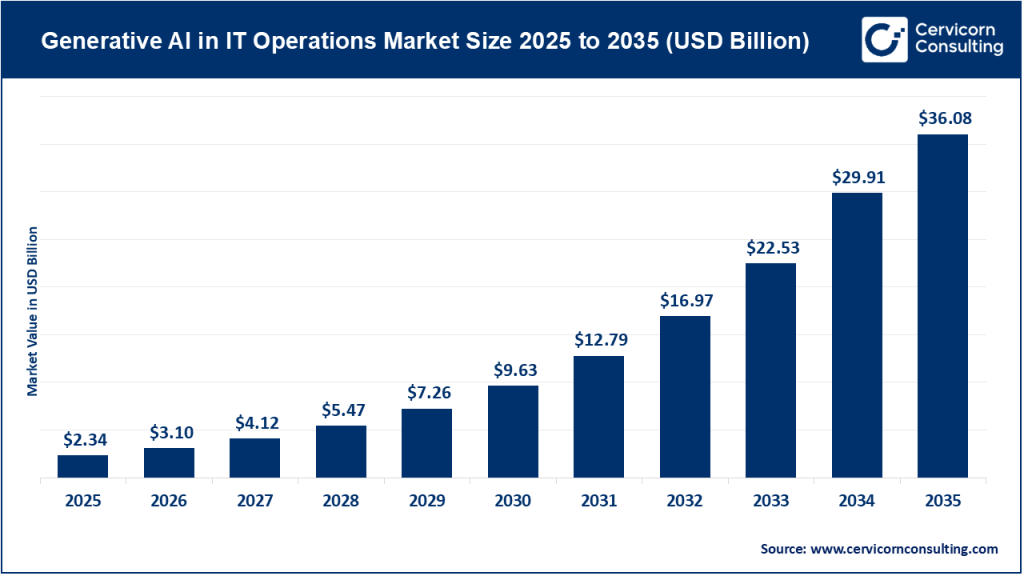
The global generative AI in IT operations market size was valued at approximately USD 3.10 billion in 2025 and is projected to reach nearly USD 36.08 billion by 2035, growing at a CAGR of 31.46%.
Generative AI in IT Operations Market Growth Factors
The generative AI in IT operations market is experiencing remarkable growth due to the increasing complexity of enterprise IT environments, rapid cloud adoption, rising demand for automated incident management, growing cybersecurity concerns, and the need for real-time infrastructure monitoring. Organizations worldwide are leveraging generative AI to streamline IT workflows, reduce operational costs, improve service reliability, and enhance decision-making capabilities. The integration of large language models (LLMs), machine learning algorithms, predictive analytics, and intelligent automation into IT operations platforms is enabling businesses to automate repetitive tasks, accelerate root-cause analysis, optimize resource utilization, and improve customer experiences.
Additionally, the expansion of hybrid and multi-cloud environments, increasing digital transformation initiatives, and growing investments in AI-driven enterprise solutions are significantly contributing to market expansion. Government support for AI innovation, enterprise adoption of AIOps platforms, and advancements in natural language processing technologies are further accelerating market growth globally.
What is Generative AI in IT Operations Market?
Generative AI in IT operations refers to the deployment of advanced artificial intelligence models capable of generating insights, recommendations, code, reports, workflows, and automated responses within IT environments. These solutions combine generative AI technologies with AIOps (Artificial Intelligence for IT Operations) platforms to enhance monitoring, incident management, infrastructure optimization, cybersecurity, and service desk operations.
Unlike traditional IT management tools that rely primarily on predefined rules and manual interventions, generative AI systems can understand context, learn from historical data, predict future events, and generate actionable solutions in real time. These capabilities allow organizations to automate complex operational tasks, improve system performance, and reduce downtime.
The market encompasses software platforms, cloud-based AI services, infrastructure monitoring tools, intelligent service management systems, cybersecurity solutions, and automated remediation technologies designed to support modern enterprise IT operations.
Get a Free Sample: https://www.cervicornconsulting.com/sample/2640
Why is Generative AI in IT Operations Important?
Accelerates Incident Resolution
Generative AI significantly reduces Mean Time to Resolution (MTTR) by analyzing system logs, identifying root causes, and generating recommended remediation actions instantly.
Enhances Operational Efficiency
IT teams spend considerable time on repetitive operational tasks. Generative AI automates ticket creation, troubleshooting, reporting, and infrastructure management, allowing personnel to focus on strategic initiatives.
Improves Service Reliability
Predictive analytics combined with generative capabilities help organizations detect anomalies before they become critical failures, ensuring improved uptime and service availability.
Supports Digital Transformation
As enterprises migrate to cloud-native architectures and hybrid environments, AI-powered IT operations provide the scalability and intelligence necessary to manage increasingly complex infrastructures.
Strengthens Cybersecurity
Generative AI can analyze security events, generate threat intelligence summaries, automate investigations, and assist security teams in responding to cyber incidents more effectively.
Reduces Costs
Automation of IT processes minimizes manual intervention, lowers operational expenses, and optimizes resource allocation across enterprise environments.
Major Companies in the Generative AI in IT Operations Market
1. Microsoft
| Category | Details |
|---|---|
| Specialization | Cloud Computing, AI, Enterprise Software |
| Key Focus Areas | Azure AI, Copilot, AIOps, Infrastructure Automation |
| Notable Features | AI-powered copilots, predictive analytics, automated incident response |
| 2025 Revenue | Approximately USD 280+ Billion |
| Market Share | Leading position in enterprise AI and cloud services |
| Global Presence | North America, Europe, Asia-Pacific, Latin America, Middle East & Africa |
Microsoft has become a dominant force in generative AI-driven IT operations through Azure AI services and Copilot integrations. The company’s AI-powered operational solutions help enterprises automate infrastructure management, optimize cloud performance, and enhance IT service delivery.
2. IBM
| Category | Details |
|---|---|
| Specialization | Enterprise AI, Hybrid Cloud, Automation |
| Key Focus Areas | Watsonx, AIOps, IT Automation |
| Notable Features | AI-powered monitoring, predictive maintenance, intelligent automation |
| 2025 Revenue | Approximately USD 62+ Billion |
| Market Share | Significant presence in enterprise IT automation |
| Global Presence | More than 175 countries |
IBM’s Watsonx platform and AIOps solutions help organizations automate operations, improve system reliability, and manage hybrid cloud infrastructures efficiently.
3. Google Cloud
| Category | Details |
|---|---|
| Specialization | Cloud Infrastructure, AI Platforms |
| Key Focus Areas | Vertex AI, Cloud Operations Suite |
| Notable Features | AI-driven monitoring, anomaly detection, intelligent recommendations |
| 2025 Revenue | Estimated USD 50+ Billion |
| Market Share | Strong cloud AI market presence |
| Global Presence | Worldwide operations across major regions |
Google Cloud integrates generative AI into cloud operations, enabling enterprises to automate infrastructure management, optimize performance, and improve operational visibility.
4. ServiceNow
| Category | Details |
|---|---|
| Specialization | IT Service Management (ITSM), Workflow Automation |
| Key Focus Areas | Generative AI for Service Operations |
| Notable Features | AI-powered ticketing, virtual agents, workflow automation |
| 2025 Revenue | Approximately USD 12+ Billion |
| Market Share | Leading ITSM provider |
| Global Presence | Operations across multiple global markets |
ServiceNow leverages generative AI to automate service desk operations, improve employee experiences, and accelerate issue resolution across enterprise environments.
5. Amazon Web Services (AWS)
| Category | Details |
|---|---|
| Specialization | Cloud Infrastructure, AI Services |
| Key Focus Areas | Bedrock, CloudWatch, Operational Intelligence |
| Notable Features | AI-driven monitoring, predictive operations, cloud automation |
| 2025 Revenue | Estimated USD 115+ Billion |
| Market Share | Global cloud infrastructure leader |
| Global Presence | Extensive worldwide cloud regions |
AWS provides a broad portfolio of AI-powered operational tools that help enterprises optimize workloads, automate infrastructure management, and enhance service reliability.
Leading Trends in the Generative AI in IT Operations Market and Their Impact
Rise of AI-Powered Autonomous Operations
Organizations are increasingly adopting autonomous IT operations platforms capable of monitoring, diagnosing, and resolving issues without human intervention.
Impact
- Reduced downtime
- Faster incident response
- Lower operational costs
- Improved service continuity
Integration of Large Language Models (LLMs)
Large language models are becoming central to IT operations platforms by enabling natural language interactions and intelligent troubleshooting.
Impact
- Enhanced user experiences
- Faster access to operational insights
- Simplified system management
- Improved productivity
Expansion of Predictive Analytics
Generative AI systems are increasingly incorporating predictive capabilities to identify potential failures before they occur.
Impact
- Improved infrastructure reliability
- Reduced outage risks
- Better resource planning
- Higher business continuity
AI-Driven Cybersecurity Operations
Security operations centers are integrating generative AI to automate threat detection, investigation, and response.
Impact
- Faster threat mitigation
- Enhanced security posture
- Reduced alert fatigue
- Improved compliance management
Hybrid and Multi-Cloud Optimization
As enterprises adopt hybrid cloud environments, generative AI helps manage complexity across multiple infrastructure platforms.
Impact
- Better workload optimization
- Improved cloud cost management
- Enhanced operational visibility
- Greater infrastructure flexibility
Intelligent IT Service Management
Generative AI is revolutionizing ITSM by automating ticket management, knowledge generation, and employee support.
Impact
- Faster service delivery
- Improved customer satisfaction
- Reduced support costs
- Increased workforce efficiency
Successful Examples of Generative AI in IT Operations Around the World
Microsoft Azure AI Operations
Microsoft has integrated generative AI capabilities into Azure operations platforms, enabling enterprises to automate incident management, infrastructure optimization, and cloud governance.
Achievements
- Faster troubleshooting
- Reduced operational overhead
- Improved cloud reliability
IBM Watson AIOps Deployments
IBM’s Watson AIOps platform is helping organizations across banking, telecommunications, and healthcare sectors automate operational processes.
Achievements
- Enhanced predictive maintenance
- Improved infrastructure monitoring
- Reduced downtime
Google Cloud Operations Suite
Google Cloud utilizes generative AI to provide intelligent recommendations and anomaly detection capabilities.
Achievements
- Automated issue identification
- Better cloud resource management
- Improved operational efficiency
ServiceNow Generative AI for ITSM
ServiceNow’s AI-powered platform automates service requests and support operations for global enterprises.
Achievements
- Faster ticket resolution
- Increased employee productivity
- Enhanced service quality
AWS Operational Intelligence Solutions
AWS integrates generative AI into monitoring and management services to help enterprises optimize cloud operations.
Achievements
- Real-time operational insights
- Automated remediation
- Improved infrastructure resilience
Global Regional Analysis of the Generative AI in IT Operations Market
North America
North America remains the largest market for generative AI in IT operations due to strong technology infrastructure, significant AI investments, and widespread cloud adoption.
Key Drivers
- Presence of major technology companies
- High enterprise AI adoption
- Advanced cloud ecosystems
- Strong venture capital investments
Government Initiatives and Policies
The United States government continues to support AI innovation through research funding, AI governance frameworks, cybersecurity initiatives, and national AI development strategies. Federal agencies are increasingly exploring AI deployment across operational environments while promoting responsible AI implementation.
Canada has also introduced AI-focused innovation programs and investments that support enterprise adoption of advanced technologies.
Europe
Europe represents a major market driven by digital transformation initiatives and enterprise modernization efforts.
Key Drivers
- Strong industrial digitization
- Growing cloud adoption
- Increased cybersecurity investments
- Rising demand for automation
Government Initiatives and Policies
The European Union has established comprehensive AI regulations emphasizing transparency, accountability, and responsible AI deployment. Various digital transformation programs and innovation funds support AI research and enterprise adoption throughout the region.
Countries such as Germany, France, and the United Kingdom are investing heavily in AI ecosystems, smart infrastructure, and industrial automation initiatives.
Asia-Pacific
Asia-Pacific is expected to experience the fastest growth during the forecast period.
Key Drivers
- Rapid digital transformation
- Expanding cloud infrastructure
- Increasing AI investments
- Growing enterprise modernization programs
Government Initiatives and Policies
China continues implementing national AI development plans aimed at becoming a global AI leader. Government support for AI research, cloud computing, and digital infrastructure is driving adoption.
India’s digital transformation initiatives, AI missions, and technology innovation programs are encouraging enterprise adoption of AI-powered operational platforms.
Japan and South Korea are investing in AI research, intelligent automation, and smart industry programs to enhance competitiveness.
Latin America
Latin America is witnessing increasing adoption of generative AI technologies as organizations modernize IT infrastructures.
Key Drivers
- Growing cloud migration
- Expansion of digital services
- Increasing cybersecurity awareness
- Demand for operational efficiency
Government Initiatives and Policies
Several governments are introducing digital economy strategies, AI roadmaps, and innovation programs to accelerate technology adoption and strengthen digital competitiveness.
Brazil and Mexico are emerging as regional leaders in enterprise AI deployment.
Middle East and Africa
The Middle East and Africa region is rapidly embracing AI-driven IT operations as governments pursue ambitious digital transformation agendas.
Key Drivers
- Smart city projects
- Cloud infrastructure investments
- Government-led digital initiatives
- Expansion of enterprise technology adoption
Government Initiatives and Policies
Countries including Saudi Arabia and the United Arab Emirates have launched national AI strategies focused on accelerating AI adoption across public and private sectors.
Vision-driven programs are encouraging investments in intelligent automation, cloud computing, and AI-powered operational technologies.
African nations are increasingly investing in digital infrastructure development and AI innovation programs to strengthen economic growth and technology capabilities.
Market Outlook
The generative AI in IT operations market is poised for substantial expansion as enterprises continue to prioritize automation, operational resilience, and intelligent infrastructure management. The convergence of generative AI, machine learning, cloud computing, cybersecurity, and predictive analytics is creating transformative opportunities for organizations worldwide. With continued innovation from leading companies such as Microsoft, IBM, Google Cloud, ServiceNow, and AWS, the market is expected to become a cornerstone of next-generation enterprise IT management, enabling autonomous operations, enhanced productivity, and superior business outcomes across industries.
To Get Detailed Overview, Contact Us: https://www.cervicornconsulting.com/contact-us
Read Report: Hydrogen Truck Market Revenue, Trends, and Strategic Insights by 2035