


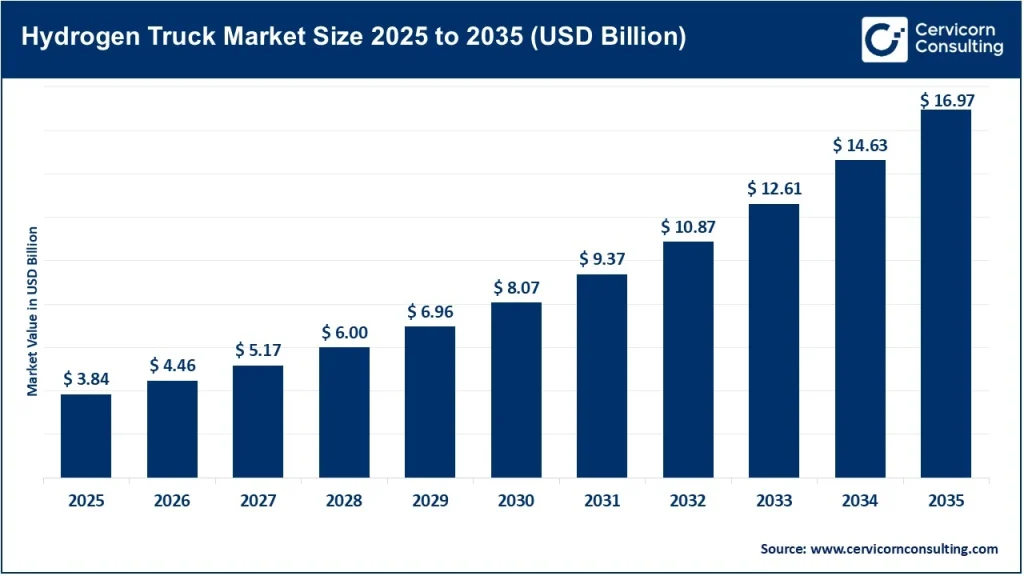
Hydrogen Truck Market Size
The global hydrogen truck market was valued at approximately USD 3.84 billion in 2025 and is projected to reach nearly USD 16.97 billion by 2035, growing at a CAGR of 16.5%.
Hydrogen Truck Market Growth Factors
The hydrogen truck market is experiencing rapid growth due to the increasing global focus on decarbonizing the transportation sector, rising demand for zero-emission commercial vehicles, stringent environmental regulations, and growing investments in hydrogen infrastructure. Governments across North America, Europe, and Asia-Pacific are implementing incentives, subsidies, and carbon-reduction policies that encourage fleet operators to adopt hydrogen-powered trucks. Technological advancements in fuel cell systems, improvements in hydrogen storage capabilities, expanding green hydrogen production, and strategic collaborations between truck manufacturers, energy companies, and logistics providers are further accelerating market expansion. Additionally, the need for long-range, heavy-duty transportation solutions with fast refueling times is positioning hydrogen trucks as a viable alternative to conventional diesel vehicles and battery-electric trucks, particularly for long-haul freight operations.
What is the Hydrogen Truck Market?
The hydrogen truck market refers to the global industry involved in the development, manufacturing, deployment, and commercialization of trucks powered by hydrogen fuel cell technology. Unlike conventional diesel-powered trucks, hydrogen trucks generate electricity through a chemical reaction between hydrogen and oxygen within a fuel cell, producing only water vapor as a byproduct.
Hydrogen-powered trucks are primarily designed for medium- and heavy-duty transportation applications, including freight logistics, construction, mining, municipal services, and regional or long-haul transportation. These vehicles offer advantages such as extended driving range, shorter refueling times, reduced emissions, and the ability to transport heavier payloads compared to many battery-electric alternatives.
As governments and industries seek sustainable transportation solutions, hydrogen fuel cell trucks are emerging as a key component of future clean mobility ecosystems.
Get a Free Sample: https://www.cervicornconsulting.com/sample/2977
Why is the Hydrogen Truck Market Important?
The hydrogen truck market plays a critical role in achieving global sustainability and climate objectives. Commercial vehicles account for a significant share of transportation-related greenhouse gas emissions, making decarbonization of freight transport essential for meeting net-zero targets.
Hydrogen trucks provide a practical solution for long-distance transportation where battery-electric vehicles may face limitations related to charging time, battery weight, and driving range. Their ability to refuel within minutes and operate over long distances makes them particularly suitable for logistics operators seeking efficiency and sustainability.
The market is also important because it stimulates innovation across multiple sectors, including renewable energy, hydrogen production, fuel cell technology, transportation infrastructure, and advanced manufacturing. As hydrogen ecosystems mature, they create economic opportunities, support energy security, and reduce dependence on fossil fuels.
Major Companies Shaping the Hydrogen Truck Market
1. Daimler Truck AG
| Category | Details |
|---|---|
| Specialization | Heavy-duty commercial vehicles and fuel-cell-powered trucks |
| Key Focus Areas | Hydrogen fuel cell systems, long-haul transportation, sustainable logistics |
| Notable Features | Co-developer of advanced fuel cell technology through strategic partnerships |
| 2025 Revenue | Approximately USD 60 billion |
| Estimated Market Share | 15–18% of the hydrogen truck segment |
| Global Presence | Europe, North America, Asia-Pacific, Latin America |
Daimler Truck AG is among the leading innovators in hydrogen-powered freight transportation. The company has invested heavily in fuel-cell technology for heavy-duty trucking applications and continues to expand pilot programs across Europe and North America. Its hydrogen truck initiatives focus on achieving long driving ranges while maintaining payload capacity and operational efficiency.
2. Hyundai Motor Company
| Category | Details |
|---|---|
| Specialization | Fuel cell electric vehicles and commercial transportation |
| Key Focus Areas | Hydrogen mobility ecosystems, fuel-cell trucks, green logistics |
| Notable Features | Pioneer in commercial deployment of hydrogen fuel cell trucks |
| 2025 Revenue | Approximately USD 125 billion |
| Estimated Market Share | 12–15% |
| Global Presence | Asia-Pacific, Europe, North America, Middle East |
Hyundai has emerged as one of the earliest commercial adopters of hydrogen truck technology. The company has successfully deployed hydrogen-powered heavy-duty trucks in several markets and continues to expand partnerships involving hydrogen production, refueling infrastructure, and logistics services.
3. Toyota Motor Corporation
| Category | Details |
|---|---|
| Specialization | Fuel cell systems, hydrogen mobility, commercial transportation |
| Key Focus Areas | Fuel-cell powertrains, heavy-duty trucking, hydrogen ecosystem development |
| Notable Features | Extensive expertise in fuel cell technology and hydrogen innovation |
| 2025 Revenue | Approximately USD 310 billion |
| Estimated Market Share | 10–13% |
| Global Presence | More than 170 countries and regions |
Toyota has leveraged decades of hydrogen research to develop advanced fuel-cell systems for commercial transportation. The company collaborates with truck manufacturers, logistics providers, and infrastructure developers to accelerate the adoption of hydrogen-powered freight solutions.
4. Volvo Group
| Category | Details |
|---|---|
| Specialization | Commercial vehicles and sustainable transportation solutions |
| Key Focus Areas | Fuel-cell trucks, carbon-neutral logistics, fleet decarbonization |
| Notable Features | Significant investment in hydrogen-powered heavy-duty vehicles |
| 2025 Revenue | Approximately USD 58 billion |
| Estimated Market Share | 10–12% |
| Global Presence | Europe, North America, Asia-Pacific, Africa |
Volvo Group continues to strengthen its hydrogen truck portfolio through research, partnerships, and pilot deployments. The company views hydrogen as a critical technology for long-haul transportation and energy-intensive freight applications.
5. PACCAR Inc.
| Category | Details |
|---|---|
| Specialization | Heavy-duty trucks and advanced transportation technologies |
| Key Focus Areas | Fuel-cell development, fleet efficiency, sustainable freight transport |
| Notable Features | Active participation in hydrogen truck demonstrations and pilot projects |
| 2025 Revenue | Approximately USD 36 billion |
| Estimated Market Share | 8–10% |
| Global Presence | North America, Europe, Australia, Latin America |
PACCAR is actively investing in hydrogen-powered commercial vehicle programs to support future zero-emission transportation requirements. Its strategy combines fuel-cell technology development with broader sustainability initiatives across commercial trucking.
Leading Trends in the Hydrogen Truck Market and Their Impact
Expansion of Green Hydrogen Production
One of the most influential trends is the rapid growth of green hydrogen production using renewable energy sources such as solar and wind power. As production costs decline, hydrogen trucks become increasingly competitive with diesel-powered alternatives. This trend supports large-scale adoption while reducing lifecycle emissions.
Development of Hydrogen Refueling Infrastructure
Governments and private companies are investing heavily in hydrogen refueling stations. Expanded infrastructure reduces operational barriers and enhances confidence among fleet operators considering hydrogen-powered vehicles.
Strategic Industry Partnerships
Collaborations between truck manufacturers, fuel cell developers, energy companies, and logistics firms are accelerating commercialization. These partnerships facilitate technology transfer, infrastructure deployment, and cost optimization across the hydrogen value chain.
Advancements in Fuel Cell Technology
Continuous improvements in fuel cell efficiency, durability, and performance are increasing vehicle reliability while lowering operating costs. Enhanced fuel-cell systems are making hydrogen trucks more attractive for commercial transportation applications.
Focus on Long-Haul Freight Transportation
Hydrogen trucks are increasingly positioned as the preferred solution for long-haul freight routes. Their ability to travel hundreds of kilometers with minimal downtime provides significant advantages over conventional and battery-electric alternatives in certain applications.
Successful Examples of Hydrogen Truck Deployment Around the World
Switzerland’s Hydrogen Truck Network
Switzerland has become a global benchmark for hydrogen-powered freight transportation. Hydrogen fuel cell trucks operate across logistics networks supported by dedicated refueling infrastructure. This ecosystem demonstrates the viability of large-scale hydrogen mobility.
Hydrogen Freight Corridors in Germany
Germany has established multiple hydrogen transportation initiatives aimed at supporting commercial vehicle adoption. Truck manufacturers, logistics companies, and government agencies are collaborating to create hydrogen freight corridors connecting key industrial regions.
Port Operations in California, United States
California has deployed hydrogen-powered trucks for freight transportation around major ports and logistics hubs. These projects contribute to emissions reduction efforts while supporting the state’s ambitious clean transportation goals.
Hydrogen Logistics Projects in South Korea
South Korea continues to expand hydrogen-powered logistics operations through government-backed initiatives and industrial partnerships. The country is positioning itself as a leading hydrogen economy with strong support for commercial transportation applications.
Hydrogen Commercial Fleets in Japan
Japan’s hydrogen strategy includes deployment of fuel-cell commercial vehicles across transportation and logistics networks. Public-private collaboration has helped accelerate infrastructure development and technology commercialization.
Global Regional Analysis
North America
North America is emerging as a significant hydrogen truck market due to strong policy support, infrastructure investments, and decarbonization initiatives. The United States and Canada are promoting hydrogen adoption through funding programs, clean energy legislation, and public-private partnerships. Major logistics companies are increasingly exploring hydrogen-powered fleets to meet sustainability targets.
Europe
Europe currently represents one of the most advanced hydrogen truck markets globally. Countries such as Germany, France, the Netherlands, Norway, and Sweden are investing heavily in hydrogen production, refueling infrastructure, and commercial vehicle deployment. The European Union’s climate policies and emissions regulations continue to accelerate market growth.
Asia-Pacific
Asia-Pacific is expected to witness the fastest growth during the forecast period. China, Japan, and South Korea are making substantial investments in hydrogen technologies. Government support, industrial capabilities, and large-scale transportation networks position the region as a major hub for hydrogen truck development and deployment.
Latin America
Latin America is gradually entering the hydrogen transportation sector. Countries including Chile and Brazil are investing in green hydrogen production projects that could support future hydrogen-powered freight transportation networks. Growing renewable energy resources provide strong long-term potential.
Middle East and Africa
The Middle East is becoming an important player in the global hydrogen economy due to large-scale investments in hydrogen production facilities. Countries such as Saudi Arabia and the United Arab Emirates are developing hydrogen export and transportation strategies that may support commercial vehicle adoption. Africa is also exploring opportunities linked to renewable energy-driven hydrogen production.
Government Initiatives and Policies Shaping the Market
Governments worldwide are playing a decisive role in accelerating hydrogen truck adoption through policy frameworks, financial incentives, and infrastructure investments.
United States
The U.S. government has introduced clean hydrogen funding programs, tax incentives, and research initiatives aimed at expanding hydrogen production and transportation infrastructure. Federal and state-level policies support hydrogen-powered commercial vehicle deployment.
European Union
The European Union’s Hydrogen Strategy and Green Deal promote hydrogen as a cornerstone of decarbonization efforts. Funding programs encourage research, innovation, infrastructure development, and commercial deployment of hydrogen-powered trucks.
Germany
Germany has established national hydrogen programs that provide financial support for hydrogen production, refueling infrastructure, and commercial vehicle projects. These initiatives position the country as a leading European hydrogen market.
Japan
Japan’s national hydrogen roadmap emphasizes fuel-cell technology deployment across transportation sectors. Government support includes subsidies, research funding, and infrastructure expansion initiatives.
South Korea
South Korea’s Hydrogen Economy Roadmap promotes widespread adoption of hydrogen-powered vehicles and infrastructure. Public and private investments are driving commercialization across transportation and logistics industries.
China
China continues to expand hydrogen demonstration programs, fuel-cell vehicle incentives, and infrastructure projects. Government policies support domestic manufacturing capabilities and accelerate adoption of hydrogen-powered commercial transportation.
The combination of supportive policies, infrastructure investments, emissions regulations, and industrial collaboration is expected to remain a key driver of hydrogen truck market growth throughout the coming decade.
To Get Detailed Overview, Contact Us: https://www.cervicornconsulting.com/contact-us
Read Report: Quantum AI Market Revenue, Trends, and Strategic Insights by 2035