


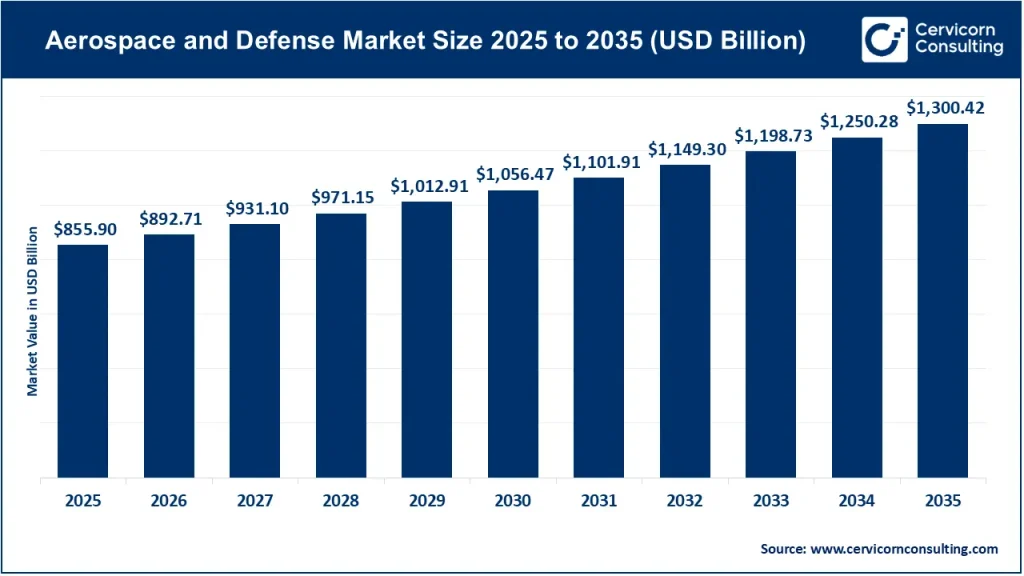
Aerospace and Defense Market Size
The global aerospace and defense market was valued at approximately USD 855.9 billion in 2025 and is projected to reach nearly USD 1,300.42 billion by 2035, growing at a CAGR of 4.27%.
Aerospace and Defense Market Growth Factors
The global aerospace and defense market is experiencing sustained growth due to rising defense budgets, increasing geopolitical tensions, expanding commercial aviation, rapid advancements in aerospace technologies, growing investments in unmanned systems, space exploration initiatives, modernization of military fleets, and the widespread adoption of artificial intelligence, autonomous systems, cybersecurity, and advanced materials. Governments worldwide are strengthening national security capabilities through long-term procurement programs while airlines continue investing in fuel-efficient aircraft to meet rising passenger demand. The growing importance of satellite communications, missile defense systems, next-generation fighter aircraft, urban air mobility, and sustainable aviation technologies is creating significant opportunities across both defense and commercial aerospace segments.
Furthermore, increased public-private partnerships, digital manufacturing, predictive maintenance, additive manufacturing, and resilient global supply chains continue to accelerate innovation and expand market opportunities.
Get a Free Sample: https://www.cervicornconsulting.com/sample/2681
What is the Aerospace and Defense Market?
The aerospace and defense market encompasses the design, development, manufacturing, maintenance, and support of aircraft, spacecraft, satellites, defense systems, weapons, military vehicles, avionics, propulsion systems, and related technologies for commercial, government, and military applications.
The industry consists of two primary segments:
Commercial Aerospace
- Commercial aircraft
- Business jets
- Helicopters
- Aircraft engines
- Aviation services
- Maintenance, Repair, and Overhaul (MRO)
Defense
- Military aircraft
- Naval defense
- Land combat systems
- Missile systems
- Radar and surveillance
- Cybersecurity
- Space defense
- Intelligence and reconnaissance platforms
As nations modernize defense infrastructure and airlines recover from pandemic-related disruptions, the aerospace and defense sector continues to expand as one of the world’s most technologically advanced industries.
Why is the Aerospace and Defense Market Important?
The aerospace and defense industry plays a critical role in national security, economic development, technological innovation, and global connectivity.
Its importance includes:
- Protecting national sovereignty through advanced defense capabilities.
- Supporting commercial aviation and international trade.
- Driving innovation in artificial intelligence, robotics, advanced materials, and satellite technologies.
- Creating millions of high-skilled engineering and manufacturing jobs.
- Strengthening disaster response, surveillance, and emergency communications.
- Supporting global navigation through satellite systems.
- Accelerating scientific research and space exploration.
- Enhancing cybersecurity for critical infrastructure.
The sector also serves as a major catalyst for innovation, with many technologies originally developed for aerospace later finding applications in healthcare, automotive, telecommunications, and consumer electronics.
Major Companies Shaping the Aerospace and Defense Market
| Company | Specialization | Key Focus Areas | Notable Features | 2025 Revenue | Estimated Market Share | Global Presence |
|---|---|---|---|---|---|---|
| Northrop Grumman Corp | Defense Systems, Aerospace, Space | B-21 Raider, Missile Defense, Space Systems, Autonomous Platforms | Advanced stealth technologies and next-generation defense solutions | Approximately USD 42.0 Billion | ~3–4% of the global aerospace & defense market | North America, Europe, Middle East, Asia-Pacific |
| General Dynamics | Defense, Marine Systems, Combat Vehicles, Aerospace | Gulfstream Business Jets, Nuclear Submarines, Mission Systems | Diverse portfolio spanning aviation and defense | Approximately USD 51–52 Billion | ~4% | Global operations across more than 45 countries |
| Raytheon Technologies Corporation (RTX) | Missiles, Aerospace Systems, Engines, Avionics | Air Defense, Collins Aerospace, Pratt & Whitney Engines | Industry-leading missile and propulsion technologies | Approximately USD 88.6 Billion | ~7% | More than 180 countries |
| Airbus Group SE | Commercial Aircraft, Defense & Space, Helicopters | A320 Family, A350, Space Systems, Military Transport Aircraft | World’s leading commercial aircraft manufacturer alongside Boeing | €73.4 Billion | ~6% | Operations and customers across more than 150 countries |
| The Boeing Company | Commercial Aviation, Defense, Space | Commercial Aircraft, Defense Systems, Satellites, Services | Extensive commercial aviation portfolio and defense capabilities | Approximately USD 78–80 Billion | ~6% | More than 150 countries |
Market shares are approximate estimates based on overall global aerospace and defense industry revenues and vary by segment.
Leading Trends Transforming the Aerospace and Defense Market
1. Artificial Intelligence and Autonomous Systems
Artificial intelligence is revolutionizing aerospace and defense operations through predictive maintenance, autonomous drones, intelligent surveillance, mission planning, and real-time battlefield analytics.
Machine learning enables aircraft to optimize flight operations while autonomous military platforms reduce operational risks.
Impact
- Faster decision-making
- Reduced operational costs
- Improved mission accuracy
- Enhanced predictive maintenance
2. Growing Defense Modernization Programs
Governments are replacing aging military equipment with advanced fighter aircraft, missile defense systems, naval vessels, and integrated battlefield technologies.
Major procurement programs include:
- Sixth-generation fighter aircraft
- Hypersonic weapons
- Integrated air defense systems
- Electronic warfare platforms
- Advanced naval fleets
Impact
Defense modernization significantly increases procurement spending and stimulates long-term contracts for leading aerospace manufacturers.
3. Expansion of Space Economy
Space has become a strategic priority for governments and private companies.
Investment areas include:
- Satellite constellations
- Space launch vehicles
- Space surveillance
- Lunar exploration
- Space communications
- Space-based defense
The commercialization of low Earth orbit continues creating entirely new business opportunities.
4. Sustainable Aviation
Commercial aviation is rapidly embracing sustainability initiatives including:
- Sustainable Aviation Fuel (SAF)
- Hydrogen-powered aircraft
- Electric propulsion
- Hybrid-electric aircraft
- Lightweight composite materials
Aircraft manufacturers are focusing on reducing carbon emissions while improving fuel efficiency.
5. Digital Manufacturing
Industry 4.0 technologies have transformed aircraft manufacturing.
Key technologies include:
- Digital twins
- Robotics
- Additive manufacturing
- IoT-enabled factories
- Automated quality inspection
These innovations reduce production time while improving product quality.
6. Cybersecurity Integration
Modern aircraft and military platforms are increasingly connected.
Cybersecurity now protects:
- Aircraft communication systems
- Military command networks
- Satellite infrastructure
- Critical defense databases
- Autonomous systems
As cyber threats become more sophisticated, cybersecurity spending continues rising across defense agencies.
7. Advanced Materials and Composite Structures
Manufacturers increasingly use:
- Carbon fiber composites
- Titanium alloys
- High-performance ceramics
- Heat-resistant materials
These materials improve:
- Fuel efficiency
- Structural strength
- Aircraft durability
- Payload capacity
Successful Examples of the Aerospace and Defense Market Around the World
Boeing 787 Dreamliner
The Boeing 787 transformed long-haul aviation by incorporating lightweight composite materials, advanced aerodynamics, and fuel-efficient engines, enabling airlines to reduce operating costs while expanding direct international routes.
Airbus A320neo Family
The Airbus A320neo program has become one of the most successful commercial aircraft families globally due to its exceptional fuel efficiency, reduced emissions, and lower maintenance requirements.
B-21 Raider
Northrop Grumman’s B-21 Raider represents one of the world’s most advanced stealth bombers, designed for long-range strategic missions using next-generation stealth technologies and digital engineering.
Patriot Missile Defense System
RTX’s Patriot missile defense system remains one of the most widely deployed air and missile defense platforms, protecting military installations and critical infrastructure against advanced aerial threats.
Gulfstream G700
General Dynamics’ Gulfstream G700 has redefined business aviation through ultra-long-range capability, advanced avionics, fuel efficiency, and luxurious passenger comfort.
Airbus Defence and Space
Airbus has successfully expanded beyond commercial aviation into military transport aircraft, satellites, secure communications, and defense electronics, strengthening Europe’s strategic aerospace capabilities.
Global Regional Analysis Including Government Initiatives and Policies
North America
North America remains the world’s largest aerospace and defense market.
Key Drivers
- High military expenditure
- Advanced manufacturing ecosystem
- Large commercial aviation sector
- Strong space industry
- Continuous technological innovation
The United States leads global defense procurement and aerospace manufacturing through extensive investments in aircraft modernization, missile defense, and next-generation military technologies.
Government Initiatives
- Increased defense appropriations supporting modernization across air, land, sea, cyber, and space domains.
- Investment in advanced programs such as next-generation fighter aircraft, autonomous systems, and missile defense.
- Continued support for NASA-led exploration and commercial space partnerships.
- Policies encouraging domestic semiconductor production and resilient aerospace supply chains.
Canada also continues investing in NORAD modernization, Arctic surveillance, and defense capability upgrades while supporting domestic aerospace manufacturing.
Europe
Europe represents one of the world’s strongest aerospace manufacturing hubs.
Major contributors include:
- France
- Germany
- United Kingdom
- Italy
- Spain
Government Policies
European governments emphasize:
- Collaborative defense procurement
- Space technology development
- Sustainable aviation
- Green aircraft innovation
- Cross-border industrial cooperation
The European Union supports research through aerospace innovation programs while increasing defense collaboration among member states.
Growing geopolitical uncertainty has accelerated defense spending throughout Europe.
Asia-Pacific
Asia-Pacific is the fastest-growing aerospace and defense market.
Major countries include:
- China
- India
- Japan
- South Korea
- Australia
Growth Drivers
- Rapid airline expansion
- Indigenous aircraft manufacturing
- Military modernization
- Rising defense budgets
- Growing satellite programs
Government Initiatives
China continues investing in domestic commercial aircraft production, military aviation, and space exploration.
India promotes domestic defense manufacturing through policies encouraging local production, technology transfer, and private-sector participation.
Japan and South Korea continue strengthening missile defense systems, cybersecurity, and advanced aerospace research.
Australia is expanding investments in naval defense, autonomous technologies, and regional security partnerships.
Latin America
The aerospace market in Latin America is steadily growing due to increasing commercial aviation demand and defense modernization.
Brazil remains the regional leader because of its globally recognized aircraft manufacturing capabilities.
Government Policies
Regional governments are investing in:
- Border surveillance
- Maritime security
- Disaster response aviation
- Aircraft fleet modernization
- Defense cooperation
Several countries are also encouraging domestic aerospace manufacturing through industrial development initiatives.
Middle East and Africa
The Middle East continues to invest heavily in advanced military aircraft, integrated air defense, and unmanned aerial systems.
Countries including Saudi Arabia and the United Arab Emirates are expanding domestic defense industries while strengthening international partnerships.
Government Initiatives
Key priorities include:
- Defense industrial localization
- Smart military technologies
- Cybersecurity
- Missile defense
- Aerospace manufacturing diversification
In Africa, governments are increasingly investing in surveillance aircraft, border security technologies, and regional peacekeeping capabilities while modernizing civil aviation infrastructure.
Future Outlook for the Aerospace and Defense Market
The aerospace and defense market is entering a transformative era shaped by artificial intelligence, digital engineering, autonomous platforms, sustainable aviation, commercial space expansion, and next-generation defense technologies. Rising geopolitical tensions, increasing commercial air travel, and government commitments to military modernization will continue supporting long-term market expansion. As manufacturers accelerate innovation across advanced propulsion systems, cybersecurity, hypersonic technologies, satellite communications, and intelligent manufacturing, the industry is expected to remain one of the world’s most strategic and technology-intensive sectors, creating significant opportunities for aerospace companies, defense contractors, suppliers, investors, and governments over the coming decade.
To Get Detailed Overview, Contact Us: https://www.cervicornconsulting.com/contact-us
Read Report: Medical Disposables Market Revenue, Trends, and Strategic Insights by 2035