


GaN Power Device Market: Where Should Semiconductor Companies Focus Their Next Growth Investments?
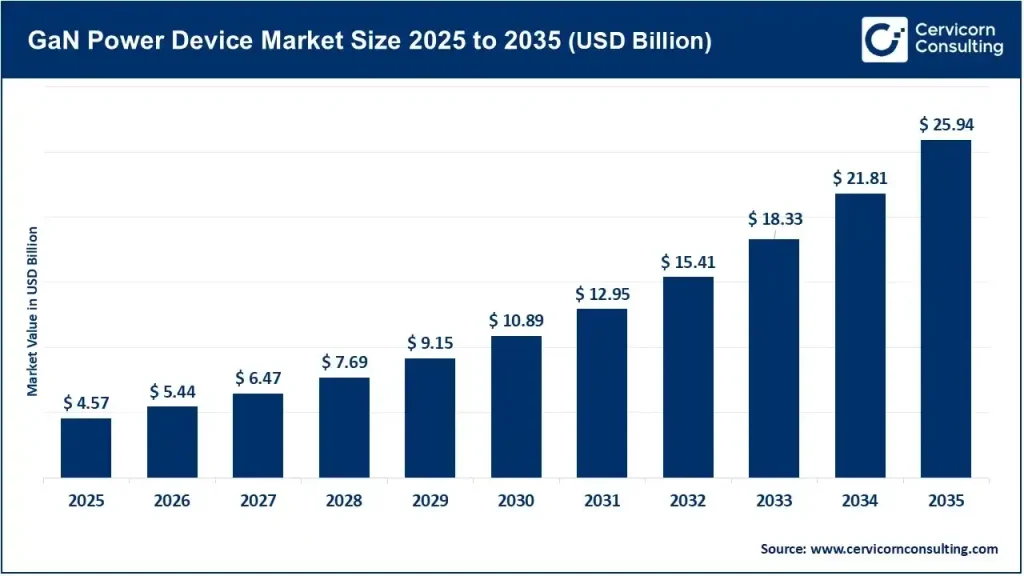
The global GaN power device market was valued at USD 4.57 billion in 2025 and is projected to reach USD 25.94 billion by 2035, growing at a compound annual growth rate (CAGR) of 19% from 2026 to 2035.
The growing demand for high-efficiency power conversion, AI data center infrastructure, electric vehicles, fast-charging systems, and advanced industrial electronics is creating new opportunities for gallium nitride (GaN) technology. As manufacturers look beyond conventional silicon-based power semiconductors, GaN is emerging as an important technology for applications requiring higher switching frequencies, improved power density, and reduced energy losses.
However, market expansion does not automatically translate into commercial success for every GaN manufacturer. Companies must determine which voltage categories offer the strongest demand, whether to prioritize discrete devices or integrated power solutions, and how quickly emerging applications can justify investments in manufacturing capacity and product development.
For semiconductor manufacturers, component suppliers, and power electronics companies, the next growth phase will depend on identifying commercially viable applications while managing manufacturing costs, reliability requirements, and competitive positioning.
1. AI Data Centers Are Creating a New Market for High-Efficiency GaN Power Devices
AI infrastructure is changing power requirements across data centers. Increasing rack power density, higher computing loads, and the expansion of accelerator-based servers are creating pressure to improve power conversion efficiency throughout the electrical infrastructure.
GaN power devices can support high-frequency switching and compact power conversion designs, making them relevant to server power supplies, AC-DC converters, and DC-DC conversion systems.
The transition toward higher-voltage power distribution architectures is also creating opportunities for advanced semiconductor technologies. As data center operators evaluate new power delivery configurations, component manufacturers have an opportunity to develop GaN solutions suited to next-generation power conversion requirements.
What companies should evaluate:
- Product development: Prioritize high-voltage GaN devices and integrated power solutions designed for high-density server power supplies.
- Application partnerships: Build relationships with server manufacturers, power supply manufacturers, and data center power infrastructure providers.
- Technology positioning: Evaluate opportunities in high-frequency switching, thermal optimization, and compact power conversion.
- Commercial readiness: Assess qualification requirements, reliability expectations, and customer adoption timelines before expanding production capacity.
The opportunity is not limited to supplying individual semiconductor components. Companies capable of supporting complete power conversion requirements could develop stronger relationships with data center equipment manufacturers.
Get a Free Sample: https://www.cervicornconsulting.com/sample/3082
2. GaN vs. Silicon vs. SiC: Choosing the Right Technology for Different Applications
The expansion of wide-bandgap semiconductors is changing the competitive landscape of power electronics. However, GaN, silicon carbide (SiC), and conventional silicon technologies serve different performance and cost requirements.
GaN offers advantages in high-frequency switching, power density, and compact power conversion. SiC is particularly relevant to high-voltage and high-power applications, including electric vehicle traction inverters and industrial power systems. Silicon continues to remain competitive in applications where established manufacturing infrastructure and lower component costs are important.
For manufacturers, the challenge is determining where GaN provides a meaningful system-level advantage rather than competing solely on device specifications.
Key considerations for technology selection:
- Operating voltage: Determine whether the application requires the commercially established 200–600 V range or higher-voltage capabilities.
- Switching frequency: Evaluate whether faster switching can reduce passive component requirements and improve overall system performance.
- Thermal management: Assess the impact of switching losses, packaging, cooling requirements, and operating conditions.
- Total system cost: Compare semiconductor costs alongside supporting components, cooling systems, system size, and energy consumption.
- Reliability: Consider qualification requirements, operating environments, and long-term performance expectations.
Companies should avoid treating GaN as a universal replacement for silicon or SiC. A more commercially viable approach is to identify applications where its performance advantages justify the additional technology and integration costs.
3. Automotive Electrification Could Expand GaN Beyond Consumer Charging Applications
Automotive electrification is creating opportunities for advanced power semiconductor technologies. Electric vehicles require efficient power conversion across battery charging, auxiliary power systems, onboard chargers, and other electrical subsystems.
GaN devices offer opportunities to develop smaller and more efficient onboard charging systems, particularly where switching frequency, weight, and power density are important design considerations.
The commercial opportunity extends beyond vehicle manufacturers. Tier 1 automotive suppliers, power electronics developers, charging equipment manufacturers, and semiconductor companies can all participate in the evolving supply chain.
However, automotive adoption requires more than achieving improved electrical performance.
Strategic priorities for automotive suppliers:
- Develop application-specific GaN devices for onboard chargers and auxiliary power conversion.
- Work with automotive OEMs and Tier 1 suppliers during early-stage product development.
- Invest in automotive-grade reliability testing and qualification capabilities.
- Evaluate the economics of GaN integration against existing silicon and SiC solutions.
- Identify vehicle platforms and charging architectures where reduced size and weight create measurable commercial value.
Automotive suppliers should also distinguish between near-term opportunities in onboard charging and longer-term opportunities in higher-power vehicle architectures. This distinction can help companies allocate research and development resources more effectively.
4. GaN Power ICs Could Change Competitive Positioning for Semiconductor Manufacturers
The GaN power device market is evolving from standalone semiconductor components toward integrated power solutions.
Discrete GaN devices accounted for approximately 42% of global market revenue in 2025, reflecting their established use in chargers, adapters, power supplies, and other power conversion systems.
However, GaN power ICs are expected to experience faster growth as manufacturers increasingly prioritize compact designs, simplified circuit architectures, and integrated power management.
Integration can reduce component count and simplify system design, creating opportunities for semiconductor companies to differentiate through product architecture rather than device performance alone.
What manufacturers should consider:
- Expand portfolios from discrete GaN transistors toward integrated power ICs.
- Evaluate integration of drivers, controllers, and protection functions.
- Develop application-specific solutions for data centers, industrial power supplies, and fast-charging systems.
- Build stronger technical support capabilities to help customers transition from silicon-based designs.
- Assess whether integrated products can improve margins and customer retention.
For established semiconductor manufacturers, portfolio expansion into integrated GaN solutions could provide an opportunity to compete for higher-value applications and strengthen relationships with power electronics customers.
5. Manufacturing Strategy: GaN-on-Silicon or Emerging Substrate Technologies?
Manufacturing scalability remains an important consideration for companies entering or expanding within the GaN power semiconductor industry.
GaN-on-silicon accounted for approximately 68% of market revenue in 2025, supported by its manufacturing scalability, compatibility with established semiconductor processes, and commercial suitability across several power conversion applications.
However, continued development of alternative substrate technologies and vertical GaN architectures could create opportunities in applications requiring higher voltage handling, power density, and performance.
Manufacturers must balance technology differentiation with production economics.
Important investment considerations include:
- Wafer manufacturing: Evaluate wafer size, production yields, material quality, and manufacturing scalability.
- Process compatibility: Assess opportunities to leverage existing semiconductor manufacturing infrastructure.
- Packaging capabilities: Invest in packaging technologies that support thermal performance, reliability, and higher power density.
- Production economics: Compare capital expenditure, manufacturing costs, yield improvement potential, and expected production volumes.
- Technology roadmap: Determine whether emerging vertical GaN and alternative substrate technologies align with long-term target applications.
The commercial success of GaN manufacturers will depend not only on device innovation but also on their ability to achieve consistent manufacturing quality and competitive production costs.
6. Asia-Pacific and North America Present Different Market Expansion Opportunities
Regional market strategies are becoming increasingly important as semiconductor manufacturers evaluate production locations, customer access, supply chains, and government-backed manufacturing initiatives.
Asia-Pacific
Asia-Pacific accounted for approximately 43% of the global GaN power device market in 2025 and remains an important manufacturing and consumption center.
China, Japan, South Korea, and Taiwan offer established electronics manufacturing ecosystems, semiconductor production capabilities, and strong demand for power electronics.
Companies targeting this region should evaluate:
- Partnerships with semiconductor manufacturers and electronics OEMs.
- Opportunities in consumer charging, telecommunications, and automotive power electronics.
- Local manufacturing and supply chain capabilities.
- Competitive pricing and access to established electronics production clusters.
North America
North America is expected to experience strong market expansion, supported by investments in AI data centers, advanced semiconductor technologies, and electric mobility.
The increasing need for efficient data center power infrastructure creates opportunities for manufacturers supplying high-voltage GaN devices and integrated power solutions.
Companies should prioritize:
- Partnerships with data center power infrastructure providers.
- Relationships with semiconductor design companies and advanced electronics manufacturers.
- Development of high-performance devices for AI server power systems.
- Opportunities associated with domestic semiconductor manufacturing initiatives.
For companies planning international expansion, regional market attractiveness should be evaluated alongside customer concentration, manufacturing economics, competitive intensity, and supply chain resilience.
7. Competitive Strategy: Product Differentiation Will Matter More Than Capacity Expansion Alone
The GaN power device industry includes established semiconductor manufacturers and specialized GaN technology companies. Competition is increasingly centered on device performance, integration, manufacturing scale, application expertise, and customer relationships.
Companies such as Infineon Technologies, Navitas Semiconductor, onsemi, Nexperia, ROHM Semiconductor, Power Integrations, Efficient Power Conversion (EPC), Innoscience, and Renesas Electronics are participating in the evolving competitive landscape.
Recent industry developments also highlight the importance of strategic partnerships and application-specific product portfolios.
For example, onsemi announced a collaboration with GlobalFoundries in December 2025 to develop and manufacture next-generation 650 V lateral GaN power devices, targeting AI data centers, automotive, industrial, and other applications.
For competing manufacturers, the development highlights the importance of combining device technology, manufacturing capabilities, and system-level expertise.
Companies should assess five competitive priorities:
- Portfolio differentiation: Develop products targeting specific voltage ranges, power ratings, and end-use applications.
- Manufacturing scalability: Improve production yields and manufacturing economics to support higher-volume adoption.
- Customer qualification: Establish early relationships with OEMs and power electronics developers.
- Technology partnerships: Collaborate with foundries, packaging providers, and system integrators.
- Application specialization: Build expertise in high-growth markets rather than competing exclusively in commoditized device categories.
Companies that combine differentiated products with reliable manufacturing and strong customer integration capabilities could be better positioned to capture emerging demand.
8. Key Business Decisions for GaN Power Device Manufacturers
As the market expands, companies need to translate technology trends into measurable investment and commercial priorities.
The following decisions can help manufacturers evaluate their strategic positioning:
- Which application should receive priority? Compare consumer charging, AI data centers, automotive, telecommunications, and industrial power systems based on demand potential, qualification requirements, and commercial readiness.
- Should investment focus on discrete devices or integrated power ICs? Evaluate product differentiation, customer requirements, development costs, and potential margins.
- Which voltage categories offer the strongest opportunities? Assess the established 200–600 V market alongside emerging demand for higher-voltage solutions.
- Should manufacturing capacity be expanded internally or through partnerships? Compare capital expenditure, production yields, foundry access, and supply chain risks.
- Which regions offer the best expansion potential? Evaluate customer ecosystems, semiconductor manufacturing infrastructure, government support, and competitive intensity.
- How should companies position themselves against SiC and silicon competitors? Identify applications where GaN offers measurable system-level benefits and a defensible commercial advantage.
These decisions are particularly important for companies transitioning from research and development toward large-scale commercialization.
Outlook: The Next Phase of GaN Growth Will Depend on Commercial Execution
The GaN power device market is entering a broader adoption phase as demand expands beyond consumer electronics into data centers, automotive, telecommunications, renewable energy, and industrial applications.
The projected increase from USD 4.57 billion in 2025 to USD 25.94 billion by 2035 highlights the scale of the opportunity. However, the distribution of growth across applications, voltage categories, device architectures, and regions will determine which companies capture the greatest commercial value.
Manufacturers that invest in scalable production, integrated power solutions, application-specific product development, and strategic customer partnerships will be better positioned to compete as GaN adoption expands.
For semiconductor companies and investors, the central question is no longer simply whether GaN technology will gain market share. It is which applications, technologies, and customer segments will generate sustainable commercial returns, and how should investment strategies adapt to capture those opportunities?
To Get Detailed Overview, Contact Us: https://www.cervicornconsulting.com/contact-us