


Dermatology Devices Market: Where Should Manufacturers and Healthcare Providers Invest as Treatment Technologies Evolve?
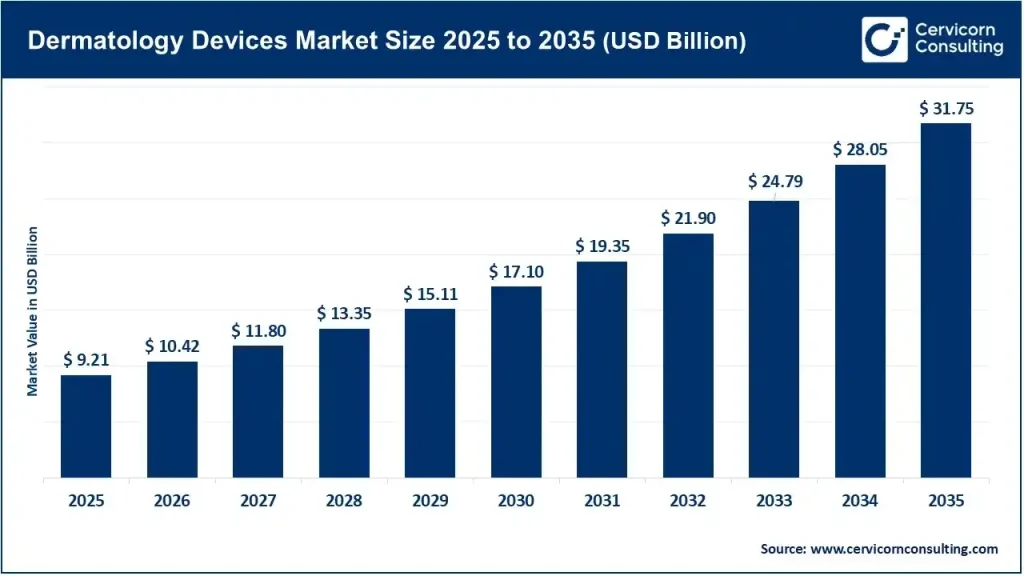
The global dermatology devices market was valued at USD 9.21 billion in 2025 and is projected to reach approximately USD 23.75 billion by 2035, expanding at a CAGR of 13.2% from 2026 to 2035.
Growth is being driven by increasing demand for minimally invasive aesthetic procedures, rising awareness of skin health, advances in laser and energy-based technologies, and greater adoption of digital dermatological diagnostics. However, market expansion also brings important commercial questions: which technologies deserve investment, how should manufacturers differentiate their platforms, and which regions offer the strongest growth opportunities?
For device manufacturers, technology developers, distributors, and dermatology clinic operators, the next phase of growth will depend less on expanding product portfolios and more on identifying commercially viable applications, improving device utilization, and responding to changing clinical requirements.
1. Should Manufacturers Prioritize Multifunctional Platforms or Specialized Devices?
Laser-based systems remain central to dermatology device adoption because of their applications in hair removal, pigmentation correction, acne-scar treatment, and skin rejuvenation. At the same time, radiofrequency, ultrasound, light-based, and other energy-based technologies are expanding the range of available procedures.
This creates an important product-development decision: whether to develop specialized devices for individual indications or multifunctional platforms that support several treatment categories.
Multifunctional systems can help clinics expand their treatment offerings without purchasing separate equipment for every procedure. However, specialized devices may provide stronger differentiation in applications requiring specific wavelengths, energy delivery, or treatment precision.
What companies should evaluate:
-
Technology versatility: Can one platform support multiple commercially relevant procedures without compromising treatment performance?
-
Clinical differentiation: Does the device offer measurable advantages in precision, safety, treatment time, or patient recovery?
-
Equipment economics: Can clinics achieve sufficient procedure volumes to justify the acquisition and maintenance costs?
-
Upgrade potential: Can manufacturers introduce new applicators, software capabilities, or treatment protocols without replacing the entire system?
Manufacturers should avoid competing solely on the number of procedures supported. Clinical effectiveness, operating costs, reliability, and ease of use will be equally important in determining purchasing decisions.
Get a Free Sample: https://www.cervicornconsulting.com/sample/3080
2. Is the Opportunity Shifting Toward Non-Invasive and Minimally Invasive Procedures?
Non-invasive procedures accounted for approximately 43% of the dermatology devices market in 2025, reflecting patient preference for treatments associated with less discomfort, limited recovery time, and reduced tissue disruption.
This demand is creating opportunities across laser resurfacing, intense pulsed light (IPL), radiofrequency skin tightening, pigmentation treatment, and other non-surgical procedures.
For manufacturers, the opportunity extends beyond developing new energy-delivery technologies. Device design must also address treatment consistency, patient comfort, safety controls, and operational efficiency.
Strategic considerations for manufacturers:
-
Develop platforms that address high-frequency procedures such as hair removal, skin rejuvenation, acne treatment, and pigmentation correction.
-
Improve treatment precision and energy control to support consistent clinical outcomes.
-
Evaluate demand for devices suitable for both medical dermatology and aesthetic applications.
-
Build product differentiation around clinical performance and treatment experience rather than cosmetic positioning alone.
For clinics, the investment decision should consider local patient demand, procedure pricing, practitioner expertise, and expected equipment utilization rather than relying exclusively on the popularity of a particular treatment.
3. How Should Companies Balance Aesthetic Dermatology and Medical Applications?
Aesthetic dermatology generated approximately 32% of the global dermatology devices market revenue in 2025, supported by demand for skin rejuvenation, wrinkle reduction, pigmentation correction, and other cosmetic treatments.
However, medical dermatology presents a separate opportunity through skin disease management, lesion monitoring, and early skin cancer detection.
This distinction matters because the two application areas involve different purchasing priorities.
Aesthetic-focused clinics may prioritize treatment versatility, patient experience, procedure throughput, and return on equipment investment. Medical dermatology providers may place greater emphasis on diagnostic accuracy, clinical validation, imaging quality, workflow integration, and regulatory compliance.
Manufacturers entering both segments should therefore evaluate whether a single product portfolio can effectively address different clinical and commercial requirements.
Where companies can focus:
-
Develop specialized diagnostic devices for dermoscopy, skin imaging, and lesion monitoring.
-
Strengthen treatment portfolios for acne, scars, pigmentation disorders, and other medical dermatological conditions.
-
Evaluate opportunities in AI-assisted skin analysis and diagnostic workflow support.
-
Build separate commercialization strategies for aesthetic clinics, hospitals, and specialized dermatology facilities.
A balanced portfolio can reduce dependence on elective aesthetic spending while creating opportunities in diagnostic and therapeutic applications.
4. Can AI-Based Dermatology Diagnostics Become a Competitive Advantage?
AI-assisted skin analysis is creating opportunities beyond conventional diagnostic equipment. Digital dermoscopy, skin imaging, lesion monitoring, and automated image analysis can support dermatologists in identifying suspicious skin changes and planning patient assessments.
The commercial opportunity is particularly relevant for companies developing diagnostic devices, imaging software, and integrated clinical platforms.
However, AI integration requires more than adding image-recognition capabilities. Manufacturers must demonstrate clinical reliability, address data quality, validate algorithms across relevant patient populations, and meet applicable regulatory requirements.
In March 2026, India’s Ministry of Health and Family Welfare highlighted requirements for AI-enabled medical devices covering technical documentation, risk analysis, validation, clinical evidence, and quality management.
Key decisions for technology developers:
-
Determine whether AI should be developed internally or integrated through technology partnerships.
-
Prioritize applications where automation can improve diagnostic workflows or clinical efficiency.
-
Evaluate the availability and diversity of clinical imaging datasets.
-
Assess regulatory requirements before commercializing AI-enabled diagnostic products.
-
Consider recurring software revenue, maintenance, and upgrade models alongside hardware sales.
Companies that combine diagnostic hardware with validated software capabilities may have opportunities to develop stronger long-term customer relationships.
5. Which Regional Markets Offer the Strongest Expansion Opportunities?
Regional investment decisions should consider both current market size and future demand. North America accounted for approximately 38% of the global dermatology devices market in 2025, while Asia Pacific is emerging as an important growth market.
North America: Established demand and technology adoption
The North American market was valued at approximately USD 3.50 billion in 2025 and is projected to exceed USD 12.07 billion by 2035.
The region benefits from established dermatology infrastructure, strong demand for aesthetic procedures, and the presence of major device manufacturers.
For companies entering this market, differentiation through clinical performance, regulatory readiness, practitioner training, and after-sales support will be important.
Asia Pacific: Expansion through clinic infrastructure and rising demand
The Asia-Pacific dermatology devices market was valued at approximately USD 2.30 billion in 2025 and is projected to reach USD 7.94 billion by 2035.
China, India, Japan, and South Korea offer opportunities through expanding private healthcare infrastructure, growing interest in aesthetic treatments, and increasing access to advanced dermatological technologies.
For manufacturers, regional expansion requires more than product availability. Pricing strategies, distribution partnerships, local regulatory requirements, service networks, and practitioner training can influence adoption.
What companies should prioritize:
-
Identify countries with expanding dermatology clinic networks and aesthetic treatment capacity.
-
Compare demand for premium imported equipment with opportunities for competitively priced systems.
-
Evaluate local distributors and clinical partnerships before establishing direct operations.
-
Adapt device portfolios to regional treatment preferences and purchasing capabilities.
Rather than entering every high-growth market simultaneously, companies should prioritize countries where their product positioning, distribution capabilities, and service infrastructure offer a realistic competitive advantage.
6. How Can Manufacturers Reduce Regulatory and Commercialization Risks?
Regulatory compliance and clinical safety are becoming increasingly important as dermatology devices incorporate advanced energy-delivery systems, imaging technologies, and AI-based software.
Devices using laser, radiofrequency, ultrasound, and other energy sources require appropriate controls to manage treatment parameters and reduce the risk of burns, pigmentation changes, scarring, and other complications.
Regulatory requirements also differ across markets, making international commercialization more complex.
Recent developments illustrate this changing environment:
-
In December 2025, CDSCO introduced an online Risk Classification Module for medical devices, providing a structured route for manufacturers to determine the classification of devices not already included in the published list.
-
In March 2026, India’s Ministry of Health and Family Welfare highlighted technical documentation, risk analysis, validation, clinical evidence, and quality management requirements for AI-enabled medical devices.
-
In February 2026, Cynosure Lutronic received regulatory approvals for its Clarity II dual-wavelength laser platform in China and Japan, demonstrating the importance of regional regulatory access for international expansion.
Strategic priorities for manufacturers:
-
Integrate regulatory planning into product development rather than treating compliance as a final commercialization step.
-
Establish clinical validation and post-market monitoring processes.
-
Evaluate country-specific registration timelines and approval requirements.
-
Invest in practitioner training and technical support.
-
Assess product liability, warranty, maintenance, and service costs when entering new markets.
For smaller manufacturers, regulatory readiness can become a competitive differentiator, particularly when competing against established international brands.
7. Which Competitive Strategies Will Matter as the Market Expands?
The dermatology devices market includes established companies with capabilities across laser systems, energy-based technologies, diagnostic imaging, and aesthetic treatment platforms.
Some of the major participants include:
-
Candela Medical: Laser and energy-based aesthetic treatment technologies.
-
Cynosure Lutronic: Laser platforms and aesthetic dermatology technologies.
-
Alma Lasers: Laser, light, and radiofrequency treatment systems.
-
Lumenis: Laser and light-based medical and aesthetic technologies.
-
Cutera: Laser and energy-based aesthetic platforms.
-
Solta Medical: Skin resurfacing and rejuvenation technologies.
-
Fotona: Multi-application laser platforms.
-
Sciton: Laser and light-based treatment technologies.
-
Venus Concept: Energy-based aesthetic treatment platforms.
-
BTL: Non-invasive aesthetic and therapeutic technologies.
-
Canfield Scientific: Skin imaging and photographic documentation systems.
-
Aerolase: Laser-based dermatological treatment systems.
For manufacturers, understanding competitors’ product launches, technology portfolios, geographical expansion, partnerships, and regulatory approvals is essential for identifying market gaps.
Three areas deserve particular attention:
-
Portfolio positioning: Identify underserved treatment applications instead of replicating established product categories.
-
Technology partnerships: Explore collaborations in imaging, AI, energy delivery, and clinical validation to accelerate product development.
-
Distribution and service differentiation: Build reliable local support networks, practitioner education, and maintenance capabilities to improve customer retention.
Competitive advantage will increasingly depend on the ability to combine technology innovation with clinical credibility and commercially sustainable device economics.
What Should Companies Prioritize Before Their Next Investment?
The expansion of the dermatology devices market creates opportunities across treatment equipment, diagnostic imaging, AI-enabled systems, and minimally invasive technologies. However, market growth alone does not guarantee commercial success.
Manufacturers and healthcare providers should evaluate investment decisions against actual clinical demand, equipment utilization, regulatory requirements, and competitive positioning.
The following priorities can help guide business planning:
| Business priority | Key decision |
|---|---|
| Product development | Invest in specialized or multifunctional devices? |
| Technology | Prioritize laser, RF, ultrasound, or AI-enabled diagnostics? |
| Application expansion | Focus on aesthetic or medical dermatology? |
| Regional expansion | Target established markets or emerging Asian markets? |
| Commercial strategy | Build direct sales networks or distributor partnerships? |
| Regulatory planning | Which markets offer commercially viable approval pathways? |
| Competitive positioning | How can products differentiate on clinical outcomes and lifecycle costs? |
The central opportunity lies in identifying where clinical demand, technological differentiation, and purchasing economics overlap. Companies that understand these factors will be better positioned to allocate R&D budgets, prioritize product launches, identify expansion markets, and develop sustainable competitive strategies.
As the industry evolves, manufacturers will need to look beyond individual device categories and assess how diagnostic technologies, energy-based treatment systems, and digital capabilities are reshaping dermatological care.
To Get Detailed Overview, Contact Us: https://www.cervicornconsulting.com/contact-us
Read Report: Biometrics Payment Market: Strategic Priorities for Secure, Scalable and Frictionless Digital Transactions