


Table of Contents
ToggleEnterprise AI Market Size
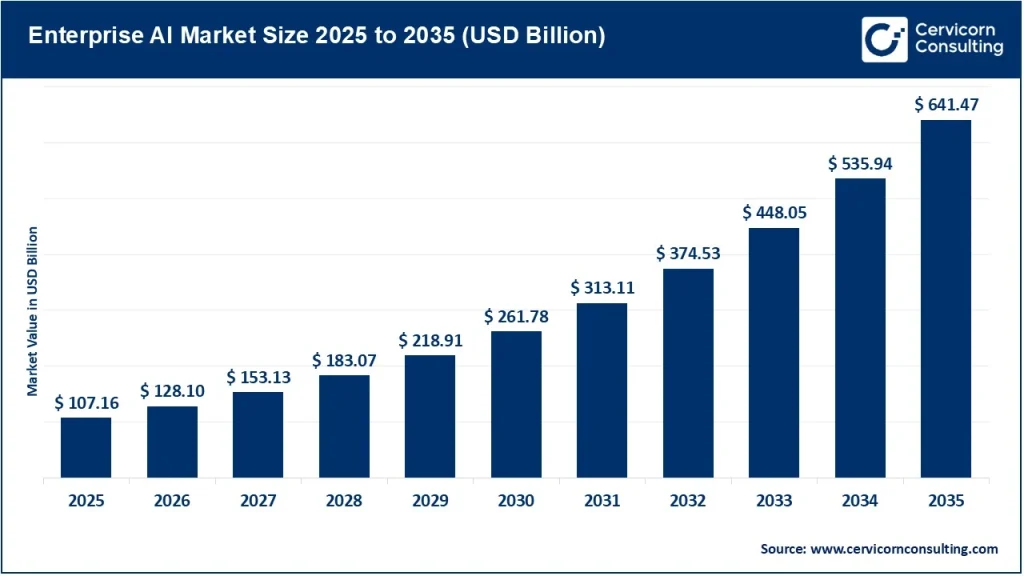
The global enterprise AI market was valued at approximately USD 107.16 billion in 2025 and is projected to reach nearly USD 641.47 billion by 2035, growing at a CAGR of 19.6%.
Enterprise AI Market Growth Factors
The Enterprise AI market is witnessing remarkable expansion due to the increasing adoption of artificial intelligence across industries, growing demand for intelligent automation, rising investments in cloud computing infrastructure, rapid advancements in generative AI and machine learning technologies, increasing availability of big data, growing focus on predictive analytics, enhanced customer experience requirements, workforce productivity optimization, digital transformation initiatives, and government-backed AI innovation programs.
Organizations are increasingly integrating AI-powered solutions into business processes to improve operational efficiency, reduce costs, accelerate decision-making, and gain competitive advantages. The emergence of AI copilots, autonomous agents, natural language processing (NLP), computer vision, and predictive analytics platforms has further accelerated enterprise adoption. Additionally, the proliferation of hybrid cloud environments, edge computing capabilities, and industry-specific AI applications continues to create substantial opportunities for market growth worldwide.
According to recent industry studies, enterprise AI adoption rates have increased significantly across manufacturing, healthcare, finance, retail, logistics, and public sector organizations as businesses prioritize intelligent transformation strategies.
Get a Free Sample: https://www.cervicornconsulting.com/sample/2692
What is the Enterprise AI Market?
The Enterprise AI market refers to the ecosystem of artificial intelligence technologies, platforms, software solutions, services, and infrastructure designed specifically for organizational and business applications. Enterprise AI enables companies to automate complex processes, analyze massive datasets, generate actionable insights, improve customer engagement, optimize operations, and enhance strategic decision-making.
Unlike consumer AI applications, enterprise AI solutions are designed to handle large-scale organizational requirements, including security, governance, compliance, scalability, and integration with existing enterprise systems.
Enterprise AI encompasses:
- Machine Learning (ML)
- Deep Learning
- Natural Language Processing (NLP)
- Computer Vision
- Generative AI
- Predictive Analytics
- AI-Powered Automation
- Intelligent Virtual Assistants
- Robotic Process Automation (RPA)
- Autonomous Decision Systems
These technologies are increasingly embedded into enterprise resource planning (ERP), customer relationship management (CRM), supply chain management, cybersecurity, human resources, and financial systems.
Why is Enterprise AI Important?
Enterprise AI has become a critical component of modern business strategies because it enables organizations to transform data into actionable intelligence while automating repetitive and complex tasks.
Improved Decision-Making
AI systems analyze large volumes of structured and unstructured data in real time, helping executives make informed decisions faster.
Operational Efficiency
Automation of routine tasks reduces manual effort, minimizes errors, and improves productivity across departments.
Cost Reduction
Organizations leverage AI to streamline operations, optimize resource allocation, and reduce operational expenses.
Enhanced Customer Experience
AI-powered chatbots, recommendation engines, and predictive customer support systems deliver personalized experiences.
Innovation Acceleration
AI helps organizations identify new business opportunities, develop innovative products, and improve service delivery.
Risk Management
Predictive analytics and anomaly detection systems enable businesses to identify potential risks before they impact operations.
Competitive Advantage
Companies adopting enterprise AI often gain market leadership through faster innovation, improved efficiency, and better customer engagement.
Major Companies Driving the Enterprise AI Market
1. Alphabet Inc.
Specialization
Cloud AI, Generative AI, Machine Learning Platforms, Enterprise Search
Key Focus Areas
- Google Cloud AI
- Gemini AI Models
- Vertex AI Platform
- AI Infrastructure
- Enterprise Data Analytics
Notable Features
- Advanced large language models
- Scalable cloud infrastructure
- Industry-specific AI solutions
- AI-powered productivity tools
2025 Revenue
Alphabet generated more than $350 billion in annual revenue, supported by significant growth in cloud and AI-related services. Google Cloud continued experiencing strong enterprise AI adoption.
Market Share
Alphabet remains among the leading providers of enterprise AI infrastructure and cloud AI services globally.
Global Presence
North America, Europe, Asia-Pacific, Latin America, Middle East, and Africa.
2. Amazon Web Services, Inc.
Specialization
Cloud Computing, Machine Learning Services, AI Infrastructure
Key Focus Areas
- Amazon Bedrock
- SageMaker
- Generative AI Services
- Data Analytics
- AI Development Platforms
Notable Features
- Extensive cloud ecosystem
- Scalable AI model deployment
- Industry-specific AI solutions
- Advanced security capabilities
2025 Revenue
AWS remains the world’s largest cloud infrastructure provider and generates tens of billions of dollars annually from cloud and AI-related services.
Market Share
Leading share in global cloud infrastructure supporting enterprise AI workloads.
Global Presence
More than 30 geographic regions with global data center infrastructure.
3. C3.ai, Inc.
Specialization
Enterprise AI Applications and Predictive Analytics
Key Focus Areas
- AI Application Development
- Predictive Maintenance
- Supply Chain Optimization
- Energy Management
- Government AI Solutions
Notable Features
- Pre-built AI applications
- Industry-specific AI models
- Large-scale enterprise deployments
- Agentic AI innovations
2025 Revenue
C3.ai reported fiscal year 2025 revenue of approximately $389.1 million, reflecting strong enterprise AI adoption across industries.
Market Share
Strong presence in enterprise AI application software.
Global Presence
North America, Europe, Asia-Pacific, and Middle Eastern markets.
4. DataRobot, Inc.
Specialization
Automated Machine Learning (AutoML)
Key Focus Areas
- AI Lifecycle Management
- MLOps
- Predictive Analytics
- Responsible AI
- Automated Model Development
Notable Features
- No-code AI development
- Automated model deployment
- Governance and compliance tools
- Enterprise-grade scalability
2025 Revenue
Privately held company with substantial enterprise AI platform adoption across global enterprises.
Market Share
Recognized as a leading AutoML platform provider.
Global Presence
North America, Europe, Asia-Pacific, and Latin America.
5. Hewlett Packard Enterprise Development LP
Specialization
AI Infrastructure and Hybrid Cloud Solutions
Key Focus Areas
- AI Computing Systems
- Hybrid Cloud
- Data Infrastructure
- Edge Computing
- Enterprise AI Platforms
Notable Features
- GreenLake platform
- High-performance computing
- AI-ready infrastructure
- Enterprise security capabilities
2025 Revenue
HPE generated billions in annual revenue and reported significant AI infrastructure demand, including more than $1 billion in AI-related revenue during quarterly operations.
Market Share
Strong presence in enterprise infrastructure and AI hardware markets.
Global Presence
Operations across more than 170 countries.
Leading Enterprise AI Market Trends and Their Impact
Rise of Generative AI
Generative AI has become the most transformative trend within enterprise technology. Businesses increasingly deploy large language models for content generation, coding assistance, customer support, and knowledge management.
Impact
- Improved employee productivity
- Faster software development
- Enhanced customer engagement
- Reduced operational costs
Growth of AI Agents and Autonomous Systems
Organizations are deploying AI agents capable of executing multi-step workflows without human intervention.
Impact
- Greater process automation
- Reduced labor costs
- Improved operational efficiency
- Enhanced business agility
AI-Powered Cybersecurity
AI-driven threat detection and automated security response systems are becoming essential.
Impact
- Reduced cyber risks
- Faster threat detection
- Improved compliance management
- Stronger enterprise resilience
Industry-Specific AI Solutions
Vendors increasingly offer customized AI platforms designed for healthcare, finance, manufacturing, retail, and logistics sectors.
Impact
- Faster implementation
- Higher ROI
- Improved regulatory compliance
- Better business outcomes
Hybrid and Multi-Cloud AI Deployments
Organizations are deploying AI workloads across multiple cloud environments and on-premises infrastructure.
Impact
- Increased flexibility
- Better data governance
- Reduced vendor lock-in
- Enhanced scalability
Responsible AI and Governance
Enterprises are prioritizing transparency, fairness, explainability, and ethical AI practices.
Impact
- Improved trust
- Regulatory compliance
- Reduced bias
- Sustainable AI adoption
Successful Enterprise AI Market Examples Around the World
Google Cloud AI
Google Cloud has enabled organizations across healthcare, retail, banking, and manufacturing sectors to deploy advanced machine learning models and generative AI solutions at scale. Strong enterprise adoption of AI-enabled cloud services continues to drive growth.
Amazon Web Services AI Ecosystem
AWS provides AI services to thousands of enterprises globally, supporting predictive analytics, recommendation systems, fraud detection, and generative AI applications.
C3 AI in Industrial Operations
C3 AI solutions have been successfully implemented in manufacturing, energy, defense, and government sectors to optimize operations, predict equipment failures, and improve supply chain efficiency.
AI in Financial Services
Global banks utilize enterprise AI for:
- Fraud detection
- Credit scoring
- Customer analytics
- Risk assessment
- Regulatory compliance
These implementations have significantly improved operational efficiency and customer satisfaction.
AI-Powered Healthcare Systems
Hospitals and healthcare providers deploy AI for:
- Medical imaging analysis
- Clinical decision support
- Drug discovery
- Patient monitoring
- Predictive diagnostics
These applications improve patient outcomes while reducing healthcare costs.
Global Regional Analysis
North America
North America remains the dominant enterprise AI market due to:
- Strong technology ecosystem
- Presence of major AI vendors
- Significant venture capital investment
- Advanced cloud infrastructure
- High enterprise technology adoption
Government Initiatives and Policies
The United States continues to invest heavily in AI research, innovation, and commercialization. Federal agencies support AI development through research grants, public-private partnerships, and national AI strategies focused on maintaining global competitiveness.
Canada has also established comprehensive AI programs supporting research institutions, startups, and commercialization initiatives.
Market Outlook
North America is expected to maintain leadership throughout the forecast period due to continuous innovation and enterprise AI adoption.
Europe
Europe represents a rapidly expanding market characterized by:
- Strong industrial automation demand
- Growing AI investments
- Focus on responsible AI
- Expanding digital transformation initiatives
Government Initiatives and Policies
The European Union has introduced comprehensive AI regulations and governance frameworks promoting trustworthy and ethical AI development.
Key initiatives include:
- AI Act implementation
- Digital Europe Programme
- Horizon Europe funding programs
- National AI strategies across member states
Market Outlook
Europe is expected to experience strong growth as enterprises adopt AI while complying with evolving regulatory standards.
Asia-Pacific
Asia-Pacific is emerging as the fastest-growing enterprise AI market.
Growth drivers include:
- Rapid digitalization
- Expanding cloud adoption
- Smart manufacturing initiatives
- Growing technology investments
- Large enterprise customer base
Government Initiatives and Policies
China
China’s AI development strategy prioritizes:
- Industrial AI deployment
- Smart cities
- AI infrastructure
- National innovation programs
India
India promotes AI adoption through:
- Digital India initiatives
- AI innovation programs
- Startup ecosystem support
- Public sector digital transformation
Japan and South Korea
Both countries invest heavily in:
- Robotics
- Manufacturing AI
- Semiconductor technologies
- Smart infrastructure
Market Outlook
Asia-Pacific is projected to register the highest growth rate due to increasing enterprise AI investments and supportive government initiatives.
Latin America
Latin America is witnessing growing enterprise AI adoption, particularly in:
- Financial services
- Telecommunications
- Retail
- Logistics
Government Initiatives and Policies
Countries including Brazil, Mexico, Chile, and Colombia are implementing national AI strategies focused on digital transformation and innovation.
Market Outlook
Increasing cloud adoption and digital modernization efforts are expected to support future market growth.
Middle East and Africa
The Middle East and Africa region is becoming an important emerging market for enterprise AI.
Key Growth Areas
- Smart city projects
- Government digitization
- Energy sector optimization
- Financial technology innovation
Government Initiatives and Policies
United Arab Emirates
The UAE has launched ambitious AI programs supporting:
- Public sector AI adoption
- Smart government services
- Innovation ecosystems
Saudi Arabia
Vision 2030 emphasizes:
- Digital transformation
- AI-driven economic diversification
- Technology investments
Market Outlook
The region is expected to witness substantial growth as governments continue investing in AI infrastructure and digital economies.
Future Outlook of the Enterprise AI Market
The enterprise AI market is entering a phase of accelerated expansion driven by generative AI, autonomous agents, predictive analytics, intelligent automation, and cloud-native AI platforms. Organizations worldwide are increasingly viewing AI as a strategic asset capable of transforming business models, enhancing operational efficiency, and creating new revenue opportunities. As technology matures and regulatory frameworks evolve, enterprise AI is expected to become a foundational component of business operations across virtually every industry.
To Get Detailed Overview, Contact Us: https://www.cervicornconsulting.com/contact-us
Read Report: Composite AI Market Revenue, Trends, and Strategic Insights by 2035