


Table of Contents
ToggleComposite AI Market Size
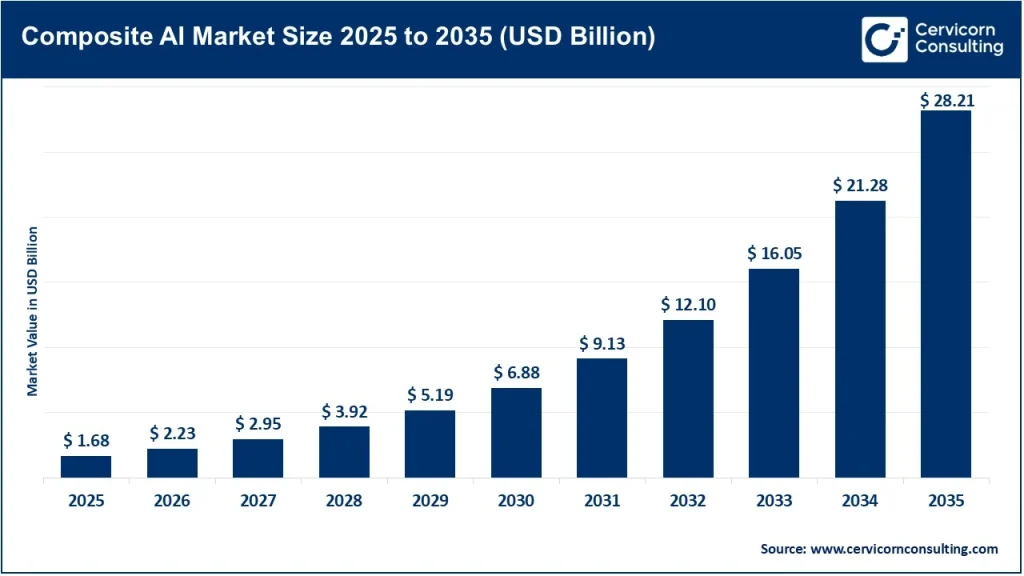
The global composite AI market was valued at approximately USD 1.68 billion in 2025 and is projected to reach nearly USD 28.21 billion by 2035, growing at a CAGR of 32.6%.
What is the Composite AI Market?
Composite AI refers to the integration of multiple artificial intelligence methodologies within a single platform or solution. Unlike traditional AI systems that rely on one technique, Composite AI combines complementary technologies to improve accuracy, transparency, adaptability, and business outcomes.
For example, a healthcare diagnostic system may combine machine learning, computer vision, knowledge graphs, and reasoning engines to deliver highly accurate diagnoses while providing explanations for its recommendations. Similarly, financial institutions use Composite AI to merge predictive analytics, fraud detection algorithms, and rule-based systems to improve risk management.
The Composite AI market encompasses software platforms, cloud services, consulting solutions, AI infrastructure, and enterprise applications designed to deliver integrated intelligence across industries. Growing demand for explainable AI, enterprise automation, and advanced analytics is driving widespread adoption.
Why is Composite AI Important?
As businesses generate enormous volumes of structured and unstructured data, relying on a single AI model often creates limitations in performance, transparency, and scalability. Composite AI addresses these challenges by leveraging the strengths of multiple AI techniques simultaneously.
Key reasons for its importance include:
- Enhanced decision-making accuracy.
- Greater explainability and transparency.
- Improved handling of complex business processes.
- Reduced bias and model limitations.
- Better integration of structured and unstructured data.
- Faster automation of enterprise workflows.
- Increased trust in AI-powered decisions.
- Stronger compliance with industry regulations.
Industries such as healthcare, banking, insurance, manufacturing, and public administration increasingly require AI systems that can explain outcomes while maintaining high predictive performance. Composite AI provides the ideal balance between intelligence and accountability.
Get a Free Sample: https://www.cervicornconsulting.com/sample/2631
Composite AI Market Growth Factors
The growth of the Composite AI market is primarily driven by the rising demand for explainable and trustworthy AI systems, increasing enterprise adoption of advanced analytics, rapid digital transformation initiatives, growing volumes of business data, expansion of cloud computing infrastructure, widespread deployment of generative AI technologies, increasing investments in AI research and development, demand for intelligent automation across industries.
Growing need for predictive decision-making tools, advancements in machine learning and symbolic reasoning, stronger regulatory requirements for transparent AI systems, emergence of industry-specific AI solutions, increasing adoption of hybrid cloud environments, and rising integration of computer vision, natural language processing, optimization engines, and knowledge graphs within enterprise applications. These factors collectively encourage organizations to move beyond standalone AI models toward comprehensive Composite AI ecosystems capable of delivering more accurate, context-aware, and scalable business outcomes.
Major Companies in the Composite AI Market
| Company | Specialization | Key Focus Areas | Notable Features | 2025 Revenue* | Estimated AI/Composite AI Market Position | Global Presence |
|---|---|---|---|---|---|---|
| IBM | Enterprise AI & Hybrid Cloud | Watson AI, Neurosymbolic AI, Automation | Explainable AI, Governance, Industry Solutions | ~$62.8 Billion | Strong enterprise AI leader | 175+ countries |
| SAS Institute | Advanced Analytics & AI | Predictive Analytics, Risk Management | Explainable AI, Data Governance | ~$3.5 Billion (est.) | Major analytics-driven AI provider | 140+ countries |
| Microsoft | Cloud AI & Enterprise Platforms | Azure AI, Copilot, LLM Integration | Large-scale AI infrastructure | $281.7 Billion | Leading AI platform provider | 190+ countries |
| AI Models & Cloud Services | Gemini, Vertex AI, DeepMind | Multimodal AI, Knowledge Graphs | ~$350+ Billion (Alphabet) | Global AI innovation leader | 200+ countries | |
| AWS | Cloud Infrastructure & AI Services | Bedrock, SageMaker, AI Infrastructure | Scalable AI deployment | AWS revenue exceeded $15 Billion AI-related run-rate | Largest cloud AI ecosystem | Global hyperscale footprint |
*Revenues represent total company revenue or reported business revenue estimates for 2025.
IBM
IBM is among the pioneers in Composite AI. Through Watson and its neurosymbolic AI research initiatives, IBM combines machine learning, NLP, reasoning engines, and knowledge representation technologies. The company focuses heavily on explainable AI, governance, and enterprise-grade deployments. IBM’s AI book of business exceeded USD 5 billion, reflecting strong demand for its AI solutions.
SAS Institute
SAS Institute leverages advanced analytics, machine learning, and decision intelligence to help organizations improve operational performance. Its Composite AI offerings emphasize explainability, risk management, fraud detection, and predictive analytics, particularly within banking, healthcare, and government sectors.
Microsoft
Microsoft integrates large language models, simulation technologies, knowledge graphs, and machine learning through Azure AI and Copilot. Microsoft generated approximately USD 281.7 billion in revenue during fiscal 2025 while investing heavily in AI infrastructure. Azure AI supports enterprise-scale Composite AI implementations globally.
Google combines DeepMind innovations, Gemini models, knowledge graphs, computer vision, and machine learning capabilities. Through Vertex AI and Google Cloud, organizations can build sophisticated Composite AI systems capable of handling multimodal data and complex reasoning tasks.
AWS
Amazon Web Services provides scalable infrastructure for Composite AI through SageMaker, Bedrock, and advanced AI services. AWS supports integration of multiple AI models and technologies, enabling enterprises to deploy hybrid AI architectures efficiently. The company remains the global leader in cloud infrastructure with approximately 32% market share in cloud services.
Leading Trends in the Composite AI Market and Their Impact
1. Rise of Generative AI Integration
Organizations are increasingly combining generative AI models with predictive analytics, knowledge graphs, and rule-based systems. This trend improves contextual understanding while reducing hallucinations and inaccuracies.
Impact:
- Better enterprise decision-making.
- More reliable AI outputs.
- Improved customer experiences.
2. Explainable AI (XAI)
Regulatory pressures are pushing businesses to adopt transparent AI systems capable of explaining recommendations and decisions.
Impact:
- Greater trust in AI systems.
- Easier regulatory compliance.
- Improved adoption in healthcare and finance.
3. Knowledge Graph Integration
Knowledge graphs provide contextual intelligence that enhances machine learning performance.
Impact:
- Better data relationships.
- Improved semantic understanding.
- Enhanced recommendation systems.
4. Industry-Specific Composite AI Platforms
Vendors increasingly develop specialized AI solutions tailored to healthcare, manufacturing, retail, and financial services.
Impact:
- Faster implementation.
- Higher accuracy.
- Improved ROI.
5. Multi-Agent AI Systems
Businesses are deploying multiple AI agents that collaborate to solve complex problems.
Impact:
- Increased automation.
- Reduced operational costs.
- Enhanced productivity.
6. Cloud-Based Composite AI
Cloud providers continue expanding AI infrastructure and deployment capabilities.
Impact:
- Lower implementation costs.
- Faster scalability.
- Global accessibility.
Successful Examples of Composite AI Around the World
Healthcare Diagnostics
Healthcare providers combine computer vision, machine learning, and medical knowledge graphs to improve disease detection and treatment planning.
Example:
- IBM Watson Health initiatives.
- AI-assisted radiology systems in North America and Europe.
Financial Fraud Detection
Banks integrate predictive analytics, behavioral analysis, NLP, and rule-based systems to identify suspicious activities.
Example:
- Major global banks using SAS analytics platforms.
- Real-time fraud monitoring systems.
Smart Manufacturing
Manufacturers combine IoT sensors, predictive maintenance algorithms, computer vision, and optimization engines.
Example:
- Automotive production facilities in Germany and Japan.
- Industry 4.0 smart factories.
Retail Personalization
Retailers use recommendation engines, customer analytics, NLP, and demand forecasting systems.
Example:
- Global e-commerce platforms.
- AI-powered customer engagement systems.
Autonomous Transportation
Transportation firms integrate computer vision, sensor fusion, predictive analytics, and reasoning systems.
Example:
- Autonomous vehicle development programs in the United States and China.
Global Regional Analysis
North America
North America dominates the Composite AI market, accounting for over 37% of global revenue. The region benefits from advanced digital infrastructure, strong venture capital investment, and the presence of major technology companies. The United States remains the primary innovation hub for Composite AI technologies.
Government Initiatives and Policies
- National AI Initiative Act.
- Federal AI research funding programs.
- Department of Defense AI modernization initiatives.
- NIST AI Risk Management Framework.
These initiatives encourage responsible AI development while supporting innovation and commercialization.
Europe
Europe focuses heavily on ethical and explainable AI deployment.
Government Initiatives and Policies
- European Union AI Act.
- Horizon Europe AI research funding.
- Digital Europe Programme.
- National AI strategies in Germany, France, and the United Kingdom.
The region emphasizes transparency, privacy, accountability, and trustworthy AI systems.
Market Outlook
Financial services, healthcare, manufacturing, and public administration are major adopters of Composite AI technologies.
Asia-Pacific
Asia-Pacific represents the fastest-growing regional market due to increasing digital transformation investments and expanding AI adoption across China, India, Japan, South Korea, Singapore, and Australia.
Government Initiatives and Policies
China
- Next Generation Artificial Intelligence Development Plan.
- AI-focused industrial modernization programs.
- Significant public and private AI investments.
India
- IndiaAI Mission.
- Digital India initiatives.
- AI innovation and startup support programs.
Japan
- Society 5.0 strategy.
- AI integration across manufacturing and healthcare.
Market Outlook
Growing enterprise adoption, government support, and increasing cloud infrastructure investments continue driving regional expansion.
Latin America
Latin America is witnessing increasing AI adoption across banking, telecommunications, and government sectors.
Government Initiatives and Policies
- Brazil’s National AI Strategy.
- AI innovation programs in Mexico, Chile, and Colombia.
- Public-sector digital transformation initiatives.
Market Outlook
Cloud adoption and fintech growth are expected to accelerate Composite AI deployment across the region.
Middle East and Africa
The Middle East is emerging as a strategic AI investment hub, while Africa continues expanding digital transformation initiatives.
Government Initiatives and Policies
United Arab Emirates
- UAE National Artificial Intelligence Strategy 2031.
- AI-driven smart government programs.
Saudi Arabia
- Vision 2030 digital transformation agenda.
- National Data and AI Authority (SDAIA) initiatives.
South Africa
- AI readiness and innovation programs.
- Public-private digital ecosystem partnerships.
Market Outlook
Investments in smart cities, healthcare modernization, financial technology, and public-sector transformation are expected to create significant opportunities for Composite AI adoption across the region.
The global Composite AI market is therefore evolving into a foundational technology layer for next-generation enterprise intelligence, combining multiple AI techniques to deliver superior accuracy, transparency, and business value across industries.
To Get Detailed Overview, Contact Us: https://www.cervicornconsulting.com/contact-us
Read Report: Organic Electronics Market Revenue, Trends, and Strategic Insights by 2035