


Enterprise AI Market: 6 Strategic Decisions Businesses Must Make to Turn AI Investment into Measurable Growth
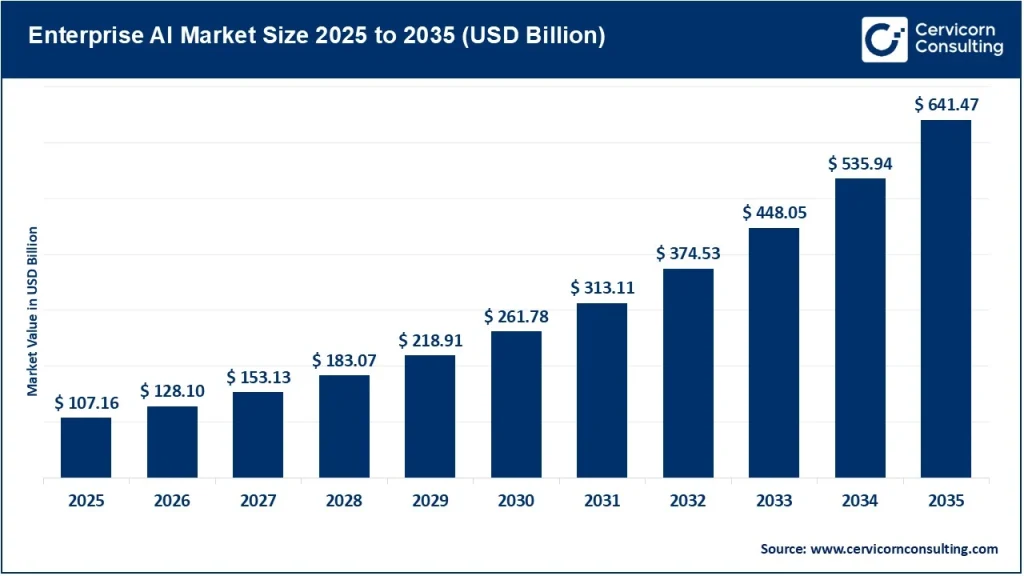
The global enterprise AI market was valued at USD 107.16 billion in 2025 and is projected to reach approximately USD 641.47 billion by 2035, growing at a CAGR of 19.6% from 2026 to 2035.
Enterprise AI is moving beyond experimentation into business-critical operations. Organizations are increasingly deploying artificial intelligence across finance, customer service, marketing, human resources, cybersecurity, manufacturing, and supply chain management. However, the next phase of adoption will not be determined simply by how much companies spend on AI. It will depend on how effectively they integrate AI into existing business processes, manage implementation costs, secure enterprise data, and translate automation into measurable commercial outcomes.
The investment opportunity is substantial, but so are the strategic considerations. Businesses must decide which applications deserve priority, whether cloud or on-premises infrastructure offers better long-term value, how much AI capability should be developed internally, and which technology partners can support enterprise-wide deployment.
Here are six strategic decisions that business leaders should evaluate as enterprise AI adoption accelerates.
1. Prioritize AI Applications Based on Business Value, Not Technology Trends
One of the most important decisions for enterprises is identifying where AI can generate the highest measurable return. Organizations often begin implementation with popular applications such as generative AI assistants, content automation, or conversational chatbots. However, the most valuable opportunity may lie in less visible business functions such as risk assessment, demand forecasting, operational analytics, and process optimization.
According to the market analysis, business intelligence and analytics accounted for approximately 37% of enterprise AI market revenue in 2025, making it the leading application segment. Security and risk management, customer support, marketing management, process automation, and human resource management also represent important application areas.
Companies should evaluate AI investments across the following functions:
-
Business intelligence and analytics: Use predictive modelling, automated reporting, and real-time data analysis to improve strategic planning, revenue forecasting, and resource allocation.
-
Security and risk management: Apply machine learning to identify suspicious transactions, detect cybersecurity threats, and strengthen compliance monitoring.
-
Customer support and experience: Introduce intelligent assistants, automated ticket routing, and customer behaviour analysis to improve service efficiency.
-
Process automation: Automate invoice processing, documentation, inventory management, and repetitive administrative activities.
-
Marketing and advertising: Improve customer segmentation, campaign targeting, recommendation systems, and advertising expenditure allocation.
-
Human resources: Use AI-assisted recruitment, workforce planning, skill-gap identification, and employee engagement analysis.
Business decision: Companies should prioritize AI applications according to their expected financial impact, implementation complexity, data readiness, and scalability. A high-value application that addresses an existing operational bottleneck is generally a better starting point than adopting AI simply to follow an industry trend.
Get a Free Sample: https://www.cervicornconsulting.com/sample/2692
2. Choose the Right Deployment Strategy: Cloud, On-Premises, or Hybrid AI
Infrastructure selection will have a direct impact on enterprise AI costs, scalability, data security, and operational flexibility.
Cloud-based deployment accounted for approximately 58% of the enterprise AI market in 2025, reflecting the demand for scalable infrastructure, lower upfront investment, and access to advanced AI capabilities. However, on-premises infrastructure remains relevant for businesses handling sensitive information or operating under strict regulatory and data governance requirements.
The choice between these deployment models should depend on the nature of AI workloads rather than general technology preferences.
Cloud-based AI is suitable for:
-
Organizations seeking faster AI deployment without significant infrastructure investment.
-
Businesses requiring scalable computing resources for changing workloads.
-
Companies integrating AI into CRM, ERP, customer support, and analytics platforms.
-
SMEs that want access to advanced AI capabilities without maintaining large technical teams.
On-premises AI is suitable for:
-
Financial institutions and healthcare organizations handling sensitive information.
-
Businesses requiring greater control over data storage and processing.
-
Industrial environments requiring low-latency AI applications.
-
Organizations with specialized infrastructure, security, or regulatory requirements.
Hybrid AI infrastructure offers another option by combining cloud scalability with on-premises control. Enterprises can use cloud resources for model development and large-scale computing while keeping sensitive datasets and selected workloads within controlled environments.
Business decision: Before selecting an infrastructure provider, companies should compare total cost of ownership, data residency requirements, integration expenses, computing requirements, and long-term scalability. They should also evaluate whether a hybrid architecture can reduce infrastructure dependency while maintaining operational flexibility.
3. Evaluate AI Vendors Based on Integration Capabilities and Long-Term Dependability
The enterprise AI ecosystem includes cloud providers, software developers, semiconductor companies, AI platform vendors, and consulting service providers. Choosing a vendor is therefore not simply a technology procurement decision; it is a long-term strategic commitment.
Major companies participating in the enterprise AI ecosystem include:
-
Microsoft Corporation: Enterprise AI integration through Azure, business software, cloud infrastructure, and AI-enabled productivity solutions.
-
Amazon Web Services: Cloud-based AI infrastructure, machine learning services, and enterprise AI development capabilities.
-
Alphabet Inc.: AI models, Google Cloud infrastructure, enterprise analytics, and AI development platforms.
-
IBM Corporation: Enterprise AI, hybrid cloud, automation, and AI governance solutions.
-
NVIDIA Corporation: AI computing infrastructure, accelerated computing platforms, and enterprise AI development technologies.
-
Oracle Corporation: AI integration across enterprise databases, cloud infrastructure, and business applications.
-
SAP SE: AI capabilities integrated into enterprise resource planning and business management applications.
-
DataRobot, Inc.: Enterprise AI platforms supporting machine learning development, deployment, and governance.
-
Hewlett Packard Enterprise: Enterprise computing infrastructure and hybrid AI solutions.
-
Wipro Limited: AI-led enterprise transformation, technology integration, and consulting services.
The competitive landscape requires businesses to evaluate providers beyond product demonstrations and advertised AI capabilities.
Important vendor evaluation criteria include:
-
Integration capabilities: Compatibility with existing ERP, CRM, cloud, and enterprise data systems.
-
Performance: Model accuracy, response time, reliability, and workload handling.
-
Security and governance: Data protection, access management, auditability, and compliance capabilities.
-
Scalability: Ability to support additional departments, users, applications, and geographies.
-
Commercial flexibility: Licensing structures, usage-based pricing, implementation costs, and maintenance expenses.
-
Vendor stability: Product development roadmap, technical support, ecosystem partnerships, and long-term platform availability.
Business decision: Enterprises should avoid building their entire AI strategy around a single vendor without evaluating alternatives. A modular architecture, interoperability standards, and clear exit provisions can reduce vendor lock-in and provide greater flexibility as AI technologies evolve.
4. Build an Enterprise AI Strategy Around Data Readiness and Legacy-System Integration
AI performance depends heavily on the quality, accessibility, and relevance of enterprise data. Organizations may invest in advanced models but still struggle to achieve meaningful results when their information is fragmented across incompatible databases, legacy applications, and disconnected departmental systems.
This challenge is particularly relevant for manufacturing, BFSI, healthcare, and logistics businesses, where information is often distributed across multiple operational platforms.
Before expanding AI implementation, companies should assess:
-
Data quality: Identify incomplete, duplicated, outdated, or inconsistent datasets that may affect model performance.
-
Data accessibility: Determine whether information can be accessed across departments through standardized interfaces and secure data pipelines.
-
System compatibility: Evaluate whether existing ERP, CRM, supply chain, and operational platforms support AI integration.
-
Data governance: Establish ownership, access permissions, retention policies, and accountability for enterprise data.
-
Infrastructure readiness: Assess computing capacity, storage requirements, connectivity, and data processing capabilities.
Another important consideration is the integration of AI with Internet of Things (IoT) and edge computing. Manufacturing companies, for example, can combine equipment sensors with AI models to identify abnormal operating conditions and predict maintenance requirements. Logistics companies can use real-time information to optimize routing, fleet utilization, and delivery scheduling.
These applications demonstrate that enterprise AI value increasingly depends on connecting intelligence with operational data rather than deploying standalone software applications.
Business decision: Companies should conduct a data and infrastructure readiness assessment before committing to large-scale AI implementation. Investments in data standardization, system integration, and governance can prevent expensive deployment delays and improve the reliability of AI-driven decisions.
5. Establish Responsible AI Governance Before Scaling Autonomous Applications
As enterprise AI systems become more advanced, governance is becoming a critical investment consideration. Organizations are moving beyond basic automation toward generative AI, intelligent workflow orchestration, and agentic AI systems capable of executing multiple tasks with limited human intervention.
Although these technologies create opportunities to improve productivity, they also introduce new operational and regulatory risks.
For instance, an AI system supporting financial decisions may generate inaccurate risk assessments. An automated recruitment platform may produce biased candidate recommendations. Similarly, an enterprise AI assistant may expose confidential information if access controls are poorly configured.
Businesses should establish a governance framework covering the following areas:
-
Transparency: Ensure that employees and relevant stakeholders understand when AI is being used and how important decisions are generated.
-
Human oversight: Retain human review for high-impact decisions involving financial approvals, healthcare, recruitment, and regulatory compliance.
-
Privacy and security: Protect sensitive business and customer information through encryption, access controls, and secure data management.
-
Model monitoring: Continuously evaluate accuracy, reliability, bias, and performance as datasets and business conditions change.
-
Regulatory compliance: Monitor applicable AI regulations and sector-specific requirements across operating markets.
-
Accountability: Define responsibility for AI-generated outputs, automated actions, and potential system failures.
The growing importance of explainable and responsible AI also creates opportunities for vendors offering AI monitoring, model governance, cybersecurity, and enterprise compliance solutions.
Business decision: Responsible AI should be incorporated into procurement, implementation, and operational planning rather than treated as a separate compliance exercise. Enterprises should establish governance standards before allowing AI systems to influence critical business decisions or execute autonomous workflows.
6. Develop a Measurable AI Investment Roadmap Instead of Scaling Too Quickly
Enterprise AI adoption requires sustained investment in software, infrastructure, data management, skilled professionals, and system maintenance. A successful pilot project does not automatically translate into a profitable enterprise-wide implementation.
Companies need to evaluate the financial viability of AI projects throughout their lifecycle.
A practical investment roadmap can be divided into three stages:
Stage 1: Identify and validate high-value use cases
Begin with business functions where operational inefficiencies, repetitive tasks, or data-related challenges are clearly identifiable. Establish baseline performance indicators before implementation.
Examples include reducing customer support response times, improving demand forecasting accuracy, automating invoice processing, and detecting fraudulent transactions.
Stage 2: Evaluate pilot performance and total implementation costs
Assess the results against measurable indicators such as:
-
Reduction in operational expenditure.
-
Improvement in employee productivity.
-
Reduction in processing time.
-
Increase in forecast accuracy.
-
Improvement in customer retention.
-
Reduction in errors and operational risks.
The evaluation should also account for cloud computing expenses, software licensing, integration costs, employee training, maintenance, and governance.
Stage 3: Scale successful applications across departments
Once an AI application demonstrates measurable business value, organizations can expand its use across additional departments, locations, and operational processes.
However, scaling should depend on the availability of quality data, infrastructure capacity, trained employees, and appropriate governance mechanisms.
For SMEs, AI-as-a-Service platforms can provide a cost-effective entry point by reducing the need for substantial upfront infrastructure investment. Larger enterprises may benefit from combining internal AI capabilities with specialized external platforms and implementation partners.
Business decision: AI investments should be approved and expanded based on measurable business outcomes rather than the number of tools deployed or the volume of AI-related spending. A phased investment strategy can help enterprises manage financial exposure while identifying applications with the strongest long-term potential.
Enterprise AI Market: Regional Opportunities and Competitive Priorities
Geographical expansion is another important consideration for companies developing enterprise AI products and services. Differences in technology infrastructure, enterprise spending, regulatory environments, and digital transformation priorities are creating distinct opportunities across regions.
The market analysis identifies the following regional outlook:
| Region | 2025 Market Size | 2035 Forecast | CAGR |
|---|---|---|---|
| North America | USD 38.96 Bn | USD 216.85 Bn | 18.7% |
| Europe | USD 25.95 Bn | USD 149.71 Bn | 19.2% |
| Asia-Pacific | USD 28.57 Bn | USD 188.47 Bn | 20.8% |
| LAMEA | USD 11.68 Bn | USD 86.44 Bn | 20.2% |
Source: Enterprise AI Market – Cervicorn Consulting.
Cervicorn Consulting+1
Three regional considerations deserve particular attention:
-
North America: Its established cloud infrastructure, technology ecosystem, and enterprise AI investments make it an important market for AI software providers, infrastructure companies, and enterprise solution vendors.
-
Asia-Pacific: With the highest projected regional CAGR of 20.8%, the region presents opportunities in industrial automation, financial services, telecommunications, retail, and enterprise software. India, China, Japan, and South Korea are important markets to evaluate.
-
Europe: Demand for responsible AI, data governance, industrial automation, and regulatory compliance creates opportunities for vendors offering secure and industry-specific enterprise AI solutions.
For businesses planning international expansion, regional market growth should be assessed alongside local competition, enterprise purchasing behaviour, regulatory requirements, infrastructure maturity, and customer adoption patterns.
What Should Businesses Watch in the Enterprise AI Market Through 2035?
Several developments are likely to influence competitive positioning and investment priorities over the coming years.
1. Increasing adoption of generative and agentic AI
Enterprise AI is progressing from conventional predictive analytics and task automation toward systems capable of generating content, coordinating workflows, and executing multi-step activities. Vendors that can demonstrate reliable enterprise integration and measurable productivity improvements may gain stronger adoption.
2. Expansion of AI-as-a-Service
Cloud-based AI platforms are reducing infrastructure and technical barriers for smaller businesses. This creates opportunities for providers offering industry-specific AI applications, managed services, and subscription-based solutions.
3. Greater demand for hybrid and edge AI
Enterprises requiring real-time processing, data control, and low-latency applications are likely to evaluate hybrid and edge infrastructure. This is particularly relevant to manufacturing, transportation, healthcare, and industrial automation.
4. Growing importance of AI security and governance
As AI becomes integrated into sensitive business processes, demand for model monitoring, data protection, explainability, and compliance solutions is expected to increase.
5. Industry-specific AI solutions
Generic AI platforms may not address every operational requirement. Demand for specialized applications in banking, healthcare, retail, telecommunications, and manufacturing creates opportunities for vendors with strong industry expertise.
These developments suggest that competition will increasingly depend on the ability to deliver reliable, secure, and commercially valuable AI solutions rather than simply offering access to advanced models.
Conclusion: Enterprise AI Investment Must Be Driven by Business Outcomes
The enterprise AI market is entering a period of significant expansion, creating opportunities for technology providers, cloud infrastructure companies, software developers, consulting firms, and enterprises adopting intelligent business systems.
However, market growth alone does not guarantee commercial success. Businesses must make informed decisions about application priorities, infrastructure investments, vendor selection, data readiness, governance, and implementation strategies.
The companies best positioned to benefit from enterprise AI will be those that connect technological capabilities with clearly defined business requirements. Organizations that establish measurable performance indicators, build scalable data infrastructure, and adopt responsible AI practices will be better equipped to convert AI investments into sustainable operational and competitive advantages.
For technology vendors and enterprise solution providers, understanding where organizations are investing, which applications are gaining adoption, and what implementation challenges remain will be equally important for identifying new market opportunities.
To Get Detailed Overview, Contact Us: https://www.cervicornconsulting.com/contact-us