


Thermal Systems Market: Where Should Manufacturers Invest as Vehicle Thermal Management Evolves?
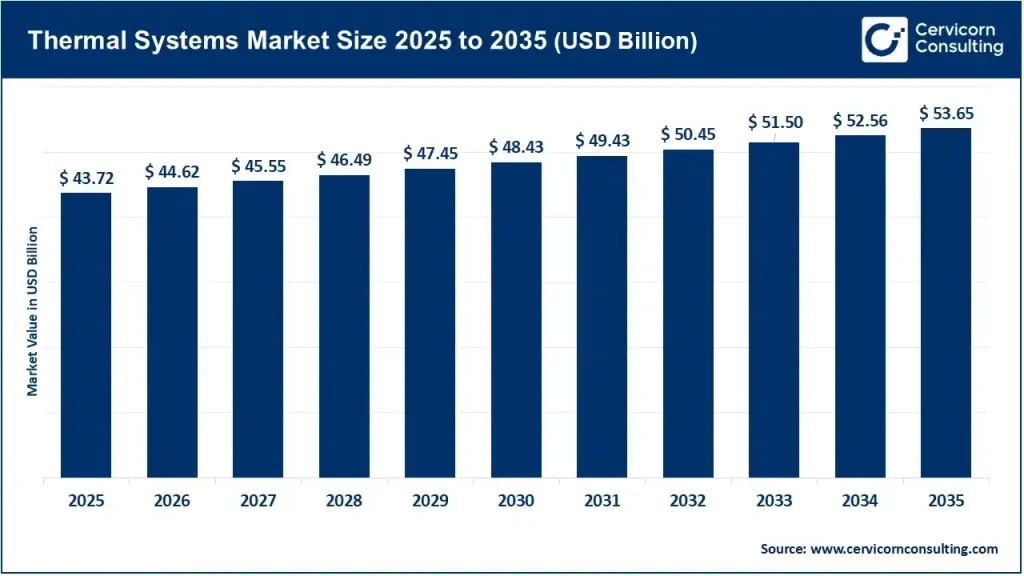
The global thermal systems market was valued at USD 43.72 billion in 2025 and is projected to reach approximately USD 53.65 billion by 2035, growing at a CAGR of 2.1% from 2026 to 2035. Although overall market expansion remains moderate, the transition toward electric mobility, integrated thermal architectures, and energy-efficient cooling technologies is changing where manufacturers can capture future value.
For automotive OEMs, Tier 1 suppliers, component manufacturers, and thermal technology providers, the opportunity is not simply to increase production capacity. It is to determine which thermal technologies, vehicle platforms, and components deserve greater investment as conventional powertrain requirements evolve.
Battery thermal management, refrigerant-based cooling, integrated thermal systems, and electronically controlled components are becoming increasingly important to next-generation vehicle architectures. Companies that align their product portfolios with these developments can strengthen their position in an increasingly technology-driven market.
1. Should Manufacturers Prioritize Battery Thermal Management Over Conventional Powertrain Systems?
The transition toward electric mobility is changing the composition of thermal management demand. Conventional powertrain thermal management systems accounted for 30% of the global thermal systems market in 2025, making them the largest system category. However, battery thermal management systems are expected to be the fastest-growing segment through 2035.
This creates an important portfolio decision for automotive suppliers: how much investment should remain concentrated in conventional engine cooling, and how much should shift toward battery-focused thermal technologies?
Battery temperature directly influences vehicle safety, charging performance, operating efficiency, and battery lifespan. As manufacturers introduce higher-capacity batteries and faster-charging platforms, the need for precise temperature regulation becomes more important.
Business decisions for manufacturers:
-
Evaluate opportunities to expand battery cooling and heating product portfolios.
-
Develop thermal management solutions compatible with different battery chemistries and vehicle architectures.
-
Strengthen partnerships with battery manufacturers and electric vehicle OEMs.
-
Assess whether existing engine cooling capabilities can be adapted for electric powertrain applications.
-
Increase R&D investment in thermal systems that support fast charging and consistent battery performance.
Companies that continue relying heavily on conventional powertrain components may face portfolio concentration risks as vehicle electrification progresses.
Get a Free Sample: https://www.cervicornconsulting.com/sample/3079
2. Is Liquid Cooling the Right Long-Term Technology Investment?
Technology selection is becoming an important competitive differentiator in thermal systems manufacturing.
Liquid-based coolant systems held the largest technology share at 35% in 2025, supported by their ability to provide efficient heat transfer across engine, battery, and electronic applications.
However, manufacturers should not assume that one cooling technology will address every emerging requirement.
Refrigerant-based cooling systems are expected to be the fastest-growing technology segment during 2026–2035. Their increasing relevance is associated with integrated thermal management architectures, battery temperature regulation, and heat pump applications.
Heat pump-based thermal management is another area gaining attention, particularly in electric vehicles where cabin heating and cooling efficiency can influence overall energy consumption and driving range.
Business decisions for manufacturers:
-
Compare liquid-based and refrigerant-based cooling technologies across different vehicle applications.
-
Evaluate opportunities to develop integrated heating and cooling systems.
-
Assess heat pump technologies for electric passenger and commercial vehicles.
-
Prioritize compact designs that reduce weight, packaging requirements, and energy consumption.
-
Consider material compatibility, refrigerant regulations, and lifecycle costs before committing to new technology platforms.
The competitive advantage will increasingly depend on matching cooling architecture with vehicle performance requirements rather than relying exclusively on established technologies.
3. Which Components Offer the Strongest Opportunities for Product Differentiation?
Thermal system performance depends on the combined efficiency of compressors, heat exchangers, pumps, valves, radiators, condensers, evaporators, and electronic control units.
In 2025, compressors accounted for 18% of total market revenue, making them the leading component category. Their importance across refrigeration, air conditioning, and automotive thermal management supports continued demand.
However, the component landscape is evolving as thermal architectures become more integrated.
Valves and manifolds are expected to be the fastest-growing component segment during the forecast period. These components enable precise regulation of coolant and refrigerant flow across multiple thermal circuits.
Thermal modules and control units are also becoming increasingly important as manufacturers integrate sensors, electronic controls, and software into vehicle thermal architectures.
Business decisions for component suppliers:
-
Identify opportunities in electronically controlled valves and advanced manifolds.
-
Expand heat exchanger portfolios with compact and high-efficiency designs.
-
Develop components compatible with centralized thermal management architectures.
-
Evaluate investments in sensors, control units, and intelligent thermal modules.
-
Identify opportunities to supply multiple components within a single thermal management platform.
For Tier 1 and Tier 2 suppliers, moving beyond individual component manufacturing toward integrated subsystem capabilities could create stronger relationships with automotive OEMs.
4. Should Companies Target Electric Commercial Vehicles as Their Next Growth Market?
Passenger cars accounted for 65% of the thermal systems market in 2025, reflecting the large installed vehicle base and widespread adoption of thermal management technologies.
However, electric commercial vehicles are expected to be the fastest-growing vehicle category during 2026–2035.
The electrification of buses, delivery vehicles, and heavy-duty transportation creates additional requirements for battery cooling, powertrain temperature regulation, and thermal performance under demanding operating conditions.
Unlike passenger vehicles, commercial vehicles often operate for extended periods and under variable load conditions. Thermal management performance can therefore influence vehicle uptime, operating costs, battery durability, and fleet efficiency.
Business decisions for manufacturers:
-
Evaluate thermal solutions specifically designed for electric buses, trucks, and delivery fleets.
-
Develop high-capacity battery cooling systems for commercial applications.
-
Explore partnerships with electric bus manufacturers and fleet electrification companies.
-
Assess aftermarket opportunities for thermal component replacement and maintenance.
-
Design modular thermal platforms that can be adapted across different commercial vehicle categories.
Suppliers with experience in heavy-duty cooling, heat exchangers, pumps, and fluid management may have opportunities to extend their capabilities into electric commercial vehicle platforms.
5. Where Should Manufacturers Expand: Asia-Pacific or North America?
Regional investment decisions require balancing manufacturing scale, customer concentration, technology adoption, and future demand.
Asia-Pacific dominated the global thermal systems market in 2025, accounting for 36% of revenue. The regional market was valued at USD 15.74 billion and is projected to reach USD 19.31 billion by 2035.
Its position is supported by a strong automotive manufacturing ecosystem, established vehicle production capabilities, and growing adoption of electric and hybrid vehicles.
North America, meanwhile, is expected to be the fastest-growing regional market during 2026–2035. Its thermal systems market was valued at USD 12.68 billion in 2025 and is projected to exceed USD 15.56 billion by 2035.
Investment in electric transportation, battery manufacturing, and advanced automotive technologies is creating opportunities for thermal system suppliers.
Europe represents another important market, with its value projected to increase from USD 10.93 billion in 2025 to USD 13.41 billion by 2035.
Business decisions for manufacturers:
-
Prioritize Asia-Pacific for access to established automotive manufacturing ecosystems.
-
Evaluate North American expansion opportunities around electric vehicle and battery supply chains.
-
Assess European demand for energy-efficient thermal technologies and advanced heat pump systems.
-
Compare local manufacturing costs, customer relationships, import requirements, and regulatory conditions.
-
Consider strategic partnerships or regional production facilities before committing to major capital expenditure.
Rather than pursuing geographic expansion based solely on market size, manufacturers should evaluate where their specific component and technology capabilities offer the strongest competitive advantage.
6. How Should Companies Prepare for Integrated and Intelligent Thermal Management Systems?
Thermal management is increasingly moving beyond individual cooling and heating components toward integrated systems that coordinate battery, powertrain, and cabin temperature requirements.
This transition is creating opportunities for manufacturers that combine mechanical engineering with electronic controls, sensors, and software-based monitoring.
Integrated and centralized thermal management systems accounted for 12% of the market in 2025. Their development reflects the increasing need to coordinate multiple thermal functions within modern vehicle platforms.
The growing adoption of connected technologies also creates opportunities for predictive maintenance, real-time temperature monitoring, and automated thermal regulation.
Business decisions for manufacturers:
-
Invest in centralized thermal management architectures.
-
Integrate temperature sensors and electronic control systems into product development.
-
Explore predictive maintenance capabilities for thermal components.
-
Develop modular solutions that can support multiple vehicle platforms.
-
Strengthen engineering capabilities in thermal simulation, system integration, and software-controlled temperature management.
Companies that develop integrated thermal solutions can potentially move into higher-value supplier relationships instead of competing exclusively on individual component pricing.
7. What Should Companies Monitor in the Competitive Landscape?
The thermal systems market includes established HVAC manufacturers, automotive technology suppliers, heat exchanger specialists, and industrial cooling companies.
Several developments in 2026 highlight how competition is evolving.
-
Mitsubishi Electric: In September 2026, the company announced a new plate heat exchanger for heat pump cooling and heating equipment, targeting improved heat-transfer performance and reduced refrigerant requirements.
-
Trane Technologies: In September 2026, the company announced two high-density AI factory reference designs featuring advanced thermal management architectures and zero-water-consumption cooling.
-
SLB: In August 2026, the company announced an agreement to acquire Kelvion, strengthening its heat-exchange and thermal management capabilities across data center and industrial applications.
These developments demonstrate that thermal management capabilities are becoming strategically relevant across multiple industries, including automotive, industrial operations, and data center infrastructure.
For automotive-focused companies, competitive monitoring should extend beyond direct competitors to include technology providers developing advanced heat exchangers, compressors, thermal controls, and integrated cooling architectures.
Business decisions for manufacturers:
-
Monitor competitor investments in heat exchangers, heat pumps, and integrated cooling.
-
Evaluate acquisition opportunities that strengthen component or engineering capabilities.
-
Identify technology partnerships that accelerate product development.
-
Benchmark product efficiency, system integration, and manufacturing capabilities.
-
Track the entry of industrial thermal technology providers into adjacent automotive applications.
Key Market Indicators Shaping Investment Decisions
The following indicators provide a snapshot of where companies should concentrate their market evaluation.
| Market indicator | 2025 position | Strategic implication |
|---|---|---|
| Global thermal systems market | USD 43.72 billion | Evaluate long-term portfolio opportunities |
| Asia-Pacific market share | 36% | Prioritize automotive manufacturing ecosystems |
| Powertrain thermal management | 30% share | Protect existing conventional vehicle business |
| Battery thermal management | Fastest-growing system segment | Expand EV-focused capabilities |
| Liquid-based cooling | 35% share | Strengthen established cooling technologies |
| Refrigerant-based cooling | Fastest-growing technology | Evaluate next-generation thermal architectures |
| Compressors | 18% component share | Invest in efficiency and product differentiation |
| Passenger cars | 65% share | Maintain existing customer relationships |
| Electric commercial vehicles | Fastest-growing vehicle segment | Explore emerging fleet applications |
Conclusion: Thermal System Manufacturers Need to Compete on Technology and Integration
The thermal systems market is entering a period in which product requirements are evolving alongside vehicle electrification and changing automotive architectures.
Although the global market is projected to grow at a relatively moderate CAGR of 2.1% through 2035, individual technology and vehicle segments present different growth opportunities. Battery thermal management, refrigerant-based cooling, valves and manifolds, and electric commercial vehicle applications deserve closer evaluation.
For manufacturers, the most important decisions involve balancing conventional product revenues with investments in emerging technologies, identifying the right regional expansion opportunities, and developing stronger integration capabilities.
Companies that align R&D investments, component portfolios, and customer partnerships with these changing requirements will be better positioned to compete as automotive thermal management becomes more sophisticated.
To Get Detailed Overview, Contact Us: https://www.cervicornconsulting.com/contact-us