


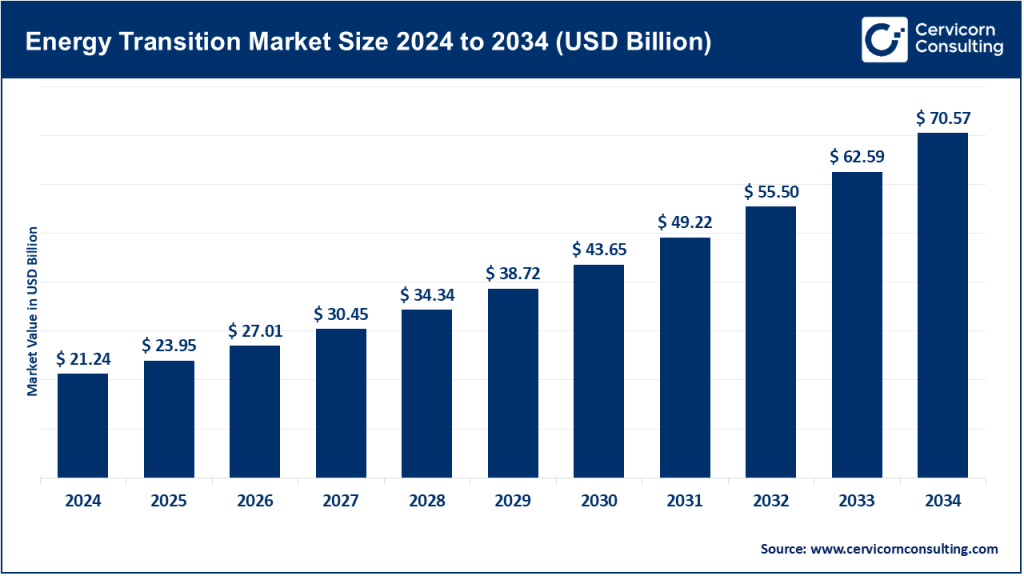
Energy Transition Market Size
The global energy transition market reached an estimated valuation of USD 21.24 billion in 2024 and is projected to grow substantially, attaining approximately USD 70.57 billion by 2034. This growth reflects a strong compound annual growth rate (CAGR) of around 12.76% throughout the forecast period.
What is the Energy Transition Market?
The energy transition market refers to the global ecosystem focused on shifting energy production, distribution, and consumption away from fossil fuels toward cleaner, low-carbon, and renewable energy systems. This market includes renewable energy generation technologies such as solar, wind, hydropower, geothermal, bioenergy, and hydrogen, along with supporting infrastructure including smart grids, energy storage systems, electric vehicle charging networks, carbon capture technologies, and energy efficiency solutions. Governments, utility companies, industrial enterprises, and technology providers are collectively investing in energy transition strategies to reduce greenhouse gas emissions, improve energy security, modernize aging power infrastructure, and support long-term sustainability goals. The market is also closely linked with digital transformation, as utilities increasingly rely on artificial intelligence, advanced analytics, IoT-enabled monitoring systems, and cloud-based grid management to optimize energy distribution and consumption.
The energy transition market has evolved rapidly over the last decade due to increasing concerns about climate change, volatile fossil fuel prices, and stricter environmental regulations. Countries around the world are setting net-zero emission targets and implementing renewable energy policies that encourage clean energy investments. In addition, financial institutions and investors are prioritizing sustainable infrastructure projects, accelerating capital inflow into renewable energy and electrification initiatives. The market spans multiple industries, including utilities, transportation, manufacturing, construction, chemicals, oil and gas, and information technology.
Energy Transition Market Growth Factors
The energy transition market is expanding significantly due to rising global commitments toward carbon neutrality, growing investments in renewable power generation, rapid electrification of transportation systems, increasing deployment of battery energy storage technologies, declining costs of solar panels and wind turbines, stronger government incentives for clean energy adoption, modernization of transmission and distribution networks, growing industrial demand for sustainable operations, increasing public awareness regarding environmental sustainability, rising demand for green hydrogen production, technological advancements in smart grid infrastructure, supportive financing from global climate funds, increasing adoption of electric vehicles, expansion of distributed energy resources, growing corporate renewable power purchase agreements, and the need to reduce dependence on imported fossil fuels amid geopolitical uncertainties.
Get a Free Sample: https://www.cervicornconsulting.com/sample/2755
Why the Energy Transition Market is Important?
The energy transition market is critically important because it directly addresses some of the world’s most pressing environmental, economic, and energy security challenges. Traditional fossil fuel-based systems contribute significantly to greenhouse gas emissions, air pollution, and climate change. Transitioning toward renewable and low-carbon energy systems helps reduce carbon emissions while supporting cleaner air and healthier communities.
The market also plays a major role in strengthening energy independence. Countries that rely heavily on imported oil, coal, or natural gas are vulnerable to geopolitical conflicts and supply disruptions. By expanding domestic renewable energy capacity, governments can stabilize long-term energy supply and reduce exposure to volatile global energy markets.
Another major reason for the importance of the energy transition market is economic development. Renewable energy projects create employment opportunities across engineering, construction, manufacturing, operations, software development, and infrastructure management. According to global energy agencies, millions of new jobs are expected to emerge in solar manufacturing, battery production, hydrogen infrastructure, and grid modernization.
The energy transition market is equally important for industrial competitiveness. Companies across manufacturing, automotive, chemicals, and technology sectors are increasingly adopting clean energy strategies to comply with environmental regulations and meet sustainability expectations from investors and consumers. Businesses that fail to adapt to low-carbon operations may face rising costs, reputational risks, and limited access to green financing.
In addition, the integration of smart energy technologies improves operational efficiency and grid resilience. Advanced energy management systems, predictive maintenance tools, and AI-driven grid optimization help utilities reduce outages, balance electricity demand, and integrate intermittent renewable energy sources more effectively.
Leading Companies in the Energy Transition Market
| Company | Specialization | Key Focus Areas | Notable Features | 2025 Revenue | Market Share | Global Presence |
|---|---|---|---|---|---|---|
| Exelon Corporation | Regulated utility operations and transmission infrastructure | Clean electricity distribution, smart grid modernization, renewable integration | Operates one of the largest utility transmission networks in the U.S. | Approx. USD 24.26 Billion | Estimated 4-5% in North American regulated utility transition market | United States with strategic energy partnerships |
| Duke Energy Corporation | Electric power generation and utility services | Renewable energy, nuclear energy, grid modernization, decarbonization | Major investor in clean energy transition and carbon reduction programs | Approx. USD 32.24 Billion | Estimated 6-7% in utility-led clean energy investments | United States with international renewable collaborations |
| Pacific Gas and Electric Company | Electricity and natural gas utility operations | Wildfire-resilient grid systems, renewable energy distribution, grid digitization | Strong renewable procurement strategy in California | Approx. USD 24.94 Billion | Estimated 3-4% in renewable utility infrastructure | Primarily U.S.-based operations |
| Southern Company | Electric utility and energy infrastructure | Renewable power expansion, carbon capture, hydrogen projects | Focus on low-carbon technologies and grid reliability | Approx. USD 29.55 Billion | Estimated 5-6% in clean utility infrastructure | United States with technology collaborations globally |
| American Electric Power | Electric transmission and utility services | Transmission expansion, renewable integration, advanced grid systems | Operates one of the largest electricity transmission systems in North America | Approx. USD 21.88 Billion | Estimated 4-5% in transmission-focused transition projects | North America with clean energy partnerships |
Leading Trends in the Energy Transition Market and Their Impact
Expansion of Renewable Energy Capacity
Solar and wind power installations continue to dominate clean energy investments globally. Falling equipment prices and improved efficiency are making renewable projects increasingly cost-competitive compared to coal and natural gas power plants. Countries across Asia-Pacific, Europe, and North America are accelerating utility-scale renewable deployment to meet net-zero targets. This trend is reducing long-term electricity generation costs and driving infrastructure investments in energy storage and transmission systems.
Rapid Growth of Battery Energy Storage Systems
Energy storage has become essential for balancing intermittent renewable power generation. Lithium-ion battery systems are increasingly used in grid-scale storage projects to stabilize electricity supply during peak demand periods. Battery technologies also support electric vehicle adoption and decentralized energy systems. The expansion of battery storage improves grid flexibility and enhances renewable energy reliability.
Smart Grid Modernization
Utilities are investing heavily in digital grid infrastructure to improve operational efficiency and resilience. Smart meters, advanced sensors, automated substations, and AI-powered analytics enable utilities to monitor electricity demand in real time and reduce transmission losses. Smart grids also facilitate the integration of distributed renewable energy resources such as rooftop solar systems.
Green Hydrogen Development
Green hydrogen is emerging as a key component of long-term decarbonization strategies, especially in heavy industries and long-distance transportation. Hydrogen produced using renewable electricity can help reduce emissions in sectors where direct electrification is difficult. Governments in Europe, Japan, South Korea, and the Middle East are investing heavily in hydrogen production and export infrastructure.
Electrification of Transportation
The growing adoption of electric vehicles is reshaping energy demand patterns globally. Governments are implementing stricter vehicle emission regulations and expanding EV charging infrastructure. Increased electricity demand from transportation is encouraging utilities to invest in renewable generation and grid upgrades.
Corporate Sustainability Commitments
Large multinational corporations are signing long-term renewable energy purchase agreements to reduce operational emissions. Technology companies, manufacturing firms, and logistics providers are increasingly sourcing renewable electricity to meet ESG objectives. This trend is creating stable demand for utility-scale renewable projects.
Decentralized Energy Systems
Distributed energy resources such as rooftop solar panels, microgrids, and community energy systems are becoming more popular. Decentralized energy systems improve resilience during grid disruptions and provide consumers with greater control over energy consumption.
Successful Examples of Energy Transition Projects Around the World
Germany’s Energiewende Program
Germany’s Energiewende initiative is one of the most recognized energy transition programs globally. The country significantly expanded renewable energy generation through supportive feed-in tariffs, renewable energy auctions, and grid investments. Wind and solar energy now account for a major portion of Germany’s electricity generation mix. The program also accelerated investments in energy efficiency and smart grid technologies.
China’s Renewable Energy Expansion
China has become the world’s largest producer of solar panels and wind turbines while also leading in renewable energy deployment. Massive investments in solar farms, offshore wind projects, hydropower facilities, and battery manufacturing have transformed China into a dominant clean energy market. The country’s large-scale renewable infrastructure projects have reduced technology costs worldwide.
Denmark’s Wind Energy Leadership
Denmark is considered a global leader in offshore wind energy. The country has invested extensively in offshore wind farms and smart energy systems, enabling wind power to supply a substantial share of national electricity demand. Denmark’s success demonstrates how supportive regulations and public-private partnerships can accelerate renewable energy adoption.
Norway’s Electric Vehicle Ecosystem
Norway has one of the highest electric vehicle adoption rates globally due to strong government incentives, tax exemptions, and charging infrastructure investments. The country’s transition toward electric mobility has significantly reduced transportation-related emissions.
United Arab Emirates Solar Projects
The United Arab Emirates has emerged as a major clean energy investor despite being a traditional oil-producing economy. Large-scale solar projects such as the Mohammed bin Rashid Al Maktoum Solar Park demonstrate the Middle East’s growing commitment to renewable energy diversification.
India’s Solar Energy Mission
India has rapidly expanded solar power generation through the National Solar Mission and supportive renewable energy auctions. Large-scale solar parks, rooftop solar initiatives, and grid expansion programs have positioned India among the fastest-growing renewable energy markets globally.
Global Regional Analysis of the Energy Transition Market
North America
North America represents a major market for energy transition investments due to strong utility modernization programs, renewable energy expansion, and growing electrification initiatives. The United States leads the region with substantial investments in solar energy, wind farms, battery storage, and electric vehicle infrastructure.
Government Initiatives and Policies
The U.S. Inflation Reduction Act has significantly accelerated clean energy investments through tax incentives for renewable energy projects, hydrogen production, battery manufacturing, and electric vehicle adoption. Federal and state-level renewable portfolio standards are also encouraging utilities to increase renewable electricity generation.
Canada is investing in clean hydrogen, hydropower expansion, and carbon capture technologies as part of its national climate strategy. Provincial governments are supporting grid modernization and renewable energy deployment.
Europe
Europe remains one of the most advanced regions in the global energy transition market due to ambitious climate policies and aggressive decarbonization targets. Countries such as Germany, France, the United Kingdom, Spain, and the Netherlands are heavily investing in offshore wind, hydrogen infrastructure, and smart grids.
Government Initiatives and Policies
The European Green Deal aims to make Europe climate-neutral by 2050. The European Union has implemented carbon pricing mechanisms, renewable energy directives, and energy efficiency regulations to accelerate clean energy adoption.
The REPowerEU strategy was introduced to reduce dependence on imported fossil fuels while accelerating renewable energy deployment and energy storage investments. European governments are also offering subsidies for electric vehicle purchases and clean industrial technologies.
Asia-Pacific
Asia-Pacific is expected to dominate the energy transition market due to rapid industrialization, rising energy demand, and increasing renewable energy investments. China, India, Japan, South Korea, and Australia are key contributors to regional growth.
Government Initiatives and Policies
China’s carbon neutrality target for 2060 has accelerated investments in renewable power generation, EV manufacturing, battery technologies, and hydrogen infrastructure. Government-backed financing and industrial policies continue to strengthen China’s leadership position.
India’s renewable energy policies, including production-linked incentives and solar manufacturing programs, are encouraging domestic clean energy development. The country aims to significantly increase renewable energy capacity while reducing coal dependency.
Japan and South Korea are focusing on hydrogen economies, offshore wind projects, and energy-efficient technologies to achieve long-term decarbonization goals.
Latin America
Latin America offers significant renewable energy potential due to abundant solar, wind, and hydropower resources. Brazil, Chile, and Mexico are leading regional clean energy development.
Government Initiatives and Policies
Brazil continues to invest in hydropower, biofuels, and wind energy projects to diversify its energy mix. Chile has introduced renewable energy auctions and green hydrogen strategies to attract international investments.
Several Latin American countries are implementing public-private partnerships to expand renewable infrastructure and strengthen electricity transmission networks.
Middle East and Africa
The Middle East and Africa region is increasingly investing in renewable energy diversification to reduce reliance on oil and gas revenues while improving energy access.
Government Initiatives and Policies
Saudi Arabia’s Vision 2030 includes major renewable energy projects and investments in green hydrogen production. The UAE is expanding solar energy capacity through large-scale infrastructure developments.
African countries are focusing on decentralized renewable systems, mini-grids, and rural electrification projects supported by international development agencies. South Africa’s renewable procurement programs are encouraging private-sector participation in clean energy generation.
Competitive Landscape and Future Outlook
The energy transition market is becoming increasingly competitive as utilities, technology firms, oil and gas companies, equipment manufacturers, and financial institutions expand investments in clean energy infrastructure. Major utility companies are prioritizing renewable generation capacity, advanced transmission systems, and digital energy management technologies to remain competitive in a low-carbon economy.
Oil and gas companies are also diversifying into renewable energy, hydrogen production, and carbon capture solutions. Technology providers are introducing advanced energy analytics, AI-driven grid optimization platforms, and predictive maintenance tools to improve operational efficiency.
Future growth in the energy transition market will likely be driven by accelerating net-zero commitments, rising electrification of transportation and industry, declining renewable technology costs, and increasing investments in grid resilience. Expanding hydrogen economies, battery recycling infrastructure, and next-generation nuclear technologies may further reshape the global energy landscape over the next decade.
At the same time, challenges such as supply chain constraints, permitting delays, grid congestion, critical mineral shortages, and high infrastructure investment requirements may affect market expansion. However, continued policy support, technological innovation, and private-sector participation are expected to sustain strong long-term growth across the global energy transition market.
To Get Detailed Overview, Contact Us: https://www.cervicornconsulting.com/contact-us
Read Report: Small Molecule Drug Discovery Market Revenue, Trends, and Strategic Insights by 2035