


Table of Contents
ToggleEnergy Recovery Ventilator Core Market Size
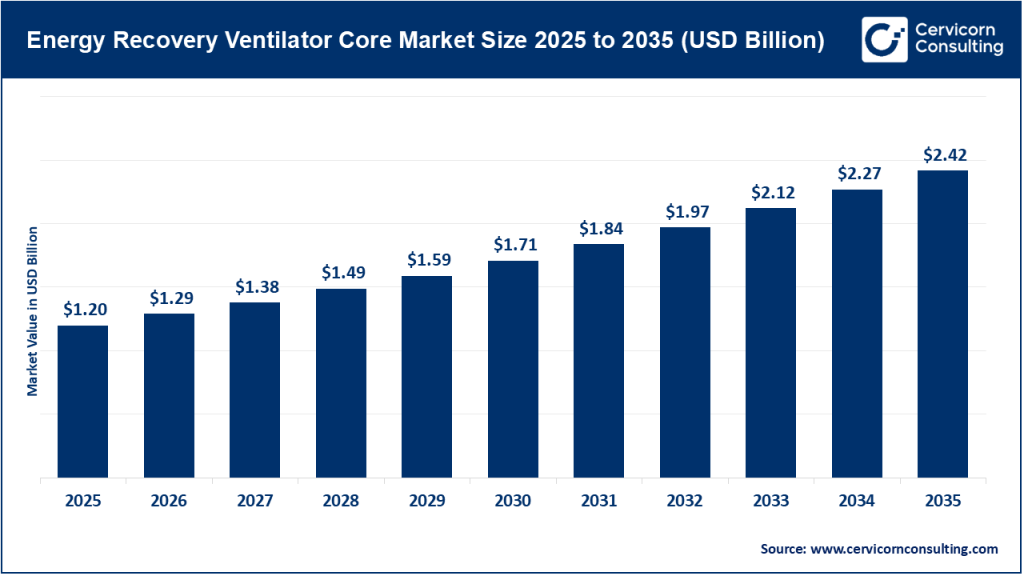
The global energy recovery ventilator core market was valued at USD 1.20 billion in 2025 and is projected to reach approximately USD 2.42 billion by 2035, growing at a robust CAGR of 7.27% during the forecast period from 2026 to 2035.
What is the Energy Recovery Ventilator Core Market?
The Energy Recovery Ventilator (ERV) Core Market refers to the global industry involved in the design, manufacturing, and supply of core heat-exchange components used in energy recovery ventilation systems. These cores are the heart of ERV units, enabling the transfer of heat and moisture between incoming fresh air and outgoing exhaust air streams. By recovering energy that would otherwise be lost during ventilation, ERV cores significantly reduce heating and cooling loads in residential, commercial, and industrial buildings. The market encompasses manufacturers of enthalpy cores, heat-exchange wheels, fixed plate exchangers, polymer membrane cores, and advanced energy recovery materials used in HVAC systems.
Growing concerns about indoor air quality, energy conservation, carbon reduction, and green building certifications are accelerating demand for ERV core technologies across developed and emerging economies. The market is witnessing consistent growth due to stricter building energy regulations, increasing urbanization, and the expansion of sustainable construction projects worldwide. The global energy recovery ventilator core market is projected to experience steady expansion through the next decade, supported by rising adoption of energy-efficient ventilation systems and sustainable infrastructure development.
Why is the Energy Recovery Ventilator Core Market Important?
The energy recovery ventilator core market plays a critical role in modern building management by addressing two major challenges simultaneously: energy efficiency and indoor air quality. Buildings account for a significant portion of global energy consumption, with HVAC systems representing one of the largest energy expenditures. ERV cores reduce this burden by recovering thermal energy from exhaust air and transferring it to incoming fresh air, minimizing the workload on heating and cooling equipment.
The importance of ERV core technology extends beyond energy savings. Modern buildings are becoming increasingly airtight to improve efficiency, which can lead to poor ventilation and indoor air pollution. ERV systems ensure continuous fresh air circulation while maintaining energy performance. This balance is particularly valuable in hospitals, schools, offices, data centers, manufacturing facilities, and residential buildings where occupant health and comfort are priorities.
Governments worldwide are promoting net-zero buildings, green construction, and carbon reduction initiatives, making ERV cores an essential component of sustainable building strategies. As climate change concerns intensify and energy costs continue to rise, energy recovery technologies are becoming indispensable for building owners seeking long-term operational savings and environmental compliance.
Get a Free Sample: https://www.cervicornconsulting.com/sample/2579
Energy Recovery Ventilator Core Market Growth Factors
The growth of the energy recovery ventilator core market is being driven by increasing global awareness of indoor air quality, stricter building energy efficiency regulations, rapid urbanization, rising investments in green buildings, growing adoption of sustainable HVAC technologies, increasing demand for energy conservation in commercial and residential infrastructure, advancements in heat-exchange materials and membrane technologies.
government incentives supporting low-carbon construction, expansion of smart building projects, rising concerns regarding climate change and carbon emissions, technological innovations in enthalpy recovery systems, and growing demand for healthy indoor environments following heightened public health awareness.
Additionally, the integration of IoT-enabled HVAC systems and the expansion of energy-efficient construction practices across developed and emerging economies continue to create substantial growth opportunities for ERV core manufacturers.
Leading Companies in the Energy Recovery Ventilator Core Market
| Company | Specialization | Key Focus Areas | Notable Features | 2025 Revenue* | Estimated Market Position | Global Presence |
|---|---|---|---|---|---|---|
| Xiamen AIR-ERV Technology Co., Ltd. | ERV and heat exchange cores | Polymer heat exchangers, ventilation solutions | Strong OEM manufacturing capabilities | Private company (not publicly disclosed) | Significant Asian supplier | Asia, Europe, North America |
| Ruskin | Air control and ventilation systems | Energy-efficient HVAC solutions | Strong distribution network and commercial HVAC expertise | Not publicly disclosed | Established HVAC participant | North America, Europe, Middle East, Asia |
| Oji Industrial Materials Management Co., Ltd. | Advanced heat exchange materials | Functional industrial materials and ERV components | Expertise in specialty materials | Not publicly disclosed | Important materials supplier | Asia-Pacific, Europe |
| Klingenburg GmbH | Heat recovery and ventilation technologies | Rotary heat exchangers and plate heat exchangers | High-efficiency recovery solutions | Private company (not publicly disclosed) | Major European participant | Europe, Asia, Middle East, Americas |
| Innergy Tech Inc. | Energy recovery wheels and ERV cores | Air-to-air energy recovery systems | Proprietary energy recovery wheel technologies | Approximately TWD 1.41 billion in 2025 | Recognized global supplier | Asia, Europe, North America |
Leading Trends Shaping the Energy Recovery Ventilator Core Market
1. Rising Demand for Green Buildings
The global construction industry is increasingly adopting green building standards such as LEED, BREEAM, and WELL certifications. ERV cores help buildings achieve energy performance targets by reducing HVAC energy consumption and improving indoor environmental quality.
Developers are incorporating energy recovery technologies into commercial complexes, educational institutions, healthcare facilities, and residential projects to meet sustainability requirements and lower operating costs.
2. Advanced Heat Exchange Materials
Manufacturers are investing heavily in innovative materials that enhance thermal conductivity, moisture transfer efficiency, corrosion resistance, and durability.
Key developments include:
- Polymer membrane exchangers
- Nanotechnology-enhanced materials
- Lightweight composite cores
- High-efficiency enthalpy transfer membranes
These innovations improve overall system performance while reducing maintenance requirements.
3. Smart HVAC Integration
Modern ERV systems are increasingly connected to smart building management platforms.
Benefits include:
- Real-time performance monitoring
- Predictive maintenance
- Automated airflow optimization
- Energy consumption analytics
Smart ERV cores enable building operators to maximize energy recovery efficiency while minimizing operational costs.
4. Increased Focus on Indoor Air Quality
The demand for healthy indoor environments has surged globally. Organizations now prioritize ventilation systems capable of delivering fresh air while maintaining energy efficiency.
This trend is particularly strong in:
- Hospitals
- Schools
- Offices
- Airports
- Hospitality facilities
As a result, demand for advanced ERV core technologies continues to rise.
5. Growth of Net-Zero Energy Buildings
Net-zero building initiatives require highly efficient ventilation systems.
ERV cores support these objectives by:
- Reducing heating loads
- Lowering cooling requirements
- Minimizing carbon emissions
- Enhancing overall building performance
Governments and private developers are increasingly adopting ERV systems as part of broader net-zero strategies.
Successful Examples of Energy Recovery Ventilator Core Market Applications Around the World
Germany: High-Efficiency Passive Houses
Germany remains a global leader in passive house construction. Many passive house projects utilize advanced ERV core technologies supplied by European manufacturers such as Klingenburg GmbH. These buildings achieve exceptional energy performance while maintaining superior indoor comfort.
Impact:
- Significant reduction in heating energy demand
- Improved indoor air quality
- Lower carbon footprint
United States: Commercial Office Buildings
Numerous commercial office developments across North America utilize ERV systems integrated with smart HVAC platforms.
Results:
- Reduced operating costs
- Improved occupant wellness
- Compliance with energy regulations
The adoption of energy recovery ventilation continues to expand across commercial and institutional facilities.
Japan: Sustainable Urban Infrastructure
Japanese building developers emphasize energy conservation and environmental sustainability.
ERV core technologies are commonly deployed in:
- High-rise residential buildings
- Mixed-use developments
- Healthcare facilities
These systems help achieve strict energy performance requirements while supporting occupant comfort.
China: Large-Scale Residential Projects
Rapid urbanization and increasing awareness of air quality have encouraged widespread adoption of ERV systems in new residential developments.
Chinese manufacturers, including Xiamen AIR-ERV Technology Co., Ltd., play an important role in supplying efficient ventilation components for these projects.
Benefits:
- Energy savings
- Improved indoor environments
- Compliance with green building standards
Canada: Cold Climate Applications
Canada’s harsh winters create strong demand for heat recovery technologies.
ERV cores are extensively used in:
- Educational facilities
- Government buildings
- Residential housing
These systems recover valuable heat energy that would otherwise be lost through ventilation.
Global Regional Analysis
North America
North America remains one of the most advanced markets for energy recovery ventilation technologies. Strong building energy codes, sustainability initiatives, and awareness of indoor air quality continue to drive adoption.
Key drivers include:
- ASHRAE ventilation standards
- Green building certifications
- Energy conservation programs
- Commercial retrofitting activities
The United States and Canada are major contributors to regional growth. North America accounts for a significant share of the broader ERV market due to advanced HVAC adoption and stringent energy regulations.
Government Initiatives
- Federal energy efficiency programs
- Incentives for sustainable construction
- Building decarbonization initiatives
- Net-zero building targets
Europe
Europe represents one of the most mature energy recovery ventilation markets globally.
Major growth countries include:
- Germany
- France
- United Kingdom
- Netherlands
- Sweden
European regulations strongly emphasize energy efficiency and carbon reduction.
Government Policies
- European Green Deal
- Energy Performance of Buildings Directive (EPBD)
- Fit for 55 Climate Package
- Net-zero carbon targets
These policies encourage widespread implementation of advanced heat recovery technologies.
Asia-Pacific
Asia-Pacific is projected to be the fastest-growing regional market.
Growth is driven by:
- Rapid urbanization
- Expanding construction sector
- Rising energy demand
- Government sustainability initiatives
Key markets include:
- China
- Japan
- South Korea
- India
- Australia
Government Initiatives
China
- Green Building Action Plan
- Carbon neutrality goals by 2060
Japan
- Zero Energy Building (ZEB) programs
- Building energy conservation standards
India
- Energy Conservation Building Code (ECBC)
- Smart Cities Mission
- Green building incentives
These initiatives are accelerating deployment of energy-efficient HVAC and ventilation technologies.
Latin America
The Latin American market is gradually expanding due to increasing investments in commercial construction and sustainability programs.
Key countries include:
- Brazil
- Mexico
- Chile
- Colombia
Government Support
Many governments are introducing:
- Energy efficiency standards
- Sustainable infrastructure investments
- Building modernization programs
Although adoption remains lower than in developed regions, long-term growth prospects remain favorable.
Middle East & Africa
Extreme climate conditions make energy-efficient cooling systems essential throughout the Middle East.
Major markets include:
- United Arab Emirates
- Saudi Arabia
- Qatar
- South Africa
Government Policies
Saudi Vision 2030
- Sustainable infrastructure development
- Energy conservation initiatives
UAE Net-Zero Strategy
- Green building regulations
- High-efficiency HVAC requirements
These initiatives are encouraging greater adoption of ERV core technologies across commercial and residential developments.
Government Initiatives and Policies Shaping the Market
Several government-led programs are significantly influencing market growth worldwide:
Energy Efficiency Regulations
Many countries have implemented stricter building codes requiring improved ventilation performance and reduced energy consumption.
Carbon Reduction Targets
National commitments to net-zero emissions are encouraging adoption of energy recovery technologies.
Green Building Certifications
Programs such as LEED, BREEAM, WELL, and regional sustainability frameworks incentivize the use of ERV systems.
Building Retrofit Programs
Governments are supporting modernization of aging infrastructure through energy-efficiency grants and incentives.
Indoor Air Quality Standards
Post-pandemic health priorities have resulted in stronger ventilation requirements across schools, hospitals, offices, and public buildings.
Sustainable Urban Development Policies
Smart city initiatives increasingly incorporate energy-efficient HVAC and ventilation solutions as key infrastructure components.
Collectively, these policies are creating a favorable regulatory environment for ERV core manufacturers and accelerating global market expansion.
The energy recovery ventilator core market continues to evolve as energy efficiency, indoor air quality, and sustainable construction become central priorities for governments, businesses, and consumers worldwide.
To Get Detailed Overview, Contact Us: https://www.cervicornconsulting.com/contact-us
Read Report: Power Electronics Market Revenue, Trends, and Strategic Insights by 2035