


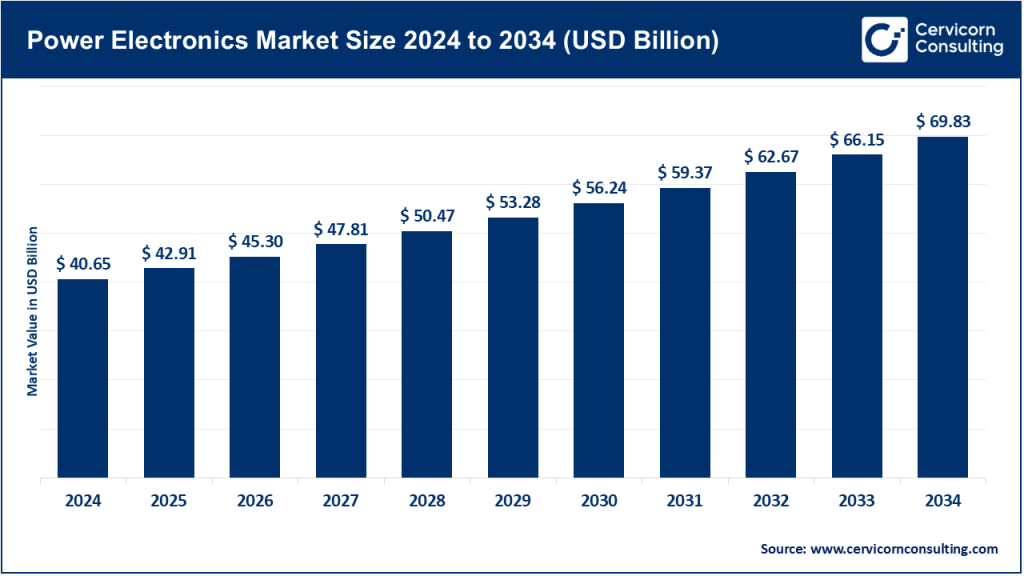
Power Electronics Market Size
What is the Power Electronics Market?
The power electronics market refers to the global industry involved in the design, manufacturing, and deployment of electronic systems and semiconductor devices that control, convert, and manage electrical power efficiently. These technologies are used to convert electricity from one form to another, such as AC to DC, DC to AC, or varying voltage and frequency levels.
Power electronics systems include components such as:
- Power semiconductors
- MOSFETs and IGBTs
- Silicon carbide (SiC) devices
- Gallium nitride (GaN) devices
- Rectifiers
- Converters
- Inverters
- Power ICs
- Motor drives
- UPS systems
- Smart power modules
These components are widely used in electric vehicles, renewable energy systems, industrial machinery, railways, aerospace systems, telecommunications, consumer electronics, and data centers.
The growing adoption of energy-efficient technologies and electrification initiatives across industries is significantly expanding the role of power electronics in modern infrastructure.
Get a Free Sample: https://www.cervicornconsulting.com/sample/2727
Why the Power Electronics Market is Important
Power electronics technologies play a critical role in enabling efficient energy utilization and supporting global sustainability goals. As countries transition toward renewable energy and electric mobility, advanced power conversion technologies are becoming essential for reducing energy losses and improving operational efficiency.
The market is important because it:
- Enables efficient power conversion and management
- Supports EV charging infrastructure and battery systems
- Enhances renewable energy integration into smart grids
- Reduces industrial energy consumption
- Improves performance of consumer electronics and appliances
- Supports automation and Industry 4.0 initiatives
- Enables high-speed telecom and data center operations
- Contributes to carbon emission reduction targets
Power electronics solutions are also crucial in solar inverters, wind turbines, electric trains, smart manufacturing equipment, and AI-driven data centers. Their importance is expected to grow as industries increasingly adopt electrification and digitalization technologies.
Power Electronics Market Growth Factors
The growth of the power electronics market is being driven by rising adoption of electric vehicles, rapid investments in renewable energy infrastructure, increasing industrial automation, expanding smart grid deployment, growing demand for energy-efficient consumer electronics, development of high-performance semiconductor materials such as silicon carbide and gallium nitride, rising demand for fast-charging systems, increasing use of robotics and AI-enabled manufacturing systems, expansion of 5G and data center infrastructure, and supportive government policies promoting clean energy and carbon reduction initiatives worldwide.
Leading Companies in the Power Electronics Market
Infineon Technologies AG
| Category | Details |
|---|---|
| Company Specialization | Power semiconductors, automotive electronics, industrial power solutions |
| Key Focus Areas | EV power modules, SiC semiconductors, industrial automation, renewable energy |
| Notable Features | Strong automotive semiconductor portfolio and leadership in power management |
| 2025 Revenue | Approximately EUR 14.66 billion |
| Estimated Market Share | Strong global presence in automotive and industrial power electronics |
| Global Presence | Europe, Asia-Pacific, North America, Middle East |
Infineon Technologies is one of the global leaders in power semiconductors and automotive power electronics. The company is heavily investing in silicon carbide technologies for electric vehicles, renewable energy systems, and AI data centers. Infineon has expanded its focus on energy-efficient semiconductor solutions that support decarbonization and industrial electrification initiatives worldwide. The company reported approximately EUR 14.66 billion in revenue during fiscal year 2025.
Mitsubishi Electric Corporation
| Category | Details |
|---|---|
| Company Specialization | Industrial automation, power devices, factory automation systems |
| Key Focus Areas | Smart manufacturing, energy systems, rail transportation, automotive electronics |
| Notable Features | Strong industrial automation expertise and advanced inverter technologies |
| 2025 Revenue | Approximately JPY 5.52 trillion |
| Estimated Market Share | Significant presence in industrial and energy power electronics |
| Global Presence | Japan, China, India, Europe, North America |
Mitsubishi Electric Corporation is a major player in industrial power electronics, factory automation systems, and energy infrastructure solutions. The company provides advanced power modules and inverter technologies used in rail systems, renewable energy projects, and industrial equipment. Mitsubishi Electric continues to expand its manufacturing capabilities in Asia, particularly in India and Southeast Asia. The company recorded approximately JPY 5.52 trillion in revenue for fiscal year 2025.
STMicroelectronics N.V.
| Category | Details |
|---|---|
| Company Specialization | Semiconductor solutions, microcontrollers, power management devices |
| Key Focus Areas | Automotive power electronics, IoT, industrial automation, energy management |
| Notable Features | Strong R&D in SiC and GaN semiconductor technologies |
| 2025 Revenue | Approximately USD 11.8 billion |
| Estimated Market Share | Leading supplier of automotive and industrial semiconductors |
| Global Presence | Europe, Asia-Pacific, North America |
STMicroelectronics is widely recognized for its advanced semiconductor technologies and energy-efficient power devices. The company plays a major role in electric vehicle powertrain systems, charging infrastructure, and industrial automation applications. STMicroelectronics continues to strengthen its silicon carbide manufacturing ecosystem to support growing EV demand worldwide. The company generated approximately USD 11.8 billion in revenue in 2025.
Texas Instruments Incorporated
| Category | Details |
|---|---|
| Company Specialization | Analog semiconductors, embedded processors, power management ICs |
| Key Focus Areas | Automotive electronics, industrial systems, consumer electronics |
| Notable Features | Broad analog and power management product portfolio |
| 2025 Revenue | Estimated above USD 15 billion |
| Estimated Market Share | Strong position in analog and power management markets |
| Global Presence | Americas, Europe, Asia-Pacific |
Texas Instruments is a major provider of analog semiconductors and power management integrated circuits. The company supplies solutions for automotive systems, industrial automation equipment, healthcare devices, and communication infrastructure. Texas Instruments is investing heavily in advanced semiconductor fabrication facilities to strengthen supply chain resilience and meet rising demand for power management technologies.
ON Semiconductor Corporation (onsemi)
| Category | Details |
|---|---|
| Company Specialization | Intelligent power and sensing technologies |
| Key Focus Areas | EVs, ADAS systems, industrial automation, renewable energy |
| Notable Features | Strong portfolio in silicon carbide and intelligent power modules |
| 2025 Revenue | Estimated above USD 7 billion |
| Estimated Market Share | Significant EV semiconductor supplier |
| Global Presence | North America, Europe, China, Southeast Asia |
onsemi is a leading provider of intelligent power technologies and automotive semiconductor solutions. The company has significantly expanded its silicon carbide production capabilities to support the growing electric vehicle and renewable energy sectors. onsemi is increasingly focusing on high-efficiency power conversion systems and energy management technologies for next-generation mobility applications.
Leading Trends in the Power Electronics Market and Their Impact
Rise of Silicon Carbide (SiC) and Gallium Nitride (GaN) Technologies
Wide-bandgap semiconductor materials such as silicon carbide and gallium nitride are revolutionizing the power electronics industry. These materials provide higher efficiency, faster switching speeds, reduced heat generation, and improved performance compared to traditional silicon semiconductors.
Impact:
- Improved EV charging efficiency
- Reduced energy losses in industrial systems
- Smaller and lighter power modules
- Better thermal performance
- Enhanced renewable energy conversion efficiency
Electrification of Transportation
The increasing adoption of electric vehicles is one of the strongest drivers of the power electronics market. EVs rely heavily on inverters, converters, onboard chargers, battery management systems, and power semiconductors.
Impact:
- Growing demand for automotive-grade power devices
- Expansion of EV charging infrastructure
- Increased investment in battery technologies
- Rising demand for high-voltage power modules
Renewable Energy Integration
Solar and wind energy projects require advanced power conversion technologies to integrate electricity into smart grids efficiently.
Impact:
- Increased demand for solar inverters
- Expansion of smart grid systems
- Greater investment in energy storage technologies
- Higher adoption of intelligent energy management systems
Industry 4.0 and Smart Manufacturing
Industrial automation and robotics are increasing the need for efficient motor drives and intelligent power systems.
Impact:
- Increased deployment of factory automation systems
- Greater use of robotics and AI-enabled machinery
- Rising need for energy-efficient industrial equipment
- Growth in predictive maintenance technologies
Expansion of AI Data Centers and 5G Networks
The growth of AI workloads and high-speed telecommunications infrastructure is creating significant demand for efficient power management systems.
Impact:
- Increased demand for high-efficiency power supplies
- Rising investments in cooling and energy management solutions
- Growth in advanced semiconductor manufacturing
- Enhanced focus on sustainable data center operations
Successful Examples of the Power Electronics Market Around the World
Tesla Electric Vehicle Ecosystem – United States
Tesla has successfully integrated advanced power electronics technologies into its electric vehicles and fast-charging infrastructure. The company uses high-performance inverters, battery management systems, and silicon carbide semiconductors to improve EV efficiency and charging speed.
Tesla’s success has accelerated global adoption of power electronics technologies across the automotive industry.
China’s Renewable Energy Expansion
China has become one of the world’s largest adopters of renewable energy systems supported by advanced power electronics technologies. Massive deployment of solar farms, wind turbines, and smart grid systems has increased demand for power converters, inverters, and industrial semiconductor devices.
The country’s investment in EV infrastructure and energy storage technologies has also strengthened its leadership in power electronics manufacturing.
Germany’s Industrial Automation Leadership
Germany has successfully implemented Industry 4.0 initiatives that rely heavily on power electronics systems for automation, robotics, and smart manufacturing.
Advanced motor drives, industrial control systems, and energy-efficient manufacturing technologies have improved productivity and reduced industrial energy consumption.
Japan’s High-Speed Rail Infrastructure
Japan’s railway systems use advanced power electronics technologies for traction systems, regenerative braking, and energy-efficient rail operations.
The country’s investments in transportation electrification and smart infrastructure continue to support the growth of power semiconductor and inverter technologies.
India’s Smart Grid and Renewable Energy Programs
India is rapidly expanding solar power generation, EV infrastructure, and smart grid modernization projects. Government initiatives supporting renewable energy and energy-efficient industrial systems are creating major opportunities for power electronics manufacturers.
The country is also emerging as a manufacturing hub for semiconductor and electronics production.
Global Regional Analysis of the Power Electronics Market
North America
North America is a major market for power electronics due to strong adoption of electric vehicles, renewable energy systems, industrial automation, and AI data center infrastructure.
Key Growth Drivers
- Rapid EV adoption in the United States
- Investments in AI and cloud infrastructure
- Expansion of renewable energy capacity
- Rising defense and aerospace electronics demand
Government Initiatives and Policies
- The U.S. Inflation Reduction Act supports clean energy and EV investments
- Government incentives for domestic semiconductor manufacturing
- Policies supporting energy-efficient industrial systems
- Federal funding for EV charging infrastructure deployment
The United States is also strengthening semiconductor supply chains through large-scale manufacturing incentives and technology investments.
Europe
Europe is one of the leading regions in energy-efficient technologies and automotive electrification.
Key Growth Drivers
- Strong EV manufacturing ecosystem
- Advanced industrial automation infrastructure
- Aggressive carbon neutrality goals
- Growth in renewable energy projects
Government Initiatives and Policies
- European Green Deal initiatives
- Carbon emission reduction regulations
- Subsidies for EV adoption and renewable energy projects
- Investments in semiconductor production facilities
Germany, France, and the Netherlands are major contributors to regional market growth.
Asia-Pacific
Asia-Pacific dominates the global power electronics market due to strong electronics manufacturing capabilities and rising investments in EVs, renewable energy, and industrial automation.
Key Growth Drivers
- Large-scale semiconductor manufacturing
- Rapid industrialization and urbanization
- Expanding EV and battery production
- Growth in consumer electronics manufacturing
Government Initiatives and Policies
- China’s clean energy and EV development policies
- Japan’s industrial automation and smart infrastructure programs
- India’s Production Linked Incentive (PLI) schemes for electronics manufacturing
- South Korea’s semiconductor investment initiatives
China, Japan, South Korea, and India remain key regional markets driving global growth.
Latin America
Latin America is witnessing growing adoption of renewable energy systems and industrial automation technologies.
Key Growth Drivers
- Expansion of solar and wind projects
- Increasing industrial modernization
- Rising energy efficiency awareness
- Growth in smart grid investments
Government Initiatives and Policies
- Renewable energy investment incentives
- Grid modernization programs
- Policies promoting energy-efficient infrastructure
Brazil and Mexico are among the leading regional markets.
Middle East and Africa
The Middle East and Africa region is gradually adopting advanced power electronics systems for renewable energy projects, smart cities, and industrial infrastructure.
Key Growth Drivers
- Investments in solar energy projects
- Smart city developments
- Industrial diversification strategies
- Expansion of utility-scale energy systems
Government Initiatives and Policies
- Saudi Arabia’s Vision 2030 infrastructure initiatives
- UAE investments in renewable energy and smart cities
- African electrification and grid modernization projects
The region is expected to witness increasing demand for power management and energy conversion technologies over the coming decade.
Future Outlook of the Power Electronics Market
The future of the power electronics market appears highly promising as industries worldwide continue transitioning toward electrification, renewable energy integration, and intelligent infrastructure systems. Advancements in semiconductor technologies, especially silicon carbide and gallium nitride devices, are expected to redefine energy efficiency standards across automotive, industrial, and consumer applications.
The increasing demand for electric vehicles, AI-driven data centers, renewable power generation, and industrial automation will continue driving innovation and investment in power electronics technologies globally. Governments and private organizations are expected to expand funding for semiconductor manufacturing, smart grids, clean energy systems, and next-generation mobility infrastructure, creating significant long-term growth opportunities for the global power electronics market.
To Get Detailed Overview, Contact Us: https://www.cervicornconsulting.com/contact-us
Read Report: Autoinjectors Market Revenue, Trends, and Strategic Insights by 2035