


Table of Contents
ToggleEmbodied AI Market Size
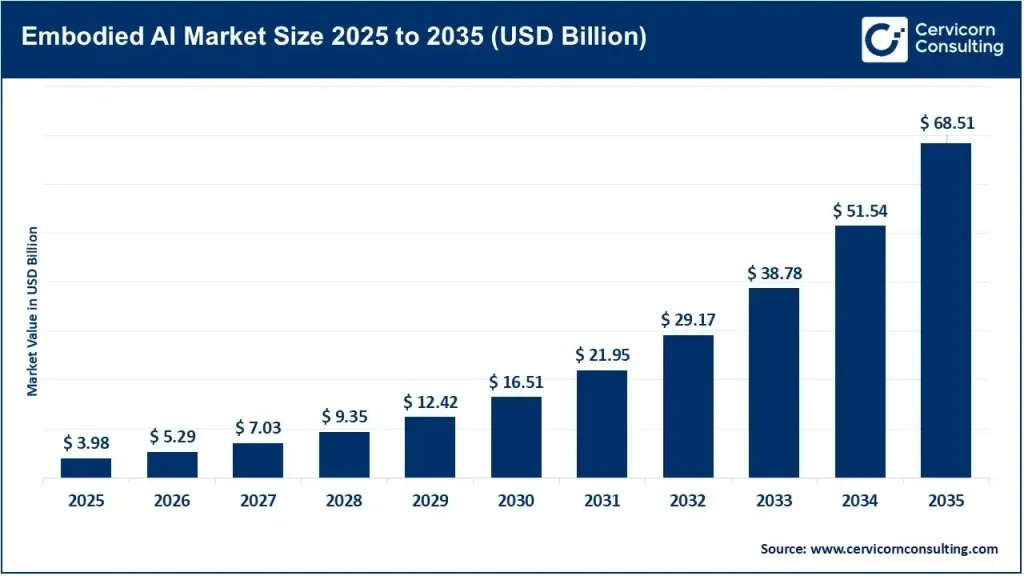
The global embodied AI market was valued at approximately USD 3.98 billion in 2025 and is projected to reach USD 68.51 billion by 2035, expanding at a CAGR of 32.9% during the forecast period.
Embodied AI Market Growth Factors
The embodied AI market is experiencing robust growth due to the rapid advancement of artificial intelligence, robotics, computer vision, edge computing, and sensor technologies. Increasing investments in humanoid robots, autonomous mobile robots (AMRs), industrial automation, warehouse robotics, healthcare assistants, and autonomous vehicles are creating significant demand for embodied AI systems capable of interacting with physical environments. The growing adoption of Industry 4.0, smart manufacturing, AI-powered logistics, precision agriculture, and intelligent healthcare is accelerating deployment across multiple sectors. Continuous improvements in generative AI, reinforcement learning, large language models (LLMs), multimodal AI, digital twins, and cloud robotics are enabling robots to learn, reason, and perform increasingly complex real-world tasks.
Rising labor shortages, aging populations, increasing workplace safety requirements, and government initiatives supporting AI innovation and domestic semiconductor manufacturing further strengthen market expansion. Additionally, strategic collaborations between AI developers, cloud providers, automotive manufacturers, robotics companies, and research institutions continue to accelerate commercialization, making embodied AI one of the fastest-growing segments of the global artificial intelligence ecosystem.
Get a Free Sample: https://www.cervicornconsulting.com/sample/2999
What is the Embodied AI Market?
Embodied AI refers to artificial intelligence systems integrated into physical machines capable of perceiving, understanding, learning from, and interacting with the real world. Unlike conventional AI software that exists only in digital environments, embodied AI combines machine learning, robotics, computer vision, natural language processing, sensor fusion, and real-time decision-making within physical devices such as humanoid robots, industrial robots, autonomous vehicles, drones, warehouse robots, healthcare assistants, delivery robots, agricultural machines, and consumer robots.
The embodied AI market encompasses hardware, software, sensors, AI chips, cloud infrastructure, simulation platforms, robotics operating systems, and associated services required to develop and deploy intelligent physical systems.
Modern embodied AI platforms continuously collect environmental information through cameras, LiDAR, radar, tactile sensors, microphones, GPS, inertial measurement units (IMUs), and force sensors. Advanced AI algorithms process this data, enabling robots to recognize objects, navigate complex environments, interact with humans, manipulate objects, learn new tasks, and improve their performance over time.
The market is expanding rapidly as organizations seek automation solutions capable of handling complex, repetitive, dangerous, or labor-intensive activities that previously required human intervention.
Why is Embodied AI Important?
Embodied AI represents one of the most transformative technological developments of the decade because it bridges the gap between digital intelligence and physical action.
Unlike software AI that primarily analyzes data or generates content, embodied AI performs real-world tasks autonomously.
Its importance continues to grow because it enables:
- Intelligent manufacturing with adaptive robotic production
- Autonomous warehouse operations
- Precision agriculture
- Safer mining operations
- Automated healthcare assistance
- Elderly care support
- Disaster response robotics
- Autonomous transportation
- Smart retail automation
- Infrastructure inspection
- Space exploration
- Defense logistics
- Construction automation
Embodied AI also addresses global labor shortages by automating repetitive and hazardous work while improving workplace safety, operational efficiency, and productivity.
Another major advantage is continuous learning. Modern embodied AI systems improve through reinforcement learning, digital twins, and simulation-based training before deployment in physical environments, reducing operational risks while accelerating innovation.
As multimodal foundation models become more sophisticated, embodied AI systems will increasingly understand natural language instructions, reason about complex tasks, collaborate with humans, and adapt to changing environments with minimal supervision.
Major Companies Driving the Embodied AI Market
| Company | Specialization | Key Focus Areas | Notable Features | 2025 Revenue* | Estimated Market Share* | Global Presence |
|---|---|---|---|---|---|---|
| NVIDIA Corporation | AI computing platforms | Robotics AI, simulation, edge AI, Isaac platform | Omniverse, Isaac GR00T, Jetson, CUDA ecosystem | Approx. USD 190+ Billion | Strong leadership in AI hardware | North America, Europe, Asia-Pacific, Middle East |
| Tesla, Inc. | Humanoid robotics and autonomous systems | Optimus robot, autonomous driving AI | Vertical integration of AI hardware and software | Approx. USD 120+ Billion | Major emerging player | Global manufacturing and automotive markets |
| Alphabet Inc. (Google DeepMind) | Advanced AI research | Robotics foundation models, reinforcement learning | Gemini AI, DeepMind robotics research | Approx. USD 390+ Billion | Significant AI software influence | Worldwide |
| Microsoft Corporation | Enterprise AI and cloud robotics | Azure AI, cloud robotics, digital twins | Azure AI infrastructure, OpenAI ecosystem | Approx. USD 300+ Billion | Leading enterprise AI provider | More than 190 countries |
| Amazon.com, Inc. | Intelligent logistics automation | Warehouse robotics, AI fulfillment, autonomous delivery | Amazon Robotics, AWS AI services | Approx. USD 700+ Billion | Dominant warehouse robotics ecosystem | Extensive global operations |
Leading Trends Transforming the Embodied AI Market
1. Humanoid Robots Enter Commercial Deployment
Humanoid robotics has evolved from research prototypes into commercially viable platforms. Technology companies are developing robots capable of warehouse operations, manufacturing support, logistics handling, hospitality services, healthcare assistance, and retail interaction.
Large language models enable these robots to understand natural language, making human-robot collaboration significantly more practical.
Market Impact
- Increased enterprise investments
- Expansion of robotics-as-a-service (RaaS)
- Lower operational costs
- Improved workforce productivity
2. Foundation Models Revolutionize Robot Intelligence
AI foundation models are becoming the “brains” of embodied AI.
Rather than programming every individual task, developers train large multimodal models capable of generalizing across thousands of activities.
Robots can now understand:
- Spoken language
- Visual environments
- Human intentions
- Object manipulation
- Context-aware planning
Impact
- Faster robot training
- Lower development costs
- Improved adaptability
- Enhanced autonomy
3. Simulation and Digital Twins Accelerate Development
Digital twins allow robots to learn millions of scenarios in virtual environments before physical deployment.
Simulation platforms significantly reduce hardware damage, testing costs, and deployment time.
Manufacturers increasingly use AI simulations to optimize:
- Robot navigation
- Warehouse layouts
- Factory automation
- Human-robot collaboration
Impact
- Faster commercialization
- Improved safety
- Lower development costs
- Greater operational efficiency
4. Edge AI Enables Real-Time Decision Making
Processing AI directly on robots rather than relying solely on cloud infrastructure dramatically reduces latency.
Modern AI chips allow robots to perform:
- Real-time navigation
- Vision processing
- Object recognition
- Motion planning
- Speech interaction
without constant internet connectivity.
Impact
- Faster response times
- Higher reliability
- Better privacy
- Reduced bandwidth costs
5. Multi-Robot Collaboration
Organizations increasingly deploy fleets of robots working collaboratively.
Warehouse robots communicate with delivery robots, inventory systems, drones, and AI software to optimize logistics operations.
Impact
- Higher throughput
- Reduced operational delays
- Intelligent workflow optimization
6. AI Chips Designed Specifically for Robotics
Semiconductor companies are developing specialized processors optimized for embodied AI workloads.
These processors integrate:
- GPU acceleration
- AI inference
- Computer vision
- Sensor processing
- Low-power computing
Impact
- Longer battery life
- More capable robots
- Lower energy consumption
- Increased deployment flexibility
Successful Examples of Embodied AI Around the World
Tesla Optimus
Tesla’s Optimus humanoid robot demonstrates AI-driven object manipulation, autonomous movement, factory assistance, and future household automation capabilities.
Amazon Robotics Fulfillment Centers
Amazon operates hundreds of thousands of AI-powered warehouse robots that transport inventory, optimize logistics, improve order fulfillment accuracy, and reduce operational costs.
NVIDIA Isaac Platform
NVIDIA provides AI platforms enabling manufacturers worldwide to develop industrial robots, autonomous mobile robots, healthcare robots, and warehouse automation systems using simulation and edge AI.
Google’s Robotics Research
Google DeepMind continues advancing robotics foundation models capable of enabling robots to understand natural language instructions and perform generalized manipulation tasks across different environments.
Autonomous Agricultural Robots
Companies across Europe, North America, and Japan deploy AI-powered agricultural robots for:
- Precision spraying
- Autonomous harvesting
- Crop monitoring
- Soil analysis
These systems reduce labor dependence while improving agricultural productivity.
Healthcare Service Robots in Japan
Japan has become a global leader in deploying embodied AI for elderly care.
AI-powered healthcare assistants support:
- Patient monitoring
- Rehabilitation
- Medication delivery
- Mobility assistance
helping address workforce shortages created by an aging population.
Global Regional Analysis
North America
North America dominates the global embodied AI market owing to the presence of leading AI developers, semiconductor companies, cloud computing providers, robotics manufacturers, and autonomous vehicle innovators.
The United States remains the world’s largest investor in AI research and commercialization.
Government Initiatives
Government support has significantly accelerated market development through:
- National AI research funding
- Semiconductor manufacturing incentives
- Advanced manufacturing programs
- Robotics innovation grants
- Defense AI modernization initiatives
- Public-private research partnerships
Federal agencies actively collaborate with universities, national laboratories, and technology companies to strengthen domestic AI leadership.
Canada is also expanding embodied AI research through robotics innovation programs, university collaborations, and AI commercialization funding.
Europe
Europe continues strengthening its embodied AI ecosystem through responsible AI regulations, industrial automation, advanced manufacturing, and collaborative robotics.
Germany, France, the United Kingdom, Sweden, Switzerland, Italy, and the Netherlands are leading regional innovation.
European manufacturers increasingly integrate AI-powered robots into automotive, aerospace, logistics, pharmaceuticals, and precision engineering industries.
Government Policies
Key government initiatives include:
- European AI innovation funding
- Digital Europe Programme
- Horizon Europe research investments
- Robotics public-private partnerships
- Smart manufacturing initiatives
- Ethical AI regulatory frameworks
The region also emphasizes trustworthy AI, human-centric robotics, and sustainable automation.
Asia-Pacific
Asia-Pacific represents the fastest-growing embodied AI market globally.
China, Japan, South Korea, Singapore, and India are making significant investments in robotics manufacturing, semiconductor production, AI infrastructure, autonomous mobility, and industrial automation.
China continues expanding domestic robotics production while investing heavily in humanoid robots and intelligent manufacturing.
Japan remains a global pioneer in industrial robotics and healthcare automation.
South Korea is strengthening robotics leadership through semiconductor innovation and smart manufacturing.
India is increasingly adopting embodied AI across logistics, healthcare, manufacturing, agriculture, and warehouse automation.
Government Initiatives
Governments across Asia-Pacific support the market through:
- National AI strategies
- Robotics manufacturing incentives
- Smart factory programs
- Semiconductor investments
- Startup funding
- AI research centers
- Digital transformation initiatives
These policies are attracting both domestic and international investments.
Latin America
Latin America is gradually expanding embodied AI adoption across manufacturing, mining, agriculture, logistics, and healthcare.
Brazil and Mexico remain the largest regional markets.
Industrial companies increasingly deploy collaborative robots to improve operational productivity while reducing workplace risks.
Government Support
Several governments encourage adoption through:
- Industry digitalization strategies
- Manufacturing modernization programs
- Innovation grants
- Startup accelerators
- Smart agriculture initiatives
Although investment levels remain below developed markets, growing foreign investment is accelerating regional growth.
Middle East & Africa
The Middle East is emerging as a promising embodied AI market driven by economic diversification, smart cities, logistics automation, and digital transformation.
Countries including the United Arab Emirates and Saudi Arabia are investing heavily in AI-powered robotics for transportation, healthcare, energy, defense, hospitality, and public services.
Africa is witnessing increasing adoption of AI-enabled robotics for agriculture, healthcare delivery, mining, and infrastructure inspection.
Government Initiatives
Regional governments are supporting the market through:
- National AI strategies
- Smart city development programs
- Innovation funds
- Robotics research initiatives
- Digital economy policies
- Technology-focused public investments
These initiatives aim to position the region as a global hub for next-generation intelligent automation while attracting international AI companies and research partnerships.
To Get Detailed Overview, Contact Us: https://www.cervicornconsulting.com/contact-us
Read Report: Single Cell Sequencing Market Revenue, Trends, and Strategic Insights by 2035