


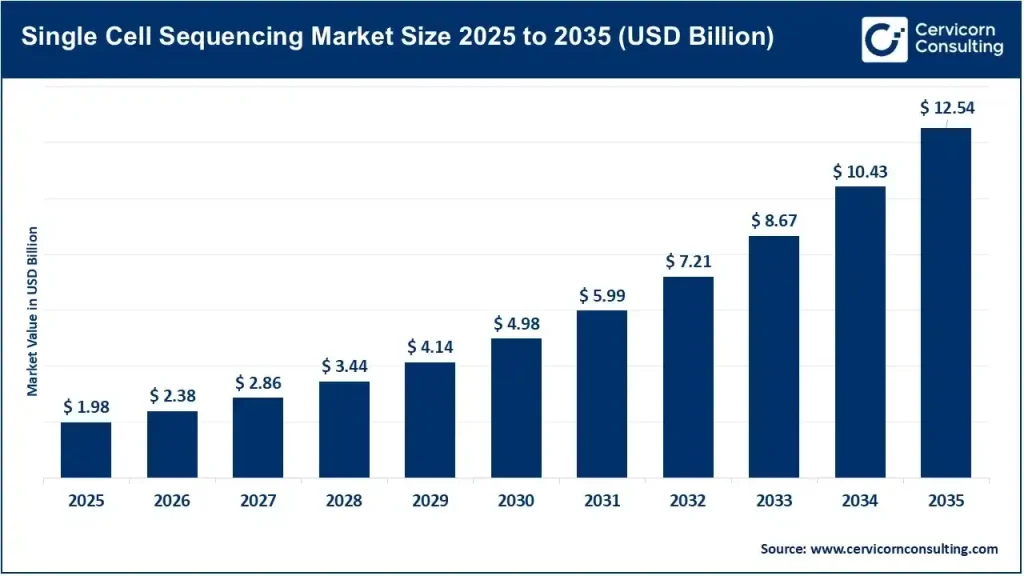
Single Cell Sequencing Market Size
The global single cell sequencing market was valued at approximately USD 1.98 billion in 2025 and is projected to reach USD 12.54 billion by 2035, expanding at a CAGR of 20.3% during the forecast period.
Internet of Single Cell Sequencing Market Growth Factors
The global Internet of Single Cell Sequencing market is experiencing significant growth due to rapid advancements in genomics, increasing adoption of artificial intelligence (AI) and cloud-based bioinformatics platforms, expanding investments in precision medicine, and growing demand for high-resolution cellular analysis. The integration of connected sequencing platforms, Internet of Things (IoT)-enabled laboratory automation, and digital data-sharing ecosystems has transformed how researchers collect, process, and analyze single-cell genomic data. Rising prevalence of cancer, autoimmune disorders, neurological diseases, and rare genetic conditions has accelerated demand for precise molecular diagnostics.
Governments and research organizations across North America, Europe, and Asia-Pacific continue to invest heavily in genomics infrastructure, while pharmaceutical and biotechnology companies increasingly rely on single-cell sequencing to improve drug discovery, biomarker identification, and personalized therapies. Furthermore, advancements in cloud computing, machine learning, high-throughput sequencing technologies, and integrated laboratory information management systems (LIMS) are making single-cell sequencing faster, more scalable, and more accessible, creating substantial opportunities for market expansion over the coming decade.
What is the Internet of Single Cell Sequencing Market?
The Internet of Single Cell Sequencing market refers to the ecosystem of connected sequencing technologies, cloud-enabled platforms, software solutions, laboratory automation systems, and analytical tools that facilitate the generation, transmission, storage, and interpretation of single-cell genomic data. Unlike conventional sequencing methods that analyze genetic material from large populations of cells, single-cell sequencing examines the DNA, RNA, or epigenetic information of individual cells.
The “Internet” component represents the digital connectivity between sequencing instruments, cloud databases, AI-powered analytics platforms, remote collaboration tools, and laboratory management software. Researchers worldwide can seamlessly share sequencing datasets, perform collaborative analyses, and accelerate scientific discoveries through connected genomic infrastructures.
The market includes:
- Single-cell RNA sequencing (scRNA-seq)
- Single-cell DNA sequencing
- Single-cell multi-omics
- Cloud bioinformatics platforms
- AI-powered genomic analytics
- Laboratory automation systems
- Sample preparation technologies
- Reagents and consumables
- Sequencing instruments
- Data visualization software
Healthcare organizations, pharmaceutical companies, biotechnology firms, research institutes, and academic laboratories increasingly depend on connected single-cell sequencing platforms to generate insights into cellular diversity and disease progression.
Get a Free Sample: https://www.cervicornconsulting.com/sample/2997
Why is the Internet of Single Cell Sequencing Market Important?
The market is transforming biomedical research by enabling scientists to analyze biological systems at an unprecedented level of detail. Every tissue contains multiple cell types with distinct genetic and molecular characteristics. Traditional sequencing methods average these signals, potentially masking important biological information.
Internet-enabled single-cell sequencing allows researchers to identify rare cell populations, understand tumor heterogeneity, monitor immune responses, and investigate developmental biology with remarkable precision.
Its importance extends across numerous applications:
- Personalized medicine
- Cancer diagnosis
- Immunology research
- Stem cell biology
- Drug discovery
- Cell therapy development
- Infectious disease research
- Neurological disorder research
- Regenerative medicine
- Precision diagnostics
By integrating cloud computing, AI algorithms, and real-time collaboration, connected sequencing platforms accelerate innovation while reducing analysis time and improving reproducibility.
Market Landscape
The market has evolved from standalone sequencing workflows into fully connected genomic ecosystems. Modern laboratories increasingly utilize integrated platforms that automate sample preparation, sequencing, cloud-based analytics, and collaborative reporting.
Major technological advancements include:
- High-throughput sequencing
- AI-powered cell annotation
- Spatial transcriptomics
- Multi-omics integration
- Cloud-native genomic analysis
- Automated laboratory workflows
- Edge computing for sequencing
- Digital laboratory management
The convergence of genomics and digital connectivity is creating entirely new opportunities for precision healthcare.
Leading Companies in the Internet of Single Cell Sequencing Market
| Company | Specialization | Key Focus Areas | Notable Features | Estimated 2025 Revenue | Estimated Market Share | Global Presence |
|---|---|---|---|---|---|---|
| 10x Genomics, Inc. | Single-cell sequencing platforms | Chromium systems, spatial biology, multiomics | Industry-leading single-cell workflow solutions | Approximately USD 650–700 Million | Strong leadership in single-cell platforms | North America, Europe, Asia-Pacific |
| Illumina, Inc. | DNA sequencing technologies | Next-generation sequencing, genomic analytics | World’s largest sequencing ecosystem | Approximately USD 4.3–4.5 Billion | Leading sequencing technology provider | More than 140 countries |
| Thermo Fisher Scientific Inc. | Laboratory technologies | Sequencing instruments, reagents, software | Comprehensive genomics portfolio | Over USD 44 Billion | Major supplier across genomics research | Global operations in over 50 countries |
| QIAGEN N.V. | Molecular diagnostics | Sample preparation, bioinformatics, sequencing workflows | Strong diagnostic integration | Approximately USD 2 Billion | Significant presence in molecular biology | Worldwide commercial footprint |
| Bio-Rad Laboratories, Inc. | Life science research | Digital PCR, single-cell analysis, reagents | Advanced cellular analysis technologies | Approximately USD 2.8 Billion | Established life science supplier | Global research and clinical markets |
Leading Trends Transforming the Internet of Single Cell Sequencing Market
1. AI-Powered Genomic Analytics
Artificial intelligence has become indispensable for interpreting complex single-cell datasets. Machine learning algorithms automatically identify cell populations, detect biomarkers, and predict disease progression with greater speed and accuracy than conventional computational methods.
Market Impact
- Faster data interpretation
- Reduced manual analysis
- Improved biomarker discovery
- Better clinical decision-making
2. Spatial Transcriptomics
Researchers increasingly combine spatial biology with single-cell sequencing to understand not only cellular genetics but also where cells are located within tissues.
Impact
- Improved cancer research
- Better tissue mapping
- Enhanced neuroscience studies
- Advanced regenerative medicine
3. Multi-Omics Integration
Modern sequencing platforms simultaneously analyze multiple biological layers including genomics, transcriptomics, proteomics, and epigenomics.
Impact
- More comprehensive disease understanding
- Accelerated precision medicine
- Improved therapeutic development
- Enhanced biomarker validation
4. Cloud-Based Bioinformatics
Cloud computing has eliminated infrastructure limitations for genomic analysis.
Organizations increasingly perform:
- Remote sequencing analysis
- Collaborative research
- Secure data storage
- Global data sharing
Impact
Cloud platforms reduce computational costs while enabling international collaboration.
5. Laboratory Automation
Automation technologies now streamline every stage of sequencing.
Examples include:
- Automated sample preparation
- Robotic liquid handling
- Smart laboratory management
- AI-driven quality control
Automation reduces human error while increasing laboratory throughput.
6. Single-Cell Multiomics
Researchers now analyze DNA, RNA, proteins, chromatin accessibility, and epigenetic markers simultaneously from the same individual cell.
Impact
- More accurate disease models
- Better immune profiling
- Improved therapeutic target identification
Successful Examples Around the World
Human Cell Atlas
The Human Cell Atlas project is among the world’s largest initiatives utilizing single-cell sequencing to map every human cell type.
Achievements include:
- Comprehensive human cell cataloging
- Improved understanding of disease biology
- Global research collaboration
- Open-access genomic databases
Cancer Research Programs in the United States
Leading cancer research centers increasingly rely on single-cell sequencing to understand tumor evolution and treatment resistance.
Applications include:
- Immunotherapy optimization
- Precision oncology
- Biomarker discovery
- Personalized treatment selection
UK’s Genomics Research Initiatives
The United Kingdom has integrated advanced sequencing technologies into national genomics research through collaborations among universities, hospitals, and research organizations.
Key achievements include:
- Rare disease diagnosis
- Cancer genomics
- Population health research
- Precision medicine
China’s Precision Medicine Programs
China has invested substantially in genomic sequencing infrastructure.
Major developments include:
- National genomics databases
- AI-enabled sequencing analysis
- Smart laboratories
- Large-scale precision medicine initiatives
Japan’s Regenerative Medicine Research
Japanese institutions utilize single-cell sequencing for stem cell biology and regenerative medicine.
Applications include:
- Tissue engineering
- Cellular differentiation
- Neurological research
- Drug development
Global Regional Analysis
North America
North America dominates the Internet of Single Cell Sequencing market owing to its mature biotechnology ecosystem, world-class academic institutions, substantial R&D investments, and widespread adoption of advanced genomic technologies. The region is home to many leading sequencing technology providers and benefits from strong collaboration among universities, hospitals, pharmaceutical companies, and government agencies.
Government Initiatives
Key government support includes:
- Large-scale genomics funding
- Precision medicine initiatives
- National cancer research programs
- Biomedical innovation grants
- Expansion of genomic data infrastructure
Public investment in genomics research continues to accelerate adoption across clinical and research settings.
Europe
Europe represents a major market supported by collaborative research frameworks, advanced healthcare systems, and strong regulatory oversight.
Countries including Germany, the United Kingdom, France, Switzerland, and the Netherlands continue expanding genomic medicine initiatives.
Government Policies
European governments support the market through:
- National genomics strategies
- Cross-border research collaborations
- Personalized medicine programs
- Public healthcare genomic integration
- Research funding for life sciences
Regulatory harmonization and public-private partnerships are helping accelerate commercialization while ensuring data privacy and ethical governance.
Asia-Pacific
Asia-Pacific is projected to experience the fastest market growth.
Major contributors include:
- China
- Japan
- India
- South Korea
- Singapore
- Australia
Rapid biotechnology expansion, increasing healthcare investments, growing pharmaceutical manufacturing, and improving sequencing infrastructure are driving demand.
Government Initiatives
Governments are investing in:
- National genome projects
- Biotechnology innovation programs
- AI-enabled healthcare
- Precision medicine initiatives
- Genomic research centers
- Digital healthcare transformation
Increasing academic collaborations and venture capital investments further support market expansion.
Latin America
Latin America is gradually expanding its genomics capabilities.
Brazil, Mexico, Argentina, and Chile are investing in:
- Academic genomics research
- Cancer diagnostics
- Molecular biology laboratories
- Public health genomics
Government Support
Key initiatives include:
- Scientific research funding
- Healthcare modernization
- University research partnerships
- Biotechnology innovation incentives
Growing awareness of personalized medicine is expected to create long-term opportunities.
Middle East & Africa
The Middle East and Africa represent an emerging market with increasing investments in healthcare modernization and biotechnology.
Countries such as the United Arab Emirates, Saudi Arabia, Qatar, and South Africa are establishing advanced genomics centers and precision medicine programs.
Government Policies
Regional governments are promoting market development through:
- National biotechnology strategies
- Healthcare digitalization initiatives
- Precision medicine investments
- International research collaborations
- Innovation-focused healthcare policies
As genomic medicine becomes more integrated into healthcare systems, adoption of connected sequencing technologies is expected to increase steadily.
Future Opportunities
Several high-growth opportunities are expected to shape the Internet of Single Cell Sequencing market over the coming years:
- Expansion of AI-driven genomic interpretation
- Growth of cloud-native sequencing platforms
- Integration of spatial biology with single-cell analysis
- Wider adoption of digital laboratory automation
- Increased use in precision oncology and immunotherapy
- Rising demand for multi-omics research
- Development of portable sequencing technologies
- Broader use in pharmaceutical R&D and clinical trials
- Expansion of national genome initiatives
- Greater collaboration between academia, healthcare providers, and biotechnology companies
These developments are expected to strengthen the role of connected single-cell sequencing technologies in advancing precision medicine, accelerating drug discovery, and enabling next-generation biomedical research worldwide.
To Get Detailed Overview, Contact Us: https://www.cervicornconsulting.com/contact-us
Read Report: Anti-Drone Market Revenue, Trends, and Strategic Insights by 2035