


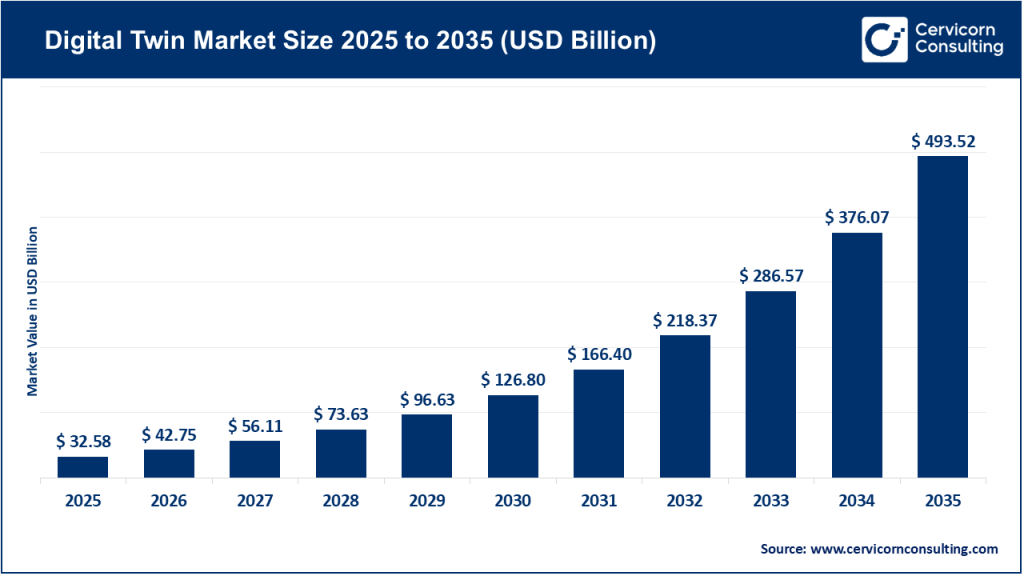
Digital Twin Market Size
The global digital twin market size was worth USD 32.58 billion in 2025 and is anticipated to expand to around USD 493.52 billion by 2035, registering a compound annual growth rate (CAGR) of 31.2% from 2026 to 2035.
What Is the Digital Twin Market?
The digital twin market encompasses the global ecosystem of technologies, platforms, and services that enable the creation of virtual replicas of physical assets, systems, processes, or environments. These digital representations are continuously updated using real-time data collected from sensors, Internet of Things (IoT) devices, and enterprise systems. By mirroring real-world conditions, digital twins allow organizations to simulate performance, predict failures, optimize operations, and evaluate “what-if” scenarios without disrupting physical assets. The market spans multiple industries including manufacturing, energy, healthcare, automotive, aerospace, construction, smart cities, and utilities, making digital twins a foundational technology for digital transformation initiatives worldwide.
Digital Twin Market Growth Factors
The growth of the digital twin market is driven by rapid industrial digitalization, the widespread adoption of IoT-enabled sensors generating real-time operational data, rising demand for predictive maintenance and asset optimization, increasing integration of artificial intelligence and machine learning for advanced analytics, expansion of cloud and edge computing infrastructures, rollout of high-speed 5G networks enabling low-latency data processing, strong investments in Industry 4.0 and smart manufacturing initiatives.
Growing focus on sustainability and energy efficiency, regulatory pressure to improve operational transparency, and the emergence of scalable Digital Twin-as-a-Service models that reduce deployment costs; collectively, these factors are accelerating adoption across industries such as manufacturing, healthcare, transportation, energy, and urban infrastructure, positioning digital twins as a critical enabler of operational resilience, cost efficiency, and innovation.
Why Is the Digital Twin Market Important?
Digital twin technology is important because it fundamentally changes how organizations design, operate, and manage physical assets and systems. Unlike traditional models that rely on static data or periodic inspections, digital twins provide continuous visibility into real-time conditions, allowing organizations to detect anomalies early, predict failures, and optimize performance proactively. This capability significantly reduces downtime, maintenance costs, and operational risks.
Digital twins also support faster innovation by enabling virtual testing and simulation before physical implementation, shortening development cycles and improving product quality. In sectors such as healthcare and smart cities, digital twins enhance planning accuracy, safety, and resource efficiency. Additionally, as sustainability becomes a global priority, digital twins help organizations monitor emissions, energy consumption, and environmental impact, making them essential tools for achieving regulatory compliance and long-term sustainability goals.
Get a Free Sample: https://www.cervicornconsulting.com/sample/2865
Key Companies Shaping the Digital Twin Market
Siemens
Specialization:
Industrial digital twins and automation-focused digital enterprise solutions.
Key Focus Areas:
Manufacturing optimization, industrial automation, product lifecycle management, factory simulation, and predictive maintenance.
Notable Features:
Siemens provides comprehensive industrial digital twin platforms that integrate simulation, real-time monitoring, and analytics across the entire product and production lifecycle. Its solutions enable virtual commissioning of factories, real-time performance optimization, and advanced process simulations.
2024 Revenue and Market Share:
Siemens generates multi-billion-dollar revenue from its digital industries segment and is estimated to hold one of the largest global shares in industrial digital twin solutions.
Global Presence:
Operations span Europe, North America, Asia-Pacific, and emerging markets, with strong adoption in manufacturing, energy, transportation, and infrastructure sectors.
General Electric (GE)
Specialization:
Asset-centric digital twins for energy, aviation, and industrial equipment.
Key Focus Areas:
Power generation, renewable energy systems, aviation engines, industrial asset health monitoring, and grid optimization.
Notable Features:
GE’s digital twin solutions focus on high-value, mission-critical assets, enabling real-time performance monitoring, predictive maintenance, and operational forecasting. These twins are widely used to improve reliability and efficiency in energy and aviation systems.
2024 Revenue and Market Share:
GE’s digital twin offerings contribute significantly to its industrial and energy revenues, with strong adoption across utilities and aerospace customers.
Global Presence:
GE serves customers across North America, Europe, Asia, and the Middle East, particularly in energy infrastructure and aviation industries.
Microsoft
Specialization:
Cloud-based digital twin platforms and enterprise-scale data integration.
Key Focus Areas:
Smart buildings, smart cities, enterprise asset management, healthcare environments, and infrastructure modeling.
Notable Features:
Microsoft’s digital twin capabilities are built on scalable cloud infrastructure, enabling seamless integration with IoT, artificial intelligence, analytics, and mixed-reality tools. These solutions support complex, interconnected digital environments.
2024 Revenue and Market Share:
Microsoft’s overall 2024 revenue exceeded USD 240 billion, with cloud services contributing a major share. Digital twin platforms form an important component of its enterprise and government cloud ecosystem.
Global Presence:
Microsoft operates globally with extensive adoption across enterprises, governments, and public infrastructure projects.
IBM
Specialization:
Enterprise-grade digital twins integrated with hybrid cloud and AI solutions.
Key Focus Areas:
Manufacturing operations, supply chain optimization, asset management, infrastructure monitoring, and cybersecurity-enabled digital twins.
Notable Features:
IBM combines AI-driven analytics with secure hybrid cloud architectures, enabling digital twins for complex enterprise environments. Its solutions are particularly suited for regulated industries requiring high levels of data security and reliability.
2024 Revenue and Market Share:
IBM’s digital twin capabilities are embedded within its broader AI and hybrid cloud portfolio, contributing to steady enterprise adoption worldwide.
Global Presence:
IBM maintains a strong global footprint across North America, Europe, Asia-Pacific, and emerging markets, serving large enterprises and public sector organizations.
Oracle
Specialization:
Enterprise digital twins integrated with cloud-based business applications.
Key Focus Areas:
Supply chain management, manufacturing operations, enterprise resource planning, and process optimization.
Notable Features:
Oracle focuses on connecting digital twins directly with enterprise data systems, enabling end-to-end visibility across business operations. Its solutions emphasize real-time analytics, process simulation, and decision support.
2024 Revenue and Market Share:
Oracle reported overall revenues exceeding USD 50 billion in 2024, with cloud applications and enterprise solutions driving growth, including digital twin-enabled capabilities.
Global Presence:
Oracle operates in more than 170 countries, with strong penetration in enterprise IT, manufacturing, logistics, and public sector organizations.
Leading Trends in the Digital Twin Market and Their Impact
Digital Twins-as-a-Service (DTaaS)
Cloud-based delivery models are lowering adoption barriers by allowing organizations to access digital twin capabilities through subscription services. This approach reduces upfront costs, accelerates deployment, and enables scalability across organizations of all sizes.
AI and Machine Learning Integration
Artificial intelligence enhances digital twins by enabling predictive analytics, automated anomaly detection, and continuous learning models. This significantly improves decision-making accuracy and operational efficiency across dynamic environments.
Smart Cities and Infrastructure Digital Twins
Governments and municipalities are increasingly adopting digital twins to model urban infrastructure, transportation systems, utilities, and environmental conditions. These models support long-term planning, disaster preparedness, and sustainable urban development.
Sustainability and Energy Optimization
Digital twins are being used to monitor energy usage, reduce emissions, and optimize resource consumption, helping organizations meet environmental targets and regulatory requirements.
Immersive Visualization and Metaverse Integration
Advanced 3D visualization, augmented reality, and virtual reality are enhancing how users interact with digital twins, enabling collaborative simulations, training, and design reviews in immersive environments.
Edge Computing and 5G Connectivity
Low-latency connectivity and edge computing allow real-time processing of digital twin data, which is essential for industrial automation, autonomous systems, and mission-critical applications.
Successful Digital Twin Examples Around the World
One of the most recognized national-scale digital twin implementations is Singapore’s comprehensive virtual city model, which supports urban planning, infrastructure management, and emergency response simulations.
In India, cities such as Varanasi have adopted 3D urban digital twins to support smart city planning, infrastructure resilience, and service optimization. Additionally, India’s first river basin digital twin initiative is being developed to improve flood prediction, drought management, and water resource planning.
In Europe, digital replicas of historical and cultural landmarks are being created to preserve architectural heritage while enabling virtual access and long-term conservation planning.
In the United States, major ports and transportation hubs use digital twins to track vessel movement, optimize logistics, and conduct emergency response simulations, improving operational efficiency and safety.
Global Regional Analysis and Government Initiatives
North America
North America leads the digital twin market due to strong industrial automation adoption, advanced IoT infrastructure, high R&D investment, and early adoption of AI and cloud technologies. Government support for smart infrastructure, manufacturing modernization, and energy optimization continues to drive growth.
Europe
Europe’s digital twin market is shaped by sustainability-driven policies, digital transformation programs, and smart infrastructure investments. Governments support digital twins through initiatives focused on climate modeling, energy efficiency, and urban resilience.
Asia-Pacific
Asia-Pacific is one of the fastest-growing regions, driven by rapid industrialization, smart manufacturing initiatives, and government-led smart city programs. Countries such as China, Japan, South Korea, and India are heavily investing in digital infrastructure and Industry 4.0 adoption.
Latin America, Middle East, and Africa
These regions are emerging adopters of digital twin technologies, particularly in smart cities, energy infrastructure, and large-scale construction projects. Government-backed economic diversification programs and urban modernization initiatives are accelerating adoption.
To Get Detailed Overview, Contact Us: https://www.cervicornconsulting.com/contact-us
Read Report: Platform Engineering Market Growth Drivers, Trends, Key Players and Regional Insights by 2035