


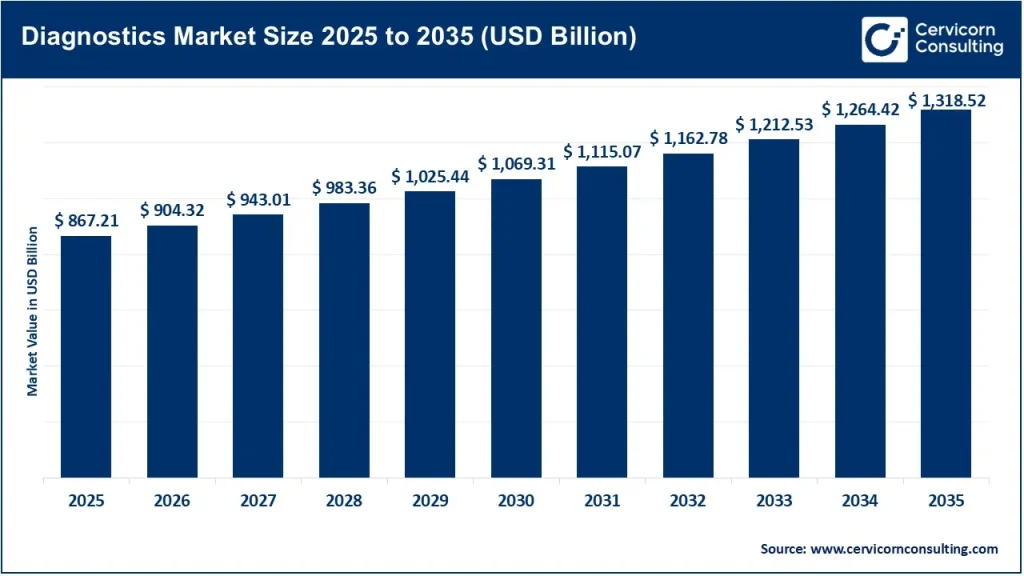
Diagnostics Market Size
The global diagnostics market size was valued at approximately USD 867.21 billion in 2025 and is projected to reach nearly USD 1,318.52 billion by 2035, growing at a CAGR of 4.3%.
What is the Diagnostics Market?
The diagnostics market refers to the global industry involved in the development, manufacturing, and commercialization of products and services used to detect, monitor, and manage diseases and medical conditions. It includes in-vitro diagnostics (IVD), molecular diagnostics, clinical laboratory testing, diagnostic imaging, point-of-care testing, pathology solutions, genetic testing, companion diagnostics, digital pathology, and AI-enabled diagnostic platforms. The market serves hospitals, diagnostic laboratories, research institutions, clinics, pharmaceutical companies, and home healthcare providers. As healthcare shifts toward preventive medicine and precision healthcare, diagnostics has become one of the most important pillars of modern healthcare systems, enabling physicians to identify diseases earlier, personalize treatments, and improve patient outcomes.
Get a Free Sample: https://www.cervicornconsulting.com/sample/2978
Diagnostics Market Growth Factors
The diagnostics market is experiencing sustained expansion due to the increasing prevalence of chronic diseases such as cancer, cardiovascular disorders, diabetes, and infectious diseases, coupled with the rapid growth of the aging population worldwide. Rising healthcare expenditure, expanding access to healthcare in emerging economies, and growing awareness regarding preventive healthcare are significantly increasing demand for early disease detection. Technological advancements including artificial intelligence (AI), molecular diagnostics, next-generation sequencing (NGS), digital pathology, liquid biopsy, and point-of-care testing are transforming diagnostic accuracy and speed. Governments across developed and developing countries continue investing in healthcare infrastructure, laboratory modernization, and disease surveillance programs, further supporting market growth.
Additionally, the increasing adoption of personalized medicine, companion diagnostics, home-based diagnostic kits, automation in laboratories, cloud-based healthcare platforms, and digital health ecosystems is creating new revenue opportunities for manufacturers. Strategic collaborations between pharmaceutical companies and diagnostic firms are accelerating biomarker discovery and precision medicine development, while increasing demand for rapid infectious disease testing and genetic screening continues to drive long-term industry expansion.
Why is the Diagnostics Market Important?
The diagnostics industry plays a foundational role in healthcare because nearly every medical decision depends on accurate diagnostic information. Early diagnosis enables timely intervention, improves survival rates, lowers treatment costs, and enhances quality of life.
Key reasons why diagnostics are important include:
- Enables early detection of chronic diseases
- Supports personalized and precision medicine
- Improves treatment selection and monitoring
- Reduces healthcare costs through preventive care
- Strengthens public health surveillance
- Supports pandemic preparedness
- Accelerates drug development through companion diagnostics
- Enhances patient outcomes and hospital efficiency
- Improves laboratory productivity using automation
- Expands access to healthcare through point-of-care testing
Healthcare experts estimate that diagnostic testing influences a significant majority of clinical decisions while accounting for only a relatively small portion of total healthcare spending, making it one of the highest-value segments within healthcare.
Major Companies Shaping the Diagnostics Market
| Company | Specialization | Key Focus Areas | Notable Features | 2025 Revenue* | Approx. Market Share | Global Presence |
|---|---|---|---|---|---|---|
| Roche | In-vitro diagnostics, molecular diagnostics | Oncology diagnostics, infectious disease testing, digital pathology | Global leader in diagnostics innovation and integrated healthcare solutions | Diagnostics sales: CHF 13.8 billion | ~7–8% | 100+ countries |
| Abbott Laboratories | Clinical diagnostics, rapid diagnostics, diabetes diagnostics | Point-of-care testing, immunoassays, blood screening | Strong portfolio across laboratory and rapid diagnostic solutions | Company revenue exceeds USD 40 billion; diagnostics is a major business segment | ~5–6% | 160+ countries |
| Siemens Healthineers | Imaging and laboratory diagnostics | MRI, CT, laboratory automation, AI diagnostics | Integrated imaging and diagnostics ecosystem | Company revenue: €23.4 billion (FY2025); Diagnostics segment: €4.35 billion | ~6–7% | 180+ countries |
| Danaher Corporation | Molecular diagnostics, life sciences | Clinical diagnostics, laboratory automation | Owns leading diagnostic brands such as Beckman Coulter and Cepheid | USD 24.6 billion company revenue (2025) | ~4–5% | 60+ countries |
| Thermo Fisher Scientific | Molecular diagnostics, laboratory instruments | Genetic testing, sequencing, specialty diagnostics | Comprehensive life sciences and diagnostics portfolio | Company revenue exceeded USD 43 billion in 2025 | ~3–4% | 180+ countries |
Leading Trends Transforming the Diagnostics Market
1. Artificial Intelligence in Diagnostics
AI algorithms are revolutionizing medical imaging, pathology, and laboratory analysis by improving diagnostic accuracy while reducing interpretation time. Machine learning assists radiologists in detecting cancers, neurological disorders, and cardiovascular diseases with higher precision.
Impact
- Faster diagnosis
- Reduced diagnostic errors
- Increased laboratory productivity
- Improved clinical decision-making
2. Point-of-Care Testing (POCT)
Healthcare providers increasingly prefer portable diagnostic devices that provide immediate results without requiring centralized laboratories.
Applications include:
- Diabetes monitoring
- Pregnancy testing
- Cardiac biomarkers
- COVID-19 testing
- Influenza diagnosis
Impact
- Faster treatment decisions
- Reduced hospital admissions
- Better healthcare access in rural regions
3. Molecular Diagnostics Expansion
Molecular diagnostics continues to become one of the fastest-growing segments due to increasing demand for PCR, DNA sequencing, and genomic testing.
Major applications include:
- Cancer diagnosis
- Rare disease detection
- Infectious diseases
- Genetic screening
- Personalized medicine
4. Personalized Medicine
Healthcare providers increasingly rely on biomarkers and companion diagnostics before prescribing targeted therapies.
Benefits include:
- Better treatment success
- Reduced adverse drug reactions
- Optimized healthcare spending
5. Laboratory Automation
Modern laboratories are adopting robotics, automated analyzers, and digital workflows to improve testing capacity.
Benefits include:
- Lower operational costs
- Higher testing throughput
- Reduced human error
- Faster turnaround times
6. Digital Pathology
Whole-slide imaging and cloud-based pathology platforms allow specialists to analyze tissue samples remotely.
Key advantages include:
- Remote consultation
- AI-assisted pathology
- Faster cancer diagnosis
- Improved workflow efficiency
7. Liquid Biopsy
Liquid biopsy is transforming cancer diagnostics by enabling non-invasive detection of tumor biomarkers from blood samples.
Advantages include:
- Earlier cancer detection
- Continuous treatment monitoring
- Reduced patient discomfort
8. Home-Based Diagnostics
Consumers increasingly prefer diagnostic kits that can be used at home.
Growing categories include:
- Blood glucose monitoring
- Fertility testing
- Infectious disease testing
- Genetic testing
- Cholesterol monitoring
Impact of Emerging Trends
These innovations are collectively transforming healthcare delivery by enabling earlier disease detection, improving diagnostic accuracy, reducing costs, shortening treatment timelines, and supporting personalized therapies. They also help expand healthcare access through remote testing and digital platforms, while automation and AI improve laboratory efficiency and reduce workforce pressures.
Successful Examples of the Diagnostics Market Around the World
Roche’s Integrated Oncology Diagnostics
Roche has developed one of the world’s most comprehensive oncology diagnostic ecosystems by combining molecular diagnostics, pathology solutions, and companion diagnostics. This integration supports precision medicine by helping physicians select targeted therapies based on individual patient biomarkers.
Abbott’s ID NOW Platform
Abbott’s rapid molecular testing platform demonstrated the value of point-of-care diagnostics by delivering fast results for infectious diseases, supporting emergency care and decentralized testing in clinics and pharmacies.
Siemens Healthineers’ AI Imaging Solutions
Siemens Healthineers has integrated AI into MRI, CT, and laboratory diagnostics, improving workflow efficiency, image interpretation, and clinical productivity while reducing diagnostic turnaround times.
Danaher’s Cepheid GeneXpert
Cepheid’s GeneXpert platform has become a global standard for rapid molecular testing, particularly for tuberculosis, COVID-19, influenza, and antimicrobial resistance, offering highly accurate results within hours.
Thermo Fisher’s Next-Generation Sequencing Solutions
Thermo Fisher Scientific has expanded access to genomic testing through advanced sequencing platforms used in oncology, inherited disease testing, infectious disease research, and precision medicine.
Global Regional Analysis
North America
North America remains the world’s largest diagnostics market owing to advanced healthcare infrastructure, significant healthcare expenditure, widespread adoption of precision medicine, and strong research capabilities.
Market Drivers
- High healthcare spending
- Large diagnostic laboratory networks
- Strong biotechnology ecosystem
- Advanced reimbursement systems
- Early technology adoption
Government Initiatives
- Increased investment in precision medicine
- Expanded cancer screening programs
- Support for infectious disease surveillance
- Funding for genomic research
- Digital health modernization initiatives
Europe
Europe continues to be a mature diagnostics market driven by universal healthcare systems, strong regulatory standards, and increasing adoption of personalized medicine.
Market Drivers
- Aging population
- Rising cancer prevalence
- Strong research collaborations
- Expansion of molecular diagnostics
Government Policies
- National cancer screening programs
- Cross-border healthcare initiatives
- Digital health implementation
- Investment in laboratory modernization
- Support for genomic medicine research
Asia-Pacific
Asia-Pacific is expected to experience the fastest growth due to expanding healthcare infrastructure, increasing disposable income, urbanization, and growing awareness of preventive healthcare.
Growth Drivers
- Large patient population
- Rising chronic disease burden
- Expansion of private healthcare
- Medical tourism
- Increased laboratory investments
Government Initiatives
- China: Expansion of precision medicine, healthcare digitization, and public hospital modernization.
- India: Production Linked Incentive (PLI) schemes for medical devices, expanded diagnostic infrastructure, and initiatives such as Ayushman Bharat to improve access to healthcare.
- Japan: Investment in AI healthcare, aging population care, and genomic medicine.
- South Korea: National support for biotechnology, digital health, and precision diagnostics.
Latin America
Latin America is witnessing increasing investment in laboratory services and infectious disease surveillance.
Key Drivers
- Expanding healthcare access
- Rising diabetes prevalence
- Growth in private diagnostic chains
- Government vaccination and screening programs
Government Support
- Public health laboratory expansion
- Disease surveillance initiatives
- National cancer control strategies
- Increased healthcare funding
Middle East & Africa
Healthcare modernization is driving diagnostics demand across the region.
Growth Drivers
- Hospital construction
- Medical tourism
- Rising chronic diseases
- Laboratory automation
Government Initiatives
- National healthcare transformation programs
- Digital health investments
- Expanded infectious disease monitoring
- Increased funding for diagnostic laboratories
Government Initiatives and Policies Shaping the Diagnostics Market
Governments worldwide are playing an increasingly active role in expanding diagnostic capabilities through investments, regulations, and public health programs. Key policy directions include:
- National screening programs: Countries are expanding screening for breast, cervical, colorectal, and lung cancers to enable earlier detection and reduce mortality.
- Precision medicine strategies: Public funding for genomic sequencing, biomarker research, and companion diagnostics is accelerating personalized healthcare.
- Laboratory modernization: Investments in automated laboratory infrastructure, digital pathology, and AI-enabled diagnostics are improving testing capacity and efficiency.
- Pandemic preparedness: Lessons from COVID-19 have led to stronger disease surveillance systems, stockpiling of diagnostic supplies, and support for rapid molecular testing platforms.
- Medical device manufacturing incentives: Programs such as India’s Production Linked Incentive (PLI) scheme encourage domestic production of diagnostic equipment and reduce reliance on imports.
- Digital health policies: Governments are promoting interoperable electronic health records, telemedicine, and cloud-based diagnostic platforms to improve care coordination.
- Regulatory harmonization: Updated regulations in major markets aim to strengthen quality standards while supporting innovation and faster access to advanced diagnostic technologies.
- Public–private partnerships: Collaborations between governments, healthcare providers, and industry are expanding access to diagnostics in underserved regions through mobile labs, community testing, and subsidized screening initiatives.
These initiatives are creating a favorable environment for innovation, improving healthcare accessibility, and supporting the long-term growth of the global diagnostics market.
To Get Detailed Overview, Contact Us: https://www.cervicornconsulting.com/contact-us
Read Report: AI in Clinical Trials Market Revenue, Trends, and Strategic Insights by 2035