


Table of Contents
ToggleAI in Clinical Trials Market Size
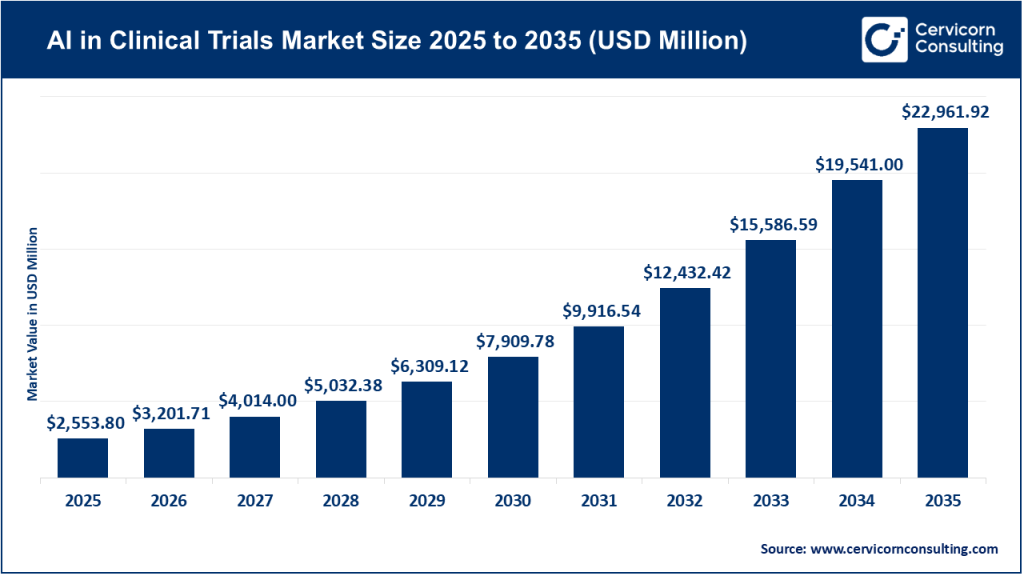
The global AI in clinical trials market was valued at approximately USD 2,553.80 million in 2025 and is projected to reach nearly USD 22,961.92 million by 2035, growing at a CAGR of 24.56%.
AI in Clinical Trials Market Growth Factors
The AI in clinical trials market is experiencing rapid growth due to the increasing complexity of drug development, rising research and development costs, growing demand for faster patient recruitment, expanding adoption of precision medicine, widespread implementation of electronic health records (EHRs), advances in machine learning and generative AI, increasing availability of real-world evidence (RWE), stronger regulatory support for digital innovation, cloud computing adoption, and growing collaborations between pharmaceutical companies and AI technology providers. AI significantly reduces the time required for protocol design, patient matching, site selection, data monitoring, adverse event detection, and predictive analytics, enabling pharmaceutical companies to shorten development timelines while improving trial success rates.
Additionally, growing investments from governments, venture capital firms, and biopharmaceutical companies continue to accelerate innovation across AI-powered clinical trial platforms, making artificial intelligence an increasingly essential component of modern clinical research.
What is the AI in Clinical Trials Market?
The AI in clinical trials market refers to the ecosystem of software platforms, analytics solutions, machine learning algorithms, deep learning models, natural language processing (NLP), computer vision technologies, and cloud-based services that utilize artificial intelligence throughout the clinical trial lifecycle.
These AI-powered solutions assist pharmaceutical companies, biotechnology firms, contract research organizations (CROs), healthcare providers, and regulatory agencies in improving every stage of clinical research, including:
- Clinical protocol design
- Patient recruitment
- Eligibility screening
- Trial site selection
- Risk-based monitoring
- Predictive analytics
- Medical imaging analysis
- Drug safety monitoring
- Data management
- Clinical documentation
- Regulatory submissions
Rather than replacing clinical researchers, AI augments human expertise by automating repetitive tasks, identifying hidden patterns within massive datasets, and providing real-time insights that improve decision-making.
Get a Free Sample: https://www.cervicornconsulting.com/sample/2635
Why is AI in Clinical Trials Important?
Clinical trials remain one of the most expensive and time-consuming phases of pharmaceutical development. Bringing a new drug from discovery to commercialization often requires more than a decade and billions of dollars in investment.
Artificial intelligence addresses many longstanding challenges by:
- Improving patient recruitment efficiency
- Reducing protocol amendments
- Predicting patient dropout
- Identifying optimal clinical sites
- Detecting safety risks earlier
- Improving data quality
- Accelerating statistical analysis
- Supporting decentralized clinical trials
- Enhancing regulatory compliance
- Lowering overall development costs
AI also enables personalized medicine by identifying patients most likely to benefit from targeted therapies, ultimately increasing trial success rates while improving patient outcomes.
Major Companies Operating in the AI in Clinical Trials Market
| Company | Specialization | Key Focus Areas | Notable Features | 2025 Revenue* | Estimated Market Position | Global Presence |
|---|---|---|---|---|---|---|
| International Business Machines Corporation (IBM) | Enterprise AI & Healthcare Analytics | Watsonx AI, Clinical Data Analytics, NLP | Advanced AI platforms for healthcare research | Approximately US$67.5 Billion | Strong enterprise AI provider | 170+ countries |
| Exscientia Ltd. | AI-driven Drug Discovery | Precision medicine, molecule design, clinical candidate optimization | End-to-end AI drug discovery platform | Public biotech; revenue primarily from partnerships (tens of millions of USD) | Emerging AI biotech innovator | North America, Europe, Asia |
| Medidata Solutions, Inc. | Clinical Trial Software | Electronic Data Capture (EDC), AI analytics, decentralized trials | AI-enabled clinical development platform | Operates as a subsidiary of Dassault Systèmes (separate revenue not publicly reported) | Leading clinical trial technology provider | 140+ countries |
| Insilico Medicine, Inc. | Generative AI Drug Discovery | AI-designed therapeutics, target discovery, predictive biology | AI-generated drug candidates entering clinical trials | Approximately US$56.2 Million | Leading AI-first biotech | Global partnerships across Asia, Europe, and North America |
| NVIDIA Corporation | AI Computing Infrastructure | GPUs, healthcare AI, accelerated computing | High-performance AI hardware powering pharmaceutical research | More than US$130 Billion (FY2025/26 reporting period) | Dominant AI infrastructure provider | Worldwide |
Leading Trends Shaping the AI in Clinical Trials Market
1. Generative AI for Clinical Research
Generative AI is transforming protocol writing, medical documentation, patient communication, and regulatory submissions.
Benefits include:
- Faster protocol development
- Reduced documentation errors
- Improved consistency
- Accelerated regulatory preparation
2. AI-Powered Patient Recruitment
Patient recruitment has traditionally been one of the largest causes of clinical trial delays.
AI analyzes:
- Electronic health records
- Medical imaging
- Laboratory data
- Genomic information
- Physician notes
This enables rapid identification of eligible participants while improving diversity and enrollment rates.
3. Decentralized Clinical Trials (DCTs)
Virtual clinical trials continue expanding worldwide.
AI supports:
- Remote monitoring
- Wearable device analytics
- Telemedicine integration
- Digital biomarkers
- Home-based patient participation
This reduces travel burdens while improving patient retention.
4. Predictive Analytics
Machine learning models can predict:
- Trial success probability
- Enrollment timelines
- Site performance
- Patient dropout risks
- Safety events
These insights help sponsors make proactive operational decisions.
5. Real-World Evidence Integration
AI increasingly combines clinical trial data with:
- Insurance claims
- Hospital databases
- Wearable sensors
- National registries
- Genomic databases
This improves patient stratification and supports regulatory decision-making.
6. AI-Assisted Medical Imaging
Computer vision algorithms analyze:
- MRI scans
- CT images
- X-rays
- Histopathology slides
Automated image interpretation enhances diagnostic consistency while reducing reviewer variability.
Impact of These Trends
These innovations collectively deliver measurable improvements:
- Faster drug approvals
- Lower clinical development costs
- Better patient engagement
- Higher-quality datasets
- Reduced protocol deviations
- Improved trial diversity
- Enhanced regulatory compliance
- Greater scalability for global multicenter studies
As AI models continue to mature, clinical trial operations are expected to become increasingly predictive rather than reactive.
Successful Examples of AI in Clinical Trials Around the World
Insilico Medicine
Insilico Medicine has become one of the world’s most recognized AI-driven biotechnology companies by using generative AI to identify novel drug targets and design molecules that have advanced into clinical development. Its partnerships with major pharmaceutical companies demonstrate the growing commercial confidence in AI-enabled drug discovery.
Medidata Solutions
Medidata integrates artificial intelligence across clinical trial management, including patient monitoring, electronic data capture, decentralized trial management, and predictive analytics. Its cloud platform is used extensively by global pharmaceutical companies conducting multinational clinical studies.
IBM
IBM leverages enterprise AI and healthcare analytics to assist life sciences organizations with clinical data analysis, natural language processing, and research automation. Its AI technologies help researchers analyze large volumes of medical information more efficiently.
NVIDIA
NVIDIA provides the high-performance GPU infrastructure that powers many AI models used for medical imaging, drug discovery, genomics, and clinical trial analytics. Pharmaceutical companies and research institutions rely on accelerated computing to train increasingly sophisticated AI models.
Exscientia
Exscientia applies AI across precision medicine and drug discovery to optimize candidate selection and improve the probability of clinical success through data-driven molecular design.
Global Regional Analysis
North America
North America remains the largest AI in clinical trials market.
Growth Drivers
- Advanced healthcare infrastructure
- Large pharmaceutical industry
- Strong venture capital ecosystem
- Mature AI technology adoption
- Extensive electronic health records
The United States leads global adoption owing to the concentration of biotechnology companies, CROs, academic medical centers, and AI developers.
Government Initiatives
Government agencies continue supporting AI innovation through:
- Increased biomedical research funding
- Expansion of precision medicine programs
- Regulatory guidance for AI-enabled medical technologies
- Digital health initiatives
- Public-private research collaborations
These efforts encourage responsible AI adoption while maintaining patient safety and data integrity.
Europe
Europe represents one of the fastest-growing markets.
Growth Drivers
- Strong pharmaceutical sector
- Cross-border research collaborations
- Digital healthcare investments
- Expanding genomics research
Countries including the United Kingdom, Germany, France, Switzerland, and the Netherlands are investing heavily in AI-powered healthcare innovation.
Government Policies
European governments support AI adoption through:
- AI regulatory frameworks
- Data governance standards
- Digital health strategies
- Horizon Europe research funding
- Ethical AI guidelines
The emphasis on trustworthy AI is encouraging sustainable innovation throughout clinical research.
Asia-Pacific
Asia-Pacific is expected to register the highest growth rate.
Growth Drivers
- Expanding pharmaceutical manufacturing
- Growing biotechnology sector
- Increasing patient populations
- Lower clinical trial costs
- Rising AI investments
China, Japan, South Korea, Singapore, and India are rapidly becoming important destinations for AI-enabled clinical research.
Government Initiatives
Several governments are encouraging AI through:
- National AI strategies
- Smart healthcare initiatives
- Digital hospital programs
- Biomedical innovation funds
- Public research grants
- Clinical research modernization
China has emerged as a major AI innovation hub, while Singapore continues investing in precision medicine and digital healthcare infrastructure.
Latin America
Latin America is gradually adopting AI-driven clinical research technologies.
Growth Drivers
- Increasing multinational clinical trials
- Growing healthcare digitization
- Expansion of CRO operations
- Rising pharmaceutical investments
Brazil and Mexico remain key regional markets.
Government Support
Governments are improving:
- Research regulations
- Digital health infrastructure
- Health data interoperability
- Clinical trial transparency
These improvements are attracting international clinical research investments.
Middle East & Africa
Although still emerging, the Middle East and Africa offer significant long-term growth opportunities.
Growth Drivers
- Healthcare modernization
- Smart hospital initiatives
- AI investment strategies
- Growing pharmaceutical partnerships
Countries including the UAE and Saudi Arabia are investing heavily in AI-enabled healthcare transformation.
Government Policies
Regional governments continue supporting:
- National AI strategies
- Healthcare digitalization
- Medical innovation hubs
- Academic-industry partnerships
- Precision medicine initiatives
These policies are expected to increase regional participation in global clinical research over the coming decade.
Government Initiatives and Policies Shaping the Market
Governments worldwide recognize that artificial intelligence can significantly improve healthcare efficiency, accelerate innovation, and strengthen national life sciences ecosystems. As a result, many countries are introducing supportive policies for AI-powered clinical research.
Key policy areas include:
- National artificial intelligence strategies promoting healthcare innovation.
- Funding for biomedical AI research through universities, hospitals, and public research institutions.
- Expansion of digital health infrastructure to improve interoperability and secure data sharing.
- Development of ethical AI guidelines focused on transparency, fairness, patient privacy, and accountability.
- Regulatory modernization to support AI-enabled software, decentralized clinical trials, and digital endpoints.
- Public-private partnerships that connect technology companies, pharmaceutical manufacturers, contract research organizations, and healthcare providers.
- Investments in genomic medicine, precision medicine, and real-world evidence platforms that strengthen AI model development.
- Cybersecurity and data governance regulations to protect sensitive patient information while enabling responsible AI adoption.
Collectively, these initiatives are fostering an environment in which AI can be integrated into clinical development more efficiently, helping accelerate drug discovery, improve trial quality, expand patient access, and support innovation across the global life sciences industry.
To Get Detailed Overview, Contact Us: https://www.cervicornconsulting.com/contact-us
Read Report: Enterprise AI Market Revenue, Trends, and Strategic Insights by 2035