


Table of Contents
ToggleData Centre Certification Market Size
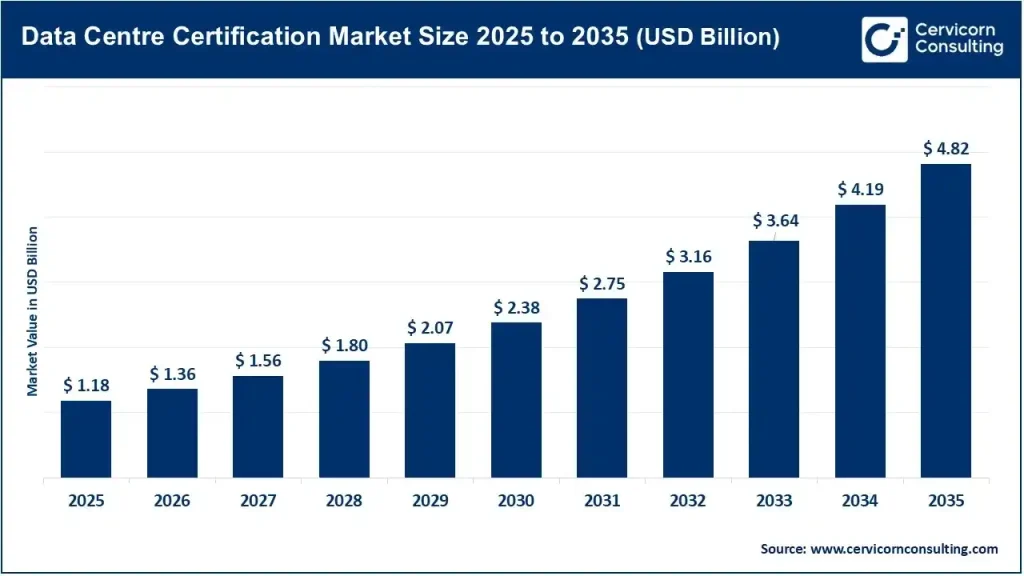
The global data centre certification market was valued at approximately USD 1.18 billion in 2025 and is projected to reach USD 4.82 billion by 2035, representing a 15.11% CAGR from 2026 to 2035.
Data centre certification market growth factors
The global data centre certification market is expanding as organizations increase investment in hyperscale, colocation, enterprise, edge and AI-focused data centre infrastructure. The market is being driven by the rapid growth of cloud computing, artificial intelligence, digital services, high-performance computing and data-intensive applications, all of which increase requirements for reliable power, cooling, redundancy, physical security and operational continuity.
Rising concerns about data centre outages are also encouraging operators to validate infrastructure through independent certification and assessment programs. Uptime Institute’s 2025 survey highlights rising costs, power constraints and the challenges of accommodating AI workloads, while its 2025 outage analysis notes that cybersecurity incidents are increasing even as overall outage frequency and severity have declined. Regulatory requirements related to cybersecurity, energy efficiency, sustainability, data protection and critical infrastructure are creating additional demand for third-party validation.
At the same time, growing deployment of modular and prefabricated data centres, edge facilities and high-density AI infrastructure is broadening certification requirements beyond traditional facilities.
Get a Free Sample: https://www.cervicornconsulting.com/sample/3030
What is the data centre certification market?
The data centre certification market comprises organizations that provide independent testing, inspection, assessment, auditing, certification and validation services for data centre infrastructure and operations. Certification can evaluate different stages of the data centre lifecycle, including design, construction, commissioning, operational sustainability, energy management, information security, business continuity, resilience and regulatory compliance.
A certification provides data centre owners and customers with third-party evidence that a facility has been assessed against a defined standard or framework. For example, Uptime Institute’s Tier Certification evaluates the application of its Tier Standard across design, construction and operations. Its current certification portfolio includes Tier Certification of Design Documents, Tier Certification of Constructed Facility and Tier Certification of Operational Sustainability. Uptime says it has issued more than 4,300 awards in over 120 countries.
The market therefore extends beyond a single certification. A modern data centre may require several independent validations covering availability, physical infrastructure, information security, environmental management, energy efficiency, occupational safety, business continuity and sustainability.
Why is data centre certification important?
Reliability and availability
Data centres support banking, telecommunications, healthcare, government, e-commerce, cloud services and increasingly AI applications. Certification helps organizations validate whether critical infrastructure can support the required availability and redundancy levels. Independent assessment can examine electrical systems, mechanical systems, cooling, distribution paths, fire protection, physical security, maintenance procedures and operational processes.
Business continuity
An outage can interrupt customer services, financial transactions, enterprise applications and cloud workloads. Certification creates a structured mechanism for evaluating infrastructure resilience and identifying weaknesses before they become operational failures.
Customer confidence
For colocation and cloud providers, certification can act as an independent assurance mechanism for prospective customers. Customers can use certification to compare infrastructure against defined requirements rather than relying entirely on provider claims.
Regulatory and compliance requirements
Data centres increasingly operate within complex regulatory environments involving cybersecurity, privacy, energy consumption and critical infrastructure. Certification and third-party assessment can help operators demonstrate conformity with applicable standards and regulatory expectations.
Sustainability
Power and water availability have become strategic concerns as data centre capacity expands. Certification frameworks increasingly incorporate energy efficiency, operational sustainability, environmental performance and responsible resource management.
Key companies in the data centre certification market
Uptime Institute
Specialization: Data centre Tier Standards, certification, operational sustainability and digital infrastructure assessments.
Key focus areas: Design certification, constructed-facility certification, operational sustainability, resilience, risk assessment, management and operations, energy efficiency and digital infrastructure performance.
Notable features: Uptime Institute’s Tier Standard is performance-based and technology-neutral. The organization says its Tier Certification has been used across more than 4,300 awards in 120+ countries. Its certification process can cover the lifecycle from design through construction and ongoing operations.
2025 revenue: Uptime Institute does not publicly disclose a standalone 2025 revenue figure in the sources reviewed.
Market share: A standalone percentage is not publicly disclosed. MarketsandMarkets identifies Uptime Institute as a leading participant in the global data centre certification market.
Global presence: Uptime Institute is headquartered in New York and maintains offices and professionals across major markets including London, São Paulo, Dubai, Riyadh, Singapore and Taipei, with services delivered internationally.
The company’s large installed base gives it an important position in certification for enterprise, hyperscale, colocation and government facilities. Its Tier framework is particularly relevant when operators need to communicate infrastructure resilience and availability to customers.
TÜV SÜD
Specialization: Testing, inspection and certification across industrial, digital, infrastructure, energy and technology markets.
Key focus areas: Data centre reliability, business continuity, information security, energy management, sustainability, infrastructure assessment and regulatory compliance.
Notable features: TÜV SÜD combines data centre certification capabilities with broader testing, inspection and certification expertise. Its global network allows certification and technical assessment to be integrated with other infrastructure and compliance requirements.
2025 revenue: €3.639 billion for the TÜV SÜD Group in fiscal 2025, compared with €3.429 billion in 2024.
Market share: A standalone data-centre-certification market share is not publicly disclosed. TÜV SÜD is identified by MarketsandMarkets as one of the leading companies in the sector.
Global presence: TÜV SÜD reported more than 30,000 employees and 1,000+ locations worldwide in 2025.
Its broad TIC portfolio positions TÜV SÜD to address data centre projects requiring multiple forms of technical assurance rather than a single infrastructure certification.
TÜV Rheinland
Specialization: Testing, inspection, certification, technical services and cybersecurity.
Key focus areas: Data centre infrastructure, reliability, cybersecurity, energy efficiency, sustainability, electrical and mechanical systems, compliance and operational performance.
Notable features: TÜV Rheinland combines data centre-related technical services with cybersecurity and industrial inspection capabilities. This combination is increasingly relevant as physical infrastructure and cyber resilience become more interconnected.
2025 revenue: TÜV Rheinland generated €2.98 billion in 2025, up from €2.71 billion in 2024. International markets generated 55.1% of group revenue in 2025.
Market share: A standalone data centre certification percentage is not publicly disclosed; MarketsandMarkets lists TÜV Rheinland among the leading companies in the market.
Global presence: TÜV Rheinland had approximately 28,550 employees at the end of 2025, with 66.1% of employees working outside Germany.
Its international footprint is important for multinational data centre operators seeking consistent technical assurance across different jurisdictions.
TÜV NORD
Specialization: Testing, inspection and certification, with growing emphasis on digital infrastructure and data centre certification.
Key focus areas: Data centre certification, critical infrastructure, cybersecurity, availability, operational security, sustainability and digital infrastructure.
Notable features: A major development was TÜV NORD’s acquisition of EPI Group, completed in October 2025. EPI is a major provider of data centre audit, certification and training services. TÜV NORD said the acquisition strengthened its position in the global data centre certification market.
2025 revenue: TÜV NORD Group generated €1.795 billion in 2025, up 6.0% from the previous year.
Market share: A standalone percentage for data centre certification is not publicly disclosed.
Global presence: TÜV NORD operates internationally, with 2025 revenue from outside Germany accounting for approximately 29.9% of total revenue.
The EPI acquisition is particularly significant because it expands TÜV NORD’s specialized capabilities in data centre audit, certification and professional training.
BSI Group
Specialization: Standards, conformity assessment, certification, training and business improvement.
Key focus areas: Data centre operational excellence, technical performance, cybersecurity, compliance, sustainability, risk management and international standards.
Notable features: In January 2026, BSI launched its Data Center Mark of Trust, a modular framework designed to validate technical, operational and compliance excellence. The framework addresses reliability, security, sustainability, regulatory compliance, energy demand, water usage and supply-chain risks.
2025 revenue: BSI’s 2025 financial information is published through its annual reporting system; a standalone revenue figure attributable specifically to data centre certification is not publicly disclosed.
Market share: A standalone data centre certification market share is not publicly disclosed. MarketsandMarkets identifies BSI among the leading market participants.
Global presence: BSI operates internationally through its standards, certification and assurance network.
The introduction of the Data Center Mark of Trust illustrates the market’s movement toward integrated certification that combines technical resilience with cybersecurity, sustainability and regulatory considerations.
Leading trends and their impact
AI-ready data centre certification
AI is changing data centre infrastructure through higher rack densities, increased power requirements, advanced cooling systems and accelerated deployment schedules. Certification providers therefore need assessment methodologies capable of evaluating high-density computing environments.
Uptime Institute’s 2025 global survey identifies power constraints and AI requirements as important challenges for data centre operators. This is increasing demand for independent verification of power, cooling, redundancy and operational capabilities.
Sustainability and energy efficiency
Energy consumption is becoming a central consideration in data centre planning. Operators are increasingly seeking certification and assessment related to energy management, carbon reduction, water consumption and sustainable operations.
The trend is shifting certification from a narrow focus on uptime toward a broader evaluation of reliability plus environmental performance.
Cybersecurity and physical resilience
Cybersecurity is becoming increasingly connected with physical infrastructure. A cyber incident can affect power management, cooling systems, monitoring platforms and operational technology.
Uptime Institute’s 2025 outage analysis reported that cybersecurity incidents were increasing and could have severe consequences. This creates opportunities for certification providers that combine infrastructure assessment with cybersecurity and operational controls.
Modular and prefabricated data centres
Modular facilities can accelerate deployment and support edge computing, temporary capacity expansion and geographically distributed infrastructure. Certification providers are developing processes that can validate repeatable modular designs.
A notable example is DXN’s Sydney facility, which received Uptime Institute Tier III Certification of Constructed Facility after using a prefabricated modular approach.
Lifecycle certification
Certification is increasingly becoming a continuous process rather than a one-time construction milestone. Providers are expanding from design assessment to construction validation and operational sustainability.
This creates recurring opportunities for certification companies while encouraging operators to maintain infrastructure performance throughout a facility’s operational life.
Successful examples of the data centre certification market around the world
Yotta NM1, India
Yotta NM1 in Mumbai represents a major example of Tier IV certification in India’s data centre industry. Uptime Institute reports that the facility achieved Tier IV Certification of Constructed Facility in 2021 and Tier IV Gold Certification of Operational Sustainability in 2022. It was described by Uptime Institute as India’s first Tier IV-certified data centre.
The project demonstrates how certification can become part of the market positioning of a hyperscale-oriented facility by providing an independently validated resilience framework.
Government data centres in India
India has developed a substantial portfolio of certified public-sector data centres. Uptime Institute’s certification database lists facilities associated with organizations including UIDAI, RBI, NPCI, BSNL, C-DAC, state governments and RailTel. For example, RBI’s Bhubaneswar data centre has received Tier IV design and constructed-facility certifications, while several government facilities have received Tier III certifications.
This demonstrates how certification is being incorporated into public digital infrastructure alongside private-sector data centre development.
DXN modular data centre, Australia
DXN’s Sydney facility provides an example of certification being applied to modular data centre architecture. The facility achieved Tier III Certification of Constructed Facility, with Uptime Institute describing it as the first globally to achieve this certification through its TIER-Ready program for a prefabricated/modular solution.
International Tier-certified facilities
Uptime Institute’s global portfolio includes certified facilities across North America, Europe, Asia-Pacific, Latin America, Africa and the Middle East. Its certification database includes projects such as Chayora in China, Datacenter United in Belgium and AIMS Data Centre facilities, demonstrating the international use of third-party certification as part of data centre development and customer assurance.
Global regional analysis and government initiatives shaping the market
North America
North America remains a major market for data centre certification because of its concentration of hyperscale cloud providers, enterprise infrastructure, colocation operators and AI computing facilities. The expansion of AI infrastructure is increasing demand for high-density power and cooling systems, creating additional requirements for independent validation.
In the United States, certification demand is also influenced by requirements for cybersecurity, business continuity, critical infrastructure protection and energy efficiency. Data centre developers increasingly need to demonstrate that facilities can support demanding workloads while managing power and environmental constraints.
Europe
Europe is experiencing increasing emphasis on data centre energy efficiency, sustainability and environmental reporting. The European Union’s policy environment is encouraging greater transparency around data centre energy performance and sustainability.
The Energy Efficiency Directive includes provisions addressing data centre energy performance and reporting. This regulatory direction supports demand for measurement, auditing, assessment and certification services.
European data centre operators are also responding to requirements involving cybersecurity and critical infrastructure resilience. Consequently, certification providers are increasingly combining technical assessment with cybersecurity and sustainability services.
Asia-Pacific
Asia-Pacific is one of the most important expansion regions for data centre certification because of rapid cloud adoption, digital transformation, AI investment and the development of hyperscale facilities.
Countries including Singapore, Japan, India, Australia and South Korea are attracting data centre investment while simultaneously addressing electricity consumption, land availability, water use and sustainability.
Singapore has placed particular emphasis on sustainable data centre development through its policy framework and data centre energy-efficiency initiatives. Certification and independent assessment can help operators demonstrate compliance with increasingly demanding performance expectations.
India
India is becoming a major data centre development market because of rapid digitization, cloud adoption, fintech expansion, e-commerce and AI infrastructure investment. India’s data centre capacity surpassed 2.1 GW in mid-2026, according to recent industry reporting, with further substantial expansion expected.
Government digital infrastructure programs and the growth of public digital services are contributing to demand for reliable, resilient facilities. Uptime Institute’s certification database shows certified facilities operated by UIDAI, RBI, NPCI, BSNL, C-DAC and multiple state governments.
The India Data Centre Policy and related state-level incentives have also encouraged investment in digital infrastructure, while data protection and cybersecurity requirements are increasing the importance of secure and resilient facilities.
Middle East
The Middle East is developing into an important data centre hub due to cloud adoption, digital government programs, smart-city development and AI investment. The United Arab Emirates and Saudi Arabia are attracting hyperscale and cloud infrastructure projects.
Certification demand is being supported by requirements for high availability, cybersecurity, operational resilience and international customer assurance. Uptime Institute maintains regional operations in Dubai and Riyadh, reflecting the growing importance of the region.
Latin America
Latin America is experiencing increasing demand for data centre capacity as cloud services, financial technology, telecommunications and digital commerce expand. Brazil, Mexico, Chile and Colombia are among the markets attracting data centre investment.
Certification provides operators with a mechanism for demonstrating reliability and infrastructure quality to multinational customers. As cloud and colocation facilities expand, demand is expected to broaden from basic infrastructure certification toward cybersecurity, energy management and sustainability assessment.
Government initiatives and policies shaping the market
Government policy is becoming an increasingly important driver of data centre certification. Key policy areas include:
- Energy-efficiency regulations: Governments are increasingly requiring measurement and reporting of data centre energy performance.
- Cybersecurity frameworks: Critical infrastructure and digital-service regulations are increasing demand for independently validated security controls.
- Data protection: Privacy and data-localization requirements encourage organizations to maintain secure and controlled infrastructure.
- Critical infrastructure policies: Governments increasingly classify digital infrastructure as strategically important, strengthening requirements for resilience and continuity.
- Sustainability policies: Carbon reduction, renewable-energy adoption, water management and environmental reporting are influencing data centre design.
- Digital transformation programs: National digitalization initiatives increase demand for resilient public and private cloud infrastructure.
- AI infrastructure programs: Government support for AI computing is increasing demand for high-density data centres, which in turn creates new certification requirements for power and cooling systems.
The direction of the market is therefore moving toward multi-dimensional data centre assurance, where certification increasingly evaluates availability, cybersecurity, sustainability, operational maturity, energy efficiency and regulatory compliance together rather than treating infrastructure reliability as an isolated requirement.
To Get Detailed Overview, Contact Us: https://www.cervicornconsulting.com/contact-us
Read Report: Telehealth 2.0 Market Revenue, Trends, and Strategic Insights by 2035