


Data Center Processors: 5 Decisions That Can Improve AI Infrastructure Investment Returns
Data center operators are under increasing pressure to expand computing capacity while controlling power consumption, infrastructure costs and hardware obsolescence. The challenge is no longer simply choosing a faster processor. It is determining which combination of CPUs, GPUs and specialized accelerators can deliver the required performance at a commercially viable cost.
For cloud providers, colocation operators, enterprise IT teams and semiconductor companies, processor selection now influences server architecture, cooling requirements, software compatibility and long-term capital allocation.
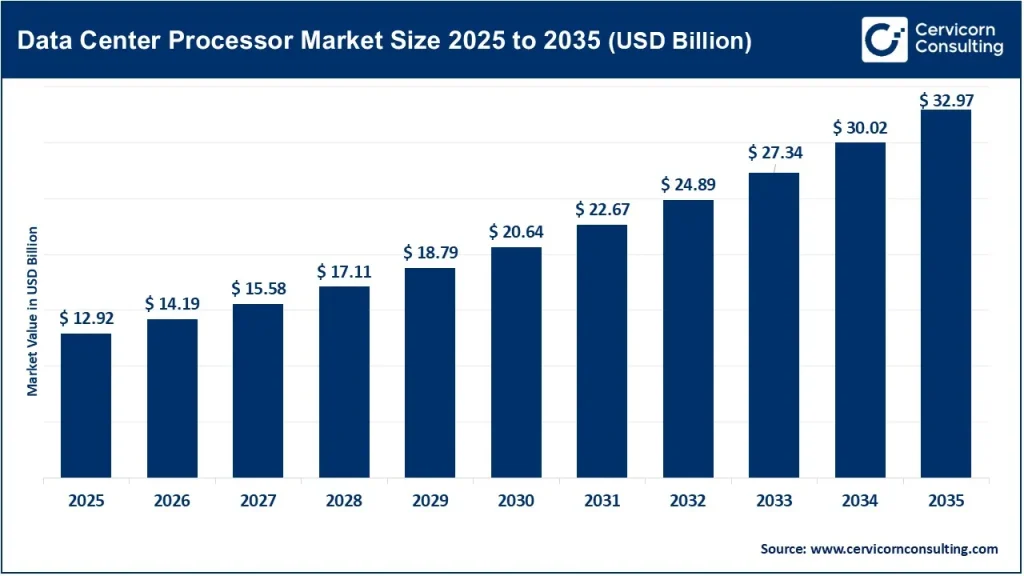
The global data center processor market was valued at USD 12.92 billion in 2025 and is projected to reach USD 32.97 billion by 2035, growing at a compound annual growth rate (CAGR) of 9.8% from 2026 to 2035. However, market growth alone does not guarantee attractive returns for every hardware investment.
The key question for decision-makers is how to match processor capabilities with actual workload requirements.
1. Should Companies Prioritize CPUs, GPUs or Specialized AI Processors?
The expansion of AI workloads has increased interest in GPUs and application-specific integrated circuits (ASICs). However, replacing general-purpose processors across an entire data center is rarely the most efficient approach.
Different processors address different computing requirements:
- CPUs: Suitable for databases, virtualization, enterprise applications, transaction processing and general-purpose cloud workloads.
- GPUs: Useful for AI model training, parallel computing and inference workloads that benefit from extensive parallel processing.
- ASICs and other AI accelerators: Designed for specific workloads where optimized performance, energy consumption or operating costs can justify the investment.
- Data processing units (DPUs): Can offload selected networking, storage and security operations from CPUs.
The commercial decision depends on workload characteristics rather than processor specifications alone.
For example, a cloud provider running large volumes of conventional business applications may benefit more from CPU upgrades and server consolidation than from deploying expensive AI accelerators. Conversely, an AI infrastructure provider may need accelerator-heavy configurations to meet customer requirements for model training and inference.
Business decision: Evaluate the expected workload mix over the next three to five years before selecting a processor architecture. Compare performance, utilization, software requirements and total cost of ownership rather than purchase price alone.
Get a Free Sample:https://www.cervicornconsulting.com/sample/3062
2. How Should Companies Evaluate the Economics of AI Server Investments?
AI infrastructure spending is increasing, but companies must distinguish between demand for computing capacity and demand that can generate sustainable returns.
According to IDC, worldwide server vendor revenue reached $166.3 billion in the second quarter of 2026, representing 52% year-over-year growth. IDC also reported that server unit growth was considerably lower, at 15.4%. This difference highlights the importance of higher-value configurations and rising component costs in overall spending growth.
For infrastructure buyers, higher expenditure does not automatically translate into proportionate performance gains or revenue growth.
Before committing to an AI server deployment, companies should assess:
- Workload utilization: Will the processors operate at sufficient capacity to justify their cost?
- Revenue potential: Can additional computing capacity support billable cloud services, AI products or measurable productivity gains?
- Power and cooling costs: What additional operating expenditure will high-density servers require?
- Deployment timelines: Will hardware arrive and become operational in time to meet customer demand?
- Technology depreciation: Could a newer processor generation reduce the competitiveness of the selected hardware before the investment is recovered?
These factors are especially important for smaller cloud providers, enterprises building private AI infrastructure and organizations considering large-scale GPU deployments.
Business decision: Build investment scenarios using conservative, expected and high-utilization assumptions. Estimate the cost per useful computing unit and the time required to recover the investment before approving additional capacity.
3. Is Performance per Watt Becoming More Important Than Peak Performance?
Power availability is becoming a critical consideration in data center expansion. A processor that delivers high computing performance may still be commercially unattractive if it requires costly infrastructure upgrades or creates cooling bottlenecks.
The relevant metric is not simply how much work a processor can perform. It is how much useful work it delivers for the energy consumed under real operating conditions.
Companies should compare processor platforms using:
- Performance per watt under representative workloads.
- Power consumption at idle, average and peak utilization.
- Cooling and power-distribution requirements.
- Rack density and available electrical capacity.
- Performance consistency under sustained workloads.
For example, a data center operating close to its power limit may achieve better economics by deploying more energy-efficient processors than by adding higher-performance systems that require new electrical infrastructure.
However, energy efficiency should not be assessed in isolation. A processor with lower power consumption may require additional servers to meet the same performance target, increasing space, networking and maintenance costs.
Business decision: Compare complete server configurations rather than individual chips. Evaluate computing output, energy use and infrastructure costs together to identify the most economical deployment.
4. When Should Companies Adopt Custom Silicon or Alternative Processor Architectures?
Custom silicon is becoming a strategic consideration for large cloud providers and technology companies seeking greater control over performance, cost and hardware availability.
TrendForce projected that ASIC-based AI servers would account for approximately 27.8% of AI server shipments in 2026, reflecting growing interest in alternatives to conventional GPU-based systems.
This shift creates opportunities, but specialized hardware is not automatically the best choice for every organization.
Custom processors may offer advantages when workloads are stable, repeated at scale and sufficiently predictable to justify architecture-specific optimization. They can be less attractive when applications change frequently, software compatibility is limited or development costs are difficult to recover.
Companies evaluating alternative processor architectures should examine:
- Compatibility with existing applications and programming frameworks.
- Availability of optimized software libraries and developer tools.
- Migration, testing and employee training costs.
- Vendor support and long-term product availability.
- Dependence on a single supplier or proprietary ecosystem.
- Expected savings across the processor’s useful operating life.
For semiconductor manufacturers, these considerations also influence which workloads offer the strongest commercial opportunities for specialized processor development.
Business decision: Consider custom silicon when workload volume and consistency support a credible economic case. For smaller deployments or rapidly changing applications, established processor platforms may offer greater flexibility and lower adoption risk.
5. How Can Companies Reduce Processor Procurement and Obsolescence Risks?
Processor purchasing decisions are increasingly connected to semiconductor supply chains, server availability and changing AI infrastructure requirements.
An organization may select a technically suitable processor but still face delays if compatible memory, networking components, packaging capacity or cooling systems are unavailable. Meanwhile, rapidly evolving AI workloads can make previously attractive configurations less competitive.
Procurement teams should therefore evaluate more than technical specifications and quoted prices.
A robust assessment should include:
- Supplier concentration: Determine how dependent the deployment is on a single processor vendor or manufacturing ecosystem.
- Delivery reliability: Assess expected lead times and the availability of complete server configurations.
- Architecture flexibility: Consider whether the infrastructure can support future processor generations without extensive redesign.
- Refresh-cycle economics: Compare early replacement with continued operation of existing systems.
- Software portability: Understand the cost of moving workloads between processor platforms.
- Demand forecasting: Align purchasing volumes with expected customer demand and realistic deployment schedules.
For data center operators, these measures can reduce the risk of idle capital, delayed service launches and premature hardware replacement. For processor manufacturers and suppliers, understanding these purchasing priorities can help identify customer segments with stronger demand and clearer adoption timelines.
Business decision: Develop procurement plans around workload forecasts, supplier risk and infrastructure readiness. Avoid committing to large hardware volumes solely because a processor generation is attracting market attention.
What Should Decision-Makers Monitor Over the Next Few Years?
The data center processor market is evolving across several connected areas. Monitoring these developments can help companies identify investment opportunities while avoiding premature commitments.
AI inference demand: As AI applications move from experimentation into production, companies will need to assess the economics of serving real-time requests at scale.
CPU demand alongside AI expansion: AI infrastructure still requires CPUs for orchestration, data preparation, virtualization and conventional workloads. Accelerator investment does not eliminate the need for general-purpose computing.
Custom processor adoption: Growth in ASIC-based systems could create new competitive opportunities, but software maturity and workload suitability will influence adoption.
Energy-efficient computing: Power availability and cooling costs will increasingly shape which processor configurations can be deployed economically.
Regional infrastructure development: Differences in cloud investment, semiconductor supply chains, power availability and data center construction will influence regional demand.
Hardware utilization and returns: Strong market growth may attract additional investment, but operators will need to demonstrate that computing capacity can generate sufficient revenue or measurable operating benefits.
Conclusion
Selecting data center processors is becoming a broader infrastructure investment decision rather than a straightforward hardware procurement exercise.
Companies need to balance computing performance, power efficiency, workload utilization, software compatibility and supply-chain resilience. The optimal architecture may combine CPUs for general-purpose computing, GPUs for demanding parallel workloads and specialized processors for applications where their economics are compelling.
For technology leaders, infrastructure planners and semiconductor companies, the priority is to identify where processor investments can deliver measurable business value—and where a more flexible or incremental approach would reduce risk.
Understanding market growth, competitive positioning, processor adoption patterns and workload-specific demand can help organizations make better-informed decisions about capacity expansion, product development and long-term infrastructure strategy.
To Get Detailed Overview, Contact Us: https://www.cervicornconsulting.com/contact-us