


Table of Contents
ToggleData Center Physical Infrastructure Market Size
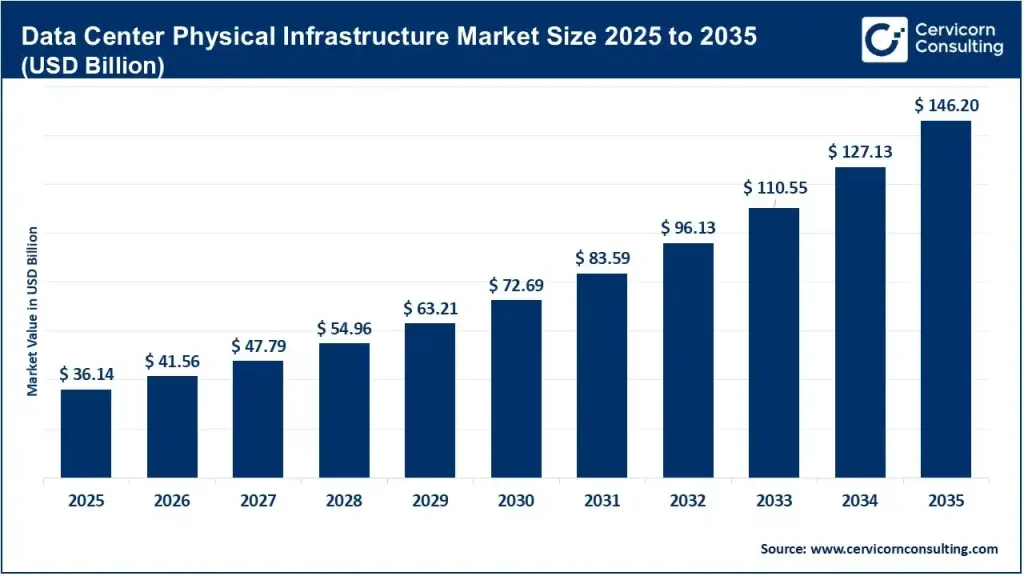
The global data center physical infrastructure market was valued at approximately USD 36.14 billion in 2025 and is projected to reach USD 146.20 billion by 2035, representing a 15% CAGR from 2026 to 2035.
What Is the Data Center Physical Infrastructure Market?
The data center physical infrastructure market refers to the global market for the physical systems, equipment, technologies, and services required to construct, power, cool, protect, monitor, and operate data centers.
Unlike the IT infrastructure layer—which includes servers, storage, operating systems, databases, and networking applications—physical infrastructure forms the facility-level foundation supporting those systems.
Major components include:
- Power infrastructure: UPS systems, switchgear, transformers, power distribution units, busways, generators, batteries, and energy-storage systems.
- Cooling infrastructure: Computer room air conditioners, computer room air handlers, chillers, cooling towers, in-row cooling, rear-door heat exchangers, direct-to-chip liquid cooling, and immersion cooling.
- Racks and enclosures: Server racks, cabinets, containment systems, high-density rack systems, and modular infrastructure.
- Cabling and connectivity infrastructure: Structured cabling, fiber-optic systems, patching, cable management, and connectivity components.
- Monitoring and management: Data center infrastructure management (DCIM), sensors, power monitoring, environmental monitoring, predictive maintenance, and automation.
- Physical security and safety: Access controls, surveillance, fire detection, fire suppression, environmental protection, and facility security.
- Modular and prefabricated infrastructure: Factory-integrated power and cooling modules that accelerate deployment and reduce onsite construction complexity.
The market is increasingly moving from conventional facility infrastructure toward AI-ready, high-density, modular, intelligent, and energy-efficient infrastructure.
Get a Free Sample: https://www.cervicornconsulting.com/sample/3018
Data Center Physical Infrastructure Market Growth Factors
The growth of the data center physical infrastructure market is being driven by the rapid expansion of AI and generative AI workloads, hyperscale and cloud data centers, increasing enterprise digitization, edge computing, 5G deployment, rising data traffic, digital banking, streaming, e-commerce, and government digitalization.
AI is particularly important because high-performance GPUs and accelerated computing systems generate substantially more heat and require higher power densities than conventional servers, increasing demand for advanced UPS systems, high-capacity electrical distribution, liquid cooling, high-density racks, power monitoring, and thermal-management solutions. The IEA estimates that data-center electricity consumption increased strongly in 2025 and is projected to roughly double from around 485 TWh in 2025 to approximately 950 TWh by 2030, while AI-focused data-center electricity consumption is expected to triple.
At the same time, hyperscale operators are building larger facilities with increasingly sophisticated power architectures, while enterprises are modernizing legacy facilities to support higher-density computing. Grid constraints, transformer shortages, rising electricity costs, sustainability requirements, and pressure to reduce carbon and water consumption are also encouraging operators to invest in energy-efficient power and cooling infrastructure. Governments are further supporting market development through data-center incentives, digital infrastructure programs, renewable-energy policies, efficiency standards, permitting reforms, and investment schemes. These factors collectively create demand not only for new data-center construction but also for retrofits, capacity expansion, modernization, monitoring, and lifecycle services.
Why Is Data Center Physical Infrastructure Important?
Physical infrastructure is essential because even the most advanced servers cannot operate without stable power, controlled temperature, humidity management, physical security, and reliable facility systems.
1. Ensures Power Reliability
Data centers require continuous electricity. UPS systems, batteries, switchgear, generators, power distribution equipment, and energy-storage systems protect critical IT equipment against outages, voltage fluctuations, and power-quality problems.
2. Enables AI and High-Density Computing
AI servers generate substantially more heat than conventional enterprise workloads. Consequently, traditional air cooling alone may not be sufficient for the highest-density deployments. Advanced liquid-cooling technologies are becoming increasingly important.
3. Improves Energy Efficiency
Electricity is one of the largest operating expenses for data centers. Efficient power distribution and cooling systems can reduce energy consumption while supporting higher computing capacity.
4. Supports Business Continuity
Banks, hospitals, cloud platforms, telecommunications companies, governments, and online retailers depend on continuous digital availability. Physical infrastructure provides the resilience necessary for high-availability operations.
5. Reduces Environmental Impact
Efficient cooling, renewable-energy integration, heat recovery, intelligent power management, and water-efficient infrastructure are becoming increasingly important as sustainability regulations intensify.
6. Accelerates Data Center Deployment
Prefabricated and modular infrastructure allows power, cooling, racks, and other systems to be assembled and tested before being delivered to the facility. This can shorten deployment schedules and reduce onsite complexity.
Major Companies in the Data Center Physical Infrastructure Market
| Company | Specialization | Key Focus Areas | Notable Features | 2025 Revenue | Market Share* | Global Presence |
|---|---|---|---|---|---|---|
| Schneider Electric | Power management, cooling, automation | UPS, switchgear, racks, cooling, DCIM, energy management | EcoStruxure, APC, modular systems, AI-ready infrastructure | €40.0B | ~3.59% broader DC infrastructure | Global |
| Vertiv | Critical digital infrastructure | Power, thermal management, racks, UPS, liquid cooling, services | Liebert, Vertiv OneCore, AI-ready cooling and power | $10.23B | ~3.98% broader DC infrastructure | Global |
| Eaton | Intelligent power management | UPS, switchgear, power distribution, energy storage | 9PX, 93PM, intelligent power systems | $27.45B | ~5.7% data-center power market | Global |
| Legrand | Electrical and digital infrastructure | Racks, PDUs, busways, cabling, UPS, containment | Raritan, Starline, high-density data-center solutions | ~€9.5B | Not separately disclosed | Global |
| ABB | Electrification and automation | MV/LV systems, switchgear, UPS, transformers, automation | ABB Ability, high-voltage and medium-voltage solutions | $33.22B | ~3.7% data-center power market | Global |
Schneider Electric
Schneider Electric is one of the most comprehensive players in the physical infrastructure ecosystem. Its portfolio spans UPS systems, power distribution, racks, cooling, energy management, automation, DCIM and prefabricated infrastructure. Schneider reported €40 billion in 2025 revenue, with 9% organic growth.
Its EcoStruxure architecture connects power, cooling, monitoring, automation, and management technologies. The company has also expanded its capabilities for AI infrastructure and high-density computing, including liquid-cooling solutions.
Vertiv
Vertiv focuses heavily on mission-critical digital infrastructure. Its portfolio includes AC/DC power management, thermal management, switchgear, busbars, UPS systems, racks, power distribution, liquid and air cooling, energy storage, software, and lifecycle services.
Vertiv reported $10.23 billion in 2025 net sales, up 27.7% from 2024. The Americas represented 62% of sales, Asia Pacific 20%, and Europe, Middle East and Africa 18%.
Its Vertiv OneCore approach integrates power, thermal systems, racks, software, and services into standardized infrastructure architectures designed to accelerate deployment.
Eaton
Eaton is a major power-management supplier serving data centers alongside industrial, commercial, utility, aerospace, and other markets.
Eaton generated $27.448 billion in 2025 sales, representing 10% growth from 2024.
Its data-center portfolio includes UPS systems, power distribution, switchgear, intelligent electrical systems, ePDUs, energy-management solutions, and related services. Eaton is particularly well positioned as data-center developers increasingly need integrated power-management systems capable of handling higher loads and improving resilience.
Legrand
Legrand has strengthened its position in data-center physical infrastructure through power distribution, busways, racks, PDUs, structured cabling, containment, UPS systems, and high-density solutions.
Legrand reported nearly €9.5 billion in 2025 sales, while data-center activities represented 26% of its 2025 sales. The company specifically highlighted the expansion of data-center solutions designed for AI infrastructure.
Its portfolio includes brands and businesses such as Raritan and Starline, helping address power distribution and high-density computing requirements.
ABB
ABB operates across electrification and automation and is increasingly benefiting from data-center investment.
ABB generated $33.22 billion in 2025 revenue, while its Electrification business generated approximately $17.4 billion.
Its data-center capabilities include medium- and low-voltage equipment, switchgear, UPS systems, transformers, power distribution, automation, and digital management. ABB reported particularly strong data-center demand in its Electrification business in 2025.
Leading Trends and Their Impact
1. AI-Driven High-Density Data Centers
AI is arguably the most important structural trend affecting physical infrastructure. GPU-based computing increases rack power density and heat output, requiring new approaches to electrical distribution and cooling.
Impact: Demand is shifting toward high-capacity UPS systems, liquid cooling, high-density racks, advanced power distribution, thermal monitoring, and facility-level automation.
The IEA notes that AI server power density has risen dramatically and that future AI racks could require power comparable to the electricity consumption of dozens of households.
2. Liquid Cooling
Direct-to-chip cooling, rear-door heat exchangers and immersion cooling are becoming more prominent as air cooling approaches practical limits at extreme rack densities.
Impact: Cooling suppliers are developing integrated liquid-cooling systems, coolant distribution units, heat exchangers, pumps, controls, and monitoring platforms.
3. Modular and Prefabricated Infrastructure
Data-center operators increasingly want faster deployment with standardized designs.
Impact: Vendors are developing factory-built electrical rooms, cooling modules, prefabricated power systems, modular UPS systems, and integrated data-center pods.
Vertiv’s OneCore approach illustrates this shift toward standardized architectures combining power, thermal management, racks, software, and services.
4. Renewable Energy and Energy Storage
Data centers require enormous quantities of reliable electricity while operators face pressure to reduce emissions.
Impact: Demand is increasing for battery energy storage, renewable-energy integration, intelligent power management, microgrids, and alternative generation.
The IEA expects renewables to supply nearly half of the additional electricity required by data centers through 2030 in its base case.
5. Intelligent Infrastructure Management
DCIM is evolving from basic monitoring toward predictive analytics, automated capacity management, digital twins, AI-assisted optimization, and real-time energy management.
Impact: Physical infrastructure vendors increasingly compete on software and analytics as well as hardware.
6. Water Efficiency
Cooling systems can consume significant quantities of water, especially in water-stressed regions.
Impact: Operators are exploring air cooling, liquid cooling, closed-loop systems, heat reuse, water-efficient cooling towers, and alternative cooling architectures.
7. Grid Resilience
Transformer shortages, transmission constraints, permitting delays, and electricity interconnection bottlenecks can slow data-center construction.
The IEA estimates that around 20% of planned data-center projects could face delays if grid risks are not addressed.
Impact: Demand is increasing for onsite power generation, energy storage, microgrids, advanced switchgear, medium-voltage equipment, and power-quality technologies.
Successful Examples of Data Center Physical Infrastructure Around the World
United States: AI-Ready Hyperscale Expansion
The United States remains the world’s largest data-center electricity market. The IEA reports that the U.S. accounted for approximately 45% of global data-center electricity consumption in 2024.
The rapid expansion of hyperscale AI facilities has created demand for high-voltage power infrastructure, transformers, UPS systems, liquid cooling, energy storage, and large-scale power distribution.
The U.S. federal government has also taken steps to accelerate infrastructure development. In July 2025, an executive order directed federal agencies to facilitate data-center infrastructure development, including projects requiring more than 100 MW of new load and related energy infrastructure.
Singapore: Green and Space-Constrained Data Centers
Singapore is an important example of how a dense digital economy can balance data-center growth with energy constraints.
Its Green Data Centre Roadmap aims to provide at least 300 MW of additional capacity in the near term, with further capacity linked to green-energy deployment. Singapore has also introduced the Green Mark for Data Centres and an Energy Efficiency Grant for eligible equipment.
The Energy Efficiency Grant launched in December 2024 provides support for eligible energy-efficient data-center IT equipment, with support of up to 70% for qualifying SMEs and up to 30% for non-SMEs through March 2027.
Europe: Sustainability-Centric Infrastructure
Europe is increasingly using regulatory frameworks to encourage efficient data-center design.
The EU’s Energy Efficiency Directive introduced reporting requirements for data centers, while the European Commission established an EU-wide sustainability-rating framework. Data centers with significant energy consumption are required to report energy-performance and sustainability indicators.
This approach is influencing demand for efficient cooling, renewable-energy integration, heat reuse, water management, energy monitoring, and high-efficiency electrical equipment.
India: Rapid Capacity Expansion
India is becoming a major growth market because of expanding cloud adoption, digital payments, AI, telecommunications, e-commerce, and enterprise digitization.
India’s data-center capacity reportedly reached around 1,700 MW in 2025, while demand is expected to continue increasing rapidly.
State-level incentives are also encouraging development. For example, Uttar Pradesh’s data-center policy includes electricity-duty exemptions, dual-grid power incentives, and transmission/wheeling-charge benefits for qualifying projects.
These initiatives support demand for electrical infrastructure, backup power, cooling, high-density racks, security systems, and facility management technologies.
Global Regional Analysis Including Government Initiatives and Policies
North America
North America remains the leading region for data-center physical infrastructure because of its extensive hyperscale ecosystem, cloud-computing market, AI investment, colocation capacity, and mature power infrastructure.
The United States dominates regional activity, while Canada is also attracting hyperscale and cloud investments.
The region’s biggest infrastructure challenge is increasingly power availability rather than simply data-center floor space. AI facilities require large quantities of electricity, creating demand for transformers, switchgear, UPS systems, generators, battery storage, microgrids, and renewable-energy integration.
U.S. federal policy has increasingly focused on accelerating AI infrastructure and data-center construction. The July 2025 executive order specifically targeted faster development of large data centers and associated energy infrastructure.
At the state level, however, the market is also experiencing greater scrutiny around electricity prices, water consumption, emissions, land use, and grid capacity. This is creating a more complex regulatory environment for new projects.
Europe
Europe represents a highly sustainability-focused market.
Countries including Ireland, Germany, the Netherlands, the United Kingdom, France, and the Nordic nations have developed significant data-center ecosystems, although grid availability, environmental requirements, and power-market conditions increasingly influence project locations.
The EU’s Energy Efficiency Directive requires reporting of key energy-performance and sustainability indicators for qualifying data centers. The European Commission is also working toward an EU Data Centre Energy Efficiency Package involving rating mechanisms and potential minimum performance standards.
Market impact: European customers are increasingly prioritizing high-efficiency UPS systems, free cooling, liquid cooling, renewable energy, heat recovery, intelligent monitoring, and low-water cooling technologies.
Asia Pacific
Asia Pacific is expected to be one of the fastest-growing regional markets because of digitalization, cloud adoption, AI development, e-commerce, telecommunications, and increasing enterprise IT spending.
China
China remains one of the world’s largest data-center markets and is expanding computing infrastructure to support AI and digital industries. The country is emphasizing large-scale computing infrastructure, energy efficiency, and integration with renewable power.
India
India is experiencing rapid data-center development as cloud and digital services expand. Government and state-level policies increasingly provide land, electricity, tax, infrastructure, and investment incentives.
The country’s physical infrastructure opportunity is particularly significant because new facilities can be designed around AI-ready electrical and cooling architectures rather than requiring extensive retrofits of legacy facilities.
Singapore
Singapore provides one of the strongest examples of government-led sustainable data-center development. Its Green Data Centre Roadmap combines capacity expansion with energy efficiency and green-energy adoption.
Japan
Japan is also becoming an important AI and data-center infrastructure market. The IEA expects Japanese data-center electricity consumption to rise substantially through 2030, supported by AI and digitalization.
This is increasing interest in resilient power infrastructure, energy efficiency, renewable energy, and next-generation cooling technologies.
Latin America
Latin America is emerging as a growth opportunity, particularly Brazil, Chile, Mexico and Colombia.
The region benefits from growing cloud adoption, digital banking, e-commerce, streaming, telecommunications and enterprise digitization. Renewable-energy availability is another potential advantage because some countries have significant hydroelectric, solar and wind resources.
However, infrastructure availability, grid reliability, financing, import costs, connectivity and regulatory complexity remain important considerations.
Brazil is particularly significant because of its large digital economy and growing hyperscale and colocation ecosystem. Increasing use of renewable electricity can also help operators address carbon-reduction objectives.
Middle East & Africa
The Middle East is developing rapidly as governments pursue digital transformation, sovereign cloud initiatives, AI programs, smart cities and economic diversification.
The UAE and Saudi Arabia are particularly important markets. Large-scale government-backed technology programs are encouraging investment in hyperscale and cloud infrastructure.
The region’s climate creates a strong requirement for advanced cooling systems. High ambient temperatures can increase cooling loads, creating opportunities for efficient chillers, liquid cooling, thermal management, heat-resistant equipment, and intelligent cooling controls.
Africa remains a smaller but potentially high-growth market. South Africa is the leading regional data-center hub, while countries such as Kenya, Nigeria and Egypt are developing additional capacity.
Growth is supported by increasing internet usage, mobile services, cloud adoption and digital payments. However, electricity reliability, infrastructure availability, financing and connectivity remain key constraints.
What the Regional Outlook Means for the Market
The global data center physical infrastructure market is moving toward a model where power, cooling, sustainability and intelligence are becoming as strategically important as the server itself.
North America is likely to remain a major revenue center because of AI and hyperscale investment. Europe will emphasize energy efficiency and sustainability compliance. Asia Pacific will offer some of the strongest expansion opportunities as cloud, AI and digital services scale. Latin America and the Middle East are emerging as attractive locations for new capacity, while India and Southeast Asia are becoming increasingly important destinations for hyperscale and colocation investments.
Across all regions, the competitive advantage is shifting toward companies capable of delivering integrated power and cooling architectures rather than individual components. Schneider Electric, Vertiv, Eaton, Legrand and ABB are positioned around this transition through combinations of electrical equipment, thermal management, automation, monitoring, modular infrastructure and lifecycle services.
The most significant opportunity is likely to come from the convergence of AI computing, high-density racks, liquid cooling, intelligent power management, renewable energy, energy storage, modular construction and digital infrastructure management. As the IEA projects global data-center electricity consumption to approach 950 TWh by 2030, physical infrastructure will remain a fundamental investment area for hyperscalers, colocation providers, enterprises and governments worldwide.
To Get Detailed Overview, Contact Us: https://www.cervicornconsulting.com/contact-us
Read Report: Orthopedic Devices Market Revenue, Trends, and Strategic Insights by 2035