


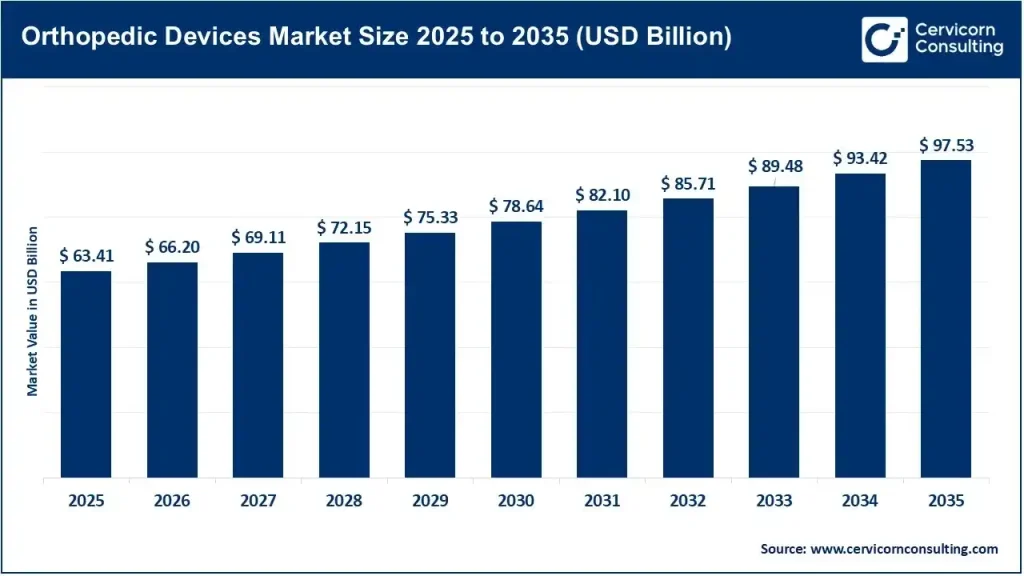
Orthopedic Devices Market Size
The global orthopedic devices market was valued at approximately USD 63.41 billion in 2025 and is projected to reach USD 97.53 billion by 2035, representing a 4.4% CAGR from 2026 to 2035.
What Is the Orthopedic Devices Market?
The orthopedic devices market encompasses medical products used to diagnose, treat, repair, replace, or support bones, joints, muscles, ligaments, tendons, and other components of the musculoskeletal system.
The market covers several major categories, including:
- Joint reconstruction devices: hip, knee, shoulder, ankle, and other joint replacement systems.
- Trauma and extremities devices: plates, screws, nails, fixation systems, and other products used to treat fractures and traumatic injuries.
- Spinal devices: spinal implants, interbody systems, fixation products, and technologies supporting spinal fusion and other procedures.
- Sports medicine devices: products for ligament, tendon, cartilage, and soft-tissue repair.
- Orthopedic surgical instruments: manual, powered, robotic-assisted, and navigation-enabled instruments.
- Orthobiologics: bone graft substitutes, biologics, and other products intended to support bone healing and regeneration.
The industry is increasingly moving beyond conventional implants toward integrated solutions combining implants, digital planning, surgical navigation, robotics, artificial intelligence, 3D printing, and patient-specific technologies.
Get a Free Sample: https://www.cervicornconsulting.com/sample/3015
Why Is the Orthopedic Devices Market Important?
Orthopedic devices play a critical role in restoring physical function and improving quality of life for patients affected by musculoskeletal conditions. Population aging is particularly important because the prevalence of osteoarthritis, osteoporosis, degenerative joint disease, and fractures tends to increase with age.
At the same time, sports participation, road accidents, workplace injuries, obesity-related joint problems, and longer life expectancy are increasing the need for orthopedic interventions. The market is also important economically because orthopedic procedures can reduce long-term disability and help patients return to work and normal activities.
Technological progress is further increasing the value of orthopedic devices. Robotic-assisted surgery, computer-assisted navigation, 3D-printed implants, patient-specific instruments, advanced biomaterials, and minimally invasive techniques are enabling physicians to perform increasingly precise procedures. These technologies can improve surgical planning and implant positioning while supporting more personalized treatment.
Orthopedic Devices Market Growth Factors
The orthopedic devices market is being driven by the rising global prevalence of musculoskeletal disorders, rapid population aging, increasing orthopedic trauma and sports injuries, growing demand for joint replacement procedures, technological advancements in robotic-assisted and minimally invasive surgery, development of advanced biomaterials and 3D-printed implants, expanding healthcare infrastructure in emerging economies, increasing adoption of ambulatory surgical centers, and improvements in diagnosis and surgical planning. The growing geriatric population is particularly significant because degenerative joint conditions and osteoporosis become more prevalent with age. At the same time, healthcare providers are increasingly seeking technologies that can improve surgical precision, shorten hospital stays, and support faster recovery. Manufacturers are responding with integrated ecosystems combining implants, robotics, navigation, digital planning, and data analytics. Rising healthcare expenditure and improving access to orthopedic care in Asia Pacific, Latin America, and other emerging markets are creating additional opportunities. However, high device costs, reimbursement limitations, stringent regulatory requirements, and concerns regarding implant longevity remain important market constraints.
Major Companies in the Orthopedic Devices Market
The competitive landscape is concentrated among large multinational medical technology companies with extensive implant portfolios, surgeon networks, manufacturing capabilities, and global distribution systems. Orthoworld estimates that the eight companies generating more than USD 1 billion in annual orthopedic sales collectively controlled approximately two-thirds of the worldwide orthopedic market in 2025.
| Company | Specialization | Key Focus Areas | Notable Features | 2025 Orthopedic Revenue* | Approx. Market Share* | Global Presence |
|---|---|---|---|---|---|---|
| Stryker Corporation | Joint reconstruction, trauma, extremities, robotics | Hips, knees, trauma, surgical robotics | Mako robotic platform, broad implant portfolio | USD 11.38B | ~17.5% | North America, Europe, Asia Pacific and other international markets |
| Johnson & Johnson MedTech (DePuy Synthes) | Joint reconstruction, trauma, spine, sports medicine | Hips, knees, trauma, spine and sports medicine | Broad global orthopedic portfolio and digital surgery capabilities | USD 9.26B | ~14.3% | Global |
| Zimmer Biomet Holdings, Inc. | Joint reconstruction, extremities, sports medicine | Hips, knees, shoulders, trauma and robotics | ROSA robotic platform and extensive reconstruction portfolio | USD 8.23B | ~12.7% | Global |
| Smith+Nephew plc | Orthopedics and sports medicine | Knee, hip, trauma, extremities and sports medicine | CORI robotic system, AETOS shoulder system | USD 4.15B | ~6.4% | U.S., Europe, Asia Pacific and emerging markets |
| Medtronic plc | Spine and related technologies | Spinal implants, navigation, enabling technologies | StealthStation and integrated spinal technologies | USD 3.61B | ~5.6% | Global |
*2025 orthopedic-sales figures and market-share calculations are based on Orthoworld’s 2025 worldwide orthopedic sales dataset; market share is calculated against the reported USD 64.95 billion total orthopedic market. These figures are orthopedic sales, not total corporate revenue, which is particularly important for diversified companies such as Johnson & Johnson and Medtronic.
Stryker Corporation
Stryker is one of the largest companies in the orthopedic devices industry, with particular strength in joint reconstruction, trauma and extremities, and robotic-assisted surgery. Its orthopedic portfolio includes knee and hip implants, trauma products, spinal implants, and other orthopedic technologies.
Stryker reported USD 25.12 billion in total corporate sales in 2025, while its reported Orthopaedics segment generated USD 9.47 billion. Trauma and extremities represented its largest orthopedic category at USD 3.95 billion, followed by knees at USD 2.66 billion and hips at USD 1.87 billion.
Its Mako robotic-assisted technology is a major competitive differentiator, allowing surgeons to use digital planning and robotic assistance in joint replacement procedures.
Johnson & Johnson MedTech — DePuy Synthes
DePuy Synthes is the orthopedic franchise of Johnson & Johnson MedTech and has a broad portfolio covering joint reconstruction, trauma, spine, sports medicine, and related technologies.
Johnson & Johnson reported USD 33.79 billion in total MedTech sales in 2025, while orthopedic sales reached approximately USD 9.26 billion, according to Orthoworld.
Its scale allows the company to combine orthopedic implants with broader surgical technologies, digital solutions, and global healthcare relationships.
Zimmer Biomet Holdings, Inc.
Zimmer Biomet remains one of the industry’s most established joint reconstruction companies. Its portfolio includes hip and knee implants, shoulder systems, extremities, sports medicine, trauma, and robotic-assisted technologies.
Zimmer Biomet reported USD 8.23 billion in full-year 2025 net sales, an increase of 7.2% from 2024.
The company’s ROSA robotic platform is an important component of its technology strategy, supporting data-driven and personalized orthopedic procedures.
Smith+Nephew plc
Smith+Nephew has a diversified orthopedic and sports-medicine portfolio. Its orthopedic business includes knee implants, hip implants, trauma and extremities, and other reconstruction technologies.
The company reported USD 6.164 billion in total revenue in 2025, including USD 2.437 billion from Orthopaedics. Orthopaedics grew 5.7% on a reported basis in 2025.
Smith+Nephew’s CORI Surgical System, sports-medicine capabilities, and expanding shoulder portfolio illustrate its focus on digital surgery and personalized orthopedic procedures.
Medtronic plc
Medtronic has a strong presence in spine and enabling technologies rather than the conventional hip-and-knee reconstruction market. Its orthopedic activities are particularly concentrated around spinal implants, navigation, and technologies supporting complex spinal procedures.
Orthoworld estimates Medtronic’s 2025 orthopedic sales at approximately USD 3.61 billion, giving it about 5.6% of worldwide orthopedic sales.
Medtronic’s broader Neuroscience portfolio includes its Cranial & Spinal Technologies business, which generated USD 2.51 billion during the first six months of fiscal 2026, demonstrating the importance of spinal technologies within its overall medical-device strategy.
Leading Trends in the Orthopedic Devices Market and Their Impact
1. Robotic-Assisted Orthopedic Surgery
Robotic-assisted surgery is one of the most transformative trends in orthopedics. Companies including Stryker and Zimmer Biomet are developing integrated ecosystems that combine preoperative imaging, digital planning, navigation, robotics, and implants.
The impact is significant because robotic systems can help surgeons execute planned bone cuts and implant positioning with greater consistency. As hospitals and ambulatory surgical centers invest in these platforms, demand is likely to shift from standalone implants toward complete technology ecosystems.
2. Artificial Intelligence and Digital Surgery
AI is increasingly being integrated into surgical planning, imaging analysis, workflow optimization, and patient-specific treatment.
AI can help physicians analyze imaging data, identify anatomical characteristics, and create personalized surgical plans. Regulatory authorities are also developing frameworks for AI-enabled medical devices. China’s NMPA, for example, has specifically identified AI-powered medical devices, medical robots, and novel biomaterial-based devices as strategic high-end medical-device categories.
3. 3D Printing and Patient-Specific Implants
Additive manufacturing is enabling manufacturers to develop complex implant geometries and porous surfaces designed to support bone integration. Patient-specific implants and surgical guides can also be designed based on individual anatomical characteristics.
China’s NMPA highlighted the emergence of additive-manufactured orthopedic products when it announced approval of a knee prosthesis featuring a trabecular porous structure produced using additive manufacturing technology.
4. Minimally Invasive Procedures
Minimally invasive orthopedic procedures are gaining importance as healthcare systems seek to reduce recovery times and improve resource utilization. Smaller incisions, advanced instruments, improved visualization, and navigation technologies are encouraging the development of less invasive surgical techniques.
5. Ambulatory Surgical Centers
Orthopedic procedures are increasingly moving beyond traditional hospital settings. Smith+Nephew specifically identifies the continued shift of procedures toward ambulatory surgical centers as an important growth opportunity for its orthopedic business.
This trend encourages manufacturers to design efficient surgical workflows, compact instruments, standardized implant systems, and technologies that support faster patient discharge.
6. Advanced Biomaterials and Orthobiologics
Innovations in titanium alloys, porous metals, ceramics, polymers, bioresorbable materials, and orthobiologics are influencing implant development.
The objective is increasingly to improve biocompatibility, mechanical performance, durability, and integration with the patient’s biological environment.
Successful Examples of Orthopedic Devices Market Development Around the World
United States — Robotics and Digital Orthopedics
The United States represents the most mature orthopedic devices ecosystem, supported by large healthcare expenditure, advanced hospitals, strong medical-device companies, and extensive surgeon adoption of technology.
The success of robotic-assisted platforms such as Stryker’s Mako and Zimmer Biomet’s ROSA demonstrates how manufacturers can move from selling individual implants toward integrated surgical platforms.
The U.S. also benefits from a sophisticated ecosystem of medical-device innovation, clinical research, regulatory pathways, and specialized orthopedic centers.
Europe — Advanced Implants and Sports Medicine
Europe has established itself as an important market for joint reconstruction, trauma devices, sports medicine, and advanced implants. Germany, the United Kingdom, France, Italy, and other European countries have developed strong orthopedic healthcare infrastructure.
The region’s regulatory environment is shaped by the European Medical Device Regulation (MDR), which emphasizes safety, clinical evidence, traceability, and post-market surveillance. The European Commission has also proposed targeted changes to simplify aspects of the medical-device regulatory framework while maintaining patient safety and supporting innovation.
China — Localization and High-End Device Innovation
China is rapidly developing its domestic orthopedic-device ecosystem. Government policy increasingly emphasizes medical-device innovation, local manufacturing, regulatory modernization, and high-end medical technologies.
In 2025, China’s State Council supported reforms intended to improve medical-device regulation and accelerate approval pathways for clinically urgent and high-end medical devices. The policy also encourages localization of manufacturing for high-end medical equipment.
China has also introduced measures to streamline domestic production of imported medical devices, potentially helping multinational companies localize manufacturing while expanding domestic supply.
India — Expanding Access and Medical-Device Infrastructure
India represents an important long-term opportunity because of its large population, expanding healthcare infrastructure, increasing private hospital capacity, and growing demand for orthopedic treatment.
Medical devices in India are regulated under the Drugs & Cosmetics Act, 1940 and Medical Devices Rules, 2017.
The country’s combination of a large patient population, expanding medical tourism, increasing availability of advanced hospitals, and growing domestic medical-device manufacturing creates opportunities for orthopedic implant manufacturers.
Global Regional Analysis
North America
North America is the dominant regional market. In 2025, the region generated approximately USD 35.85 billion, representing 54.92% of global orthopedic-device revenue.
The United States is the primary contributor due to its large orthopedic procedure volumes, advanced hospital infrastructure, high adoption of robotic surgery, established reimbursement systems, and strong presence of leading manufacturers.
Government Initiatives and Policies
The U.S. Food and Drug Administration continues to develop guidance for innovative orthopedic technologies. In May 2026, the FDA issued final guidance on patient-matched guides for orthopedic implants, providing recommendations for premarket submissions and design processes.
Such regulatory clarity can help manufacturers develop patient-specific orthopedic products while supporting safety and consistency in product evaluation.
Europe
Europe accounted for approximately 20.81% of the global orthopedic devices market in 2025, with market revenue of about USD 13.58 billion.
The region benefits from sophisticated healthcare systems, aging populations, strong orthopedic research capabilities, and demand for technologically advanced implants.
Government Initiatives and Policies
The EU MDR remains a major regulatory framework governing medical devices. Its emphasis on clinical evidence, device safety, conformity assessment, traceability, and post-market monitoring has increased compliance requirements for orthopedic manufacturers.
At the same time, the European Commission’s proposed regulatory simplification aims to make medical-device rules more efficient and digitally enabled while maintaining high patient-safety standards.
Asia Pacific
Asia Pacific generated approximately USD 10.74 billion in 2025, accounting for 16.45% of the global market. It is also expected to be one of the fastest-growing regional markets.
Japan, China, India, South Korea, Australia, and Southeast Asian economies are contributing to regional growth. Aging populations in Japan and China, rising healthcare expenditure, increasing orthopedic procedure volumes, and improvements in medical infrastructure are important growth factors.
Government Initiatives and Policies
China is particularly important. The country’s 2025 regulatory reforms support high-end medical devices, AI-enabled devices, medical robotics, innovative biomaterials, and improved regulatory processes.
China has also introduced measures supporting the localization of imported medical-device manufacturing, which could encourage multinational companies to establish or expand domestic production.
Latin America
Latin America represents a smaller but increasingly attractive orthopedic-device market. Brazil and Mexico are the major markets, supported by expanding private healthcare networks, urbanization, rising healthcare expenditure, and increasing access to orthopedic procedures.
The region presents opportunities for manufacturers offering cost-effective implants and surgical technologies. However, reimbursement differences, economic volatility, import dependence, and unequal healthcare infrastructure can limit adoption of premium orthopedic technologies.
Local distribution partnerships and regional manufacturing strategies can therefore be important for companies seeking market expansion.
Middle East & Africa
The Middle East and Africa represent emerging opportunities for orthopedic-device manufacturers. Gulf countries are investing heavily in advanced hospitals, medical tourism, surgical infrastructure, and digital healthcare.
Saudi Arabia and the UAE are particularly relevant because of healthcare modernization programs and investment in technologically advanced medical facilities.
Africa presents longer-term potential because of population growth, urbanization, expanding healthcare infrastructure, and rising demand for trauma and orthopedic care. However, affordability, access to specialist surgeons, device availability, and healthcare financing remain important challenges.
Government Initiatives and Policies Shaping the Global Orthopedic Devices Market
Government policy is becoming increasingly influential because orthopedic devices are highly regulated products that require extensive evidence regarding safety, performance, manufacturing quality, and clinical effectiveness.
In the United States, FDA guidance is increasingly addressing newer technologies such as patient-matched orthopedic guides, helping manufacturers understand evidence and submission expectations.
In Europe, the MDR framework is strengthening clinical evidence and post-market requirements, while the European Commission is working toward targeted simplification of medical-device regulations.
In China, regulatory reforms are supporting innovative medical devices, high-end implants, AI-enabled products, medical robotics, and biomaterials. The country is also strengthening whole-life-cycle regulatory management and international regulatory harmonization.
China’s revised medical-device GMP framework, scheduled to take effect on November 1, 2026, strengthens quality-risk management, validation, quality assurance, and digital-intelligent manufacturing requirements.
India continues to regulate medical devices through the Medical Devices Rules, 2017, creating a formal framework covering products including implants and devices used to support or modify anatomy.
These policies are creating a market in which competitive advantage increasingly depends not only on implant design but also on regulatory expertise, clinical evidence, manufacturing quality, cybersecurity and digital capabilities, traceability, and post-market surveillance.
Future Market Opportunities
The next phase of orthopedic-device growth is likely to be shaped by the convergence of implants, robotics, artificial intelligence, advanced materials, 3D printing, digital planning, and real-world clinical data.
Companies that can integrate these technologies into complete treatment ecosystems may gain an advantage over manufacturers focused exclusively on conventional implants. The increasing migration of procedures to ambulatory surgical centers will also create demand for efficient, standardized, and digitally enabled surgical workflows.
Emerging markets offer another significant opportunity. As orthopedic treatment becomes more accessible in Asia Pacific, Latin America, and the Middle East, manufacturers will increasingly need to balance advanced technology with affordability and local clinical requirements.
Overall, the market is transitioning from a traditional implant-driven business toward a technology-enabled orthopedic ecosystem, where personalized implants, robotic assistance, digital planning, advanced biomaterials, and data-driven surgery increasingly influence purchasing decisions and clinical outcomes.
To Get Detailed Overview, Contact Us: https://www.cervicornconsulting.com/contact-us
Read Report: Pharmacy Benefit Management Market Revenue, Trends, and Strategic Insights by 2035