


CRISPR Gene Editing Market: From research tool to scalable precision medicine platform
CRISPR gene editing is moving into a more commercially significant phase of development. What began primarily as a laboratory technique for modifying DNA is increasingly being evaluated across therapeutic development, functional genomics, diagnostics, agriculture, and industrial biotechnology.
The shift is creating opportunities, but it is also exposing a practical challenge for companies working with CRISPR: better editing efficiency alone is no longer enough. Developers increasingly need to address delivery, off-target effects, validation, manufacturing, regulatory requirements, and the cost of translating laboratory results into scalable applications.
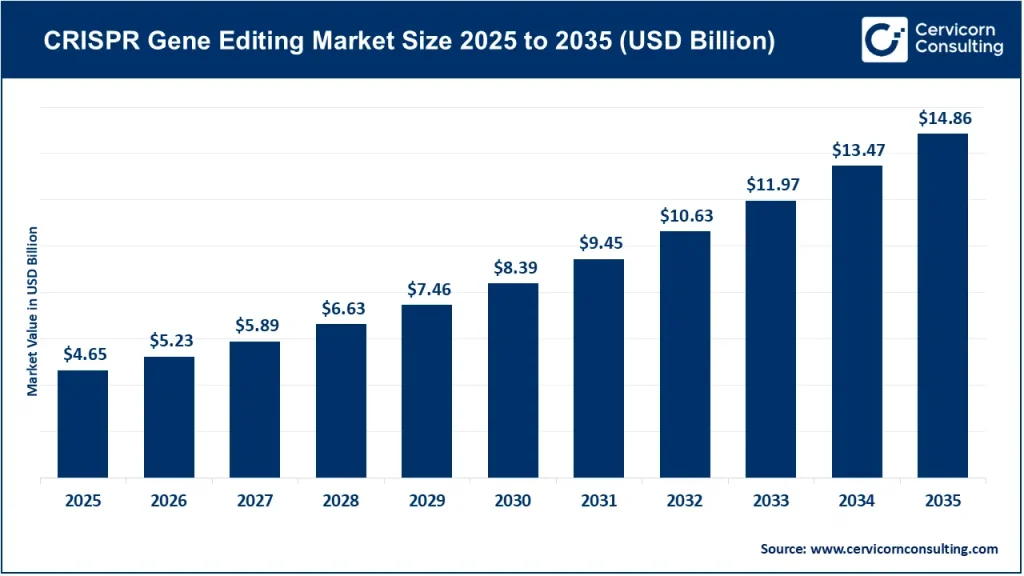
The global CRISPR gene editing market was valued at USD 4.65 billion in 2025 and is projected to reach approximately USD 14.86 billion by 2035, expanding at a CAGR of 12.32% from 2026 to 2035. The market is estimated at USD 5.23 billion in 2026.
Why CRISPR is becoming more relevant to therapeutic development
One of the strongest drivers of CRISPR adoption is the growing focus on diseases where conventional treatment approaches do not address the underlying genetic cause.
Genetic disorders, cancer, rare diseases, and hematological conditions have become important areas for genome-editing research. CRISPR can potentially modify disease-associated genetic material rather than simply managing symptoms, creating a different development pathway from conventional pharmaceuticals.
The clinical landscape has also moved beyond theoretical potential. Casgevy became the first approved CRISPR-Cas9-based therapy, marking an important transition from experimental gene editing toward commercialized treatment. A 2026 review of the clinical landscape describes the approval of Casgevy for sickle cell disease and transfusion-dependent beta-thalassemia as a major milestone for CRISPR therapeutics.
This transition changes the questions facing developers. Instead of asking whether CRISPR can edit a particular gene, organizations increasingly need to determine whether the editing approach can be delivered safely, validated consistently, manufactured at scale, and supported by sufficient clinical evidence.
The safety problem is becoming a development priority
Off-target editing remains one of the most important technical concerns surrounding therapeutic genome editing.
An editing system needs to reach the intended genetic sequence while minimizing unintended changes elsewhere in the genome. This makes sequencing, computational analysis, guide-RNA optimization, and increasingly sophisticated validation methods important components of the development process.
The U.S. FDA issued draft guidance in April 2026 specifically addressing the use of next-generation sequencing to assess genome-editing safety in human gene therapy products. The guidance discusses NGS-based approaches that may support nonclinical studies before clinical trials of investigational genome-editing products.
For developers, this means that the CRISPR workflow is expanding beyond the editing reaction itself. Analytical technologies, sequencing platforms, bioinformatics, and validation services are becoming increasingly connected to the commercial opportunity.
Base editing and prime editing are expanding the technology landscape
Traditional CRISPR-Cas systems are commonly associated with targeted DNA cutting. However, newer approaches such as base editing and prime editing are broadening the types of genetic modifications researchers can pursue.
These technologies are particularly relevant where developers want greater control over individual nucleotide changes or specific sequence modifications while potentially avoiding some of the challenges associated with conventional double-strand DNA breaks.
This does not eliminate safety and delivery challenges. Instead, it creates another layer of technology differentiation. Companies developing editing platforms must evaluate accuracy, editing efficiency, delivery compatibility, durability, scalability, and clinical applicability together.
For pharmaceutical and biotechnology companies, this makes technology selection increasingly strategic. The most useful editing platform may depend on the disease target, cell type, delivery method, manufacturing requirements, and regulatory pathway rather than on editing efficiency alone.
For detailed market sizing, segmentation and regional analysis, readers can request the CRISPR gene editing market sample report from Cervicorn Consulting.
Delivery could determine how quickly in vivo CRISPR expands
Another major bottleneck is delivery.
Ex vivo editing allows cells to be removed from a patient, modified under controlled conditions, tested, and subsequently administered. In vivo approaches, by comparison, require the editing machinery to reach the appropriate cells or tissues directly inside the body.
This makes delivery technologies such as viral vectors, lipid nanoparticles, and other non-viral systems increasingly important to the CRISPR ecosystem.
Cervicorn Consulting identifies next-generation delivery platforms as an important market opportunity, particularly as developers explore approaches that can improve safety, scalability, and tissue targeting.
The commercial implications extend beyond CRISPR developers themselves. Progress in delivery can create demand across vector manufacturing, lipid nanoparticles, formulation technologies, analytical testing, contract development and manufacturing, and specialized laboratory services.
Regulatory requirements are becoming more structured
As CRISPR therapies progress toward commercialization, regulatory requirements are becoming an increasingly important part of product development.
In April 2026, the FDA issued draft guidance focused on safety assessment for genome-editing products, while a separate June 2026 draft guidance discussed how developers could leverage prior knowledge when developing human gene therapies incorporating genome editing. The latter covers both ex vivo and in vivo genome editing of human somatic cells.
The FDA also issued a 2026 framework addressing individualized therapies for ultra-rare diseases, including genome-editing approaches where conventional randomized controlled trials may not be feasible because of very small patient populations.
For companies operating in this market, regulatory strategy is therefore becoming intertwined with technology development. Evidence generation, manufacturing controls, safety assessment, clinical design, and platform knowledge can influence development timelines and commercialization requirements.
CRISPR is not limited to human therapeutics
Healthcare receives much of the attention surrounding CRISPR, but the technology is also being developed for applications outside medicine.
In agriculture, genome editing is being investigated for characteristics such as disease resistance, drought tolerance, nutritional enhancement, and crop productivity. Industrial biotechnology is another emerging application, where genome editing can be used to modify microorganisms and biological production systems.
These applications can have different development economics and regulatory requirements from human therapeutics. As a result, the broader CRISPR market cannot be understood solely through the pharmaceutical pipeline.
Cervicorn Consulting’s market segmentation includes biomedical applications, agriculture, industrial biotechnology and synthetic biology, diagnostics and gene monitoring, reflecting the expanding range of commercial use cases.
AI is changing how CRISPR experiments are designed
The integration of artificial intelligence, computational biology, and CRISPR is another emerging development.
Guide-RNA design is a particularly relevant area because researchers need to identify sequences that can achieve the desired editing outcome while minimizing unintended activity. Computational models can help researchers evaluate potential targets and narrow experimental possibilities before laboratory testing.
This creates a connection between two rapidly developing technology markets: AI-driven biological design and genome editing.
The impact is potentially broader than guide-RNA selection. Computational tools can contribute to target identification, sequence analysis, off-target prediction, experimental design, and interpretation of large genomic datasets.
For research organizations, the resulting value proposition is not simply faster experimentation. It is the potential to reduce unnecessary laboratory iterations and improve the efficiency of increasingly complex genome-editing workflows.
North America remains the largest market, while Asia-Pacific expands
North America accounted for 44.1% of global CRISPR gene editing market revenue in 2025, supported by established biotechnology clusters, substantial R&D investment, research infrastructure, and clinical adoption. Cervicorn estimates the North American market at USD 2.05 billion in 2025, with the potential to reach approximately USD 6.55 billion by 2035.
Europe represents another important market, supported by translational research capabilities and a strong focus on regulatory oversight and patient safety.
Asia-Pacific is becoming increasingly significant because of expanding biotechnology capabilities across China, Japan, South Korea, India, and other markets. Cervicorn estimates that the Asia-Pacific CRISPR gene editing market will increase from approximately USD 1.00 billion in 2025 to USD 3.20 billion by 2035.
The regional differences matter for companies assessing market opportunities. Research infrastructure, clinical-trial activity, regulatory frameworks, agricultural applications, manufacturing capabilities, and government-supported biotechnology programs can all influence the commercial potential of CRISPR technologies.
What companies need to watch next
The next stage of CRISPR market development is likely to depend less on the novelty of gene editing itself and more on how effectively the technology can solve development and commercialization challenges.
For pharmaceutical and biotechnology companies, important questions include:
- Which editing technology is most appropriate for the target disease or application?
- Can the editing system reach the required tissue or cell type?
- How can off-target activity be detected and reduced?
- What analytical and sequencing capabilities are required?
- Can the manufacturing process be scaled consistently?
- How will regulatory requirements affect clinical development timelines?
- Where can AI and computational biology reduce experimental complexity?
- Which applications outside human therapeutics offer commercially viable opportunities?
These questions are also relevant for CROs, CDMOs, research institutions, sequencing companies, reagent manufacturers, delivery-platform developers, and technology providers.
The CRISPR market is therefore developing as an ecosystem rather than a single technology category. Growth will depend on progress across editing platforms, delivery systems, analytical tools, software, laboratory services, manufacturing, clinical development, and regulatory infrastructure.
As CRISPR moves further from laboratory experimentation toward broader clinical and commercial applications, understanding these interconnected market dynamics becomes increasingly important for organizations evaluating investment, partnerships, product development, and expansion opportunities.
To Get Detailed Overview, Contact Us: https://www.cervicornconsulting.com/contact-us
Read Report: How Solid State Batteries Are Solving the Safety and Performance Limits of Conventional Batteries