


Table of Contents
ToggleCO2 Separation Membrane Market Size
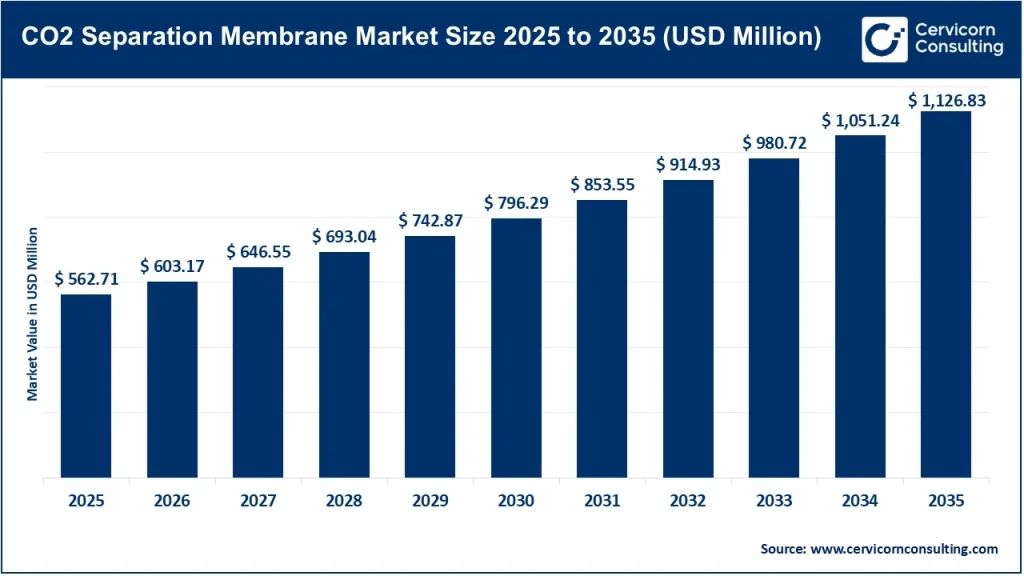
The global CO2 separation membrane market was valued at approximately USD 562.71 million in 2025 and is projected to reach nearly USD 1,126.83 million by 2035, growing at a CAGR of 7.2%.
Why is the CO2 Separation Membrane Market Important?
The growing urgency to address climate change has placed carbon capture technologies at the center of global sustainability strategies. CO2 separation membranes play a crucial role in capturing carbon emissions from industrial processes before they enter the atmosphere. They help industries reduce their carbon footprint while maintaining operational efficiency. These membranes are also essential for producing cleaner natural gas, upgrading biogas into renewable natural gas (RNG), supporting hydrogen production, and enabling carbon capture initiatives in power plants and manufacturing facilities.
The technology’s importance extends beyond environmental benefits. Membrane systems often require less energy than traditional separation methods, making them economically attractive. Their modular nature allows easy scaling, which is particularly beneficial for emerging carbon capture projects and decentralized industrial facilities.
CO2 Separation Membrane Market Growth Factors
The CO2 separation membrane market is experiencing strong growth due to rising global investments in carbon capture and storage projects, stricter emissions regulations across developed and emerging economies, increasing adoption of biogas upgrading systems, growing demand for low-carbon hydrogen production, technological advancements in polymeric and ceramic membrane materials, expanding natural gas processing activities, government incentives supporting decarbonization initiatives, the rapid development of CCUS infrastructure, increasing industrial focus on energy-efficient separation technologies, and growing corporate commitments toward net-zero emissions targets. Furthermore, advancements in mixed-matrix membranes, graphene-based materials, and all-carbon membrane technologies are significantly improving separation efficiency and reducing operating costs, accelerating market adoption across multiple industries.
Get a Free Sample: https://www.cervicornconsulting.com/sample/2964
Major Companies Operating in the CO2 Separation Membrane Market
Competitive Landscape Overview
The market is characterized by the presence of global membrane technology leaders, engineering companies, specialty material manufacturers, and industrial gas solution providers. Key participants focus heavily on R&D investments, strategic partnerships, pilot projects, and commercialization of next-generation membrane systems.
Leading Company Profiles
| Company | Specialization | Key Focus Areas | Notable Features | 2025 Revenue* | Estimated Market Share* | Global Presence |
|---|---|---|---|---|---|---|
| BORSIG GmbH | Industrial gas separation membranes | Natural gas processing, petrochemicals, carbon capture | High-performance membrane systems for complex industrial applications | Private company (not publicly disclosed) | Significant niche participant | Europe, Middle East, Asia-Pacific |
| Pall Corporation | Advanced filtration and membrane technologies | Carbon management, industrial gas purification | Extensive expertise in separation technologies | Subsidiary revenue not separately disclosed | Established global supplier | North America, Europe, Asia-Pacific |
| Toray Industries, Inc. | Polymeric and carbon-based membranes | Environmental technologies, biogas upgrading, carbon capture | Advanced all-carbon CO2 separation membranes | Approximately USD 18-20 billion corporate revenue | Leading market participant | More than 30 countries worldwide |
| UBE Corporation | Gas separation membrane technologies | Biomethane production, sustainable energy solutions | Strong expertise in polyimide membrane systems | Approximately USD 4-5 billion corporate revenue | Major membrane supplier | Asia, Europe, Americas |
| NGK INSULATORS, LTD. | Ceramic and advanced membrane technologies | Carbon capture, industrial gas separation | High-performance ceramic membrane innovations | Approximately USD 4-5 billion corporate revenue | Important technology provider | Global operations across major industrial regions |
*Revenue figures represent total corporate revenue estimates where dedicated CO2 membrane revenues are not publicly disclosed. Market shares are indicative because the CO2 separation membrane industry remains fragmented.
Leading Trends Shaping the CO2 Separation Membrane Market
1. Expansion of Carbon Capture, Utilization, and Storage (CCUS)
Governments and industries worldwide are investing heavily in CCUS infrastructure. Membrane-based CO2 separation technologies are increasingly selected because they offer lower energy requirements compared with solvent-based systems. As large-scale carbon capture projects become more common, membrane demand is expected to rise substantially.
Impact
- Increased deployment in power plants
- Growth in industrial carbon capture facilities
- Higher investment in membrane manufacturing capacity
2. Growth of the Biogas Upgrading Industry
Biogas produced from agricultural waste, wastewater treatment plants, and landfills contains significant amounts of CO2. Membrane systems efficiently remove CO2 and impurities to produce high-purity biomethane.
Impact
- Expanded adoption in renewable energy projects
- Greater demand for modular membrane systems
- Increased opportunities in Europe and North America
3. Development of All-Carbon Membranes
Manufacturers are developing advanced carbon-based membranes with superior selectivity and permeability. Toray’s investments in all-carbon membrane technologies illustrate this trend.
Impact
- Improved separation efficiency
- Reduced operational costs
- Enhanced commercial viability
4. Integration with Hydrogen Production
The hydrogen economy is expanding rapidly. CO2 separation membranes are increasingly used in blue hydrogen production facilities to capture carbon emissions generated during hydrogen manufacturing.
Impact
- New growth opportunities
- Greater collaboration between hydrogen and membrane industries
- Expansion of industrial gas processing applications
5. Artificial Intelligence and Process Optimization
Industrial operators are utilizing AI-driven monitoring systems to improve membrane performance and extend membrane life cycles.
Impact
- Reduced maintenance costs
- Improved operational reliability
- Increased adoption among industrial users
Successful Examples of CO2 Separation Membrane Applications Around the World
Natural Gas Processing in North America
The United States has become one of the largest adopters of membrane-based CO2 removal technologies in natural gas processing. Membrane systems help producers meet pipeline-quality gas standards while reducing processing costs.
Key Benefits
- Lower energy consumption
- Reduced infrastructure footprint
- Enhanced gas quality
Biogas Upgrading in Germany
Germany’s renewable energy sector extensively utilizes membrane technologies to upgrade biogas into biomethane. These systems support the country’s renewable gas initiatives and carbon neutrality objectives.
Results
- Increased renewable gas production
- Reduced greenhouse gas emissions
- Enhanced energy security
Carbon Capture Projects in Japan
Japanese companies such as Toray, UBE, and NGK have pioneered advanced membrane solutions for industrial carbon capture projects. Their innovations are helping industries achieve stricter environmental targets.
Results
- Improved capture efficiency
- Commercialization of next-generation membranes
- Expansion into global markets
Renewable Natural Gas Projects in Europe
European wastewater treatment plants and landfill facilities increasingly deploy membrane technologies to convert biogas into market-ready renewable natural gas.
Results
- Diversification of energy sources
- Increased circular economy initiatives
- Enhanced waste-to-energy economics
Global Regional Analysis
North America
North America remains a leading market due to extensive carbon capture initiatives, large-scale natural gas production, and supportive federal policies.
Government Initiatives and Policies
- Expansion of carbon capture tax incentives.
- Federal funding for CCUS demonstration projects.
- Support for clean hydrogen production programs.
- Incentives for industrial decarbonization investments.
Market Outlook
The region benefits from significant investments in carbon management infrastructure and advanced manufacturing capabilities, making it a key hub for membrane technology deployment.
Europe
Europe represents one of the most mature markets for CO2 separation technologies due to ambitious climate policies and strong renewable energy adoption.
Government Initiatives and Policies
- European Green Deal.
- Net-Zero Industry Act.
- Carbon Border Adjustment Mechanism (CBAM).
- Emissions Trading System (ETS).
Market Outlook
European industries increasingly invest in membrane technologies to reduce compliance costs associated with carbon emissions and achieve sustainability targets.
Asia-Pacific
Asia-Pacific is expected to witness the fastest growth due to rapid industrialization, increasing carbon reduction commitments, and growing investments in hydrogen and renewable energy.
Government Initiatives and Policies
China
- Carbon neutrality target by 2060.
- Major investments in carbon capture infrastructure.
- Support for clean energy technologies.
Japan
- Green Growth Strategy.
- Hydrogen economy development programs.
- Industrial decarbonization incentives.
South Korea
- Korean New Deal initiatives.
- Carbon-neutral industrial transformation programs.
India
- National Green Hydrogen Mission.
- Expanding renewable energy policies.
- Industrial emission reduction initiatives.
Market Outlook
The region’s rapidly expanding manufacturing base and growing environmental awareness create substantial opportunities for membrane technology providers.
Middle East and Africa
The Middle East is increasingly adopting CO2 separation membranes within natural gas processing and hydrogen production projects.
Government Initiatives and Policies
- National hydrogen strategies in Gulf countries.
- Carbon capture investments by energy producers.
- Diversification initiatives beyond traditional oil revenues.
Market Outlook
The region’s abundant natural gas resources and growing hydrogen ambitions are expected to drive membrane adoption.
Latin America
Latin America is emerging as a promising market due to growing renewable energy investments and increasing biogas production.
Government Initiatives and Policies
- Renewable natural gas promotion programs.
- Clean energy transition strategies.
- Incentives for waste-to-energy projects.
Market Outlook
Countries such as Brazil, Argentina, and Mexico are expected to increase investments in membrane-based biogas upgrading systems as part of broader sustainability goals.
Future Opportunities in the CO2 Separation Membrane Market
Several opportunities are expected to accelerate market expansion during the coming decade:
- Large-scale deployment of CCUS projects.
- Growth of renewable natural gas infrastructure.
- Expansion of blue and green hydrogen ecosystems.
- Commercialization of graphene and mixed-matrix membranes.
- Rising industrial decarbonization investments.
- Increasing adoption in cement, steel, and chemical industries.
- Development of low-cost, high-selectivity membrane materials.
- Integration with digital monitoring and predictive maintenance systems.
As governments, industries, and investors continue prioritizing carbon reduction strategies, CO2 separation membranes are positioned to become one of the most important technologies enabling the transition toward a low-carbon global economy.
To Get Detailed Overview, Contact Us: https://www.cervicornconsulting.com/contact-us
Read Report: Cloud AI Market Revenue, Trends, and Strategic Insights by 2035