


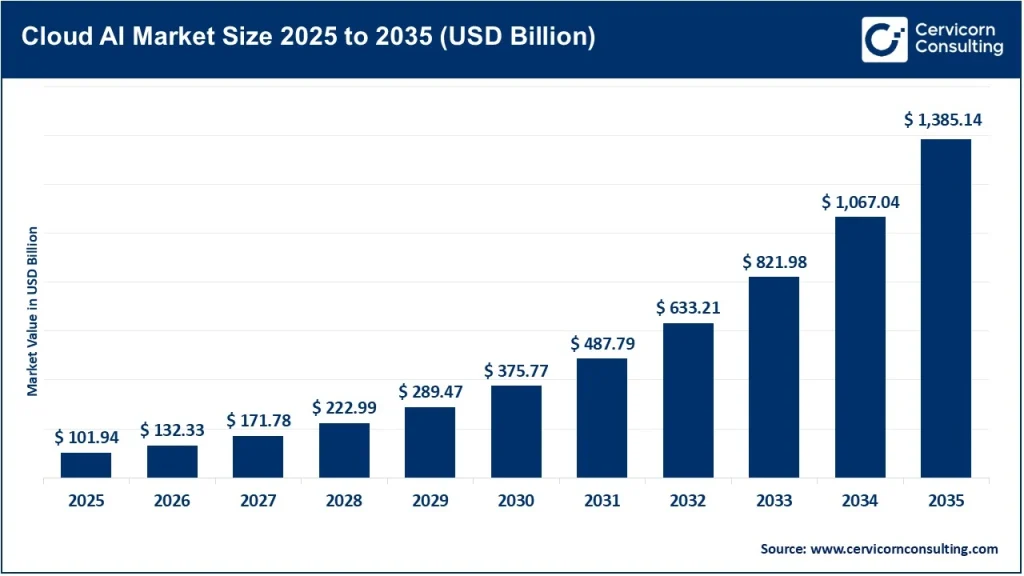
Cloud AI Market Size
What is the Cloud AI Market?
The cloud AI market refers to the ecosystem of cloud-based artificial intelligence solutions, platforms, infrastructure, and services that enable organizations to access AI capabilities through cloud environments. These services include machine learning (ML), natural language processing (NLP), computer vision, predictive analytics, generative AI, speech recognition, and AI-powered automation.
Instead of investing heavily in on-premises AI infrastructure, organizations can leverage cloud AI platforms to access scalable computing resources, pre-trained AI models, AI development tools, and managed services on a pay-as-you-go basis. Major cloud providers offer comprehensive AI ecosystems that simplify model development, training, deployment, and monitoring while reducing operational complexity.
Cloud AI encompasses:
- AI Infrastructure as a Service (AI-IaaS)
- AI Platform as a Service (AI-PaaS)
- AI Software as a Service (AI-SaaS)
- Machine Learning Operations (MLOps)
- Generative AI Platforms
- AI-enabled Analytics Solutions
Get a Free Sample: http://cervicornconsulting.com/sample/2961
Why is the Cloud AI Market Important?
The importance of the cloud AI market lies in its ability to democratize access to advanced artificial intelligence technologies. Historically, AI implementation required substantial investments in computing infrastructure and specialized expertise. Cloud AI eliminates many of these barriers.
Key reasons why cloud AI is important include:
Accelerated Innovation
Organizations can rapidly experiment with AI applications without investing in expensive hardware or infrastructure.
Cost Efficiency
Cloud-based AI services reduce capital expenditures by offering flexible subscription-based pricing models.
Scalability
Businesses can instantly scale AI workloads according to demand, ensuring optimal resource utilization.
Faster Deployment
Pre-built AI services and APIs accelerate development cycles and reduce time-to-market.
Enhanced Accessibility
Small and medium-sized enterprises can leverage enterprise-grade AI capabilities previously available only to large corporations.
Global Collaboration
Cloud platforms enable geographically distributed teams to develop, train, and deploy AI models collaboratively.
Data-Driven Decision Making
Cloud AI helps organizations analyze massive datasets in real time, improving operational and strategic decisions.
Cloud AI Market Growth Factors
The cloud AI market is experiencing substantial growth due to the rapid adoption of generative AI technologies, increasing enterprise digital transformation initiatives, growing demand for scalable computing infrastructure, rising investments in AI-driven automation, expansion of hybrid and multi-cloud environments, proliferation of big data analytics, advancements in machine learning algorithms, increasing demand for real-time decision intelligence, widespread adoption of IoT-connected devices, growing cybersecurity requirements, enhanced cloud-native application development, increasing government support for AI innovation, and the availability of high-performance GPUs and AI accelerators through cloud platforms. Additionally, organizations are increasingly leveraging cloud AI to improve operational efficiency, customer engagement, predictive maintenance, supply chain optimization, healthcare diagnostics, and financial risk management, further accelerating market expansion worldwide.
Major Companies Operating in the Cloud AI Market
The cloud AI market is dominated by several global technology leaders that provide AI infrastructure, platforms, and services.
| Company | Specialization | Key Focus Areas | Notable Features | 2025 Revenue* | Market Share** | Global Presence |
|---|---|---|---|---|---|---|
| Microsoft Corporation | Azure AI, Generative AI, Enterprise AI | AI infrastructure, Copilot, OpenAI integration | Azure AI Studio, Azure OpenAI Service | ~$75 Billion Cloud Revenue | ~21% | 60+ cloud regions worldwide |
| Amazon Web Services (AWS) | AI Infrastructure, ML Services | Generative AI, Bedrock, AI chips | SageMaker, Bedrock, Trainium, Inferentia | ~$128.7 Billion | ~28% | Global availability zones across continents |
| Google Cloud | AI Platforms, Data Analytics | Gemini AI, Vertex AI, Data Cloud | Vertex AI, Gemini Models | ~$58.8 Billion | ~15% | Extensive multinational cloud footprint |
| Oracle Corporation | Enterprise Cloud AI | Database AI, Industry Cloud Solutions | Oracle AI Agents, OCI AI Services | ~$27 Billion Run Rate | ~3-4% | 160+ cloud regions operational/planned |
| IBM Corporation | Hybrid Cloud AI | Watson AI, Enterprise Automation | Watsonx Platform, AI Governance | ~$26 Billion Total Revenue | ~2-3% | Operations in 170+ countries |
*Revenue figures represent cloud-related or cloud business estimates for 2025.
**Market share estimates reflect global cloud infrastructure positioning.
Company Profiles
Microsoft Corporation
Microsoft continues to strengthen its leadership through Azure AI services, Copilot solutions, and deep integration with OpenAI technologies. The company focuses heavily on enterprise AI adoption, productivity enhancement, and responsible AI frameworks.
Amazon Web Services
AWS remains the largest cloud provider globally, offering extensive AI capabilities through Amazon Bedrock, SageMaker, and custom AI chips. Its infrastructure leadership provides a strong foundation for enterprise AI deployment.
Google Cloud
Google Cloud leverages its expertise in machine learning and data analytics to offer advanced AI solutions. The company’s Gemini models and Vertex AI platform continue to gain enterprise adoption.
Oracle Corporation
Oracle is expanding rapidly through Oracle Cloud Infrastructure (OCI), focusing on AI-enabled databases, enterprise applications, and industry-specific cloud solutions.
IBM Corporation
IBM’s Watsonx platform emphasizes trustworthy AI, governance, and hybrid cloud deployment models, particularly for regulated industries.
Leading Trends and Their Impact on the Cloud AI Market
1. Generative AI Integration
Generative AI has become the primary growth catalyst for cloud AI adoption. Organizations are integrating large language models into customer service, software development, content creation, and business intelligence workflows.
Impact
- Increased cloud consumption
- Higher demand for AI infrastructure
- Expanded enterprise AI spending
- New revenue opportunities for cloud providers
2. AI-as-a-Service (AIaaS)
Organizations increasingly prefer consuming AI capabilities as managed cloud services rather than building models from scratch.
Impact
- Lower barriers to adoption
- Faster implementation timelines
- Greater SME participation
- Increased subscription revenues
3. Hybrid and Multi-Cloud AI
Enterprises are deploying AI workloads across multiple cloud environments to improve resilience and optimize costs.
Impact
- Reduced vendor lock-in
- Enhanced operational flexibility
- Increased interoperability requirements
4. Industry-Specific AI Solutions
Cloud vendors are creating tailored AI offerings for healthcare, manufacturing, financial services, retail, and telecommunications.
Impact
- Faster adoption in regulated sectors
- Improved ROI from AI investments
- Stronger vertical market penetration
5. AI Governance and Responsible AI
Organizations are prioritizing transparency, fairness, security, and compliance in AI deployments.
Impact
- Increased investment in AI governance tools
- Stronger regulatory compliance
- Greater customer trust
6. Edge AI and Distributed Computing
AI workloads are increasingly being processed closer to data sources.
Impact
- Reduced latency
- Enhanced real-time analytics
- Improved IoT integration
7. AI-Powered Cybersecurity
AI is becoming a critical component of cloud security strategies.
Impact
- Faster threat detection
- Automated response capabilities
- Improved risk management
Successful Examples of Cloud AI Market Implementation Around the World
Healthcare: AI-Assisted Diagnostics
Healthcare providers globally use cloud AI platforms to analyze medical images, identify diseases earlier, and improve patient outcomes. Cloud-based AI models assist radiologists in detecting cancers and neurological disorders with greater accuracy.
Financial Services: Fraud Detection
Banks and financial institutions deploy cloud AI solutions to monitor transactions in real time, identify suspicious activities, and prevent fraud. Machine learning algorithms continuously learn from evolving threat patterns.
Retail: Personalized Shopping Experiences
Global retailers leverage cloud AI to analyze consumer behavior, optimize inventory, and provide personalized product recommendations, significantly improving customer engagement.
Manufacturing: Predictive Maintenance
Manufacturers use cloud AI to monitor industrial equipment and predict maintenance requirements before failures occur, reducing downtime and operational costs.
Transportation: Intelligent Logistics
Logistics providers employ cloud AI for route optimization, fleet management, demand forecasting, and warehouse automation.
Telecommunications: Network Optimization
Telecom operators utilize AI-driven cloud platforms to optimize network performance, improve customer service, and automate infrastructure management.
Smart Cities
Governments worldwide deploy cloud AI solutions for traffic management, public safety monitoring, environmental sustainability, and urban planning.
Global Regional Analysis
North America
North America remains the largest cloud AI market due to strong technology infrastructure, significant AI investments, and the presence of major cloud providers.
Key Drivers
- Strong enterprise digital transformation
- Advanced cloud infrastructure
- Significant venture capital investment
- High AI adoption rates
Government Initiatives
The United States continues investing in national AI strategies, research funding, semiconductor development, and responsible AI frameworks. Government agencies increasingly utilize cloud AI technologies for defense, healthcare, and public administration applications.
Market Outlook
The region is expected to maintain leadership through continuous innovation and AI commercialization.
Europe
Europe is witnessing rapid cloud AI adoption across manufacturing, healthcare, automotive, and financial services sectors.
Key Drivers
- Industrial automation
- Smart manufacturing initiatives
- Sustainable AI development
- Data sovereignty requirements
Government Initiatives
The European Union’s AI Act is shaping responsible AI deployment while encouraging innovation. Governments across Germany, France, and the Nordic countries are funding AI research and digital transformation programs.
Market Outlook
Europe is expected to remain a significant growth hub, particularly for ethical and regulated AI solutions.
Asia-Pacific
Asia-Pacific is projected to be the fastest-growing cloud AI market.
Key Drivers
- Rapid digitalization
- Expanding internet penetration
- Growing startup ecosystem
- Smart city initiatives
Government Initiatives
Countries such as China, India, Japan, Singapore, and South Korea have launched national AI strategies focused on innovation, workforce development, and infrastructure expansion.
India’s Digital India initiatives and AI-focused programs are encouraging adoption across healthcare, agriculture, education, and public services. China continues significant investments in AI research, cloud infrastructure, and intelligent manufacturing.
Market Outlook
The region is expected to generate substantial growth opportunities due to large-scale digital transformation and increasing enterprise AI investments.
Latin America
Latin America is gradually emerging as an attractive cloud AI market.
Key Drivers
- Expanding cloud adoption
- Growing fintech ecosystem
- Digital banking transformation
- Increasing internet connectivity
Government Initiatives
Governments in Brazil, Mexico, Chile, and Colombia are supporting digital innovation through cloud adoption programs and AI development strategies.
Market Outlook
Growth will be supported by increasing technology investments and modernization initiatives.
Middle East and Africa
The Middle East and Africa are experiencing significant cloud AI adoption, particularly in smart city development and public sector modernization.
Key Drivers
- Digital transformation initiatives
- Smart infrastructure projects
- Growing cloud investments
- Expansion of data centers
Government Initiatives
Countries including the UAE and Saudi Arabia have introduced national AI strategies aimed at economic diversification, innovation, and technological leadership. Major investments are being directed toward AI research centers, digital infrastructure, and public-sector AI applications.
Market Outlook
The region is expected to experience strong growth as governments accelerate digital transformation agendas.
Government Initiatives and Policies Shaping the Market
Governments worldwide recognize AI as a strategic technology and are actively supporting cloud AI development through policy frameworks and investments.
Key policy areas include:
- National AI strategies
- AI research funding
- Digital transformation programs
- Cloud-first government policies
- Data governance regulations
- AI ethics and responsible AI guidelines
- Cybersecurity frameworks
- Workforce reskilling initiatives
- Semiconductor and AI infrastructure investments
- Public-private AI partnerships
These initiatives are creating favorable conditions for innovation while ensuring secure, ethical, and transparent AI deployment across industries.
The continued alignment of government policies, enterprise investment, and technological innovation is expected to sustain strong growth in the cloud AI market throughout the coming decade.
To Get Detailed Overview, Contact Us: https://www.cervicornconsulting.com/contact-us
Read Report: Data Center Power Market Revenue, Trends, and Strategic Insights by 2035