


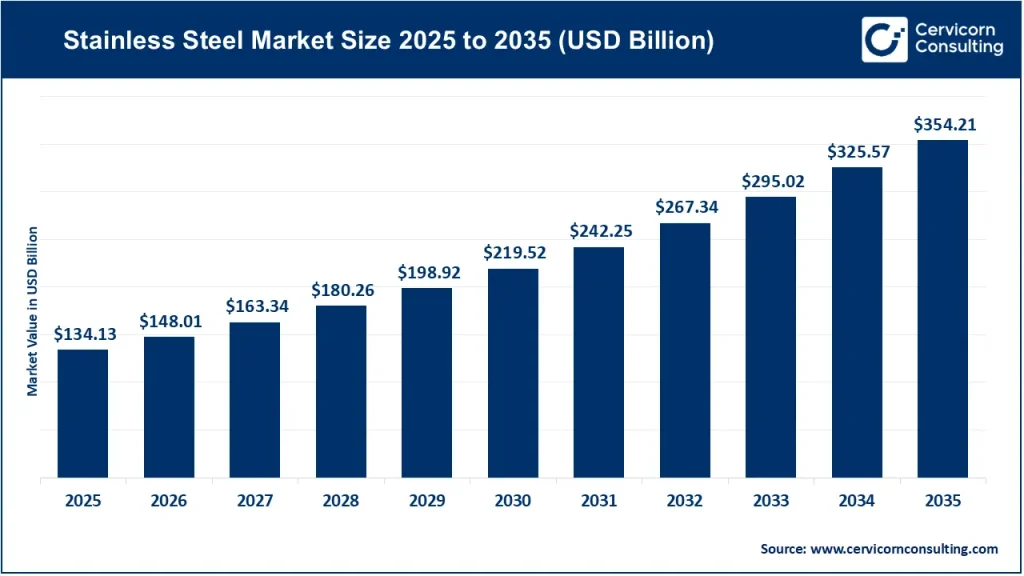
Stainless Steel Market Size
The global stainless steel market was valued at USD 134.13 billion in 2025 and is projected to reach approximately USD 354.21 billion by 2035, expanding at a 10.2% CAGR from 2026 to 2035.
Stainless Steel Market Growth Factors
The global stainless steel market is being driven by rising infrastructure development, urbanization, construction activity, automotive production, industrial manufacturing, food processing, chemical processing, energy infrastructure, and consumer demand for durable and corrosion-resistant materials. Stainless steel’s combination of strength, corrosion resistance, recyclability, hygiene, aesthetic appeal, and relatively low maintenance requirements continues to support adoption across building and construction, transportation, consumer goods, medical equipment, industrial machinery, food and beverage processing, and chemical applications.
Growing adoption of electric vehicles, renewable-energy infrastructure, high-performance industrial equipment, modern architecture, smart appliances, and hygienic processing systems is further creating opportunities for stainless-steel producers. At the same time, the transition toward low-carbon steelmaking, higher scrap utilization, electric arc furnaces, hydrogen-based production, and circular manufacturing is reshaping investment priorities across the industry.
Get a Free Sample: https://www.cervicornconsulting.com/sample/2759
What Is the Stainless Steel Market?
The stainless steel market encompasses the production, processing, distribution, and consumption of steel alloys containing sufficient chromium to provide enhanced resistance to corrosion and oxidation. Stainless steel is manufactured in several grades and forms, including austenitic, ferritic, martensitic, duplex, and precipitation-hardening grades. Among these, the 300 series is particularly important because of its corrosion resistance, formability, and broad applicability.
The market includes products such as stainless-steel sheets, plates, coils, bars, rods, tubes, pipes, wires, and fabricated components. Flat products account for a substantial portion of demand because they are widely used in construction, automotive components, appliances, food-processing equipment, industrial machinery, and architectural applications.
The material’s ability to withstand harsh environments while maintaining mechanical performance makes stainless steel particularly valuable in applications where product life, hygiene, reliability, and appearance are important.
Why Is the Stainless Steel Market Important?
Stainless steel is strategically important because it supports several interconnected industrial sectors. In construction, it is used for structural components, façades, roofing, railings, bridges, elevators, and architectural finishes. In transportation, stainless steel contributes to vehicle exhaust systems, railcars, automotive components, and specialized transportation equipment.
The material is also critical for food and beverage processing because its corrosion resistance and cleanability support stringent hygiene requirements. Chemical and petrochemical industries use stainless steel in tanks, pipelines, heat exchangers, and processing equipment exposed to aggressive chemicals.
Healthcare is another important application area. Stainless steel is used in surgical instruments, medical equipment, hospital furniture, sterilization equipment, and other products where durability and hygiene are essential.
The market also contributes to the circular economy because stainless steel can be repeatedly recycled while retaining its fundamental properties. This makes scrap collection, sorting, remelting, and electric-arc-furnace production increasingly important to the industry’s sustainability strategy.
Major Companies in the Stainless Steel Market
Tata Steel
Specialization: Integrated steel production, flat and long steel products, specialty steels, downstream products, and sustainable steel solutions.
Key Focus Areas: Tata Steel focuses heavily on India, automotive steel, construction, industrial applications, advanced materials, recycling, and low-carbon steel production.
Notable Features: Tata Steel is one of the world’s geographically diversified steel producers, with operations across India, Europe, Southeast Asia, and North America. Its FY2024-25 consolidated revenue was ₹2,18,543 crore, while EBITDA reached ₹25,802 crore. The company reported record Indian crude-steel production of approximately 21.7 million tonnes during FY2025.
By FY2025-26, Tata Steel reported consolidated turnover of ₹2,32,140 crore, consolidated production of 31.67 million tonnes, and deliveries of 31.97 million tonnes. The company also inaugurated its first scrap-based electric arc furnace in Ludhiana, Punjab, strengthening its recycling and lower-carbon production strategy.
2025 Revenue: ₹2,18,543 crore for FY2024-25.
Market Share: Tata Steel does not publicly disclose a standalone global stainless-steel market-share percentage.
Global Presence: India, the United Kingdom, the Netherlands and other European markets, Southeast Asia, and North America.
Zhangjiagang Pohang Stainless Steel
Specialization: Stainless steel production, particularly stainless-steel flat products for industrial and consumer applications.
Key Focus Areas: China, stainless-steel manufacturing, downstream industrial customers, and Asian supply chains.
Notable Features: POSCO Zhangjiagang Stainless Steel was historically an important part of POSCO’s overseas stainless-steel footprint in China. However, POSCO resolved in July 2025 to sell its equity interest in the company, and it was subsequently excluded from POSCO’s consolidated steel segment from 2025.
The available POSCO data indicate that Zhangjiagang POSCO Stainless Steel generated approximately USD 1.73 billion in revenue in 2025, compared with USD 2.26 billion in 2024. Its 2025 operating profit was reported at approximately negative USD 141 million, illustrating the pressure facing stainless-steel producers amid overcapacity and challenging market conditions.
2025 Revenue: Approximately USD 1.73 billion.
Market Share: A standalone global market-share percentage is not publicly disclosed.
Global Presence: Primarily China, with its importance historically linked to POSCO’s broader Asian stainless-steel network.
POSCO
Specialization: Integrated steel production, stainless steel, automotive steel, plates, hot-rolled and cold-rolled products, and advanced steel materials.
Key Focus Areas: Automotive steel, stainless steel, high-value products, low-carbon steel, overseas production, and advanced materials.
Notable Features: POSCO operates major steelworks at Pohang and Gwangyang in South Korea and maintains an extensive international network. Its stainless-steel products serve household goods, chemical processing, paper manufacturing, aviation, automotive, construction, and food-processing industries.
POSCO reported 2.364 million tonnes of stainless-steel product deliveries in 2025, equivalent to 8.2% of its sales volume of principal steel products sold directly to external customers. Stainless steel represented 18.7% of the revenue generated from those principal steel products. POSCO also estimated its domestic South Korean stainless-steel market share at approximately 52% in 2025.
2025 Revenue: POSCO Holdings reported consolidated sales of KRW 69.095 trillion in 2025.
Market Share: Approximately 52% of South Korea’s stainless-steel market, according to POSCO’s 2025 business reporting; this is not a global market-share figure.
Global Presence: South Korea, China, Indonesia, India, Vietnam, Mexico, and other international markets.
Thyssenkrupp
Specialization: High-quality steel, stainless steel, specialty materials, processing, and industrial solutions.
Key Focus Areas: Automotive materials, industrial steel, stainless steel, advanced materials, processing, and decarbonization.
Notable Features: Thyssenkrupp has historically maintained a strong position in European specialty and stainless-steel markets. Its stainless-steel activities serve demanding applications where surface quality, corrosion resistance, strength, and precise material characteristics are required.
The company’s steel operations are increasingly influenced by Europe’s industrial decarbonization agenda. The transformation toward lower-emission steel production is becoming a central factor in capital allocation, production technology, energy sourcing, and customer relationships.
2025 Revenue: Thyssenkrupp’s consolidated revenue should be interpreted at group level rather than as stainless-steel revenue, since the company does not separately report a comparable global stainless-steel revenue figure.
Market Share: A standalone global stainless-steel market-share figure is not publicly disclosed.
Global Presence: Germany and wider Europe, with international operations serving automotive, industrial, engineering, and materials customers.
ArcelorMittal
Specialization: Integrated steel production, flat steel, long steel, advanced high-strength steel, coated products, and specialized steel solutions.
Key Focus Areas: Automotive, construction, industrial manufacturing, infrastructure, high-value-added steel, recycling, and decarbonization.
Notable Features: ArcelorMittal is one of the world’s largest steel producers, with a broad geographic footprint and a significant presence across Europe, North America, South America, Africa, and other markets. Although stainless steel is not its sole business focus, its scale, research capabilities, global customer network, and advanced steel portfolio make it an important participant in the broader specialty-steel ecosystem.
2025 Revenue: Group revenue should be used for comparison because stainless-steel revenue is not separately disclosed on a directly comparable basis.
Market Share: A standalone global stainless-steel market-share figure is not publicly disclosed.
Global Presence: Europe, North America, South America, Africa, and other international markets.
Leading Trends and Their Impact on the Stainless Steel Market
Expansion of Construction and Infrastructure
Infrastructure modernization is one of the most important long-term demand drivers. Stainless steel is increasingly used in bridges, transit systems, airports, commercial buildings, rail stations, public infrastructure, façades, elevators, and architectural applications.
Rapid urbanization in India, Southeast Asia, the Middle East, and parts of Africa is supporting demand for durable construction materials. Stainless steel’s longer service life can reduce maintenance requirements, particularly in humid, coastal, industrial, and polluted environments.
Growth of Automotive and Electric Vehicles
The automotive sector is expanding its use of advanced steel materials as manufacturers balance lightweighting, safety, durability, corrosion resistance, and vehicle performance.
Electric vehicles are creating new requirements for battery enclosures, thermal-management systems, structural components, charging infrastructure, and specialized corrosion-resistant materials. This creates opportunities for stainless-steel grades designed for demanding electrical and thermal environments.
Rising Demand for Sustainable Materials
Sustainability is becoming a competitive differentiator. Stainless steel’s recyclability supports circular material flows, while producers are investing in scrap-based electric arc furnaces, renewable electricity, energy efficiency, hydrogen, carbon capture, and other low-carbon technologies.
India, for example, has established a Green Steel Taxonomy intended to define and promote lower-emission steel and support investment in green production technologies.
Expansion of Food and Beverage Processing
Global demand for processed foods, beverages, dairy products, pharmaceutical products, and packaged food is increasing the need for hygienic processing equipment. Stainless steel is preferred because it is relatively easy to clean, resistant to corrosion, and compatible with stringent sanitation requirements.
This trend is particularly relevant in emerging markets where food-processing infrastructure is expanding alongside rising urban populations and changing consumption patterns.
Increasing Industrial and Chemical Applications
Chemical, petrochemical, pharmaceutical, water-treatment, and industrial-processing facilities require materials capable of operating under corrosive and high-temperature conditions. Duplex and high-performance stainless-steel grades are particularly important in these applications.
As industrial capacity expands in Asia and the Middle East, demand is shifting toward higher-value stainless-steel products capable of supporting more demanding operating conditions.
Low-Carbon Manufacturing
Decarbonization is transforming steelmaking. Producers are evaluating electric arc furnaces, hydrogen-based direct reduced iron, renewable energy, carbon capture, material efficiency, and increased scrap utilization.
India’s Ministry of Steel has identified energy efficiency, renewable energy, green hydrogen, material efficiency, process transition, carbon capture, utilization and storage, and biochar as important pathways for the industry’s green transition.
Successful Examples of Stainless Steel Market Development Around the World
India’s Recycling and Green Steel Transition
India is developing a broader framework for lower-carbon steel production while simultaneously expanding domestic steel capacity. The government’s Production Linked Incentive Scheme for Specialty Steel is designed to encourage investment and domestic manufacturing. The government has indicated an anticipated additional investment of ₹27,106 crore under the specialty-steel PLI framework, alongside downstream capacity creation of approximately 24 million tonnes.
Tata Steel’s scrap-based electric arc furnace in Ludhiana represents a practical example of increasing scrap utilization and developing a more circular steel-production model in India.
South Korea’s High-Value Stainless Steel Ecosystem
South Korea has built a highly integrated steel ecosystem around automotive manufacturing, shipbuilding, electronics, appliances, infrastructure, and advanced manufacturing. POSCO’s domestic stainless-steel market share of approximately 52% in 2025 demonstrates the importance of established domestic production capabilities.
The country’s strategy increasingly combines traditional steelmaking with high-value products, advanced materials, overseas production, and low-carbon technologies.
China’s Large-Scale Production Base
China remains central to global stainless-steel supply because of its enormous manufacturing ecosystem and extensive downstream demand. Stainless steel is closely linked to China’s construction, machinery, consumer goods, appliances, transportation, energy, and industrial sectors.
However, China’s large production capacity has also generated concerns regarding overcapacity and international trade pressure. In 2025, China extended anti-dumping duties on selected stainless-steel billet and hot-rolled stainless-steel plate imports from the European Union, United Kingdom, South Korea, and Indonesia for another five years, with duties ranging from 20.2% to 103.1%.
European Focus on Low-Carbon Steel
Europe represents an important market for premium and lower-emission steel products. European producers face stringent climate objectives, high energy costs, carbon-related regulation, and increasing customer demand for traceable materials.
This environment is accelerating investments in cleaner production technologies and encouraging customers in automotive, construction, appliances, and industrial manufacturing to consider the carbon footprint of their material supply chains.
Global and Regional Analysis
Asia Pacific
Asia Pacific is the dominant regional market. It accounted for 69.0% of global stainless-steel revenue in 2025, according to Grand View Research.
China, India, Japan, South Korea, and Southeast Asian economies represent major production and consumption centers. Infrastructure development, automotive manufacturing, consumer appliances, electronics, shipbuilding, industrialization, and urbanization are supporting demand.
China’s scale gives the region a substantial influence over global pricing and supply conditions. India is emerging as an increasingly important growth market because of infrastructure spending, manufacturing expansion, urbanization, and government programs designed to increase domestic steel production.
Japan and South Korea are particularly important for high-value steel, automotive applications, electronics, precision manufacturing, and advanced materials.
India
India’s stainless-steel market is supported by infrastructure development, railways, construction, automotive manufacturing, food processing, consumer products, and industrial investment.
Government policies are increasingly focused on strengthening domestic steel capabilities and improving environmental performance. The Production Linked Incentive Scheme for Specialty Steel, Steel Quality Control Orders, domestic procurement policies, and the Green Steel Taxonomy are shaping investment decisions.
The Indian government has also established a roadmap for green transition covering renewable energy, hydrogen, material efficiency, CCUS, and process transformation.
China
China remains one of the most influential stainless-steel markets because of its enormous production capacity and downstream manufacturing ecosystem.
Government policy increasingly combines industrial competitiveness with trade protection, environmental objectives, and supply-chain security. China’s extension of anti-dumping duties on selected stainless-steel imports illustrates the increasing use of trade policy to protect domestic producers.
At the same time, Chinese producers are under pressure to improve production efficiency, reduce emissions, consolidate capacity, and develop higher-value products.
Japan
Japan has a mature stainless-steel industry characterized by advanced manufacturing, precision engineering, automotive production, electronics, construction, and high-quality industrial materials.
The market is increasingly focused on efficiency, recycling, advanced grades, high-value applications, and decarbonization. Japanese manufacturers also benefit from strong demand for stainless steel in precision industrial and technology-intensive applications.
South Korea
South Korea’s stainless-steel industry is closely connected with POSCO, automotive manufacturers, shipbuilders, electronics companies, appliances, construction, and industrial machinery.
POSCO’s approximately 52% domestic stainless-steel market share in 2025 illustrates the concentration of domestic production capabilities.
The country’s future market direction is expected to emphasize higher-value steel, energy efficiency, advanced materials, recycling, and lower-carbon production.
North America
North America represents a technologically advanced stainless-steel market supported by construction, aerospace, automotive, food processing, healthcare, energy, and industrial manufacturing.
Demand is increasingly shaped by domestic supply-chain strategies, infrastructure modernization, electric-vehicle investment, reshoring, and trade policies.
Protectionist steel measures can influence stainless-steel pricing and import flows. These policies may benefit domestic producers by reducing import competition but can also increase raw-material costs for downstream manufacturers.
Europe
Europe remains a major market for specialty and premium stainless steel. Demand comes from automotive manufacturing, food processing, construction, chemical processing, industrial machinery, healthcare, and energy.
The major structural issue is decarbonization. European steel producers are investing in lower-carbon production while customers increasingly seek material with transparent environmental credentials.
High electricity prices and competitive pressure from imported materials remain challenges. Consequently, productivity improvements, energy efficiency, recycling, green electricity, and low-carbon steel technologies are becoming central to competitiveness.
Middle East and Africa
The Middle East and Africa represent emerging growth opportunities as countries expand infrastructure, airports, hotels, water-treatment facilities, energy projects, food-processing capacity, and industrial manufacturing.
Stainless steel is particularly relevant in desalination and water infrastructure because of its resistance to corrosion. Gulf countries’ investments in tourism, smart cities, renewable energy, transportation, and industrial diversification can create additional demand.
Latin America
Latin America’s stainless-steel market is supported by mining, food processing, agriculture, construction, automotive manufacturing, energy, and industrial applications. Brazil represents the region’s largest industrial base, while Mexico benefits from automotive and manufacturing integration with North American supply chains.
Infrastructure modernization and expansion of food-processing and industrial facilities provide opportunities for stainless-steel suppliers, while currency volatility, energy costs, and global commodity cycles remain important market considerations.
Government Initiatives and Policies Shaping the Market
Government policy is becoming one of the strongest structural influences on stainless-steel production and consumption.
India’s Green Steel Taxonomy: India’s Ministry of Steel notified its Green Steel Taxonomy in December 2024 to establish a framework for defining lower-emission steel and encouraging green technologies.
India’s Green Steel Roadmap: The country’s roadmap identifies energy efficiency, renewable energy, green hydrogen, material efficiency, alternative production routes, CCUS, and biochar among the pathways for steel-sector decarbonization.
Specialty Steel PLI: India’s Production Linked Incentive program for specialty steel is designed to attract investment, increase domestic manufacturing, and reduce dependence on imports.
Steel Quality Control Orders: India has expanded quality standards covering carbon steel, alloy steel, and stainless steel, helping restrict substandard products from entering the domestic market.
China’s Trade Protection Measures: China’s extension of anti-dumping duties on selected stainless-steel imports demonstrates how trade policy can directly affect international supply chains and competitive dynamics.
Global Decarbonization: Governments worldwide are increasingly linking industrial policy with carbon reduction, encouraging steelmakers to invest in electric arc furnaces, hydrogen, renewable electricity, scrap utilization, energy efficiency, and carbon-management technologies.
These policies are likely to influence not only production costs but also procurement decisions, product premiums, international trade flows, plant investment, and the competitive positioning of stainless-steel manufacturers over the coming decade.
To Get Detailed Overview, Contact Us: https://www.cervicornconsulting.com/contact-us
Read Report: GNSS in Agricultural Market Revenue, Trends, and Strategic Insights by 2035