


Clinical Trial Supplies: How Can Pharma Companies Reduce Supply Costs Without Putting Trial Timelines at Risk?
Clinical trials depend on more than patient recruitment and clinical outcomes. Investigational medicines must be manufactured, packaged, labelled, stored and delivered to the right locations in the right quantities and within defined timelines. When supply planning falls behind changes in trial design or enrolment, pharmaceutical companies can face shipment delays, unused inventory, product expiry and additional operating costs.
For sponsors and contract research organizations (CROs), the challenge is not simply securing clinical trial supplies. It is building a supply strategy that balances patient availability, product integrity, regulatory requirements and cost efficiency throughout the study.
Clinical Trial Supplies Market: Growth Is Increasing the Importance of Supply Decisions
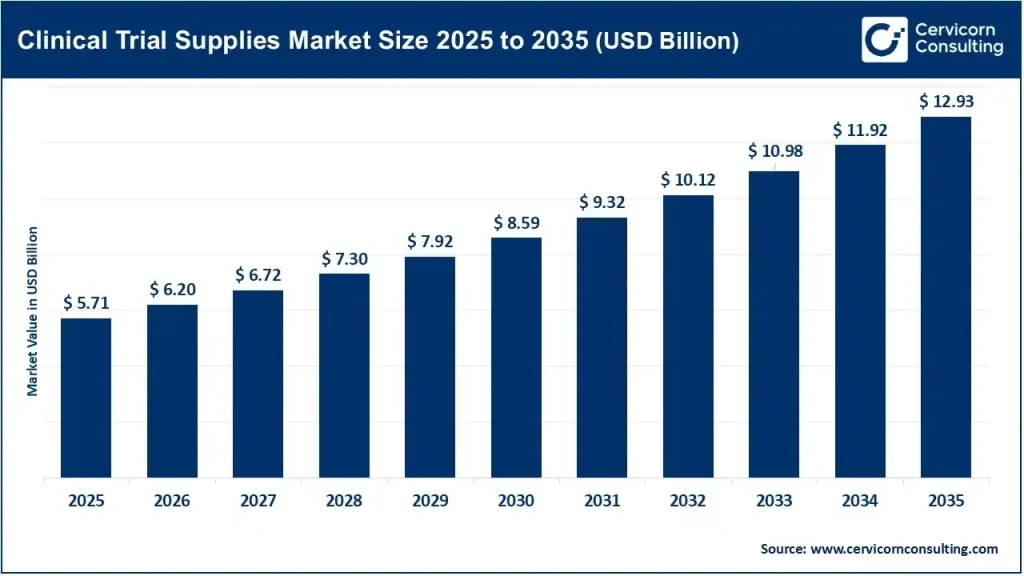
The global clinical trial supplies market is expanding as pharmaceutical and biotechnology companies increase research investment and conduct more complex studies. The clinical trial supplies market was valued at USD 5.71 billion in 2025 and could reach USD 12.93 billion by 2035, representing a compound annual growth rate (CAGR) of 8.5% from 2026 to 2035. Its estimates reflect growing demand for supply-chain management, temperature-controlled logistics and specialized services for biologics and other complex therapies.
For decision-makers, this growth signals a shift in the role of clinical supply operations. Supply-chain capability increasingly influences how efficiently a study can expand across regions, accommodate changes in patient recruitment and maintain product quality. However, rising market demand does not automatically translate into better operational performance. The value comes from selecting the right supply model for each trial’s requirements.
Why Clinical Trial Supply Costs Can Escalate During a Study
Clinical supply budgets are often established before enrolment patterns, site activation and treatment requirements become fully visible. Forecasts must account for uncertainties such as recruitment rates, patient discontinuation, protocol amendments and the time needed to manufacture or release additional batches.
Overestimating demand can leave sponsors with unused or expired investigational products. Underestimating demand can trigger emergency production, expedited shipping or resupply delays. Both situations can increase costs, although their financial effects differ.
A more effective approach is to connect supply forecasts with clinical operations. Recruitment data, site activation schedules, expected patient dosing and inventory at depots should inform replenishment decisions. Sponsors should also establish clear thresholds for when to manufacture, release or redistribute additional stock.
This approach is particularly relevant for studies with long manufacturing lead times, limited product shelf life or recruitment that varies considerably between sites.
Get a Free Sample: https://www.cervicornconsulting.com/sample/3061
How Trial Design Changes Supply-Chain Requirements
The supply strategy should reflect the clinical protocol rather than follow a standard model across every study.
Early-phase trials require flexibility. Patient numbers and dose-escalation decisions may change as evidence develops. Smaller production runs and carefully controlled inventory can reduce the risk of excess stock while preserving the ability to respond to protocol changes.
Phase III trials require stronger coordination and forecasting. Larger patient populations, multiple countries and more clinical sites increase the importance of consistent packaging, labelling, depot allocation and resupply planning. A delay affecting one regional supply route can disrupt several sites simultaneously.
Decentralized and hybrid trials introduce additional distribution requirements. Medicines may need to reach patients’ homes, local healthcare providers or other locations outside traditional clinical sites. The U.S. Food and Drug Administration’s September 2024 guidance on decentralized clinical trials addresses the use of such decentralized elements. For supply teams, these models require appropriate delivery controls, accountability for product receipt and procedures for handling temperature-sensitive shipments.
The practical implication is that a supply model designed for a small, site-based study may not be suitable for a multinational trial with home delivery and variable enrolment.
Cold-Chain Management: Where Logistics Decisions Become Product-Quality Decisions
Biologics, vaccines and advanced therapies can require tightly controlled storage and transportation conditions. For these products, logistics performance directly affects product integrity and whether supplies remain suitable for use.
Sponsors should evaluate more than the quoted shipping rate. Relevant considerations include validated packaging, temperature monitoring, transit duration, customs clearance, contingency routes and the availability of qualified storage facilities near trial sites.
A lower-cost route may become more expensive if it increases the probability of delays, temperature excursions or replacement shipments. Conversely, using premium logistics services for every shipment can unnecessarily increase expenditure where less intensive controls are appropriate.
The better decision is to match logistics requirements to product stability, destination risk, delivery urgency and the consequences of a shipment failure. This can help organizations distinguish between costs that protect product quality and costs that may be avoidable through better planning.
Should Pharmaceutical Companies Outsource Clinical Trial Supplies?
Outsourcing can give sponsors access to specialized packaging facilities, global depots, temperature-controlled distribution and clinical supply expertise without requiring them to build every capability internally. It can be particularly valuable for biotechnology companies with limited infrastructure or sponsors running studies across multiple regions.
However, outsourcing does not automatically guarantee lower costs or better service. The commercial outcome depends on the scope of work, forecast accuracy, contract structure, geographic coverage and the ability to coordinate the supplier with clinical operations.
Before selecting a provider, companies should assess:
- Geographic coverage: Can the provider serve planned trial countries and reach sites within required timelines?
- Technical capabilities: Does it support the relevant dosage forms, packaging, blinding and temperature requirements?
- Capacity flexibility: Can it accommodate enrolment changes, additional sites and protocol amendments?
- Inventory visibility: Can sponsor teams access timely information on stock, expiry, shipment status and resupply requirements?
- Cost transparency: Are storage, handling, relabelling, returns, destruction and expedited shipments clearly priced?
- Quality and compliance: Are responsibilities, documentation, deviation management and escalation procedures clearly defined?
A provider with the lowest initial quotation may not deliver the lowest total cost across the study. Comparing providers against a common set of service requirements and realistic scenarios provides a more meaningful basis for procurement decisions.
What Should Companies Evaluate Before Investing in Clinical Supply Technology?
Digital platforms can improve inventory visibility, demand forecasting and coordination between sponsors, CROs, depots and logistics partners. Their effectiveness, however, depends on the quality of the underlying data and their integration with clinical and supply-chain workflows.
Companies considering new technology should first identify the operational decision they want to improve. For example, an inventory platform may help prevent stockouts, while shipment monitoring may help teams identify delays before they affect a clinical site.
Investment decisions should consider data integration, system validation where applicable, user adoption, reporting requirements and the time needed to realize measurable benefits. Implementing technology without standardizing inventory definitions, forecasting processes and escalation responsibilities may simply digitize existing inefficiencies.
Useful performance indicators include inventory expiry, stockout frequency, forecast accuracy, on-time delivery, emergency shipment expenditure and the time required to resolve supply deviations. Tracking these measures before and after implementation helps determine whether the investment is producing operational value.
Regional Expansion Requires More Than Selecting a Distribution Hub
Multiregional clinical trials introduce differences in import procedures, customs documentation, product-release requirements, local distribution infrastructure and delivery lead times. A centralized depot may simplify inventory control, but it may also create longer delivery routes or greater exposure to customs delays.
A regional distribution model can improve responsiveness in some circumstances, although additional depots may increase storage costs and fragment inventory.
Companies should compare centralized, regional and hybrid models using the expected trial footprint, shipment frequency, product stability, local requirements and the financial impact of delayed supply. The right choice is the one that balances total landed cost, delivery reliability and inventory flexibility—not necessarily the one with the fewest facilities.
For companies expanding clinical research in Asia Pacific, local logistics capabilities and the availability of qualified service providers deserve particular attention alongside labour and operating costs. Regional growth opportunities are most useful when evaluated against the practical requirements of the intended trial portfolio.
Key Decisions for Clinical Trial Sponsors and CROs
Clinical supply performance is shaped by a connected set of decisions: how much product to manufacture, where to hold inventory, which services to outsource, how to distribute supplies and when to replenish stock.
Sponsors can improve these decisions by linking supply forecasts with recruitment data, reviewing supplier performance against measurable service levels and assessing total study costs rather than individual service prices. Contingency planning should also account for manufacturing delays, customs disruption, temperature excursions and unexpected changes in enrolment.
The most effective strategy will differ according to trial phase, therapeutic modality, geographic reach and protocol complexity. Companies managing a small early-phase study may prioritize flexibility and low inventory exposure, while a large multinational study may require stronger regional coordination, standardized processes and greater distribution capacity.
As clinical research becomes more geographically dispersed and operationally complex, clinical trial supplies should be treated as a strategic component of trial execution—not simply a procurement function. Better alignment between clinical planning, supply forecasting and logistics can help organizations control costs while protecting continuity of supply and study timelines.
To Get Detailed Overview, Contact Us: https://www.cervicornconsulting.com/contact-us
Read Report: Web3 Gaming Market: Which Business Models Can Deliver Sustainable Growth and Profitable Player Engagement?